Alone in the Grand Canyon: Returning to the Rim and Civilization

Day 6 – Cremation Canyon To South Kaibab Trailhead

6.5 Miles, +3600′

December 4, 2024

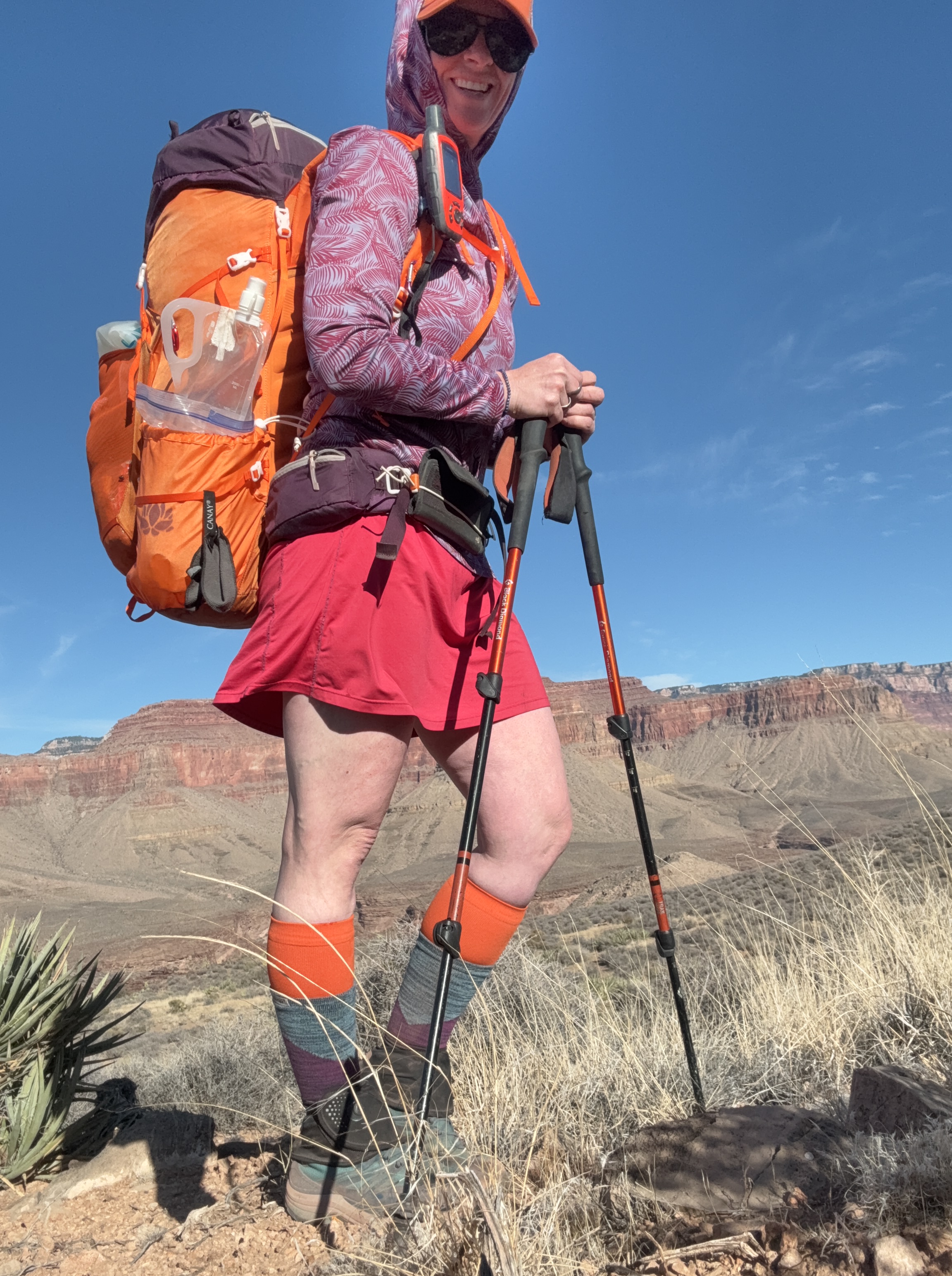
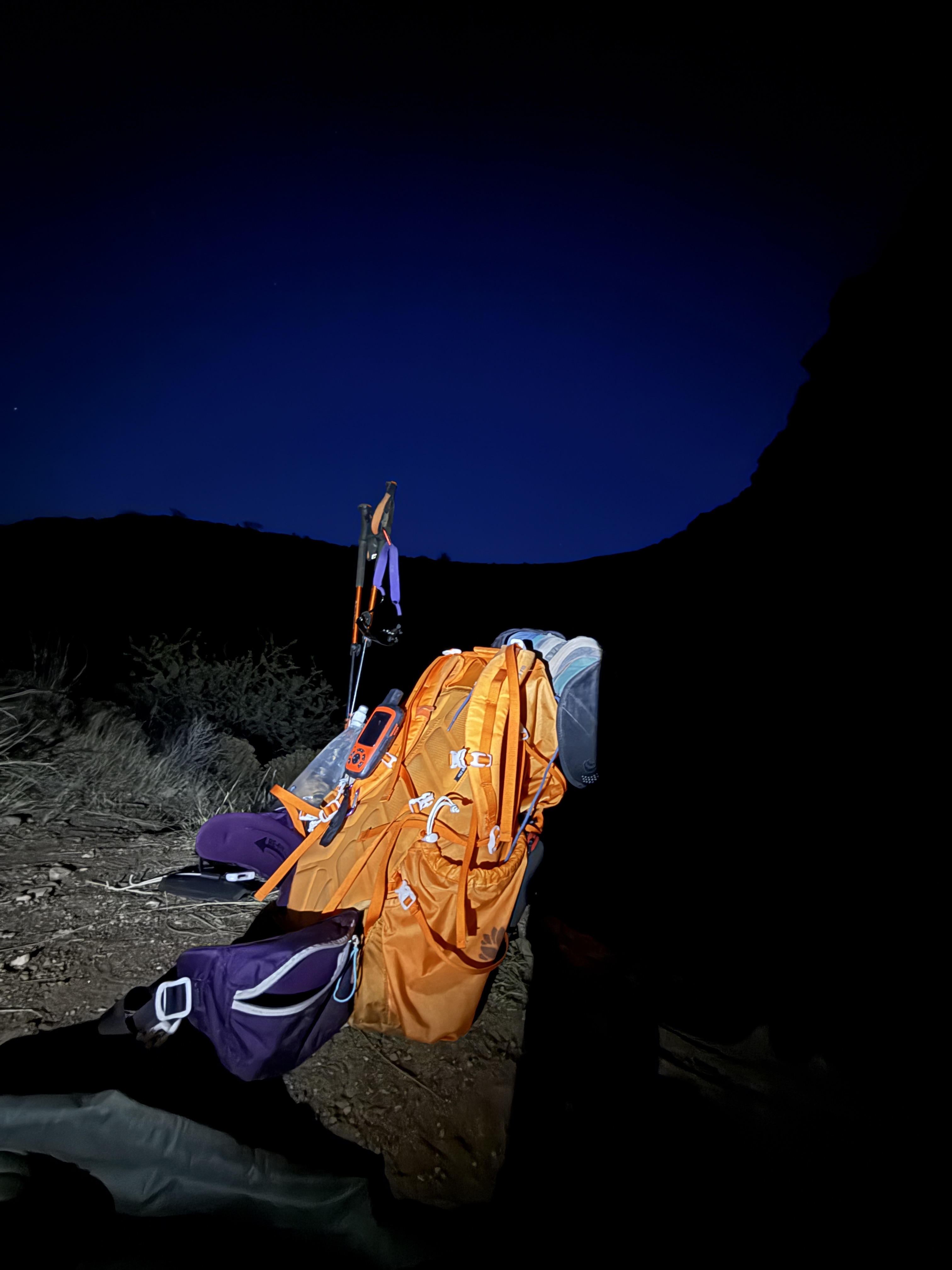
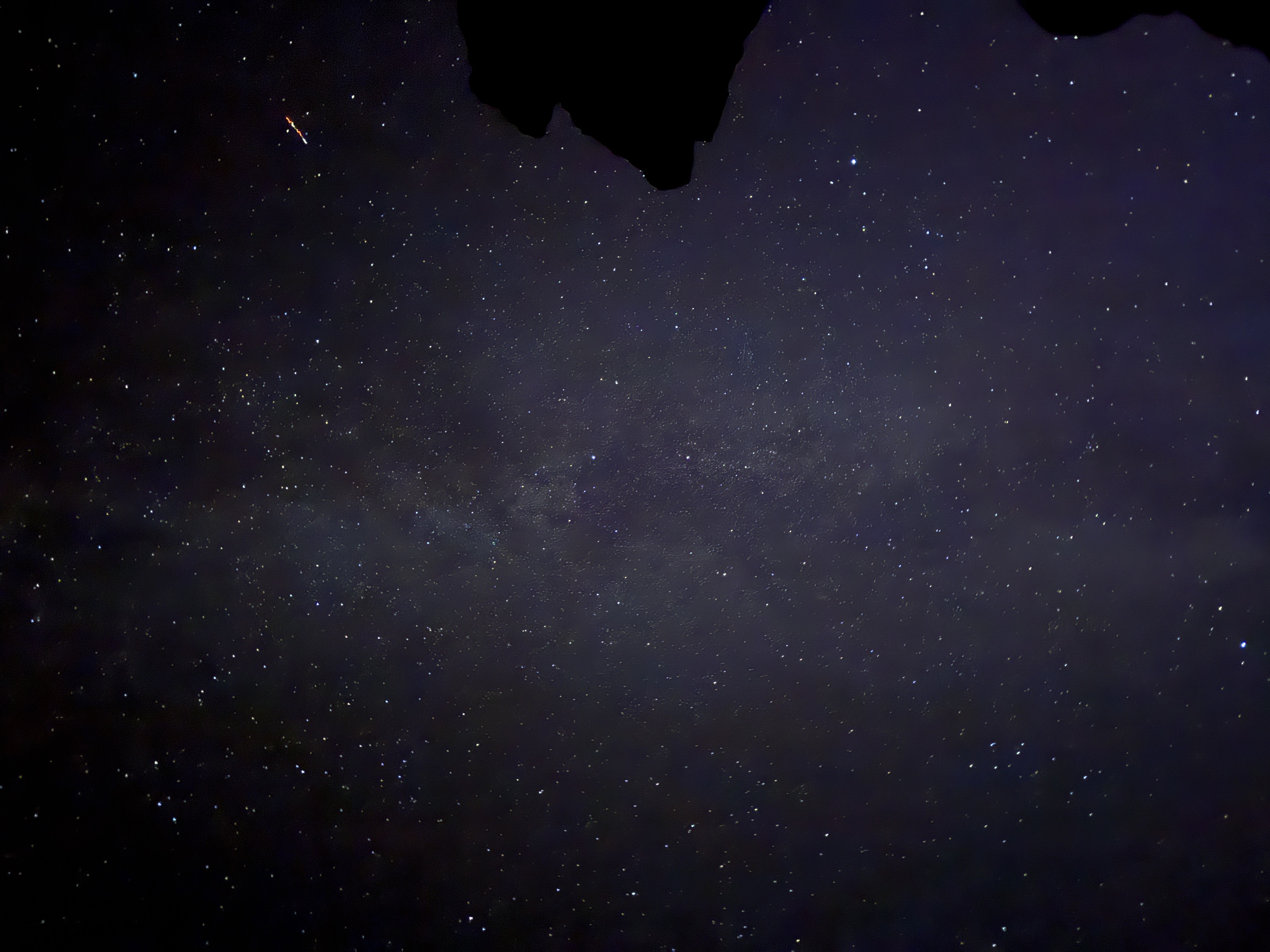
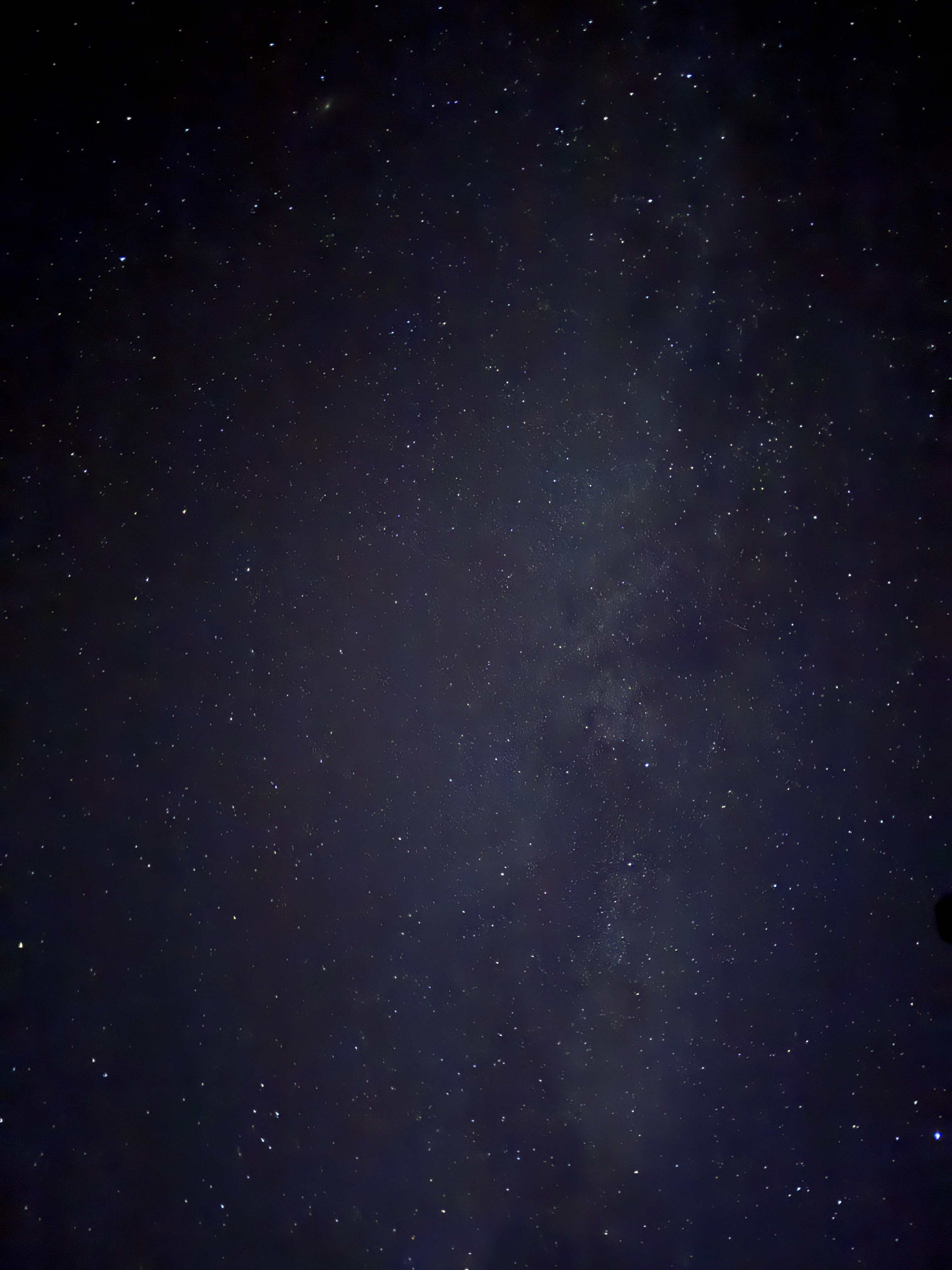
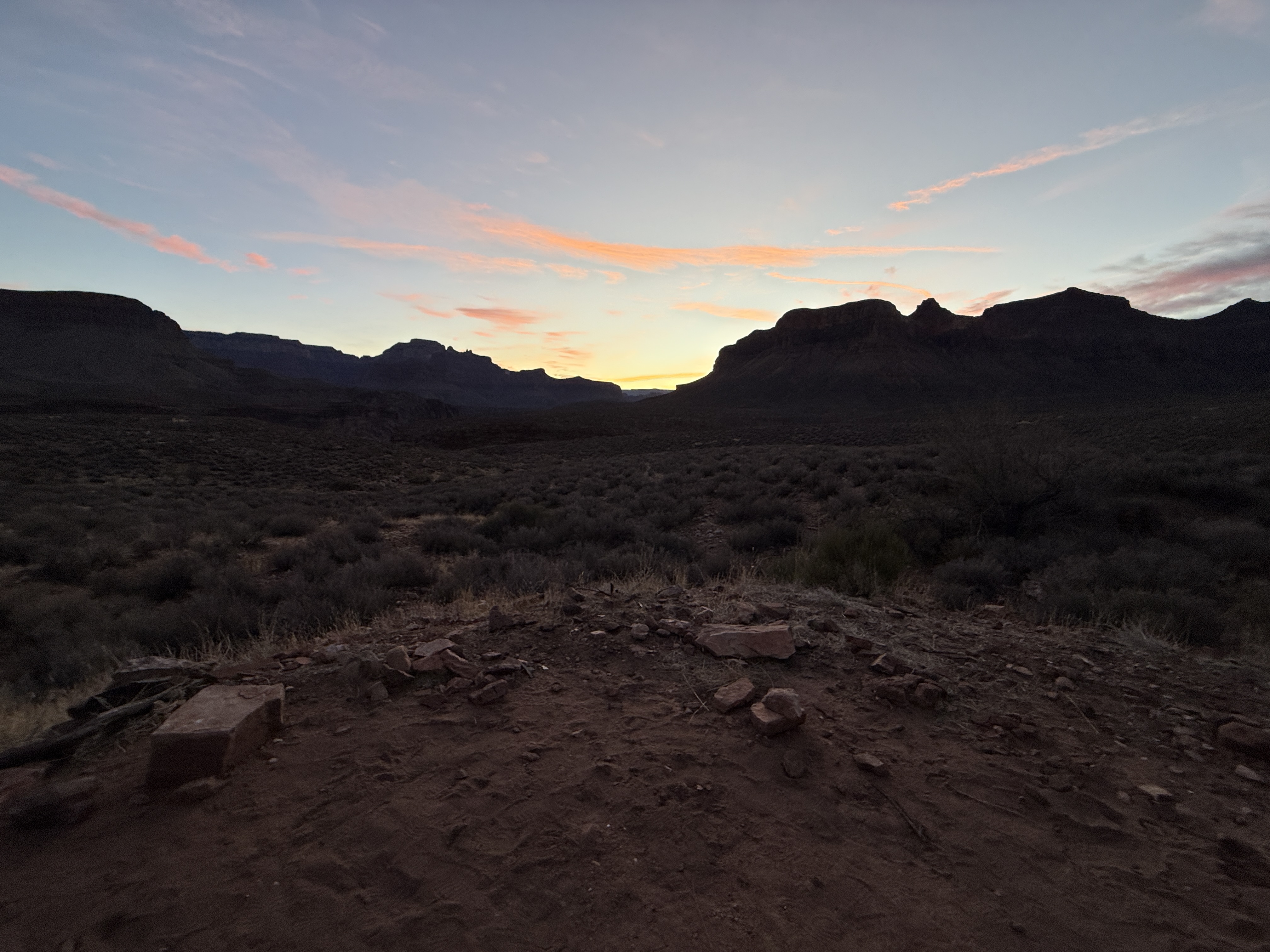
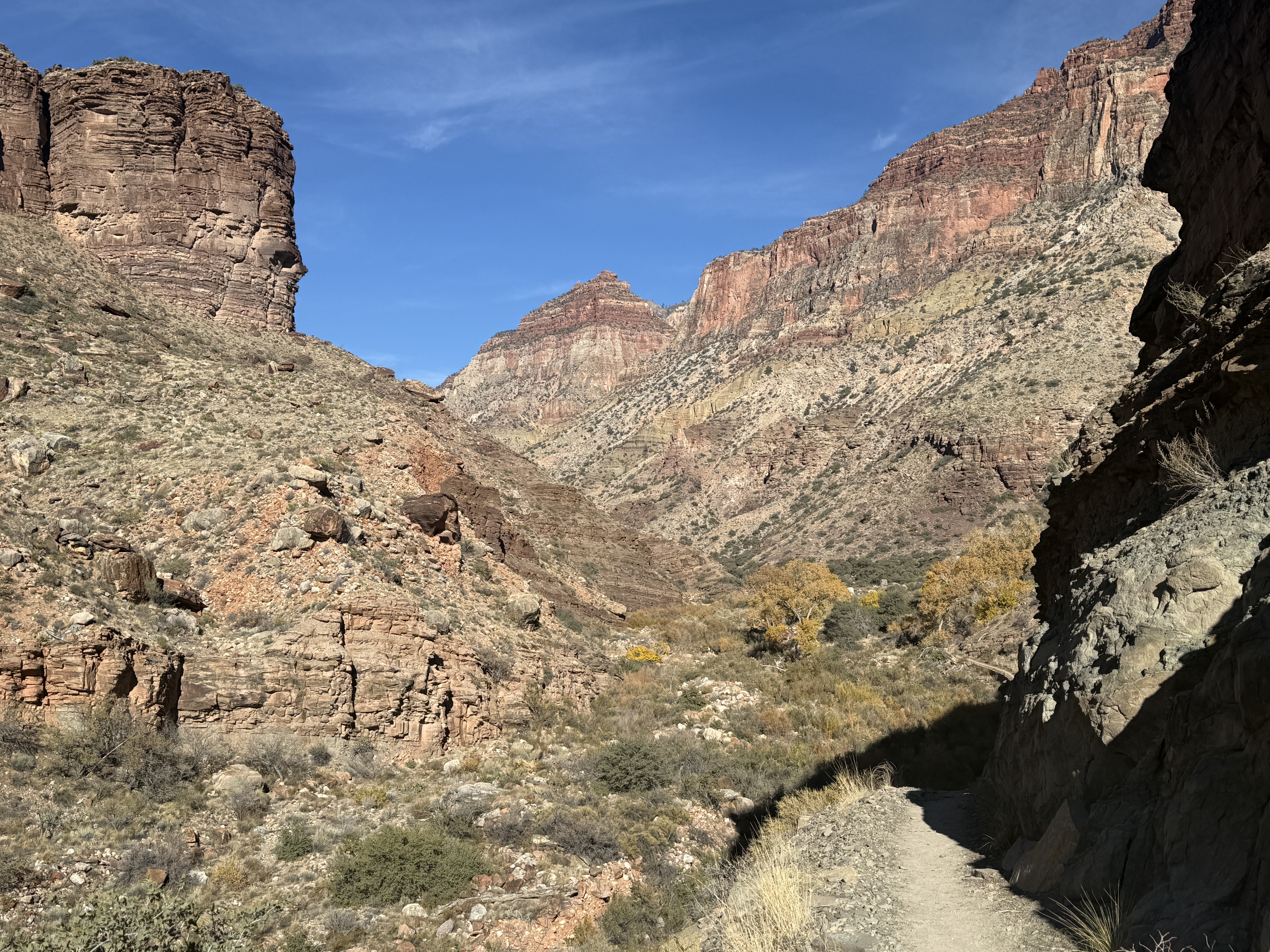
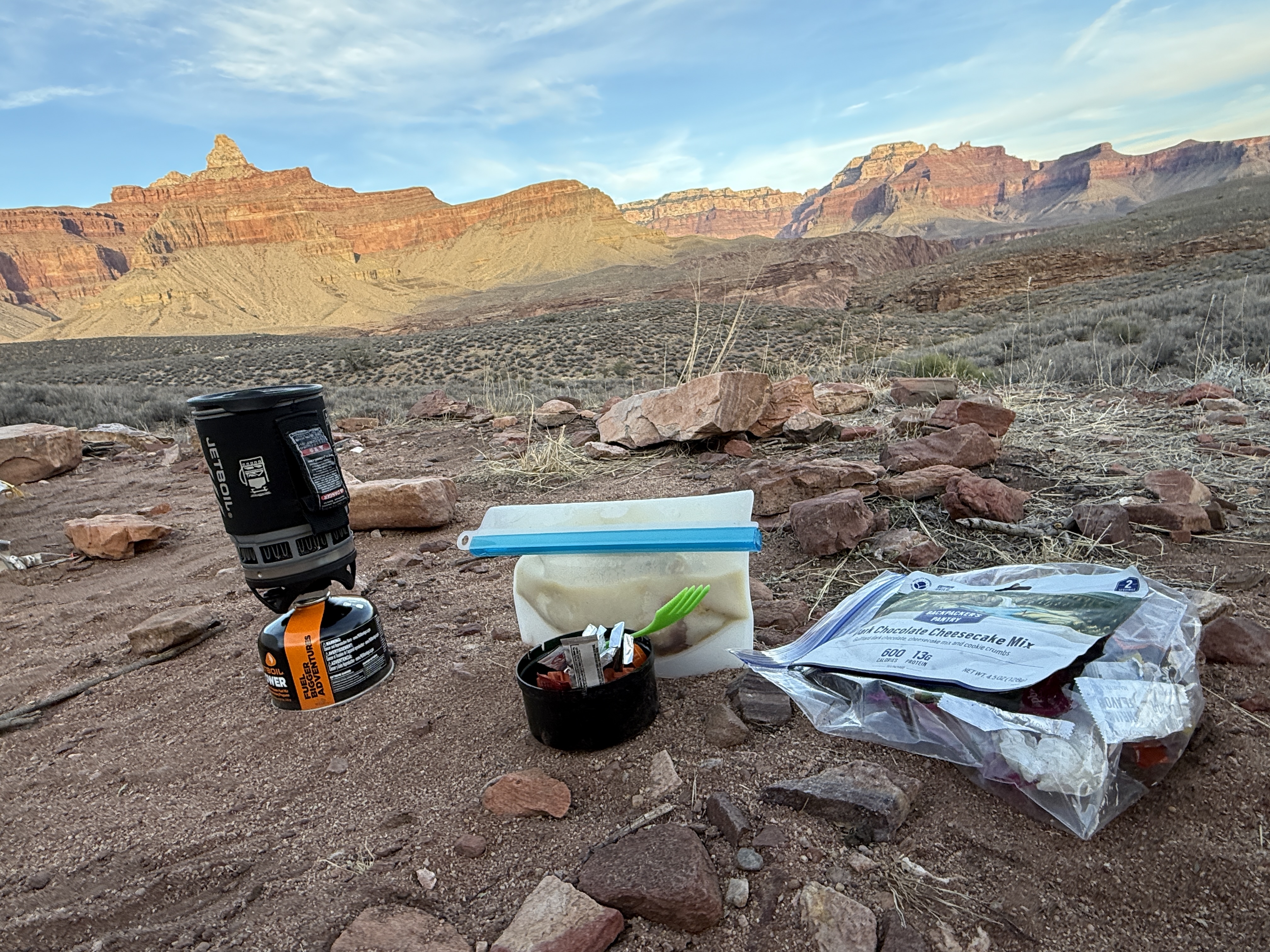
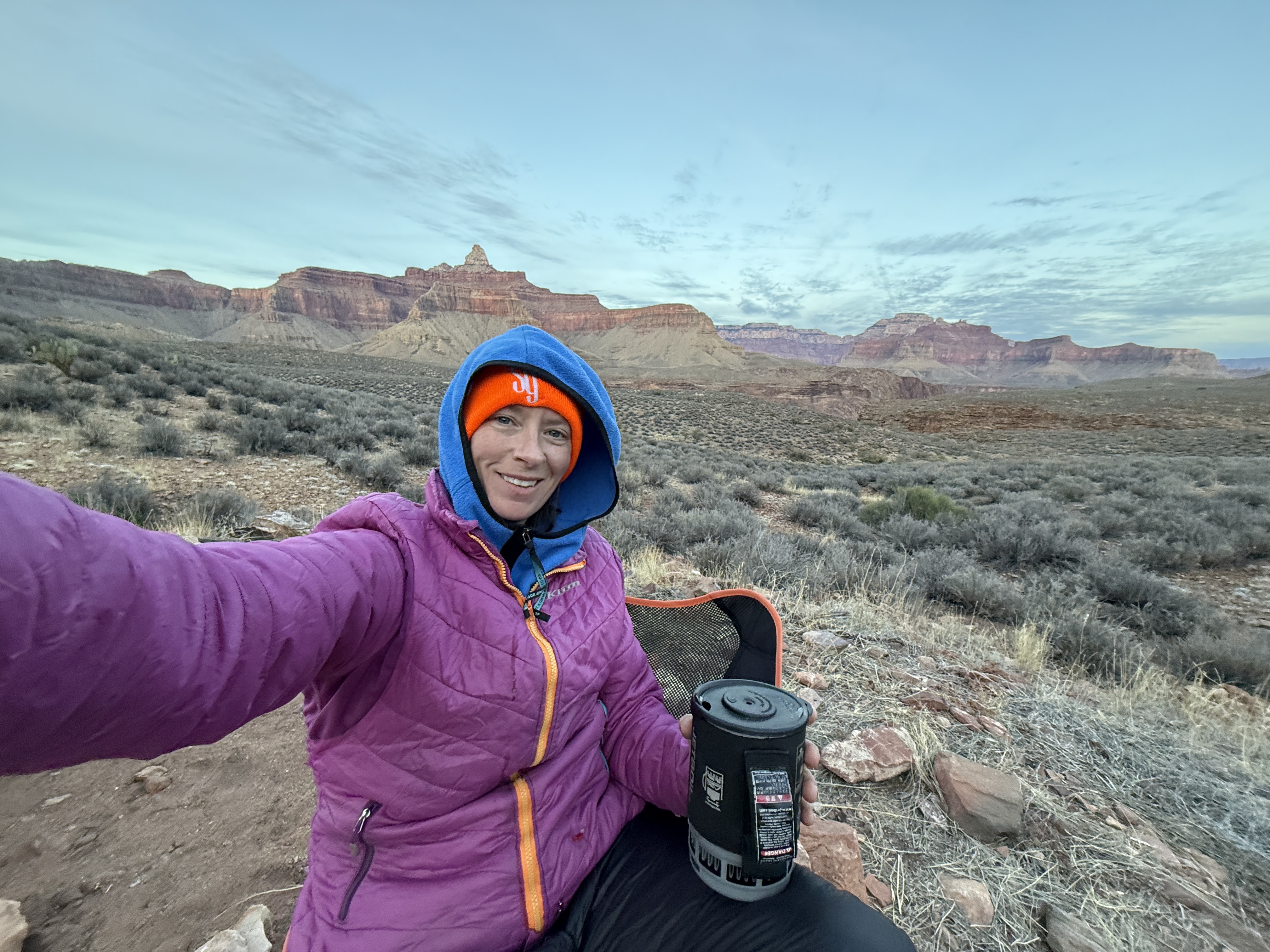
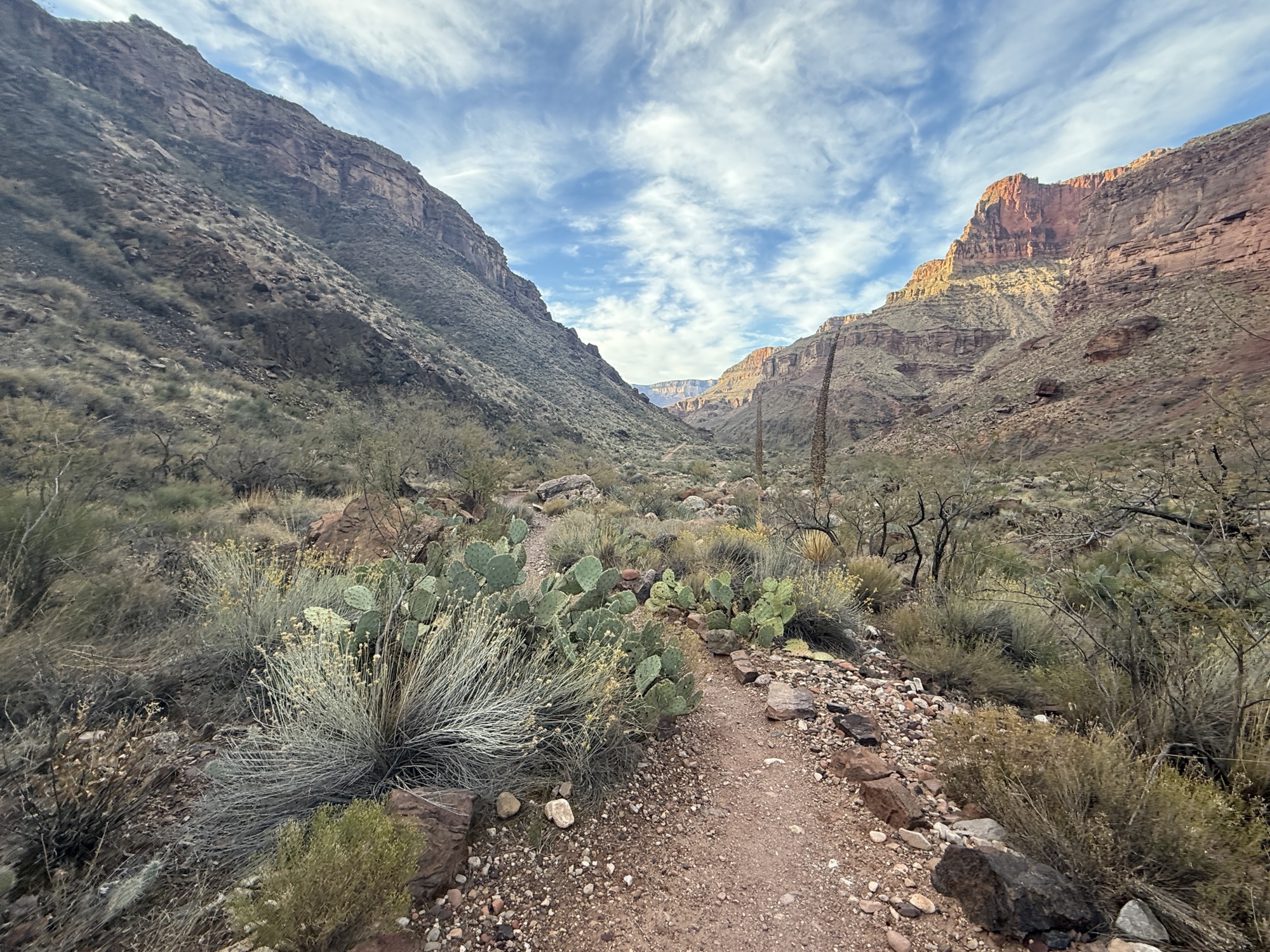
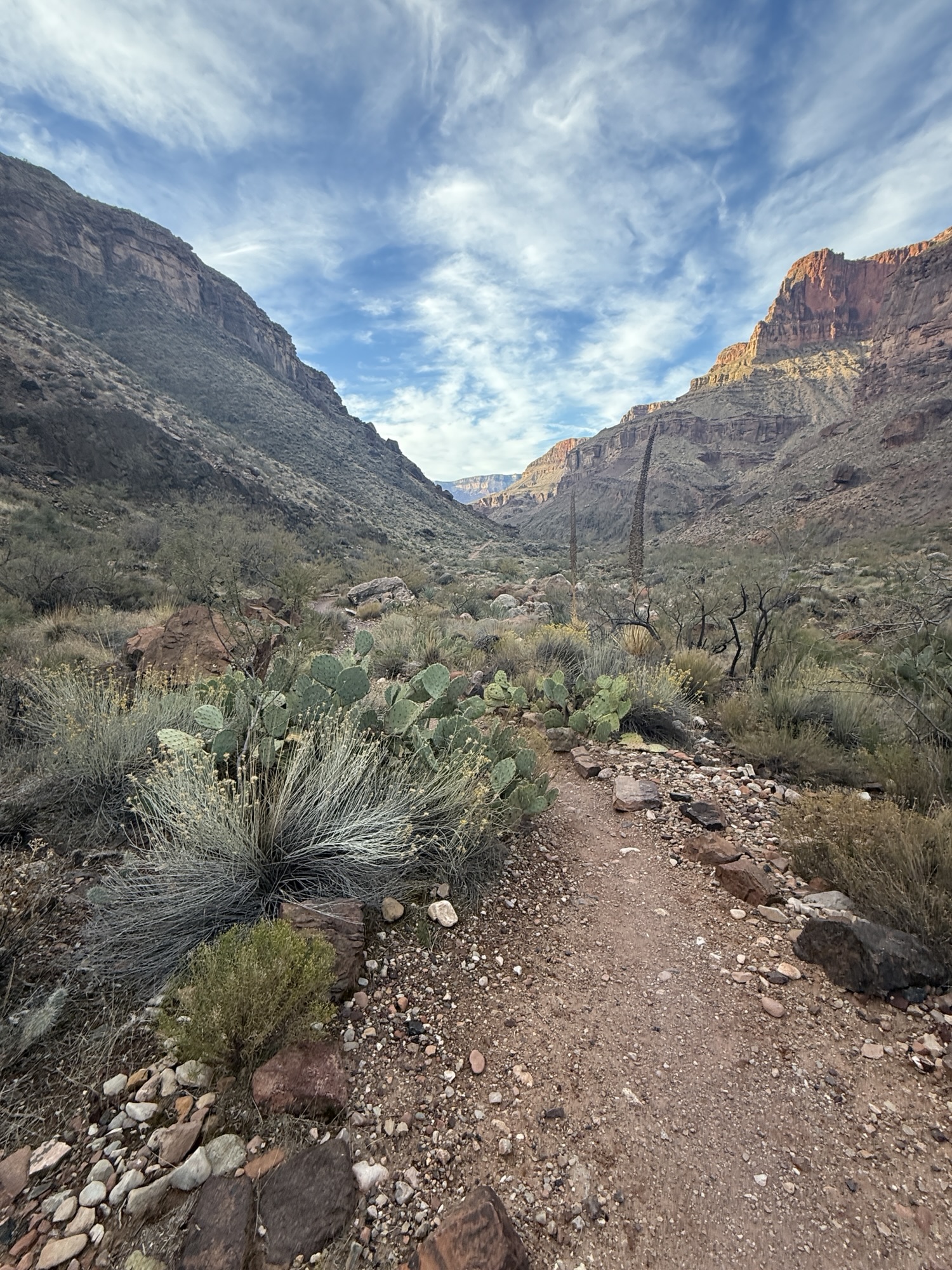
The choice to cowboy camp under the stars was a great one. I wasn’t bothered by any wildlife, and I was able to wake up every once in a while, to see how the night sky had spun. By 530am I was packed and moving in the dark. All of my hiking had been in the day and this morning afforded me the opportunity to have some introspective moments uninterrupted by awe inspiring views. Being an Alaskan, I was comfortable in the dark with just a headlamp, and had no trouble navigating through the scrub brush.

I thought about how the last five days had been good for my soul, and how I had never had an experience that quite rivaled this one. I felt completely at ease the entire time, not once questioning my abilities or why I was there. Not one bit of anxiety or fear.

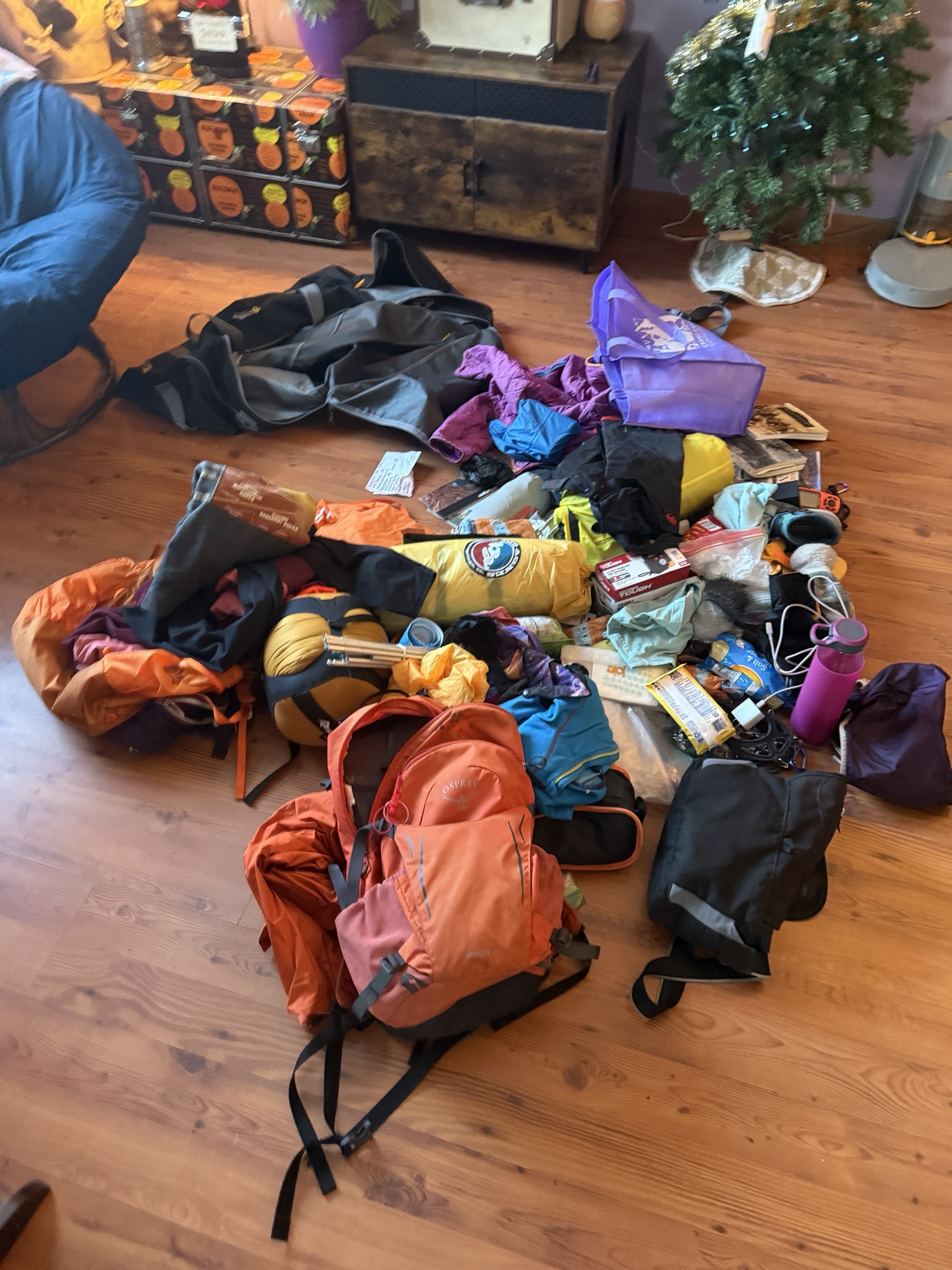
The early start would give me plenty of time to ascend back to my starting point at the Kaibab Trailhead on the South Rim, get a shower, do laundry and then make it back to Phoenix in time for my flight early the next morning. I would be sleeping on my Nemo pad tonight, but instead of being under the stars, I would be in an airport.

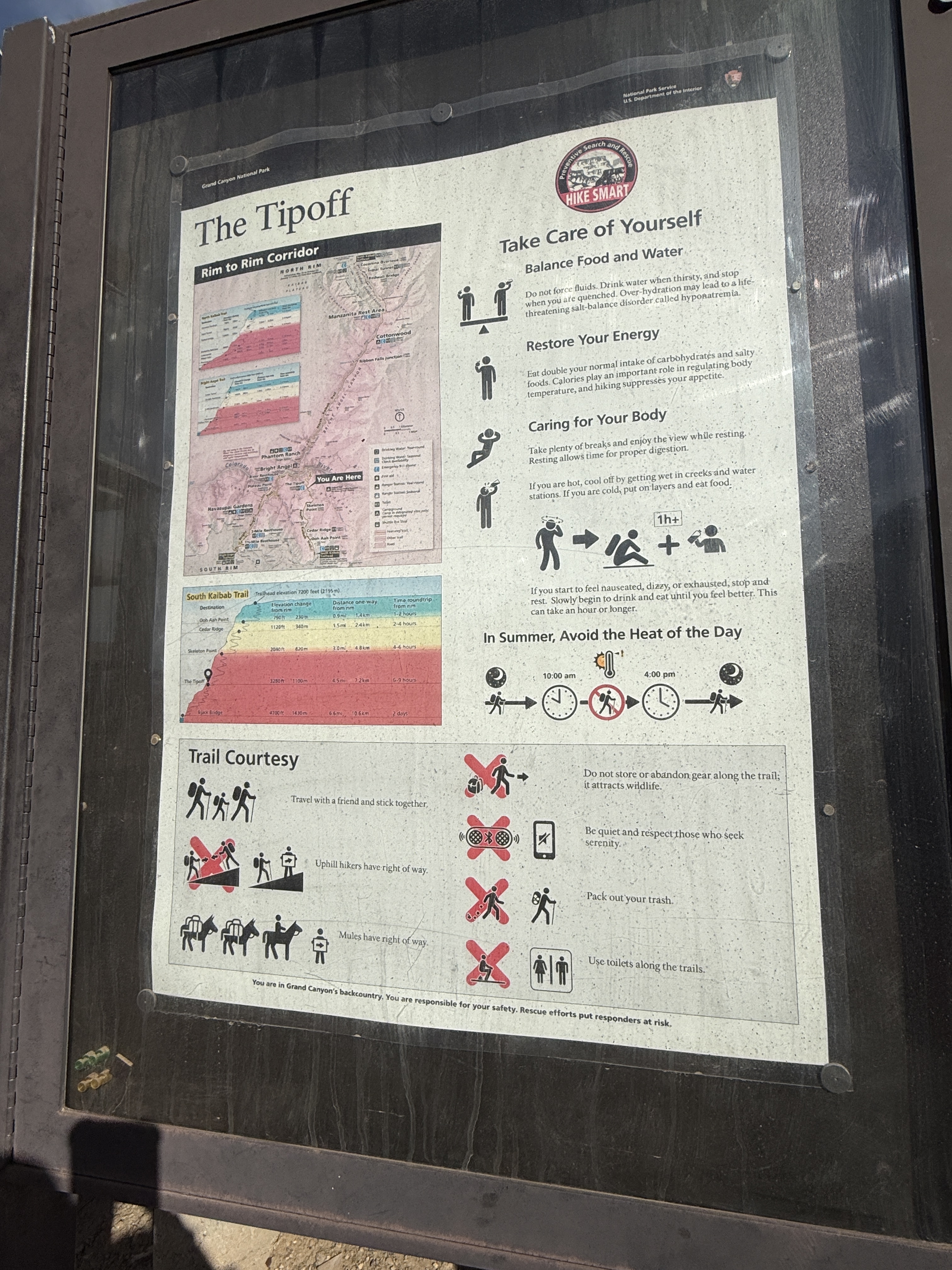
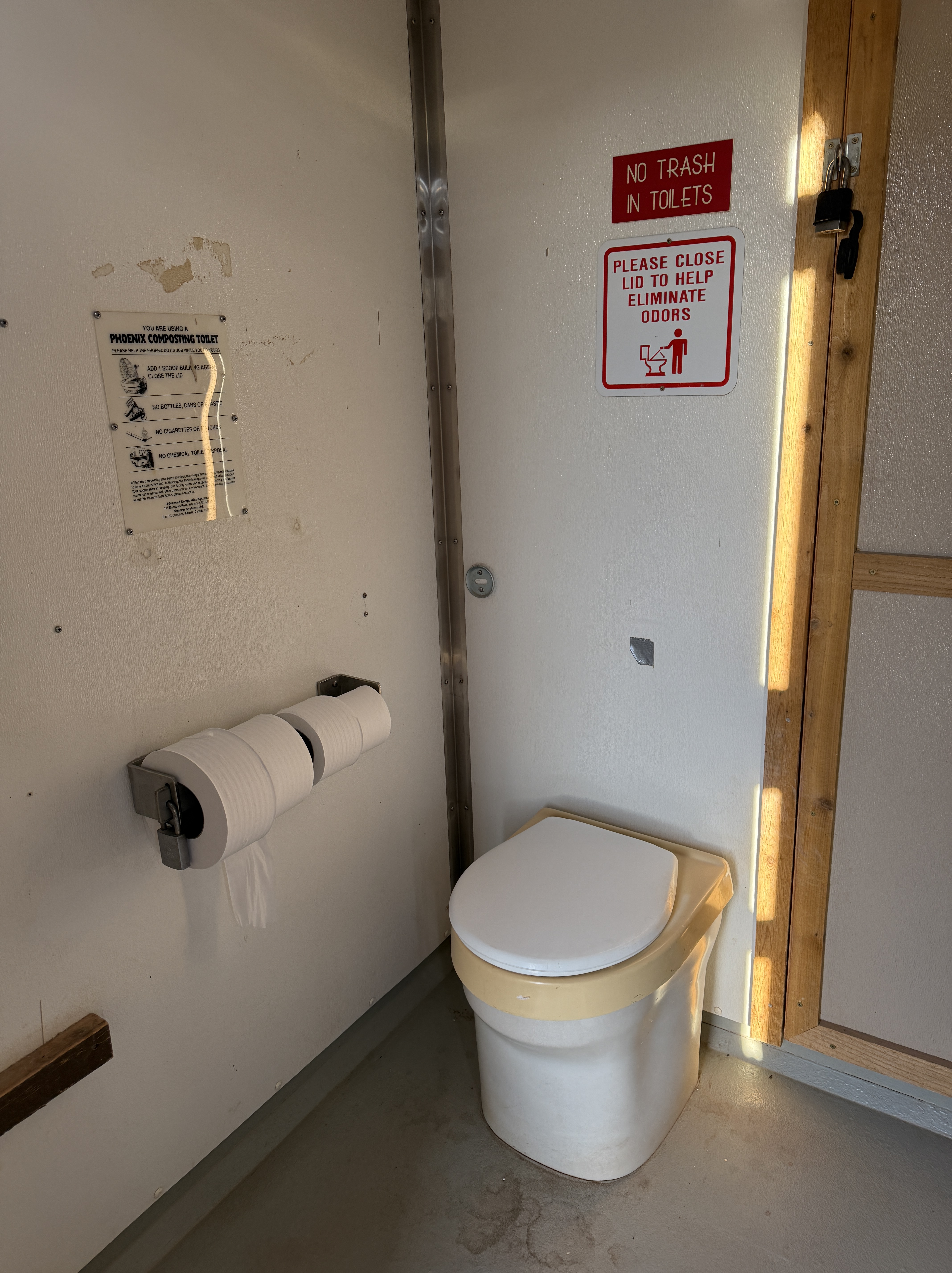
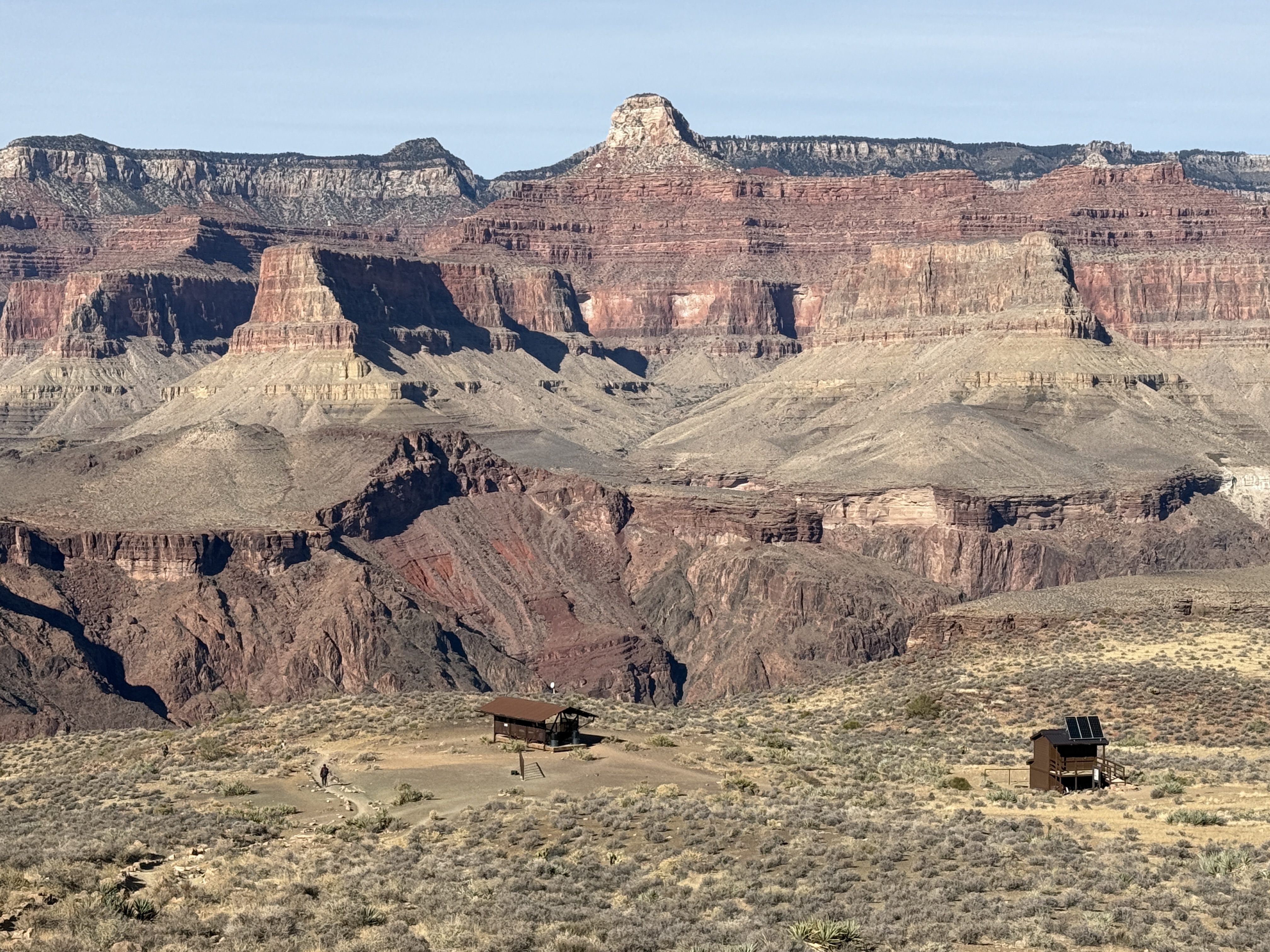
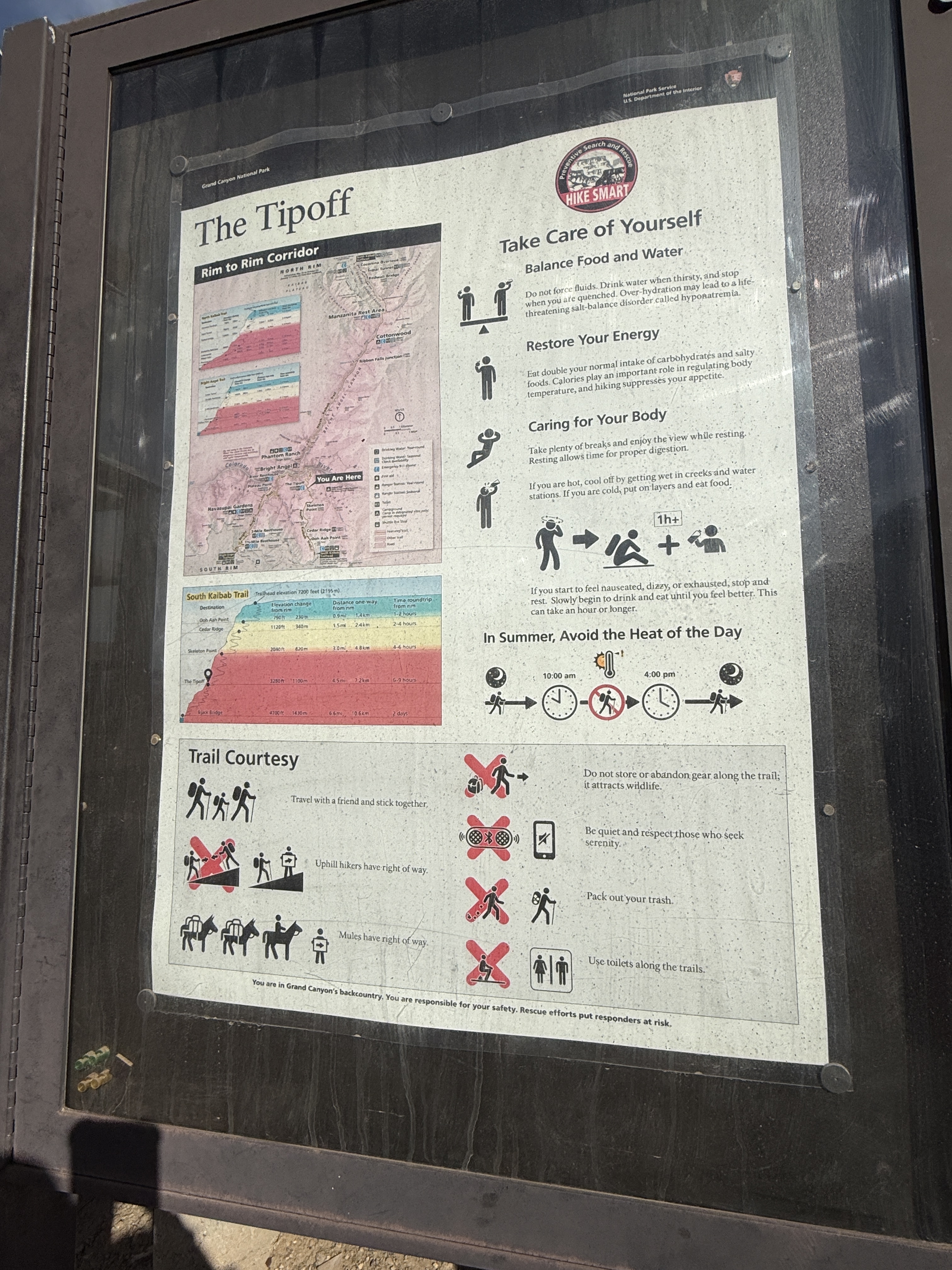
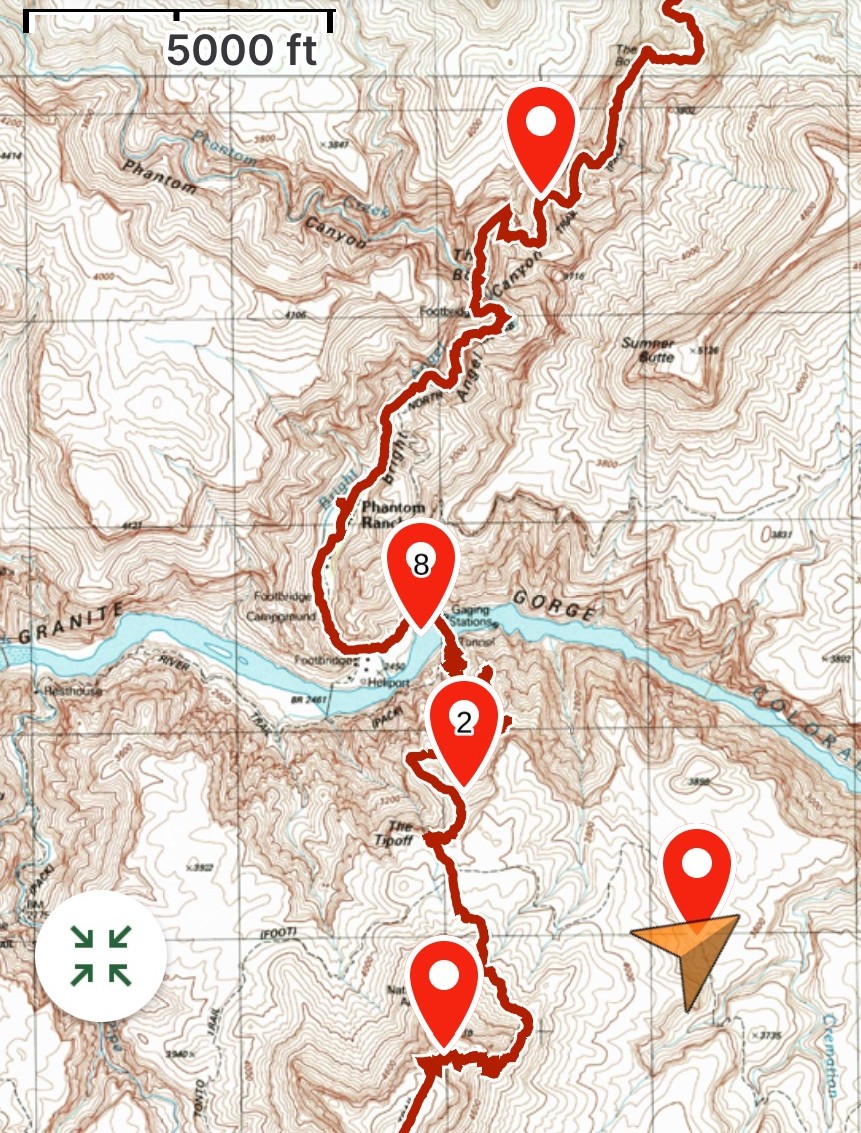
I made it the two miles to Tip Off in an hour and I had officially succeeded in not having to use any wag bags. One day I would hike the 95-mile Tonto Trail, and I wouldn’t be so lucky. There would be limited facilities on that trip. I saw headlamp lights and heard talking coming from the neighboring stall. I thought maybe the guys had a rough day and ended up sheltering in the bathroom. It didn’t make any sense, but it also didn’t make any sense that people were already here at 630 in the morning, not to mention sharing a bathroom.

I knocked and an Asian man opened the door, he was sitting on the floor, and a woman behind him. They didn’t speak much English, but I signed asking if they had food and water and were ok. The man nodded and smiled. They didn’t seem in distress, so I kept moving. My best guess is they had reservations at Phantom Ranch but hadn’t gotten the notification of the closure due to a waterline break. I would wager they hiked all the way down to the Ranch and then couldn’t make it back up to the South Rim, either from fatigue or discomfort with the dark.

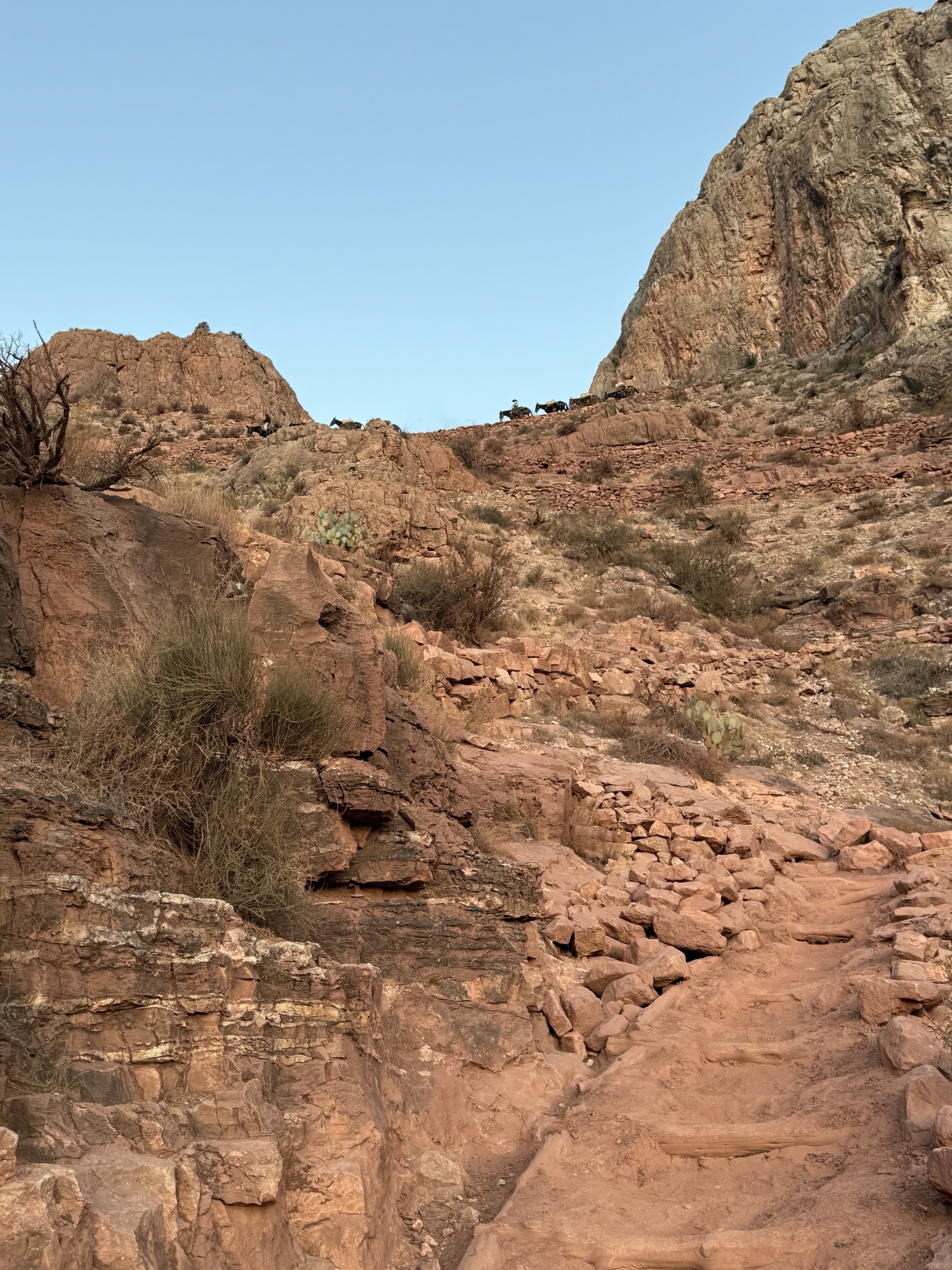
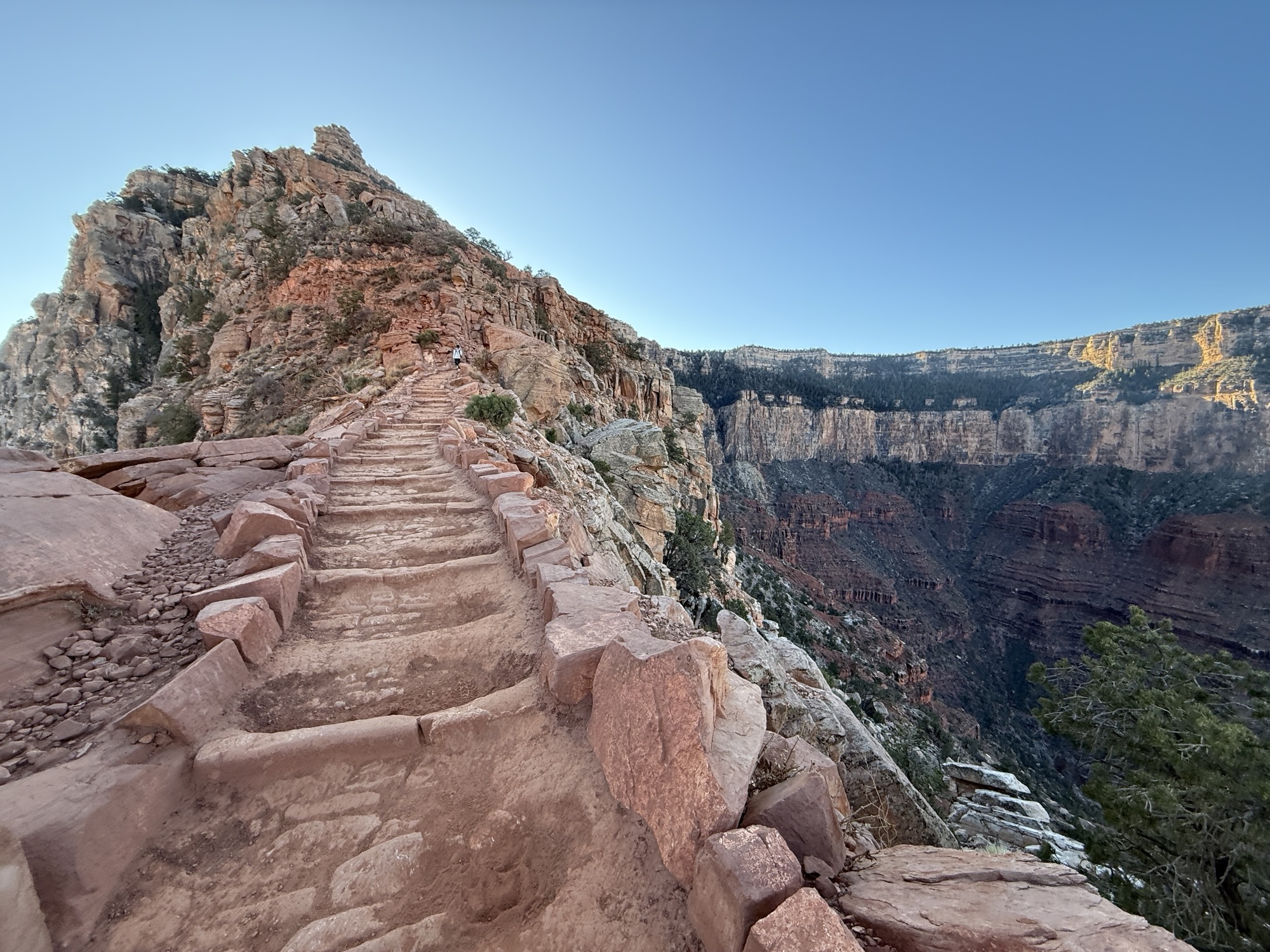
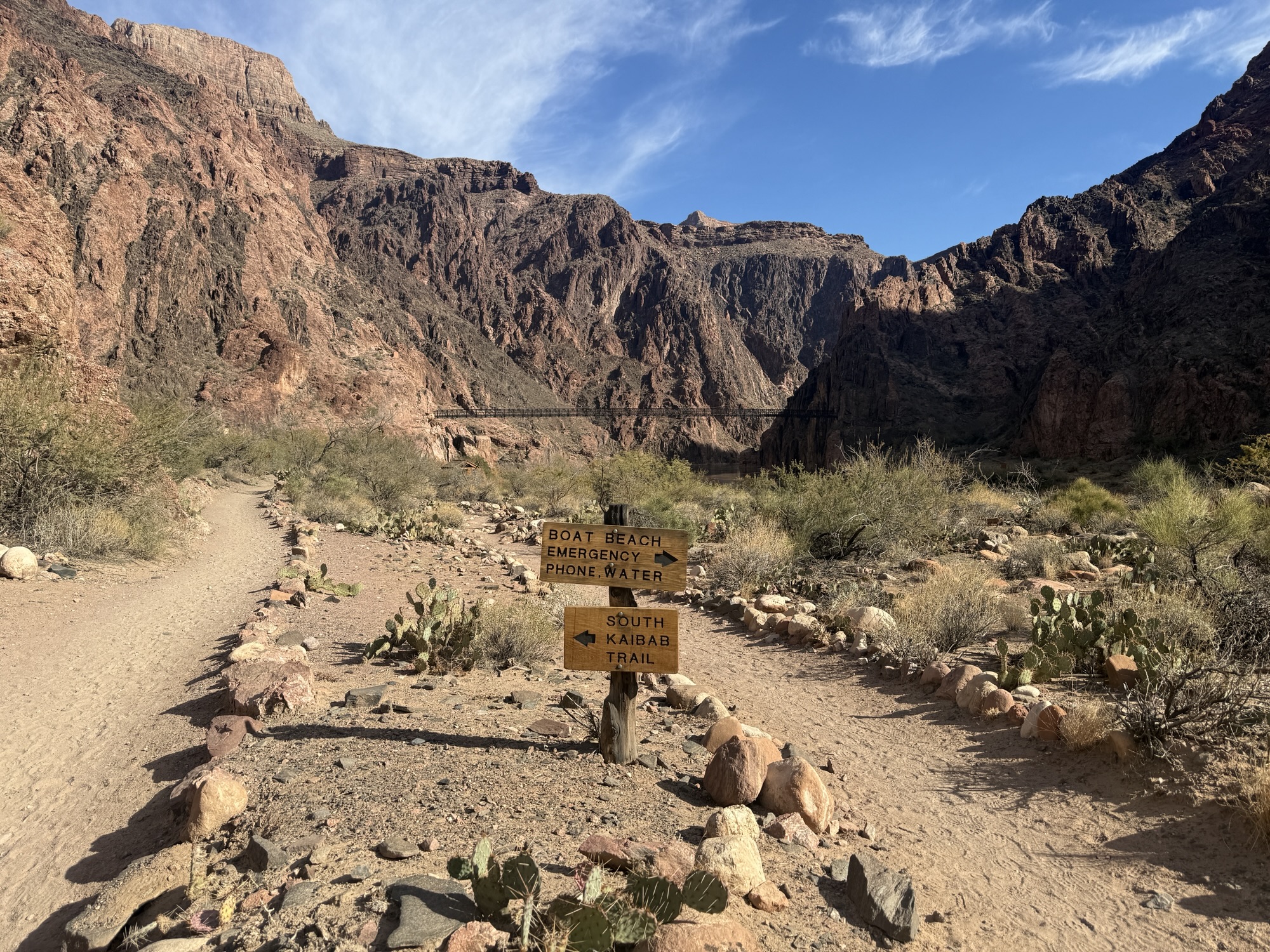
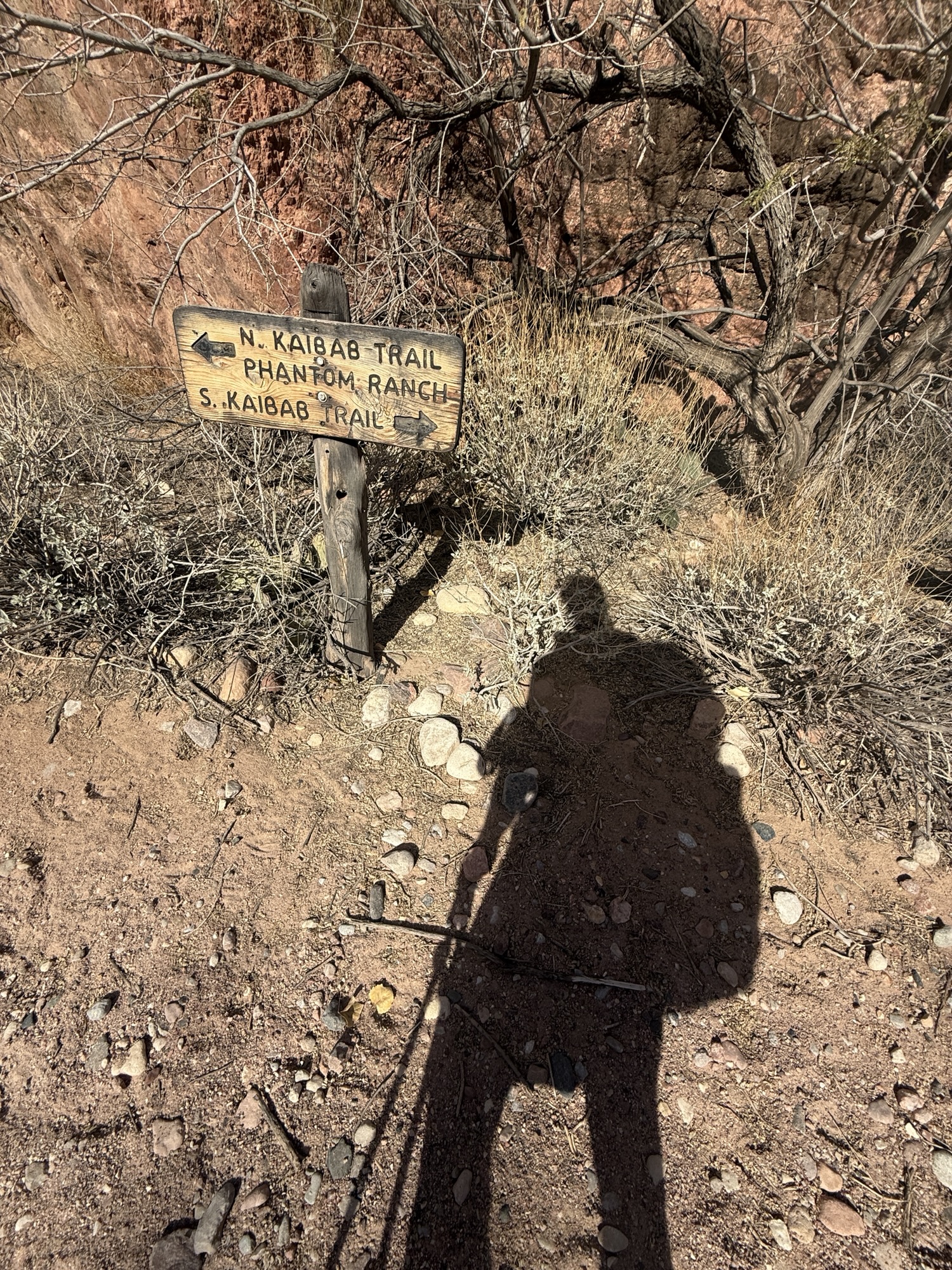
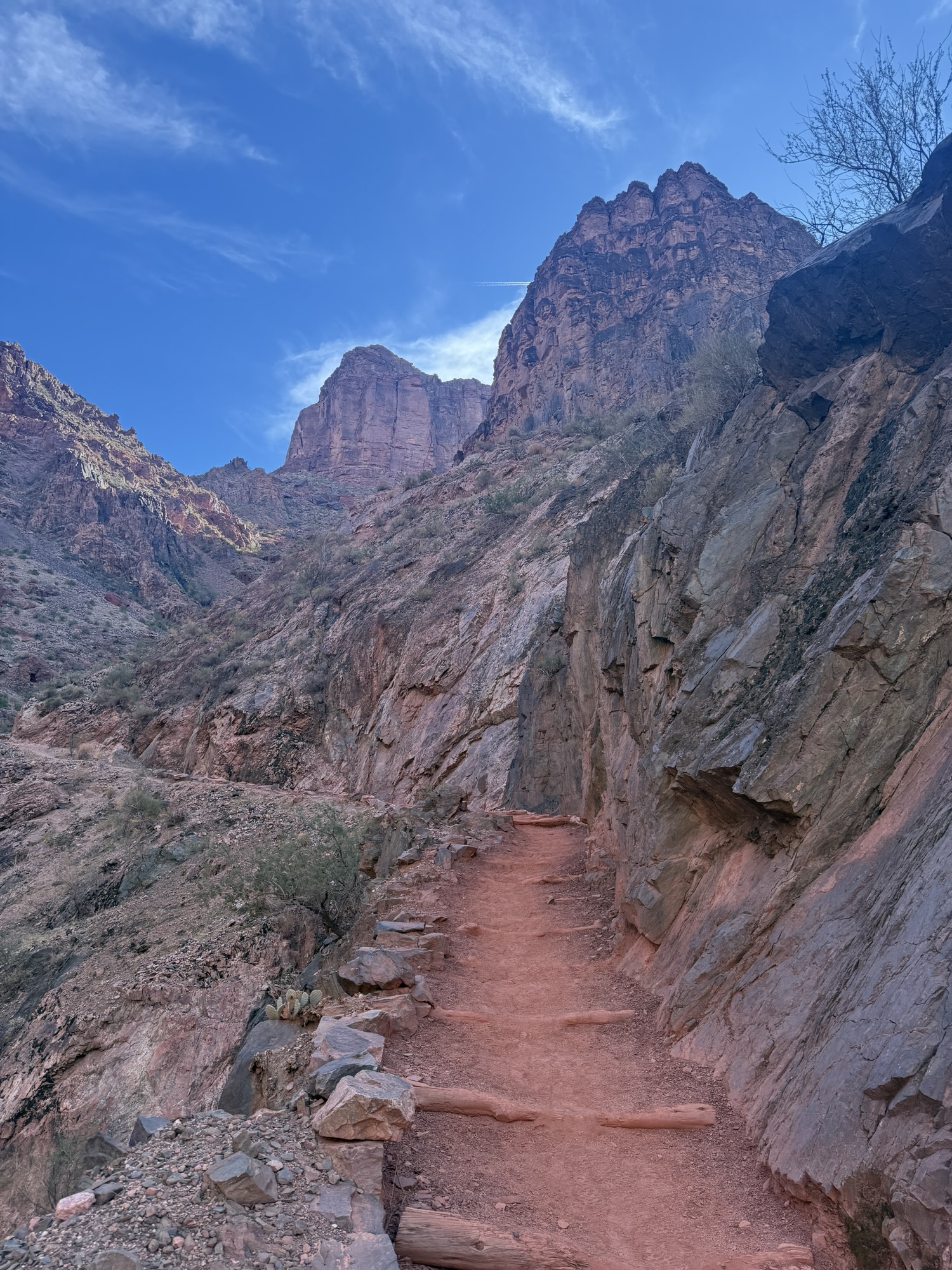
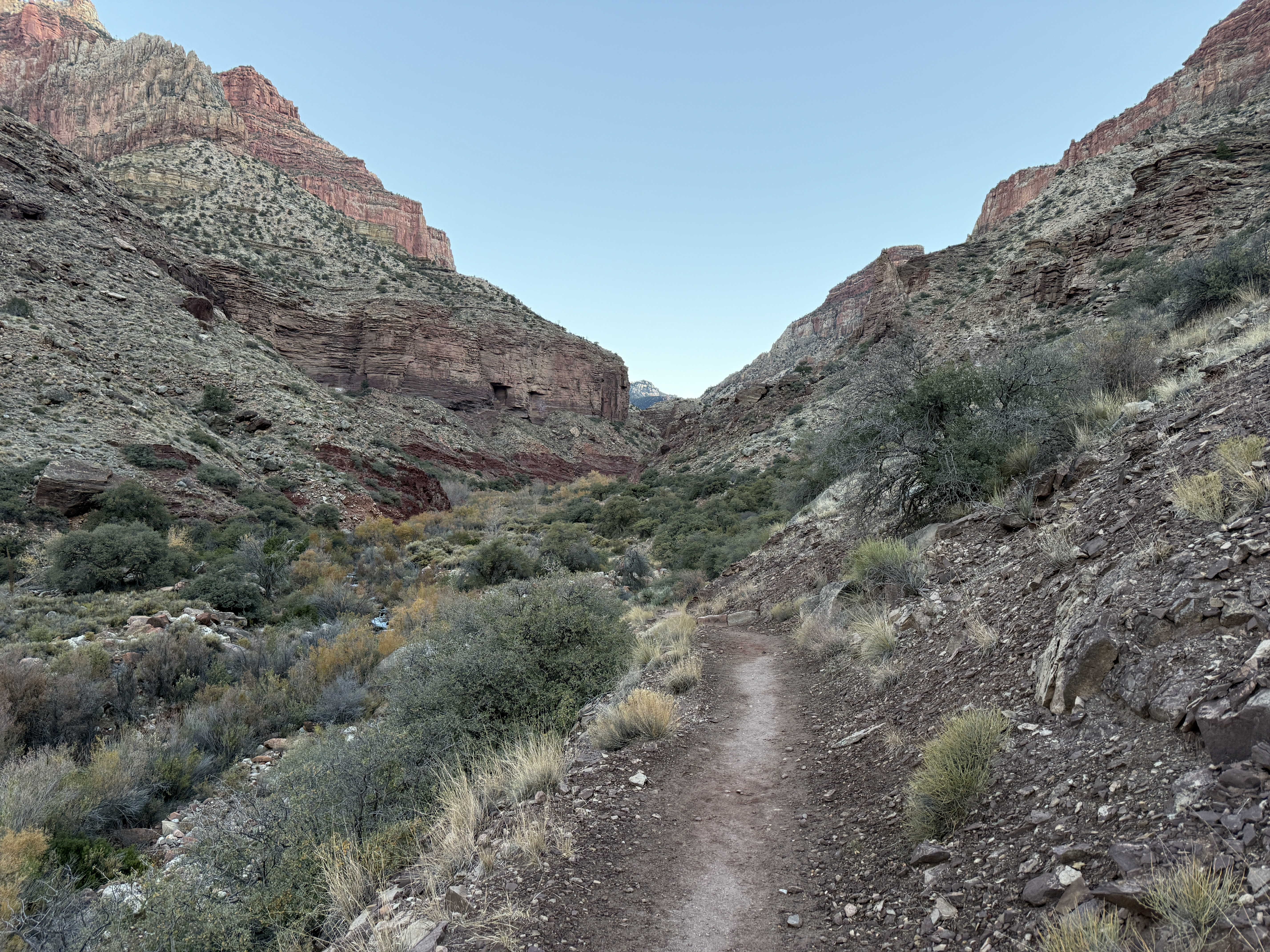
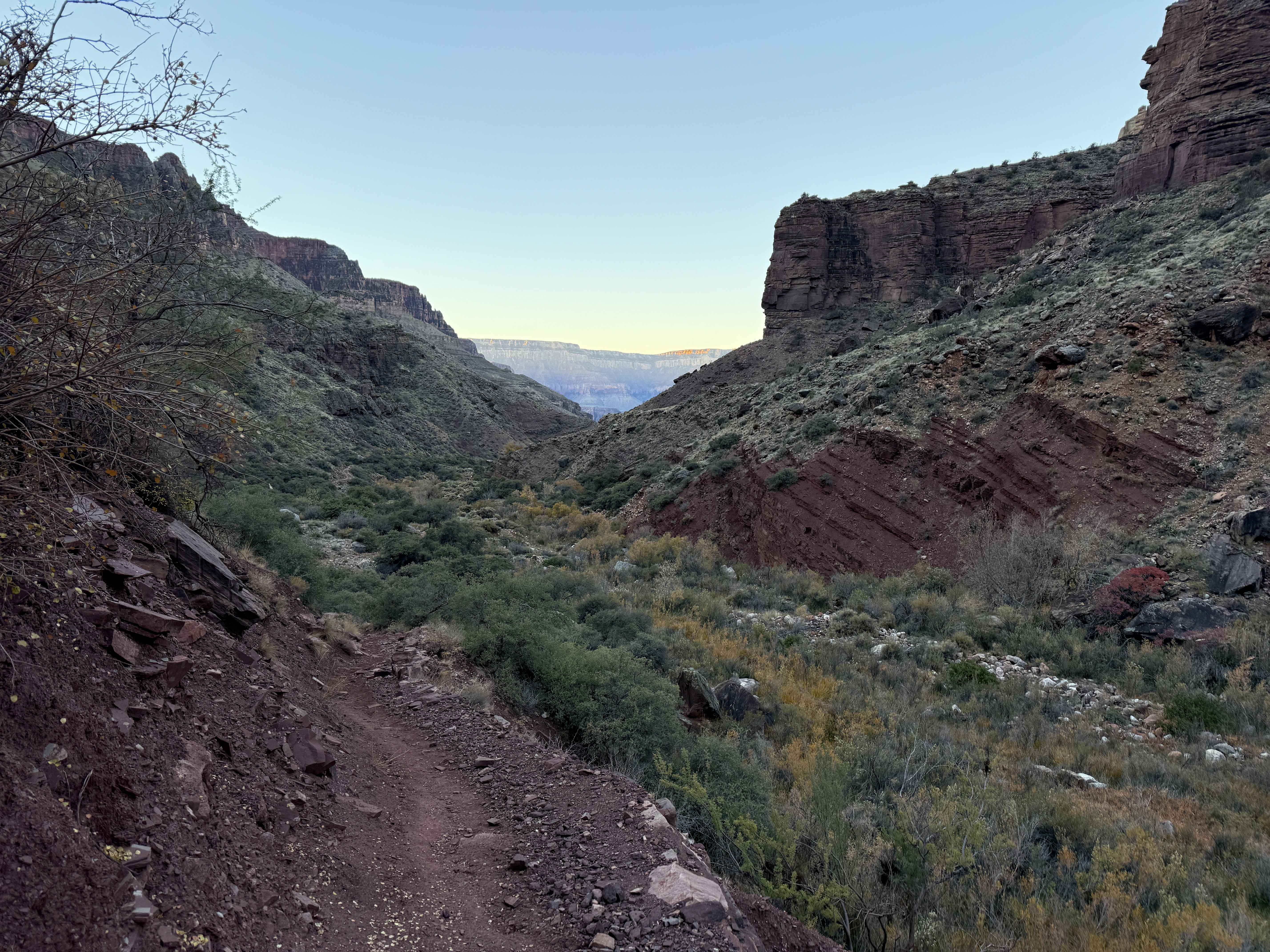
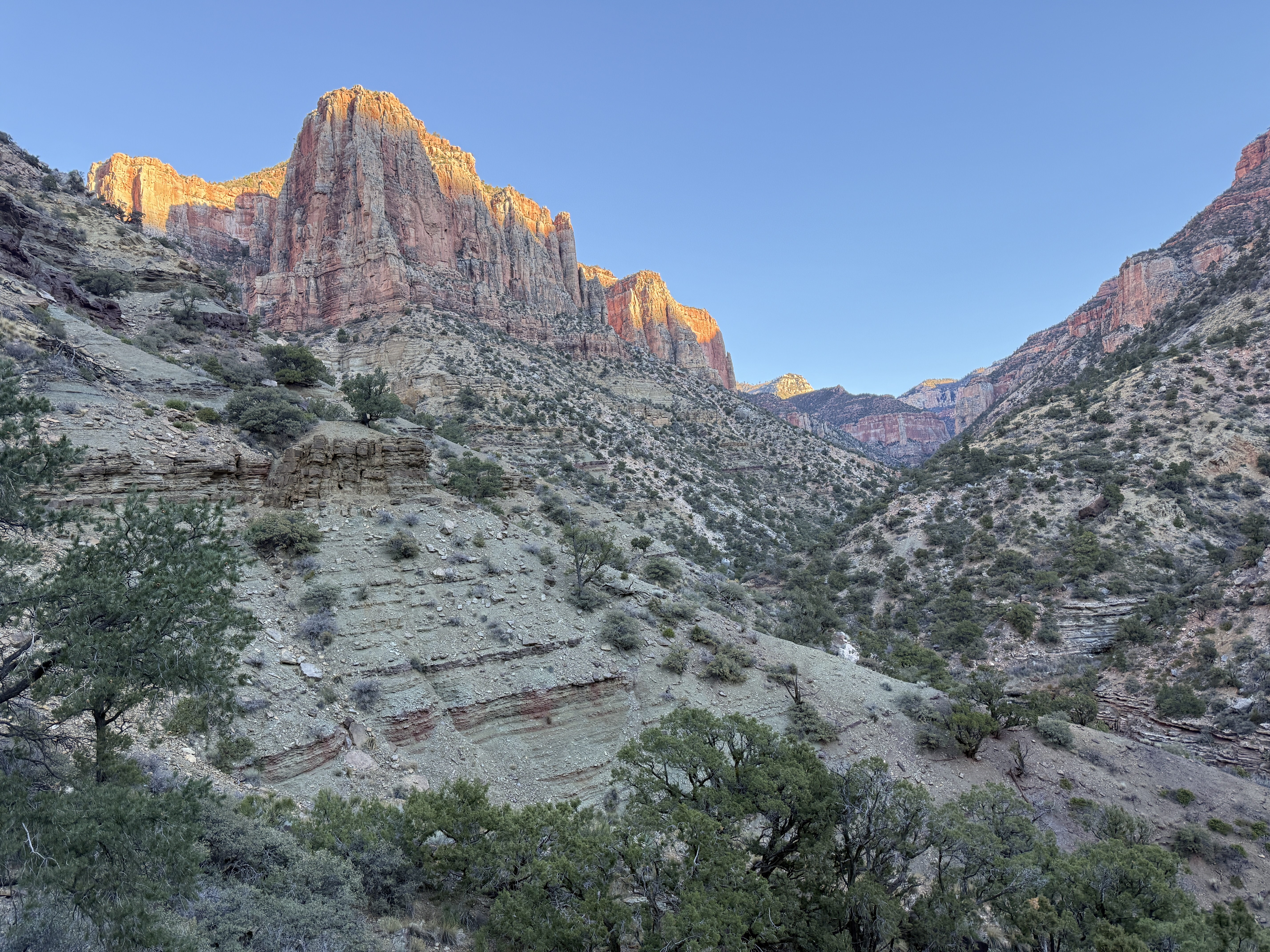
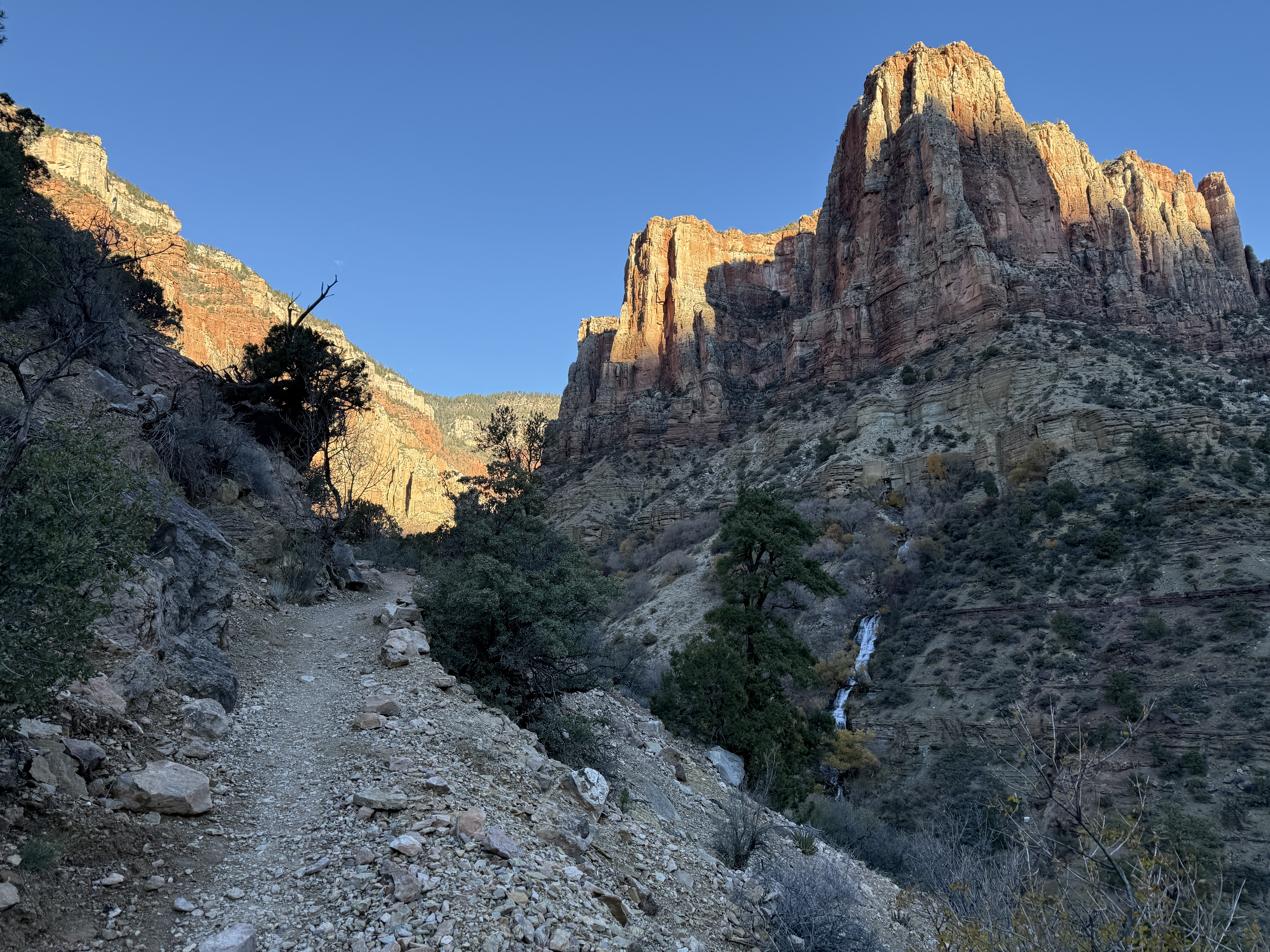
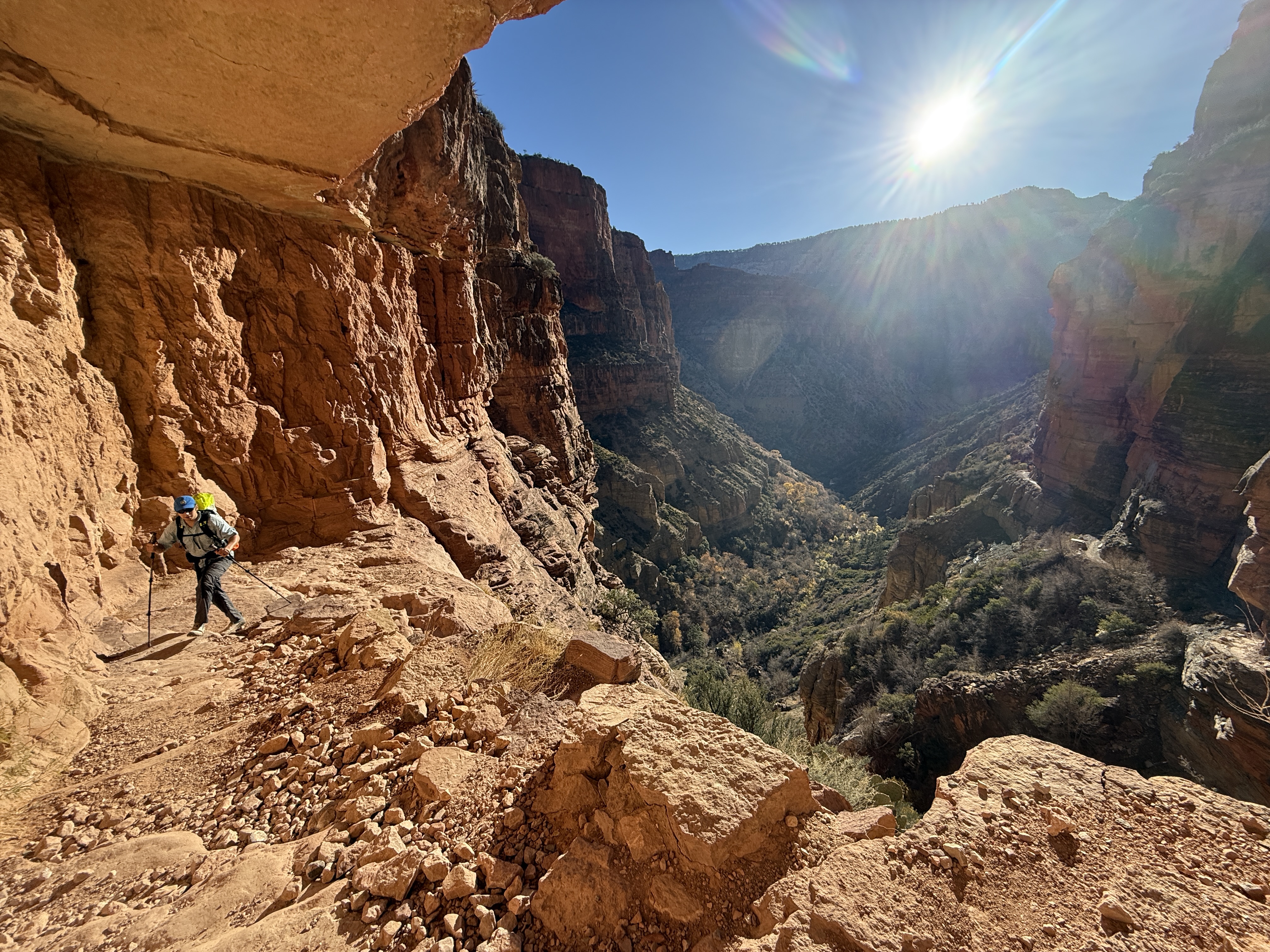
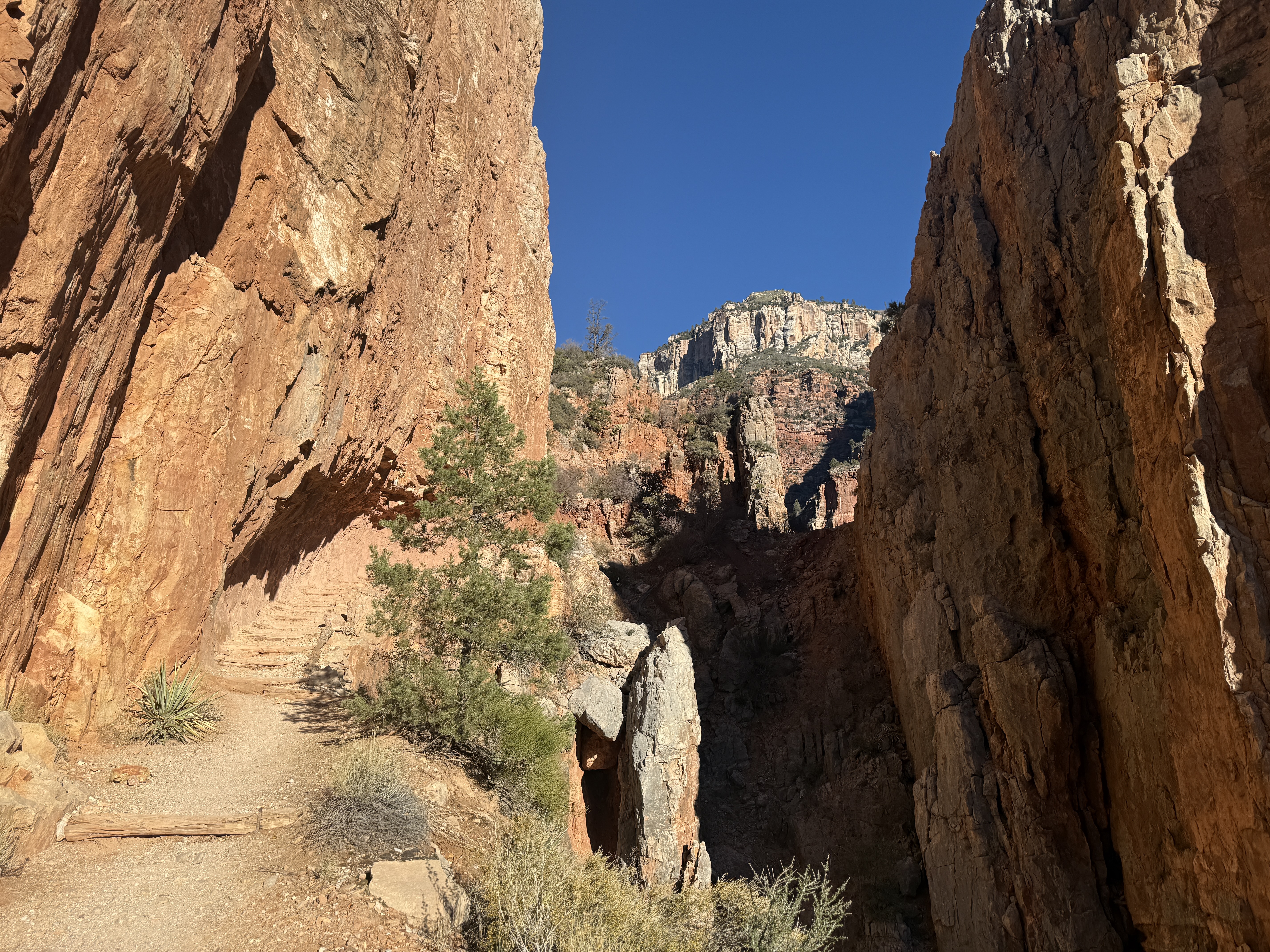
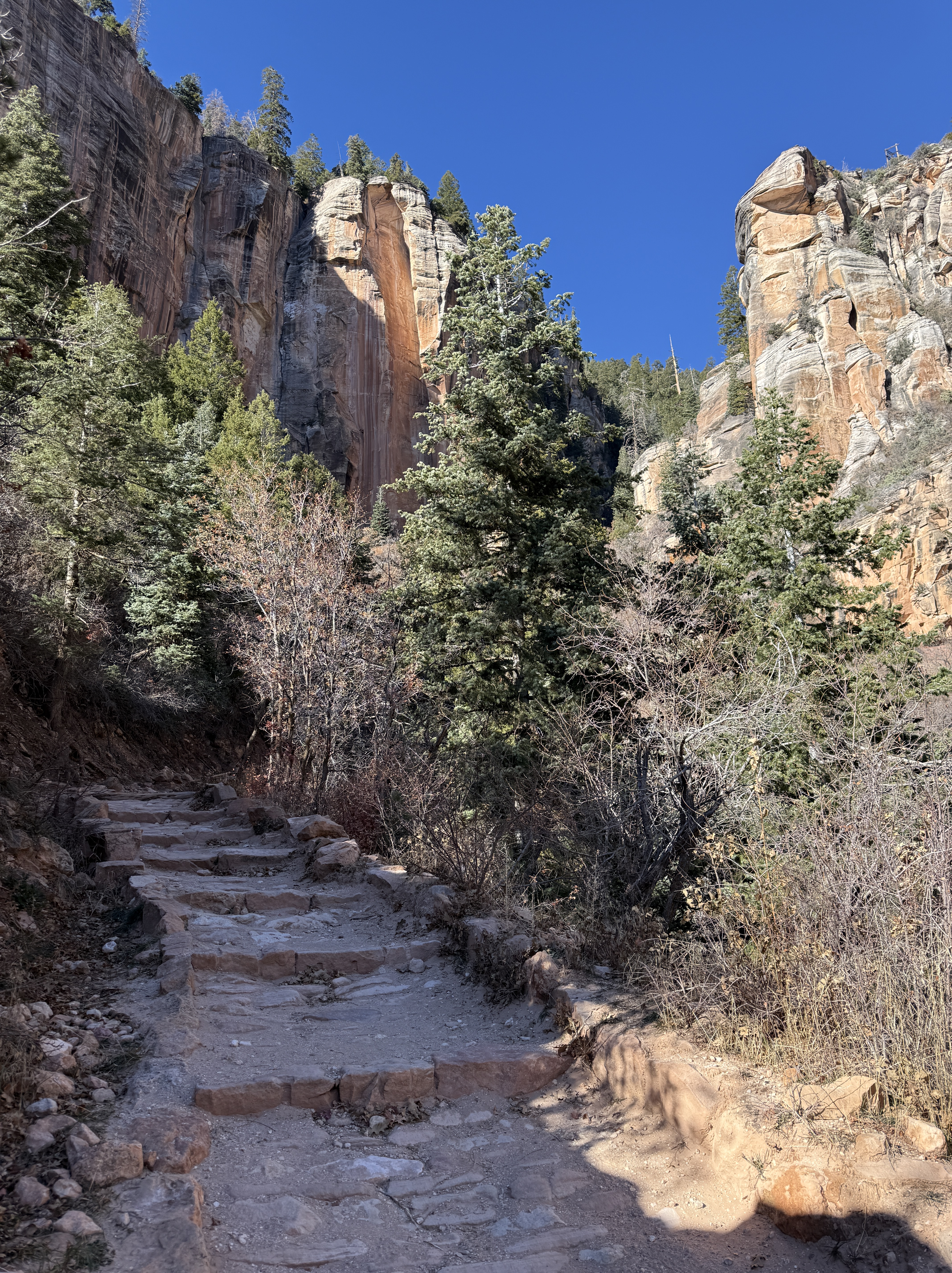
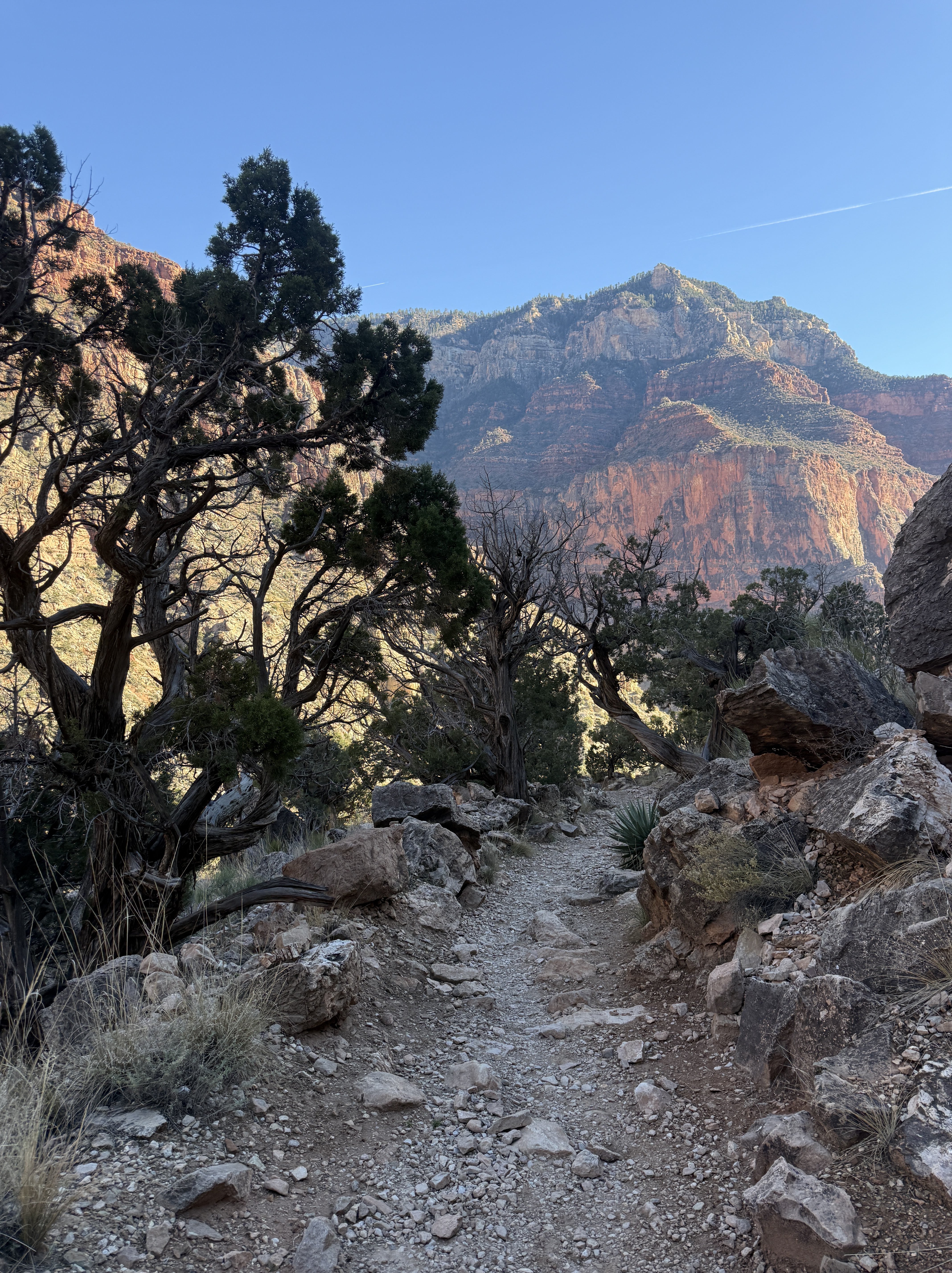
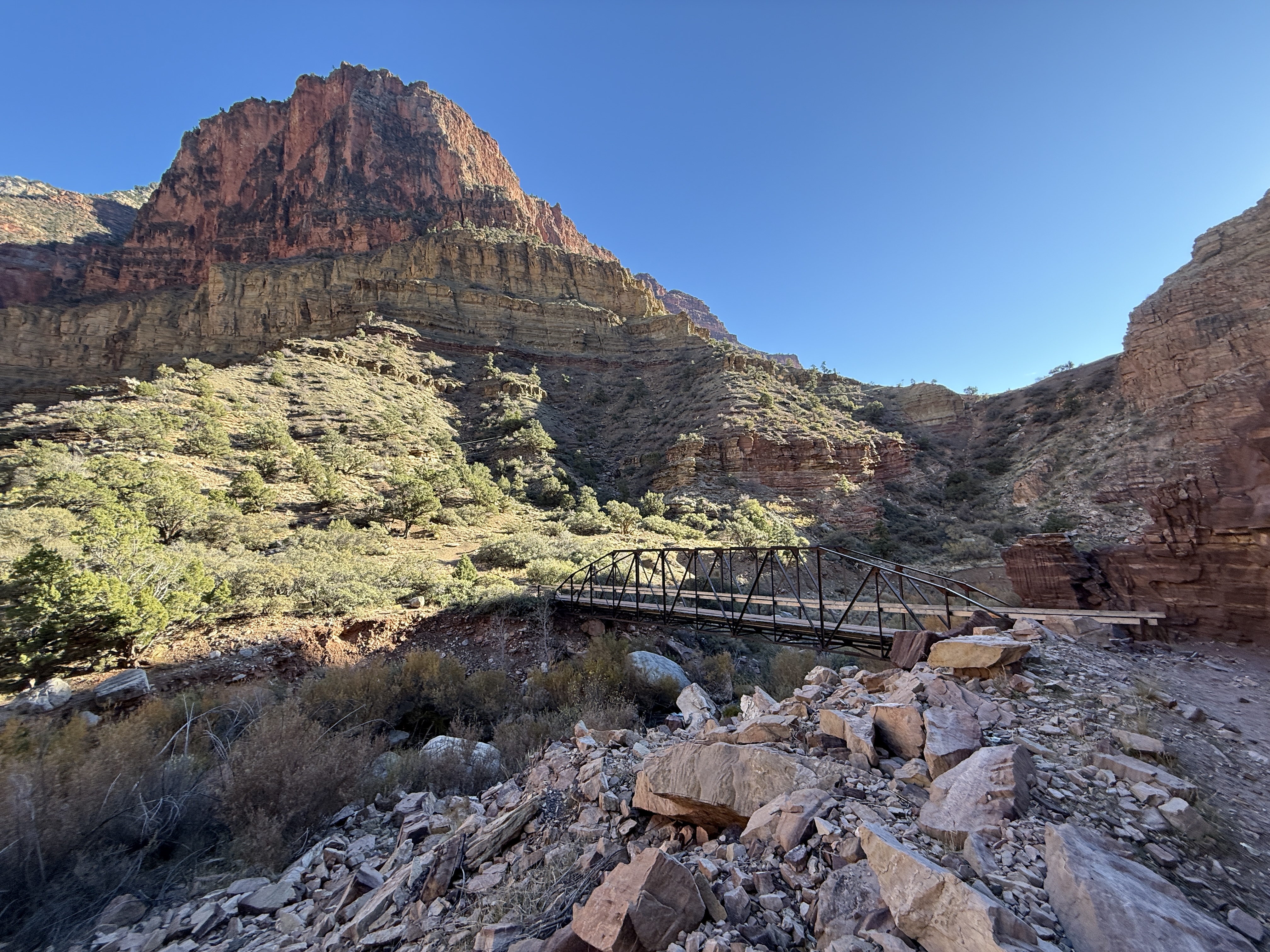
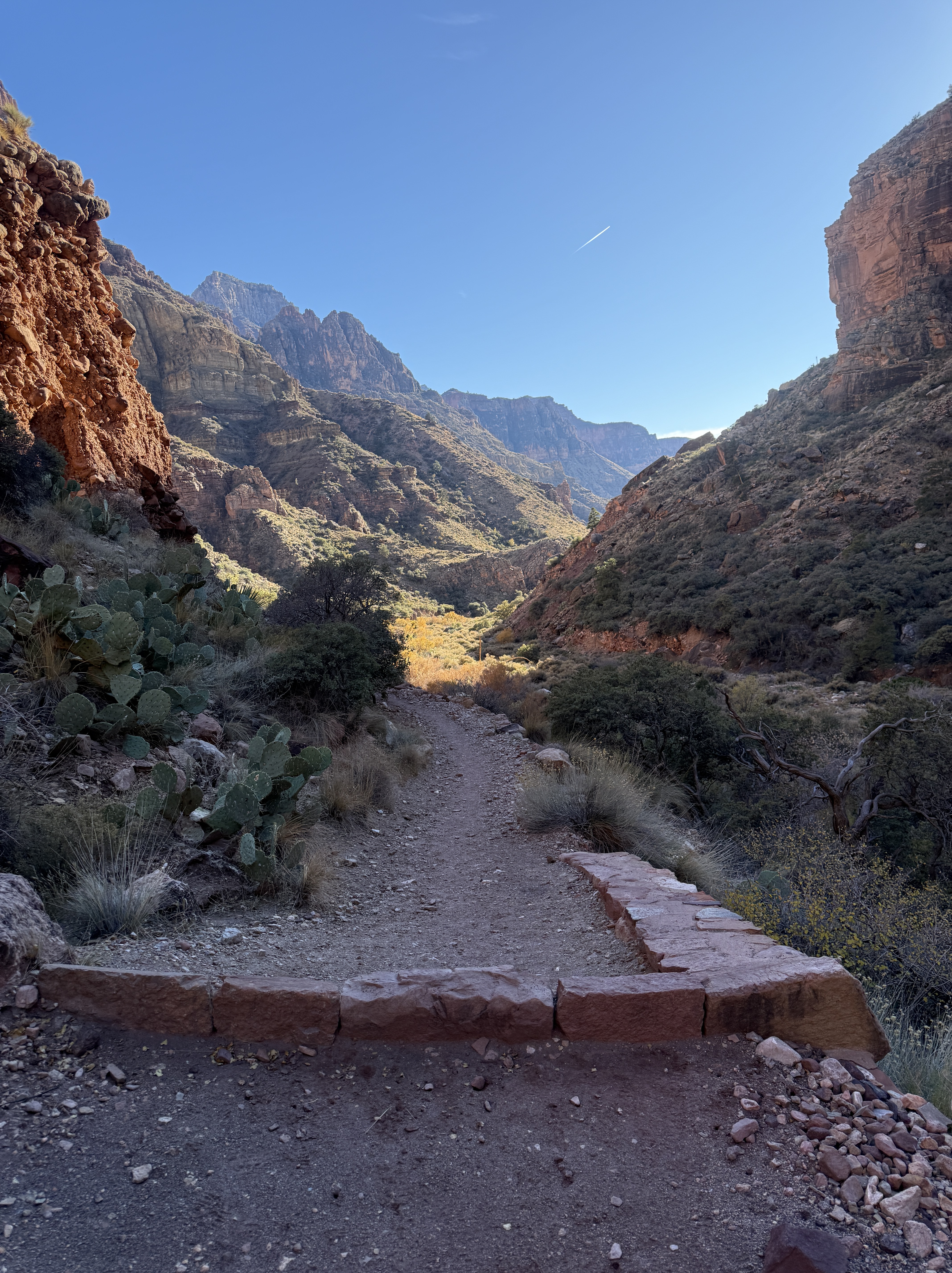
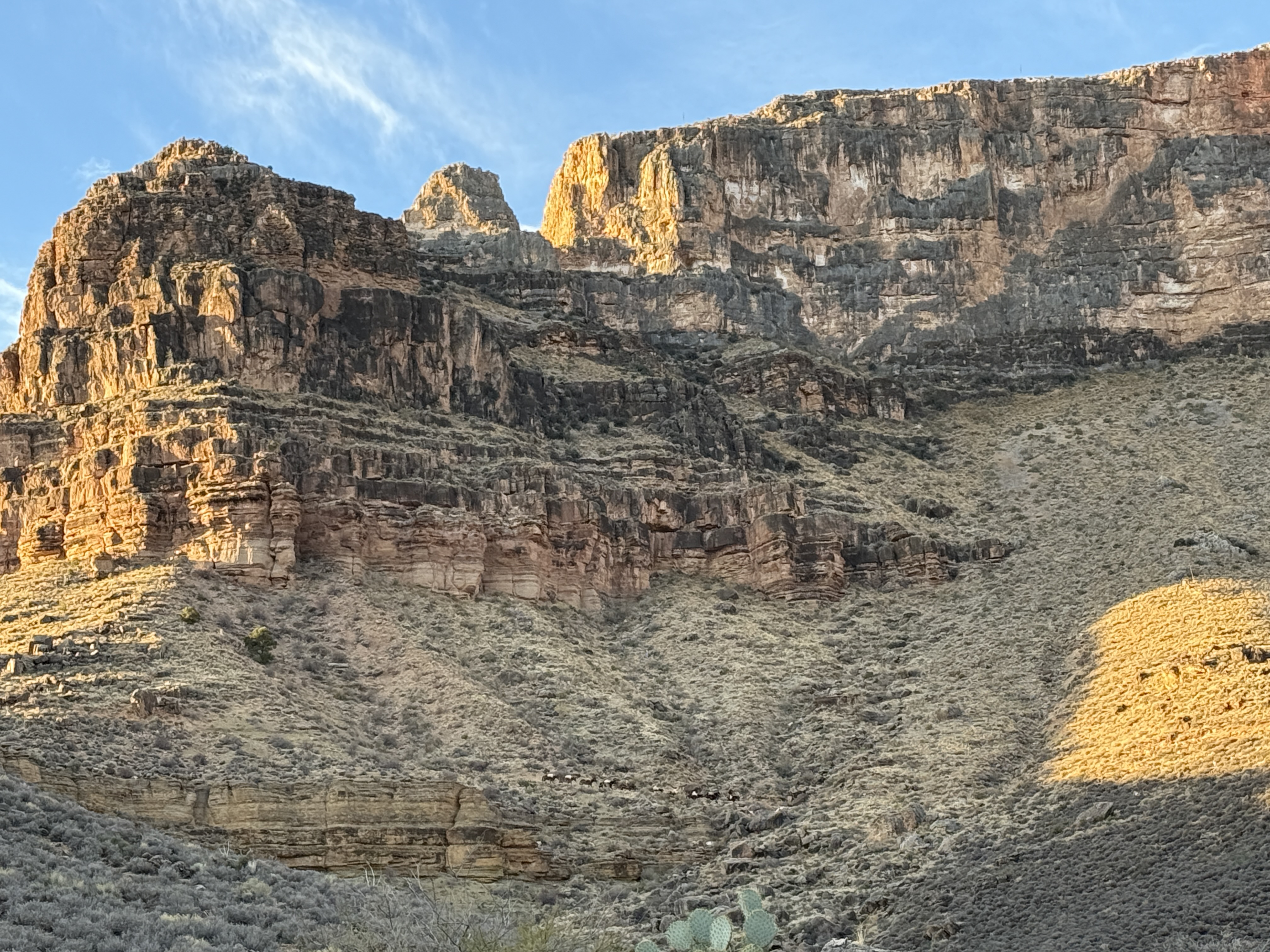
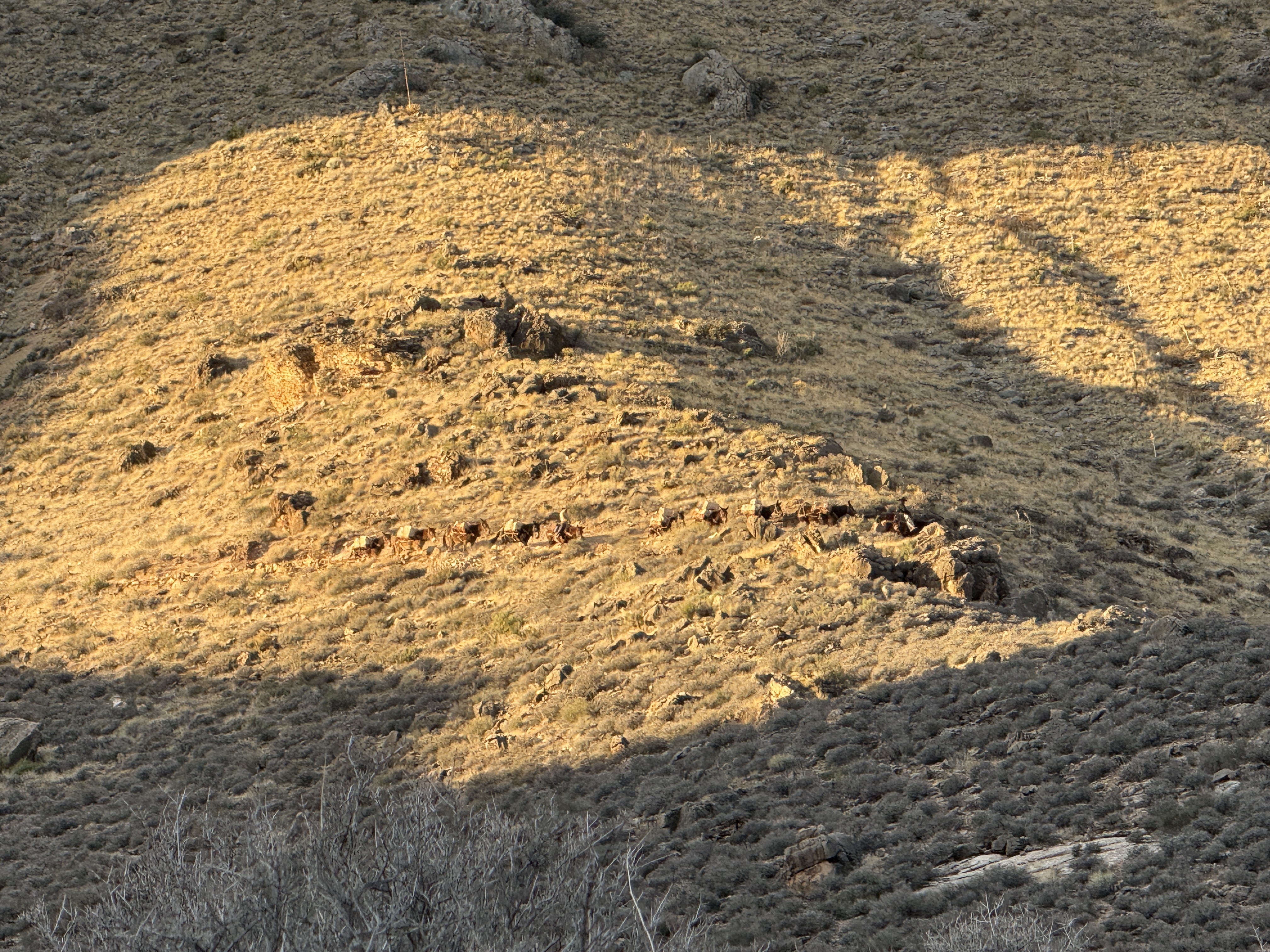
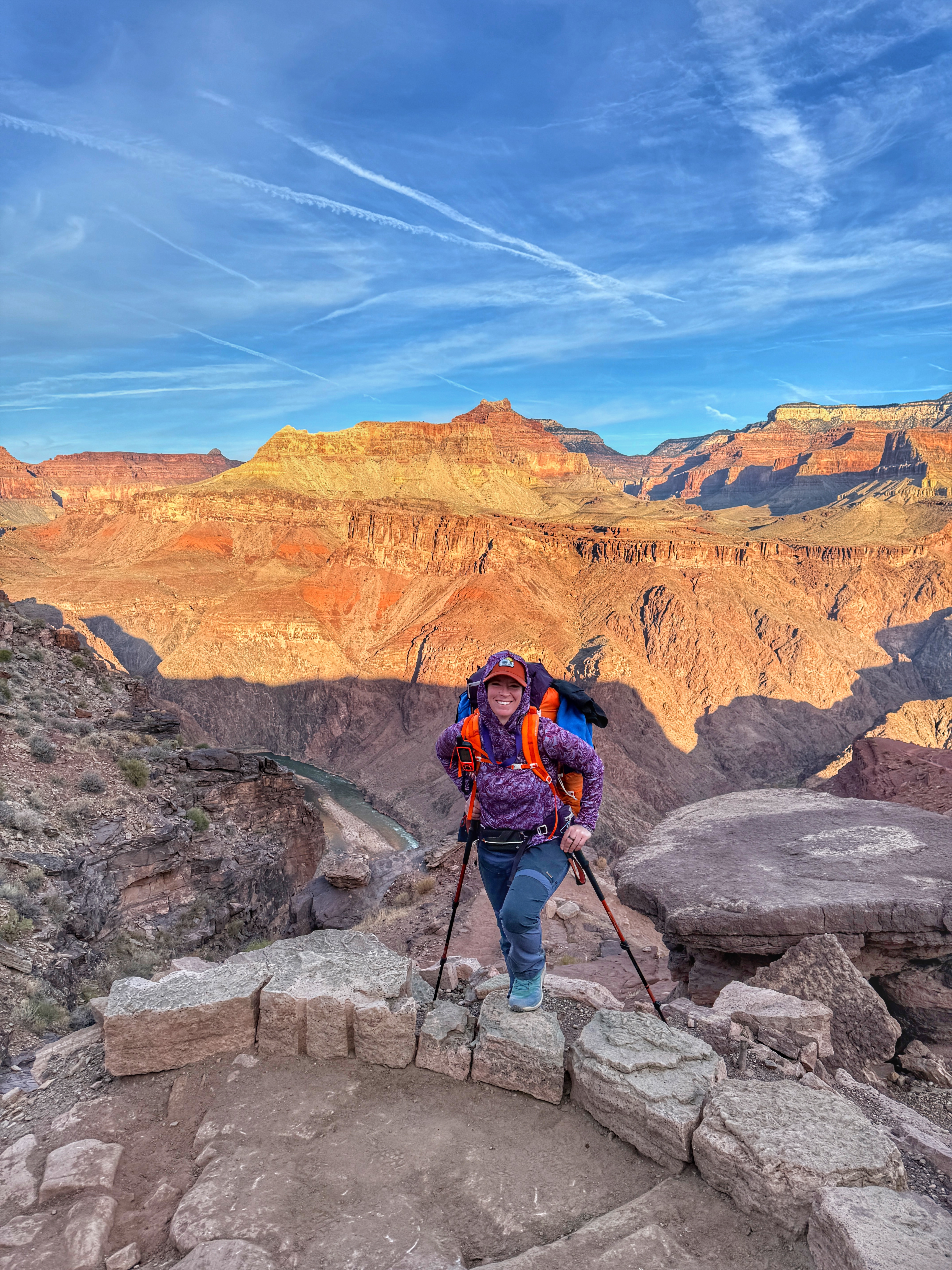
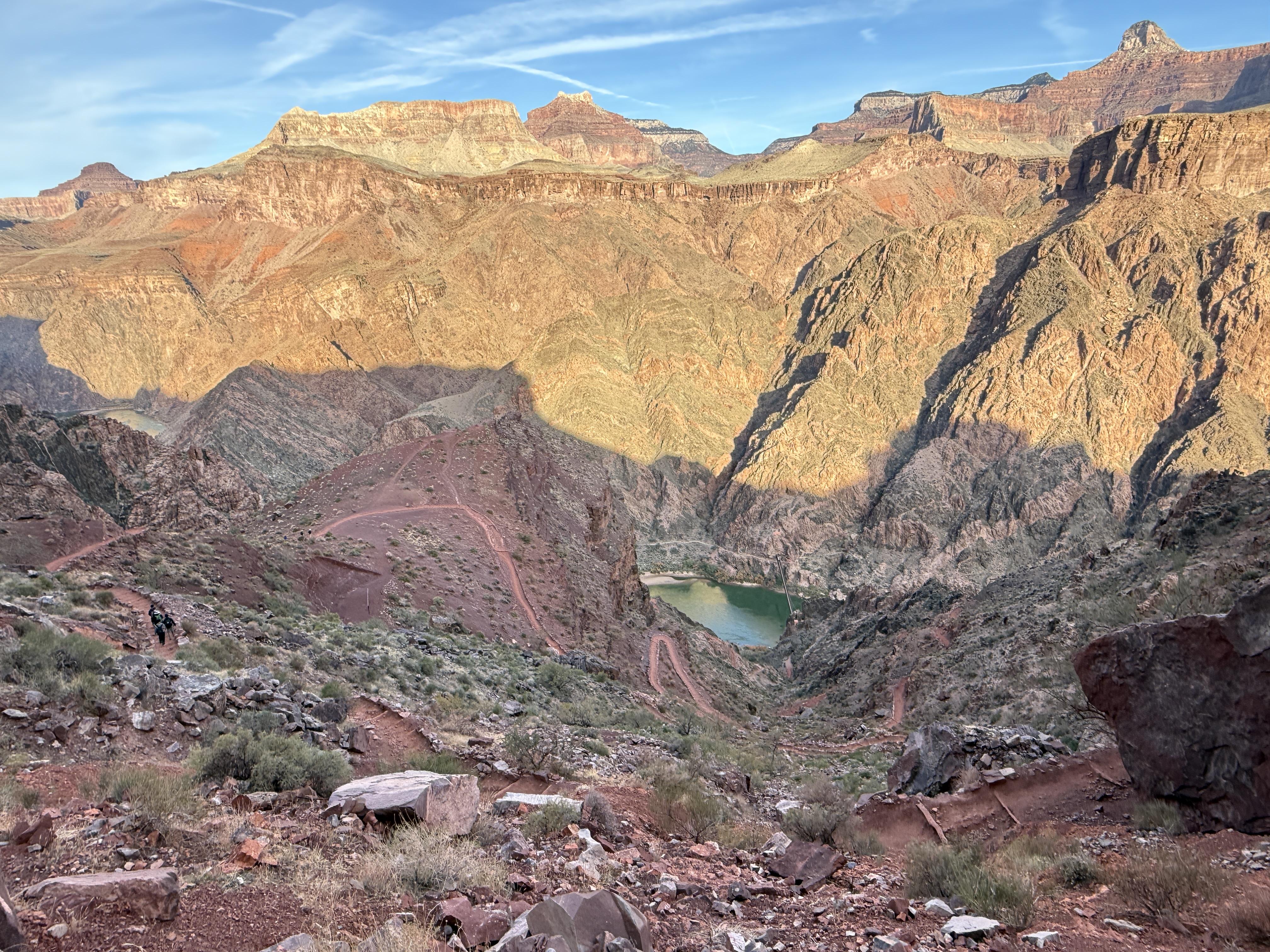
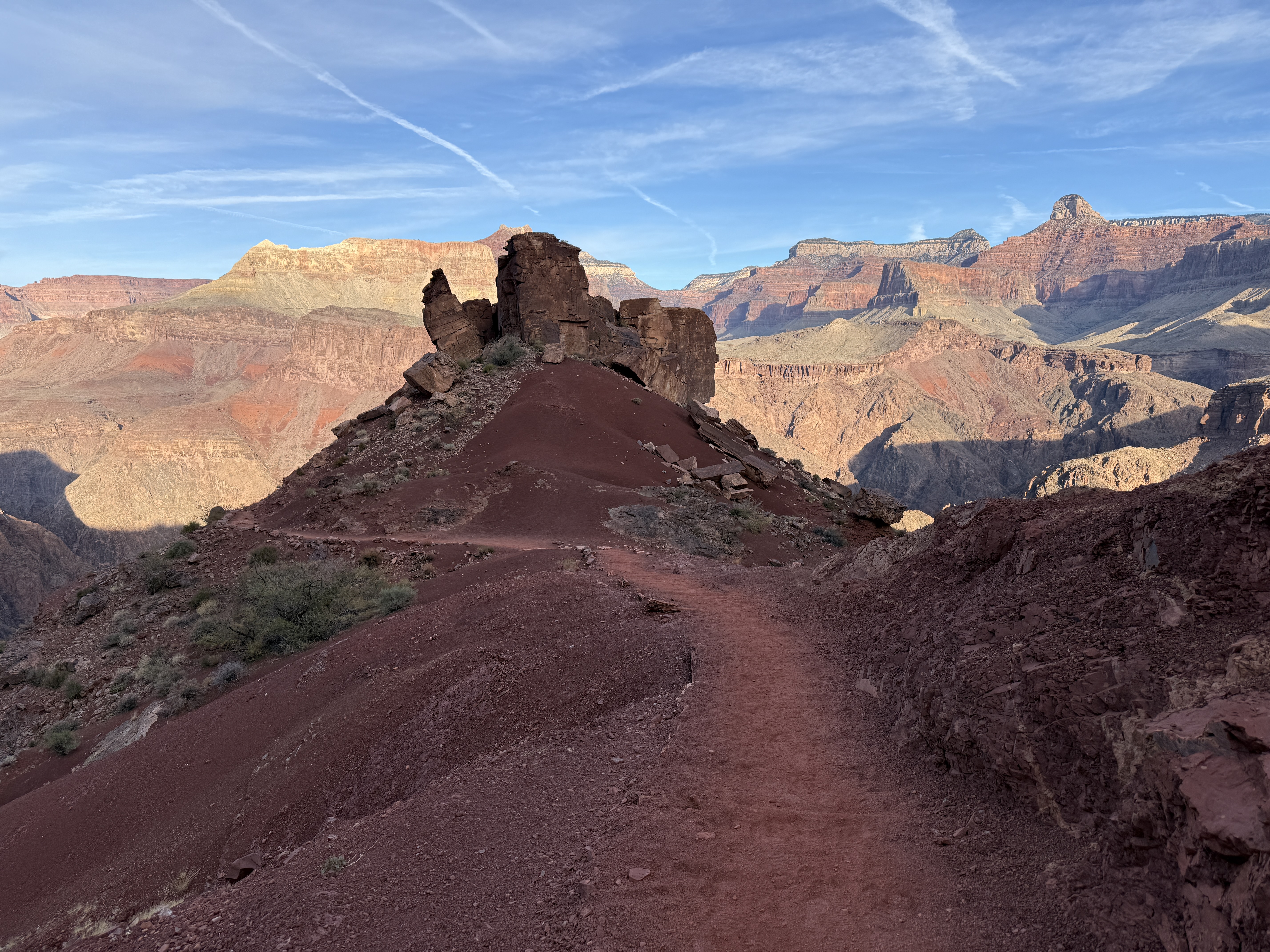
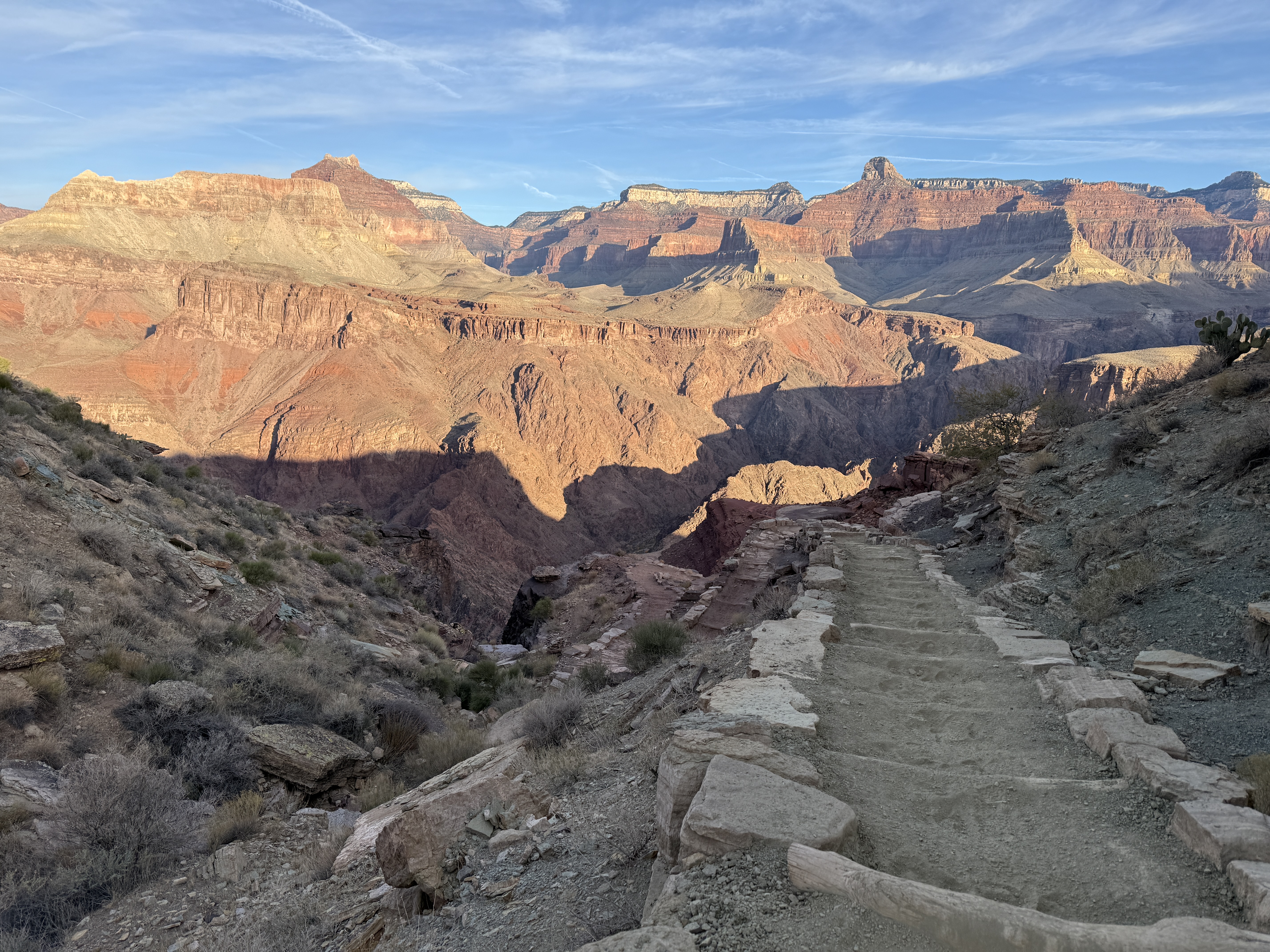
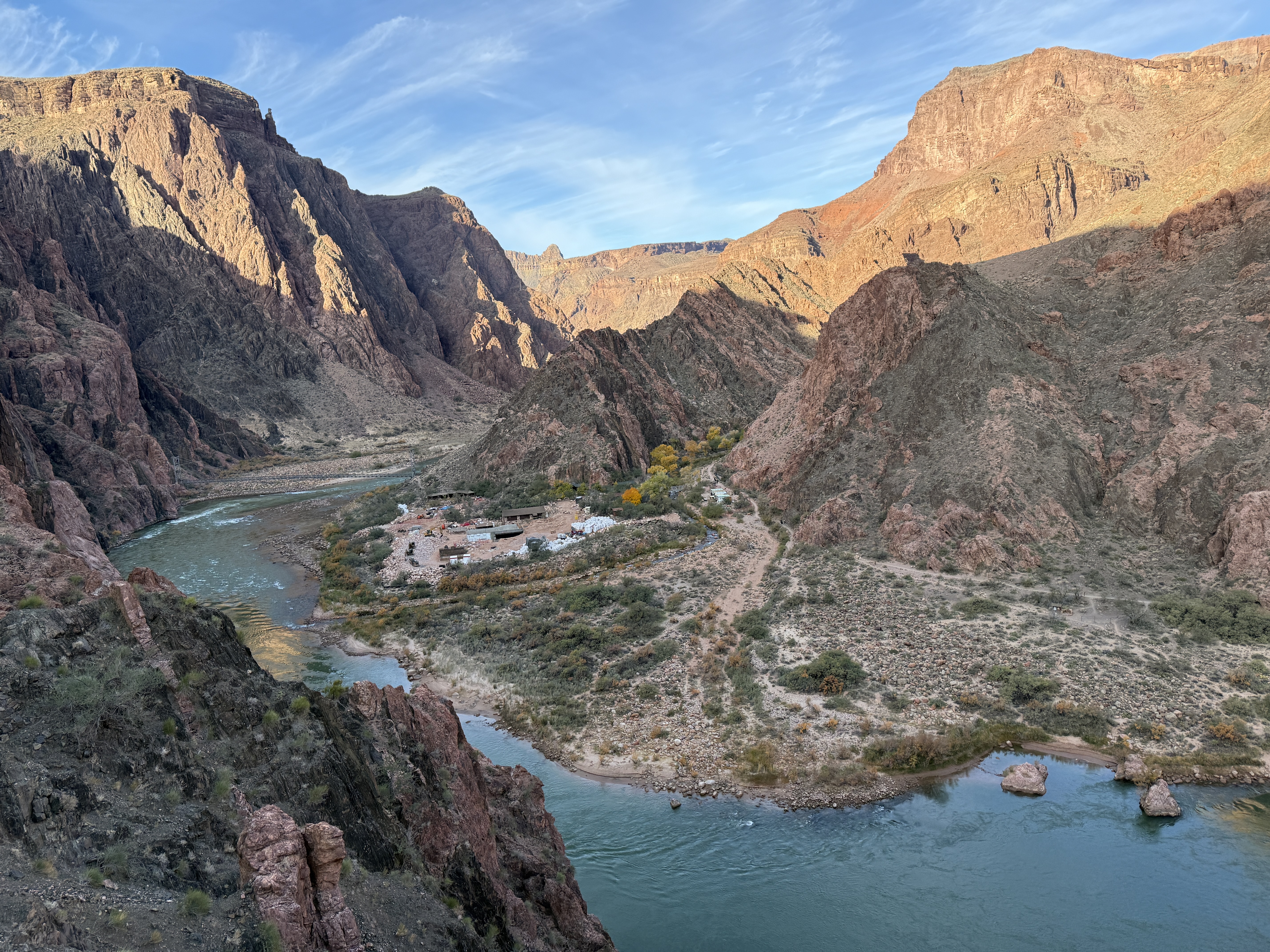
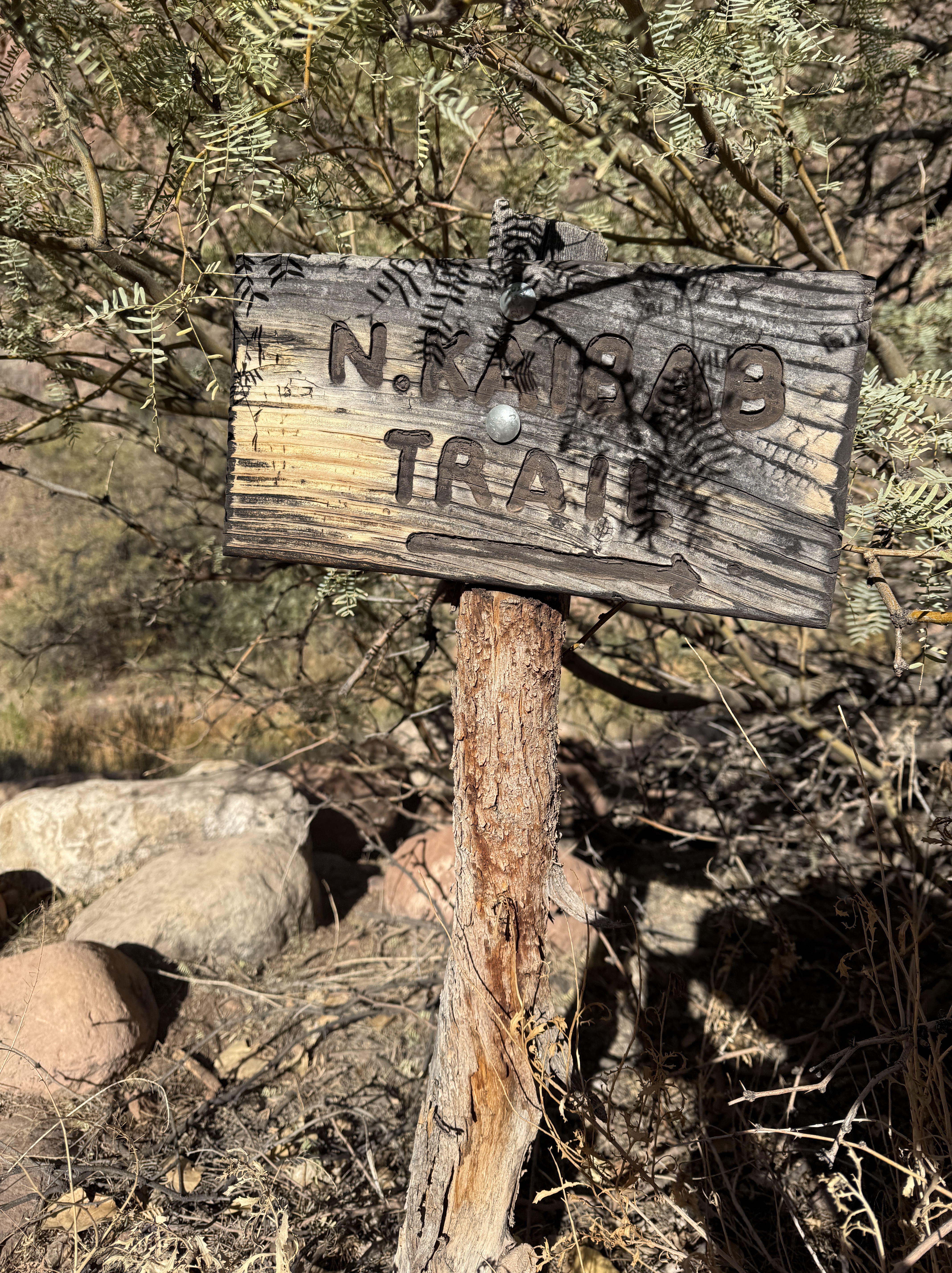
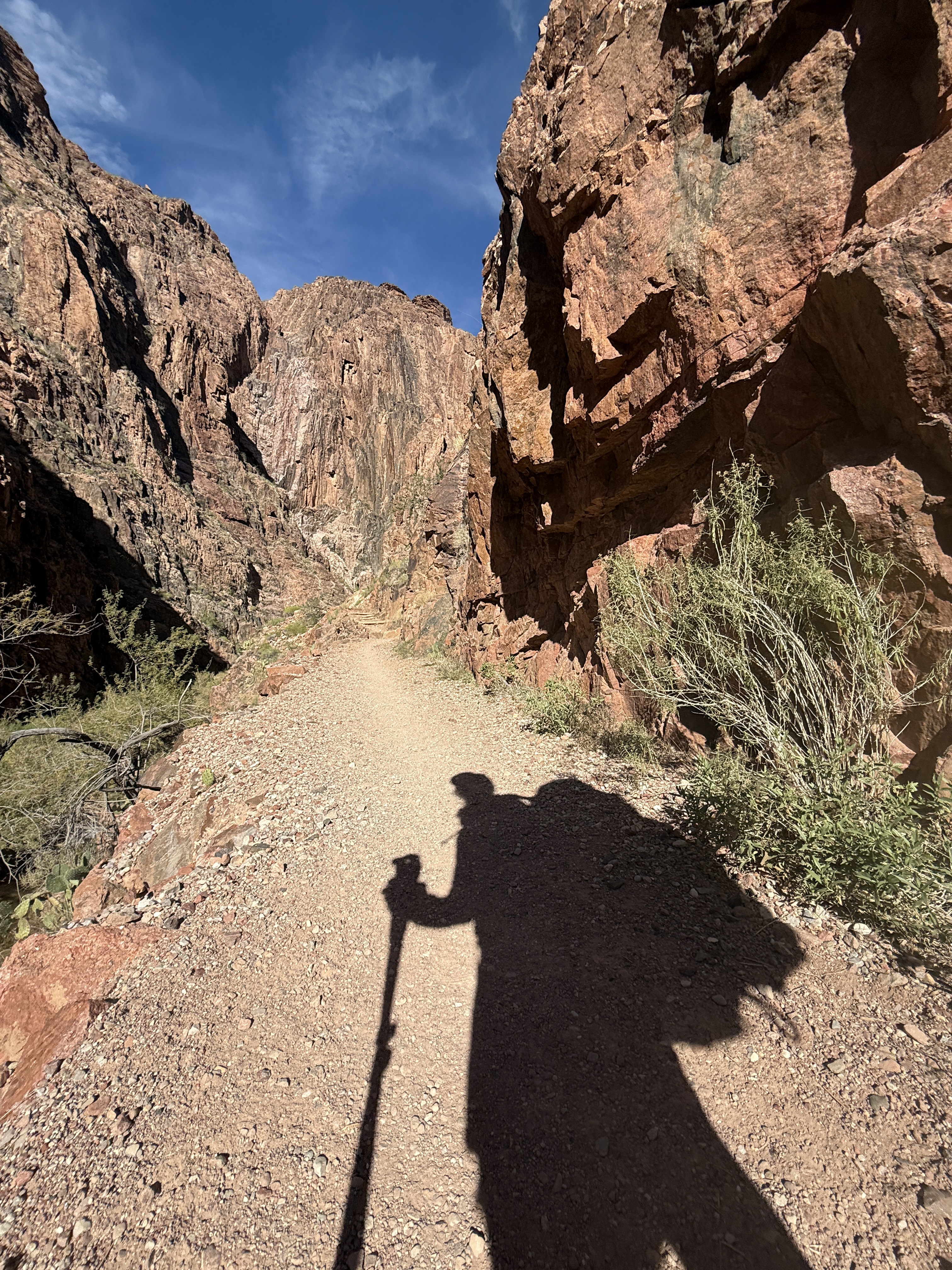
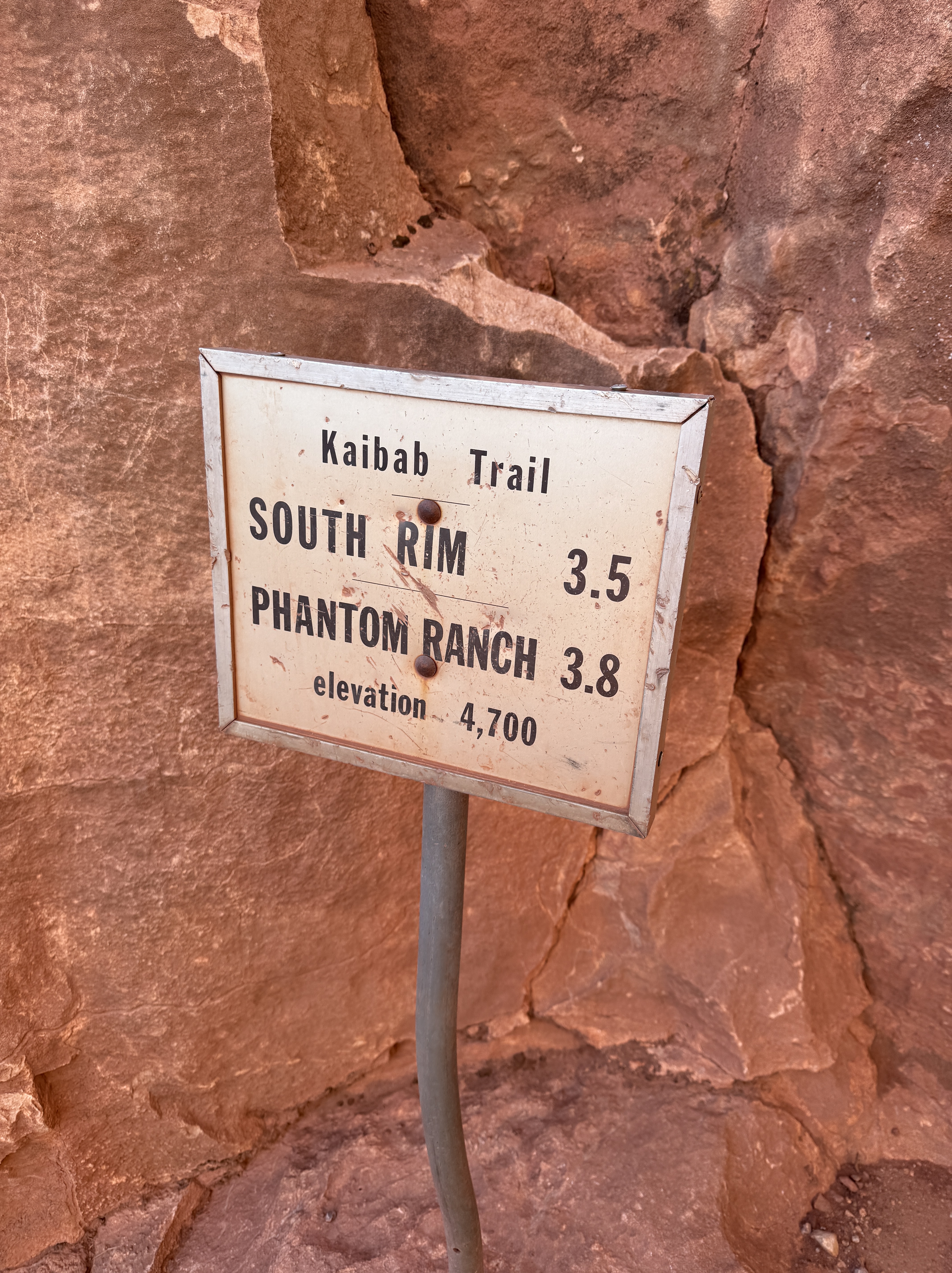
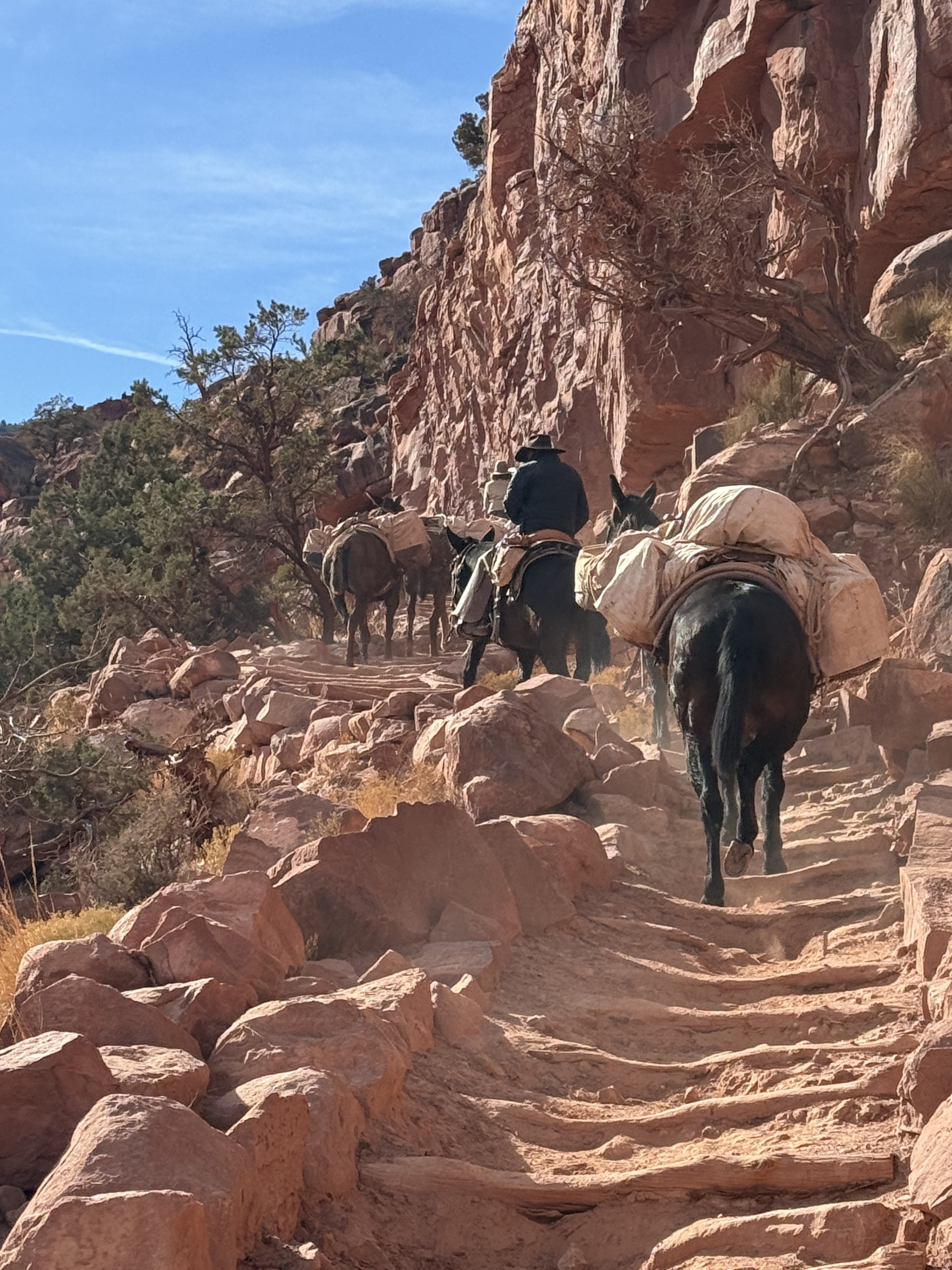
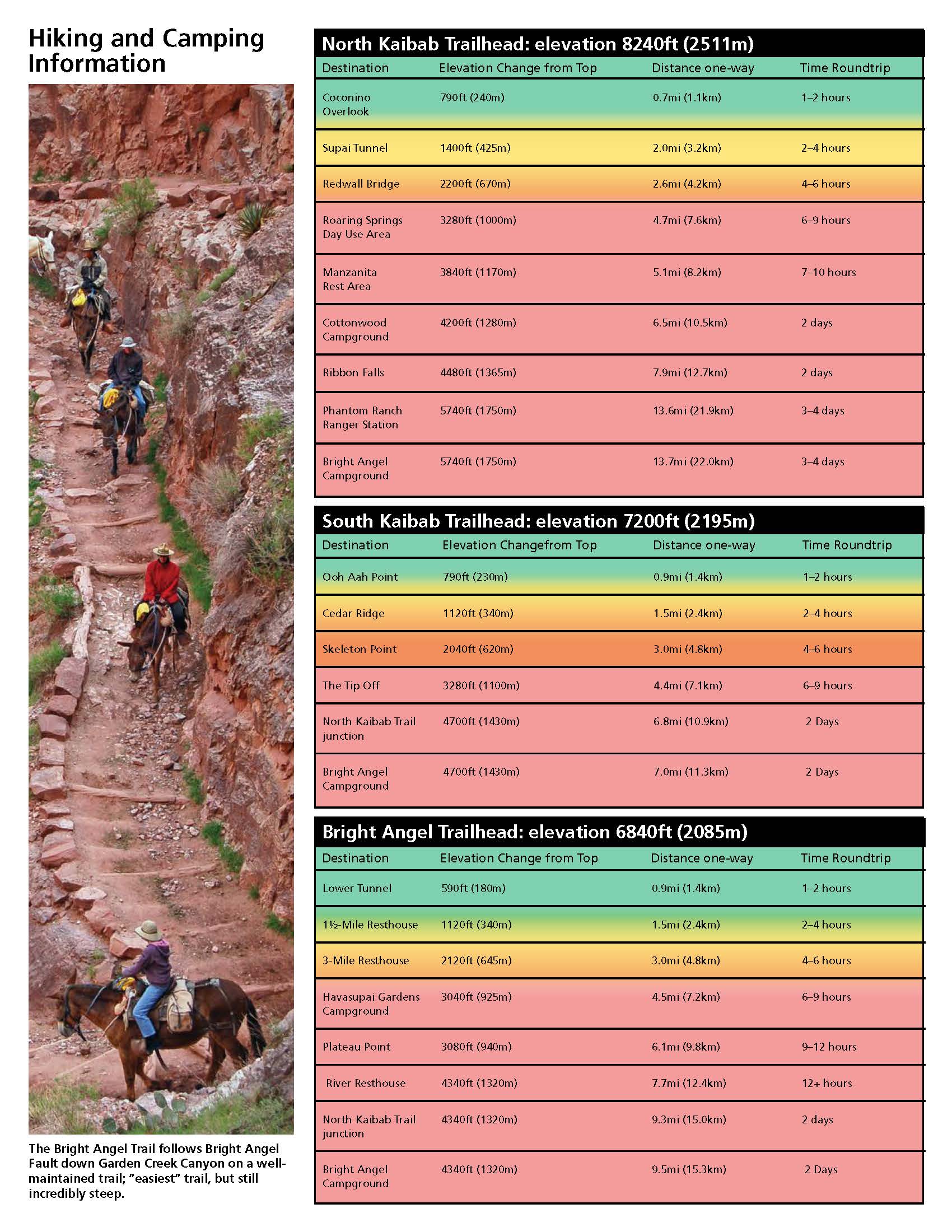
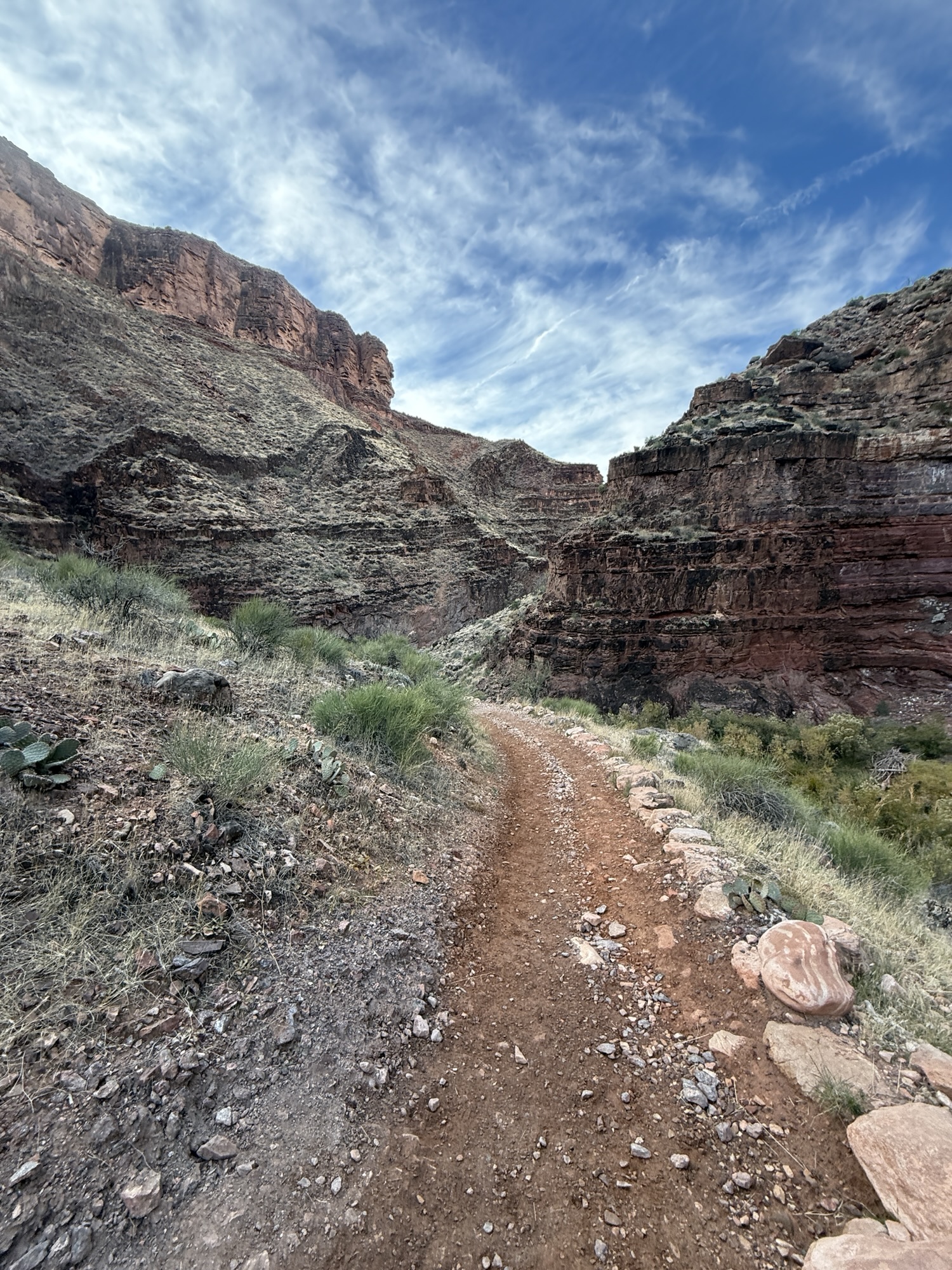
I began climbing up the South Kaibab Trail, starting to see some color where the sun would be rising. The sky soon became golden, and I watched a pack train descending above me. We crossed paths at a sign that said we were at 4,700’ and 3.5 miles from the South Rim. I moved slowly, wanting to really savor this beautiful, quiet morning in the Canyon.

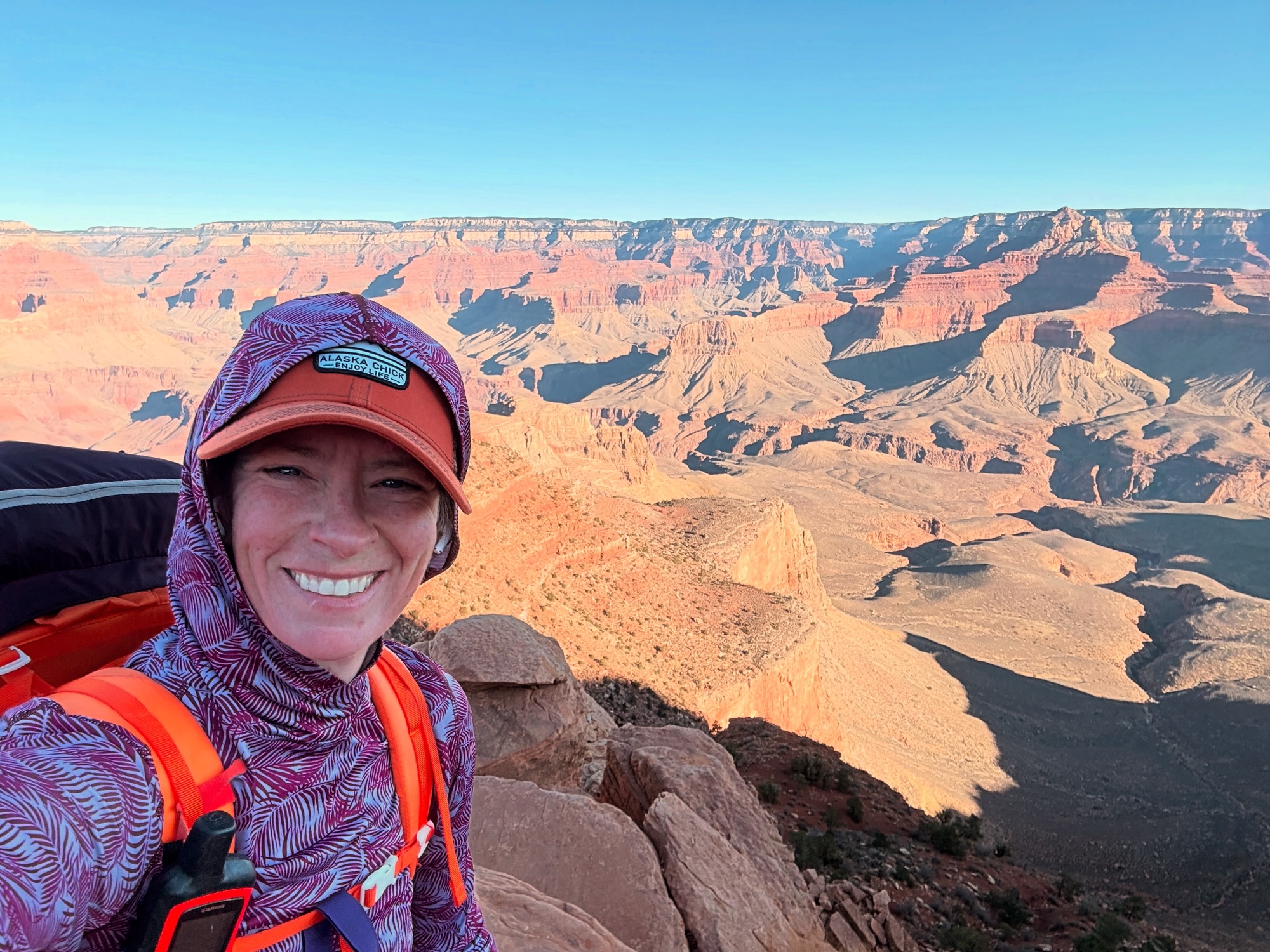
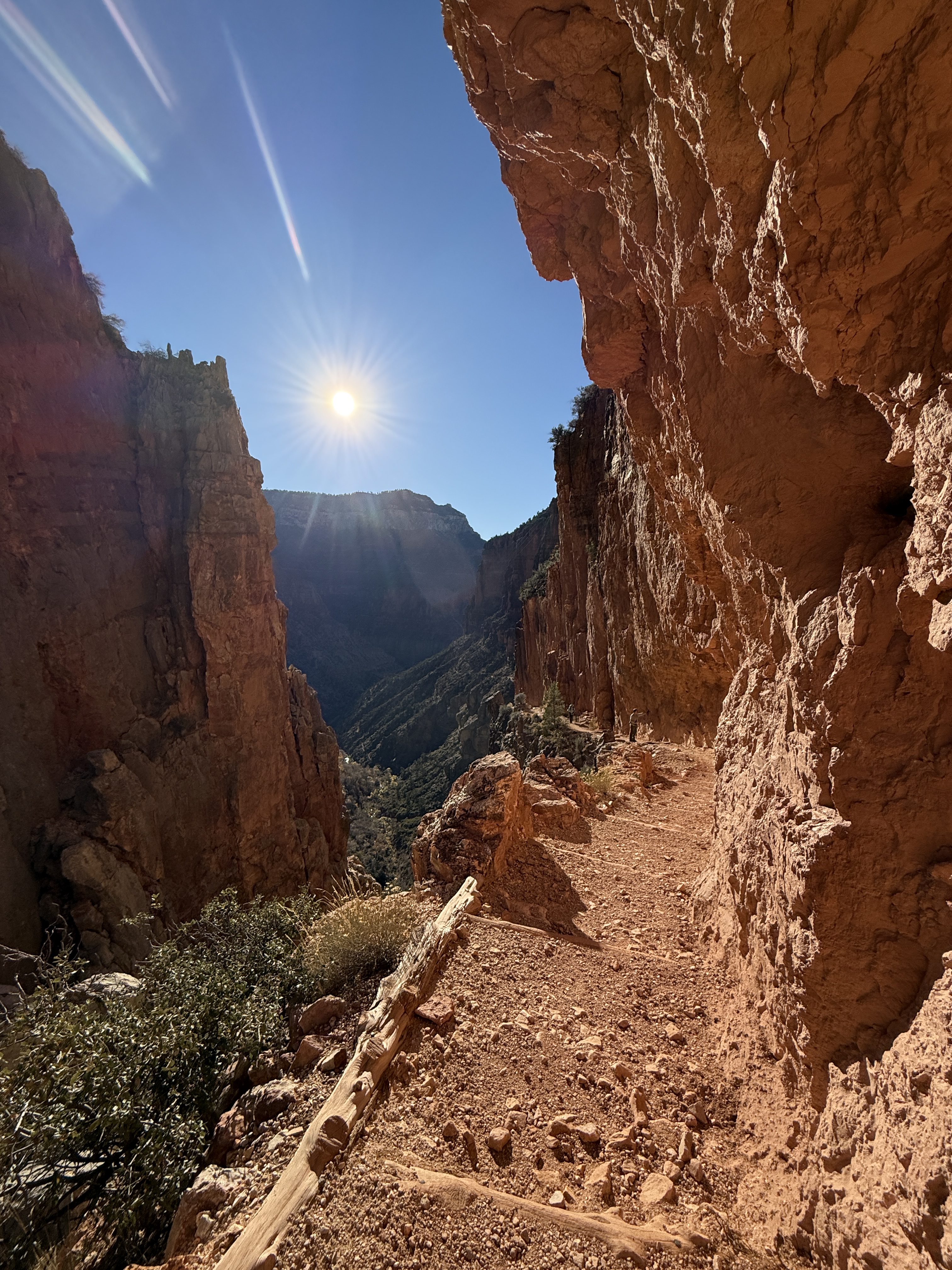
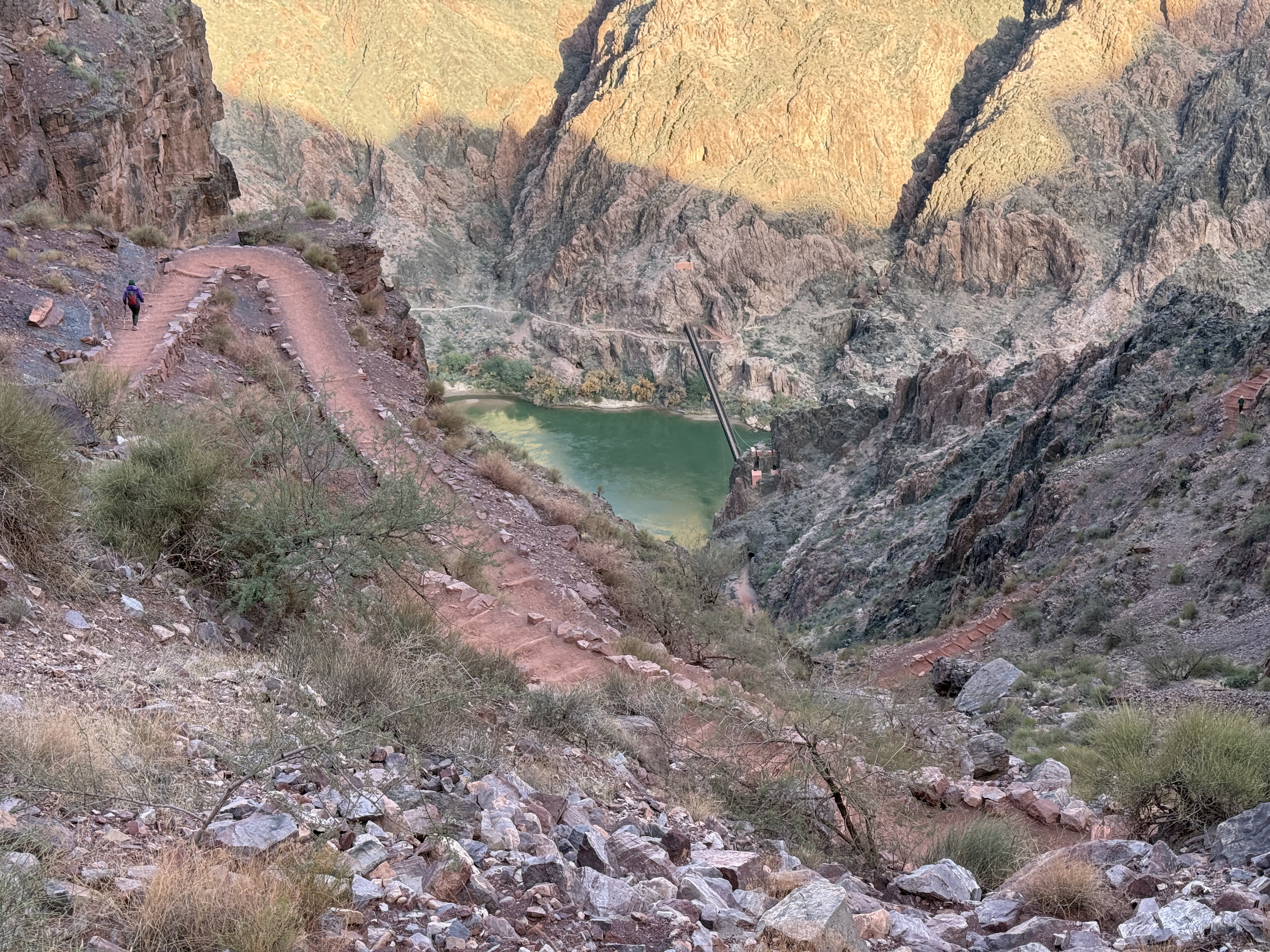
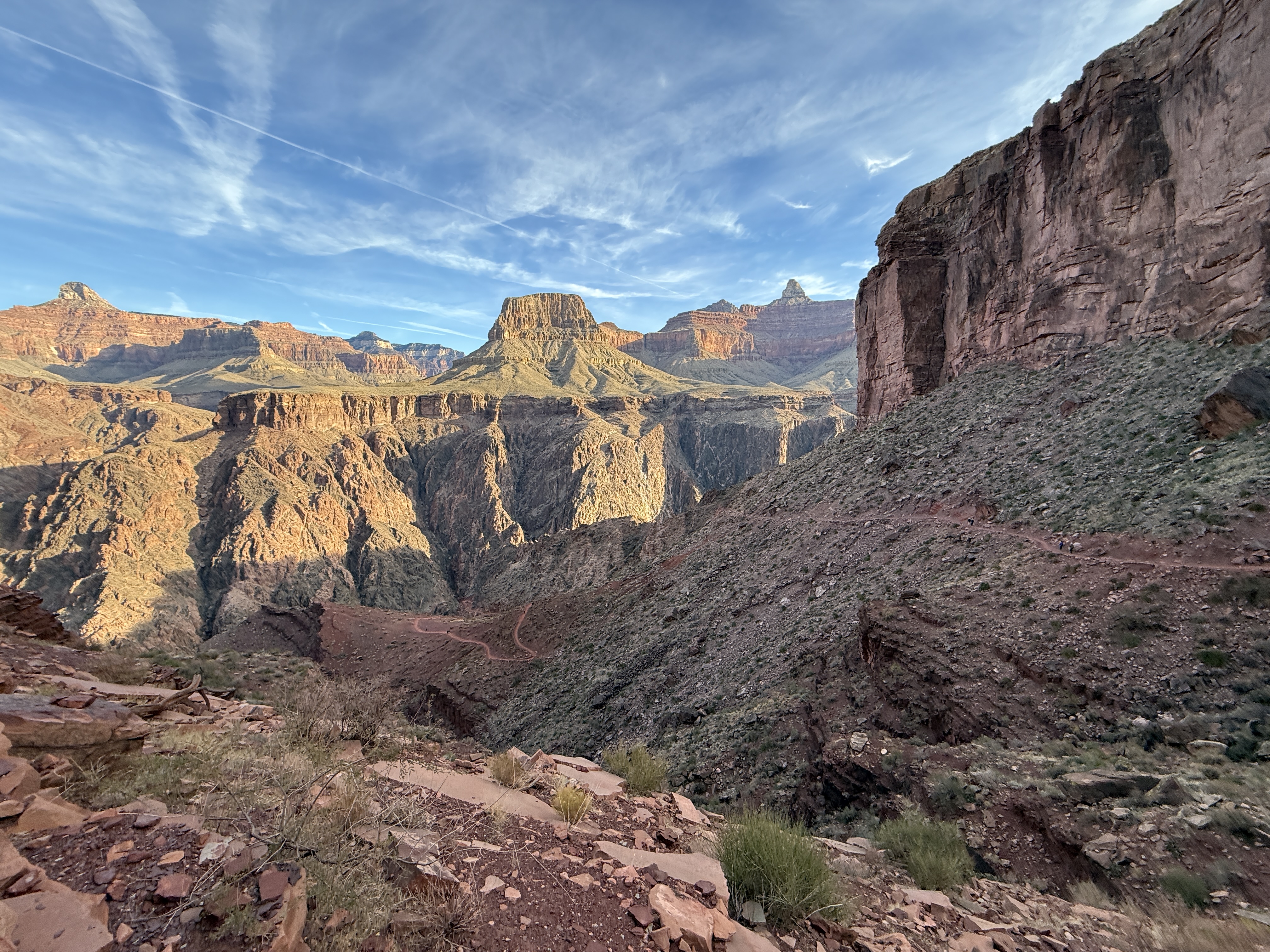
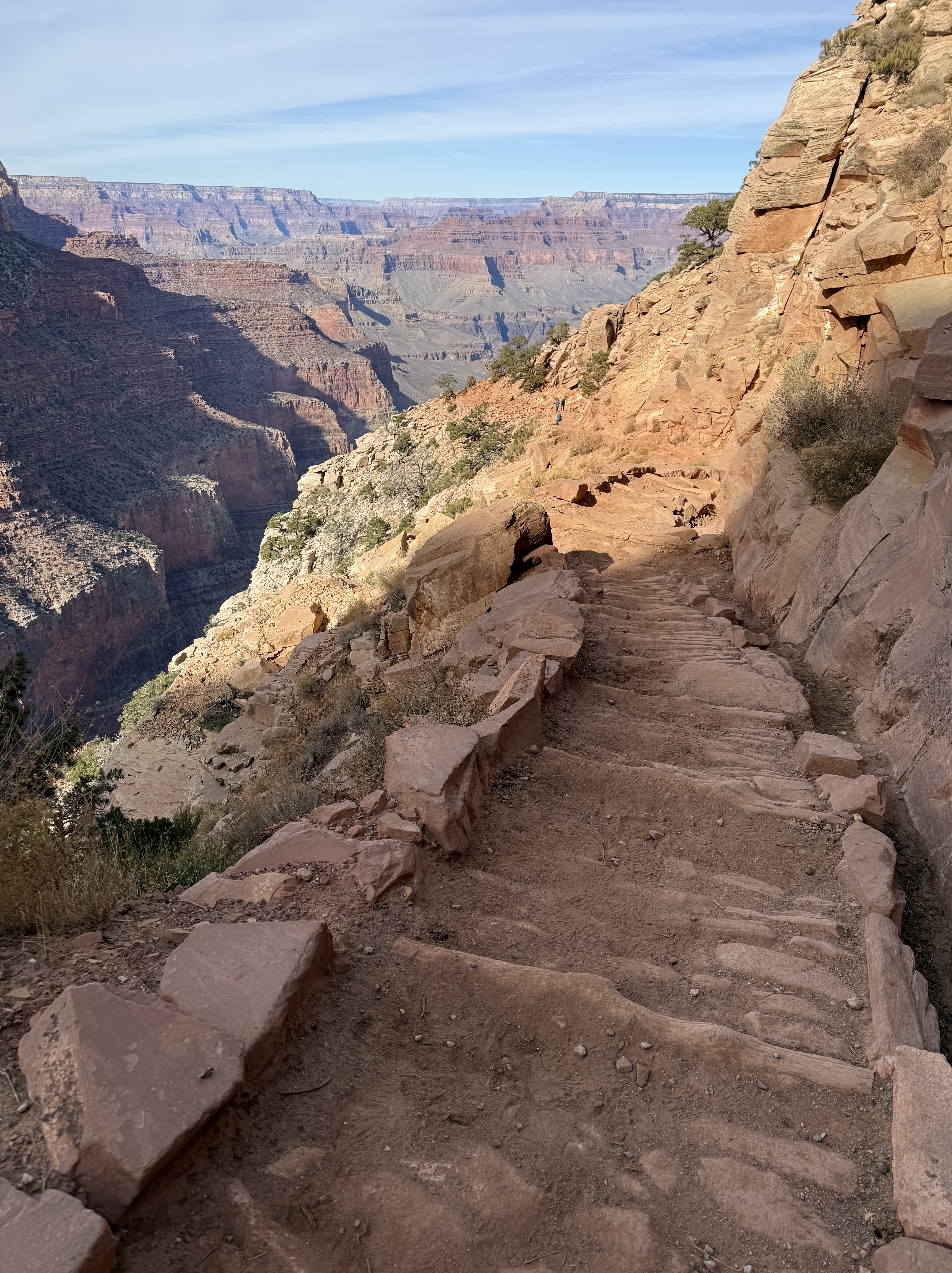
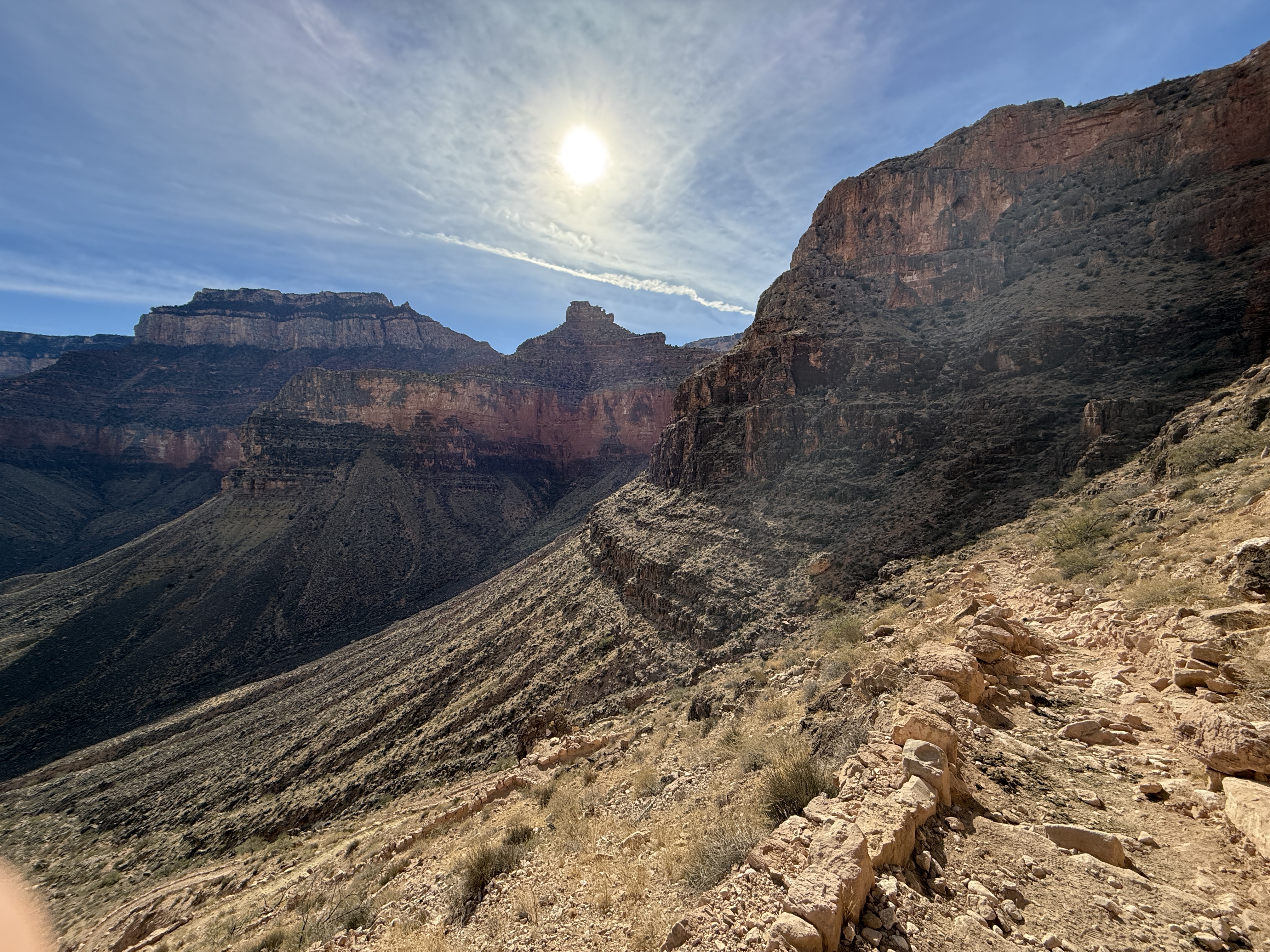
Just below Skeleton Point, the trail switches back and forth on itself, with an expansive view to the east. I stopped and watched the sun rise over the canyon walls, one of the most beautiful sights I had ever seen, and it hit me. I would soon be out of the Canyon. It was almost over.

I wasn’t ready. I wanted to see this sunrise every day forever. I wanted to cowboy camp under the stars. I wanted to walk every trail and explore every canyon. I couldn’t help but tear up, and soon I was crying both with joy for the gifts I was given by The Canyon but also in mourning for the end of my trip. To this day when I think of that moment I get choked up, and I think that will continue to happen for the rest of my existence on this Earth.

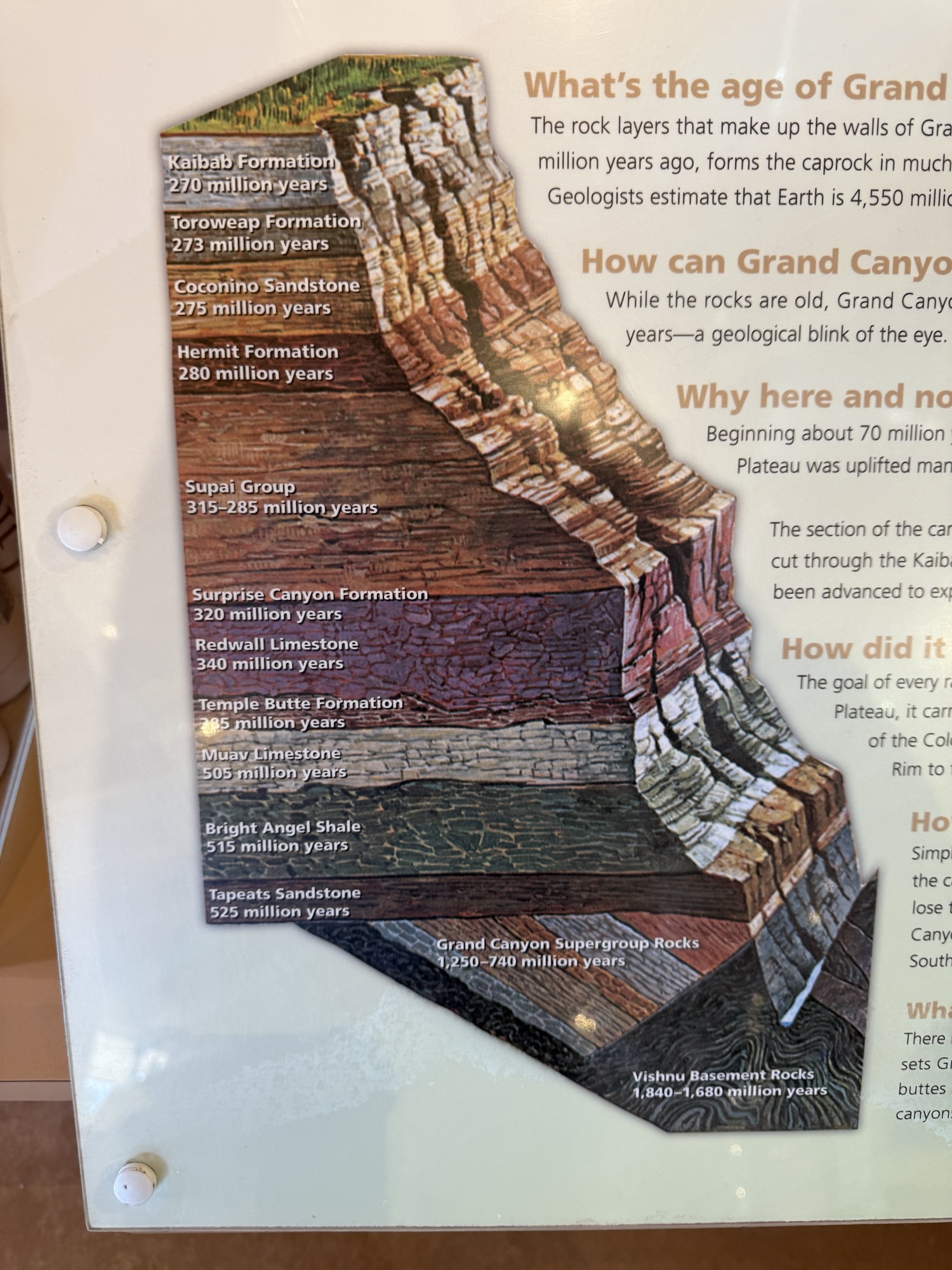
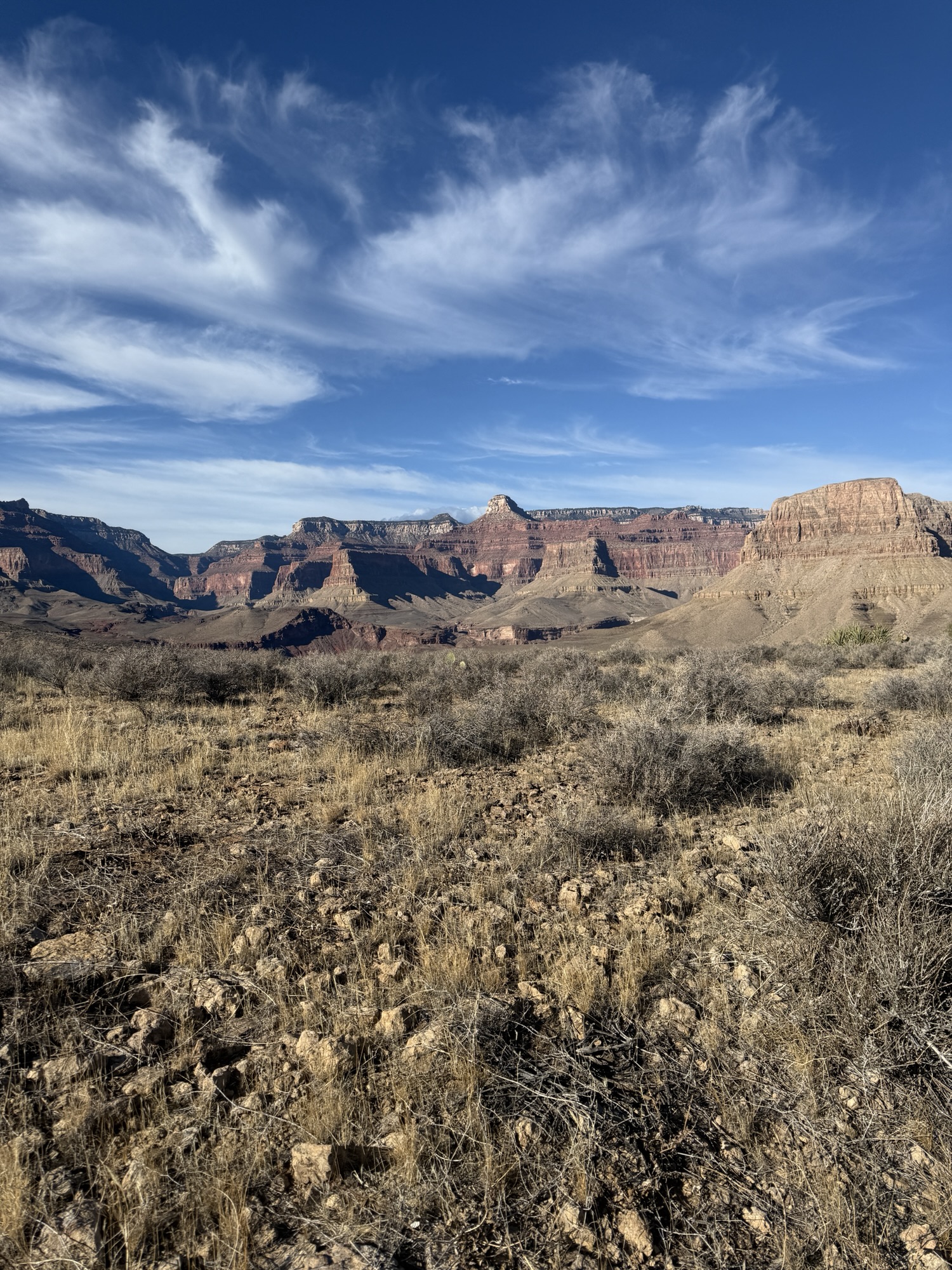
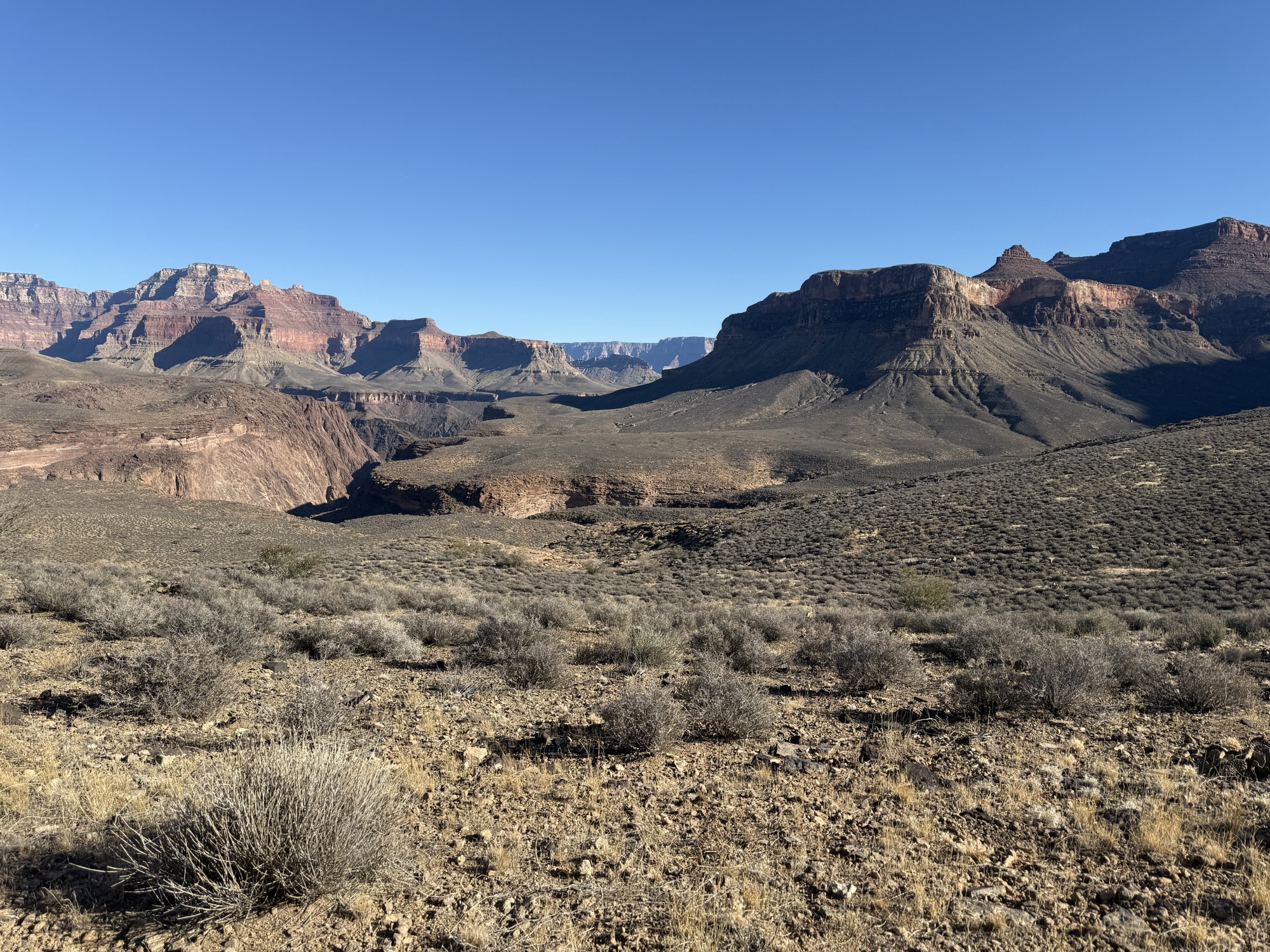
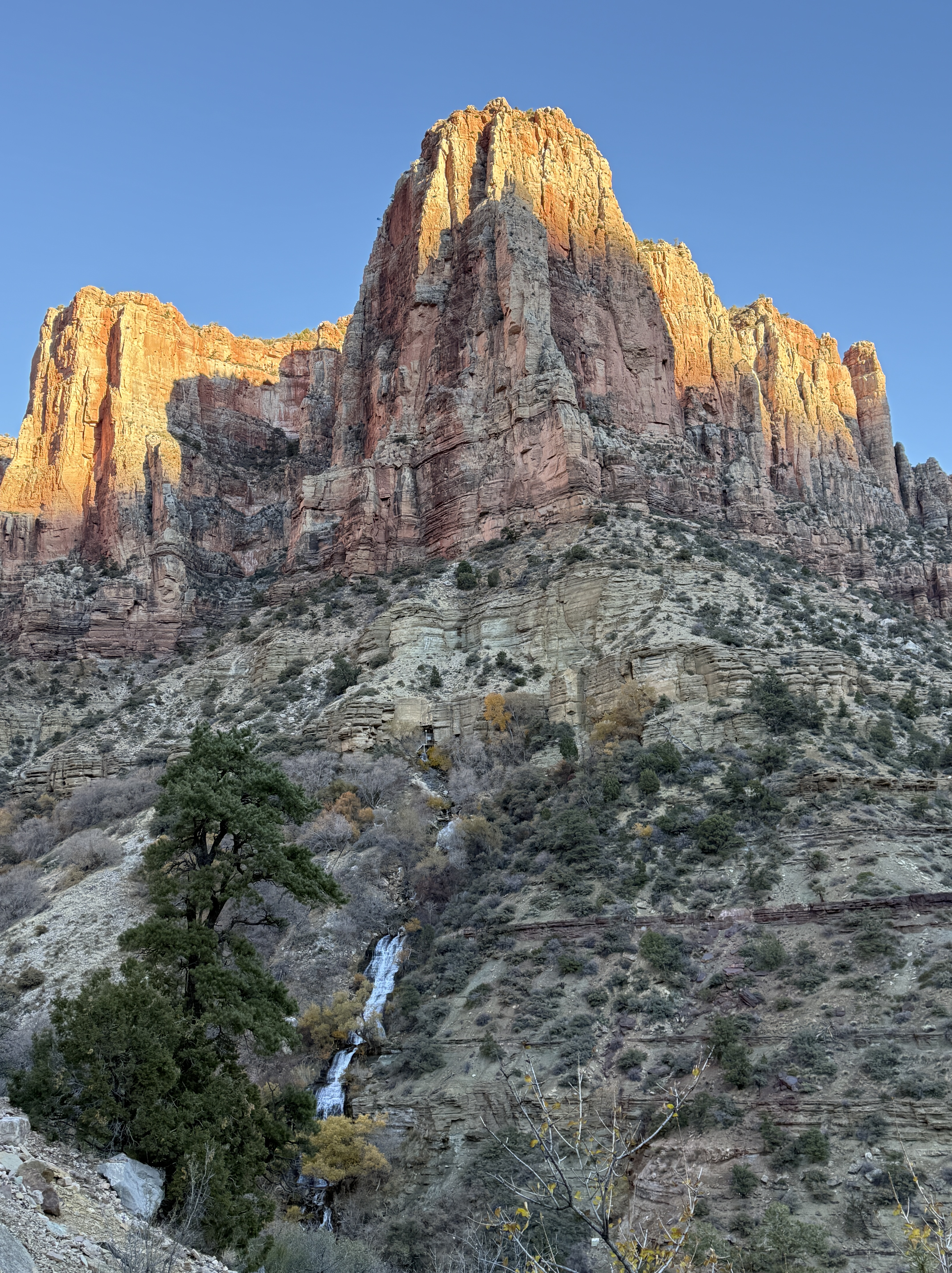
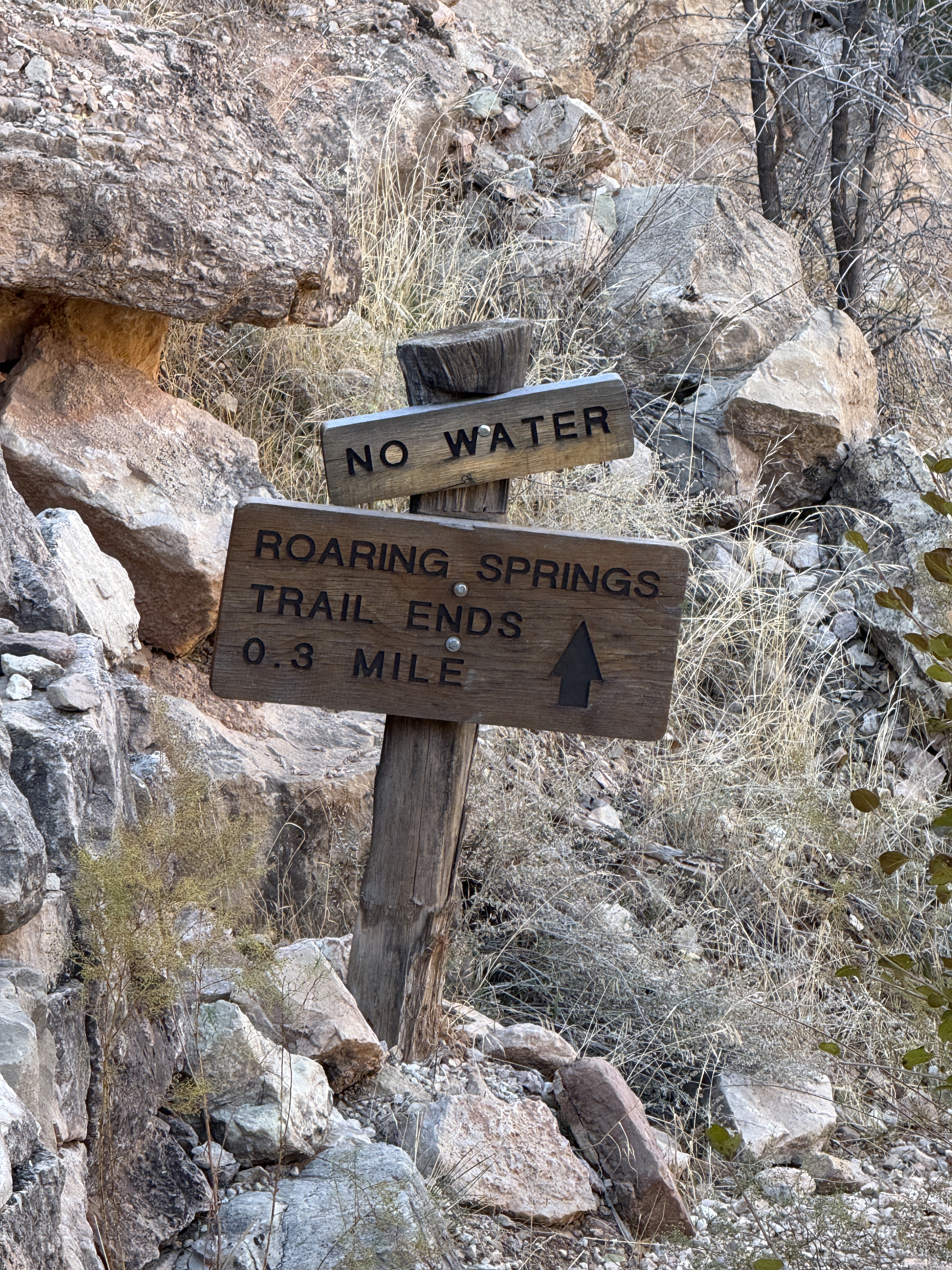
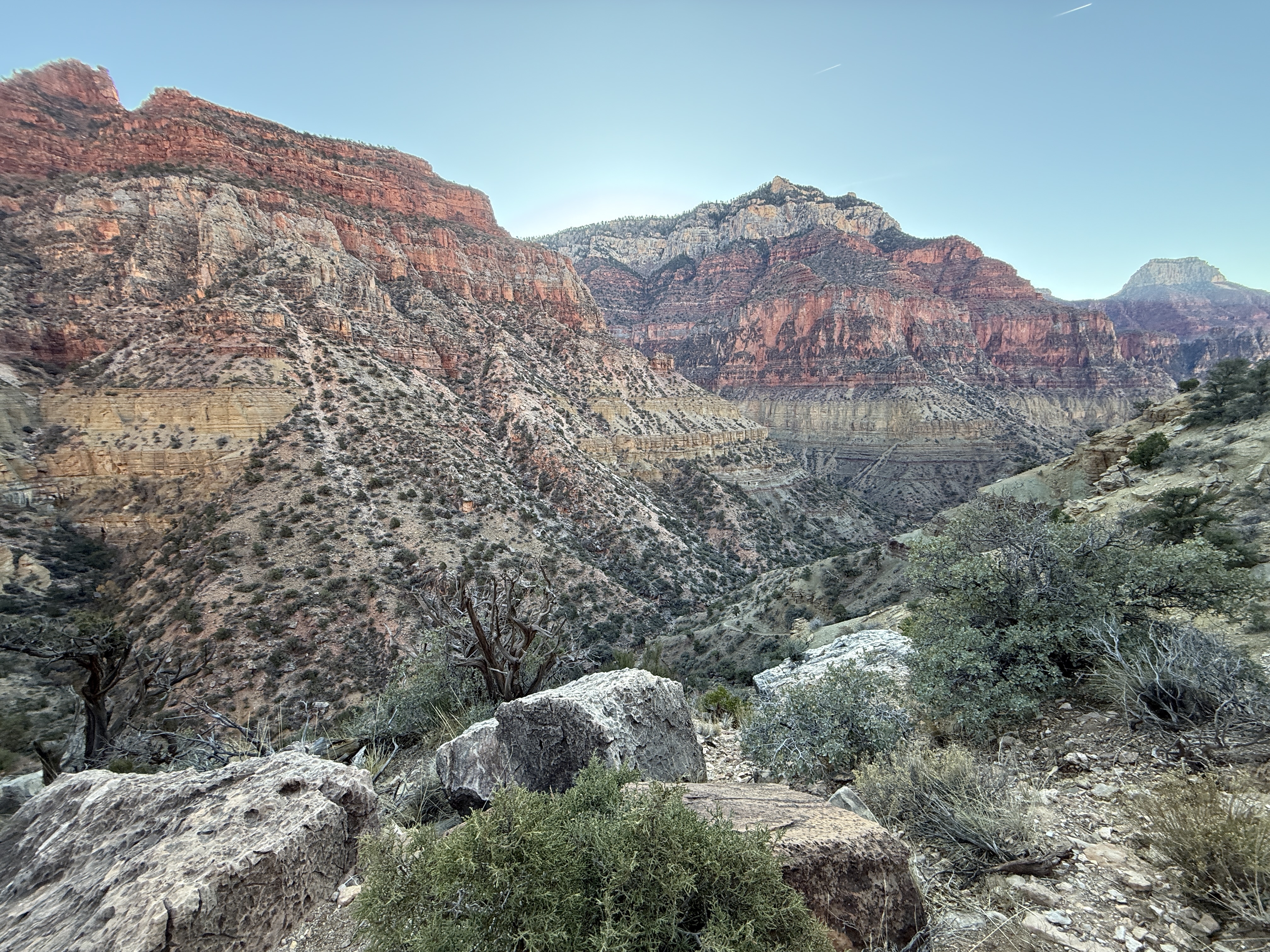
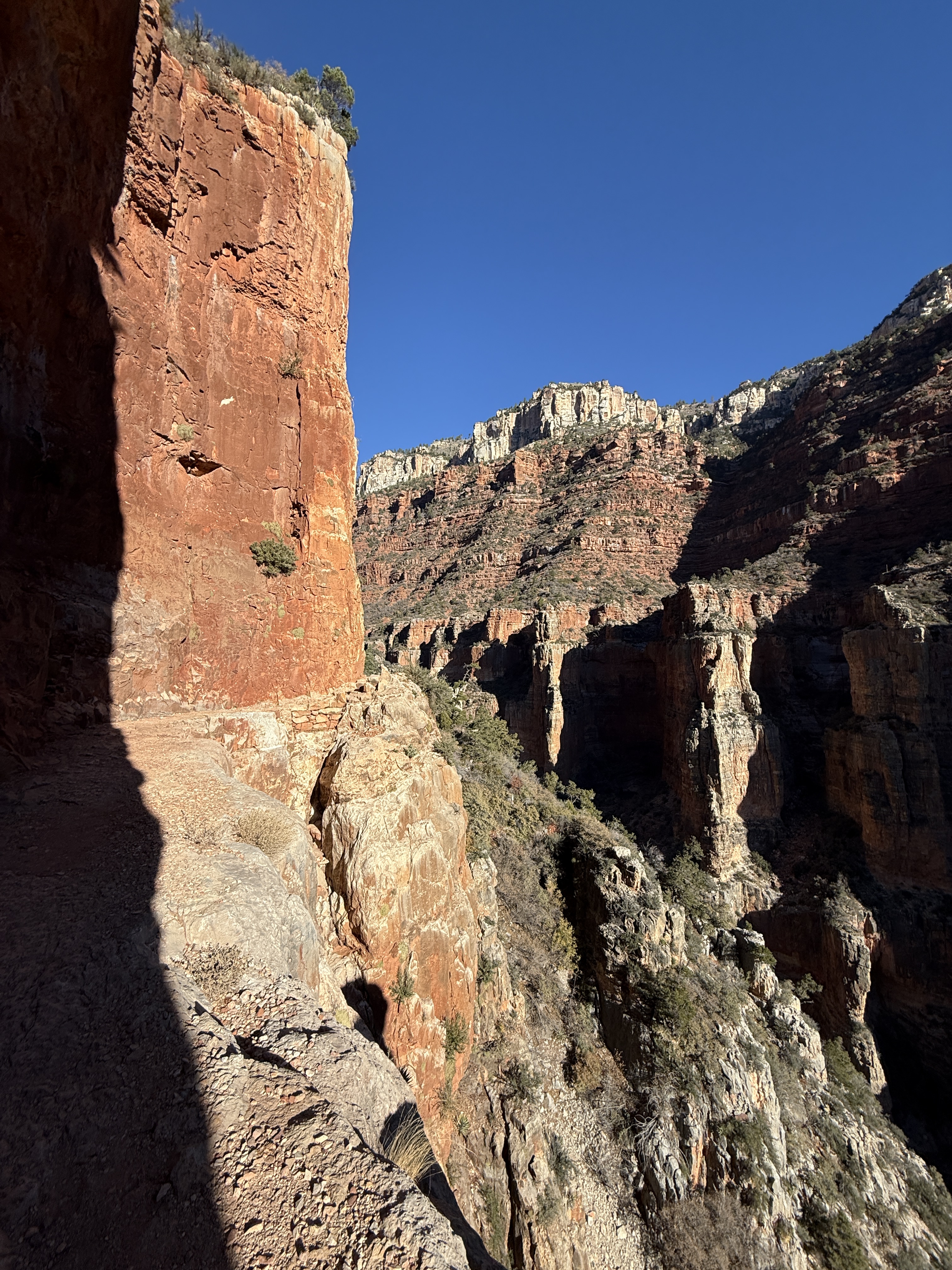
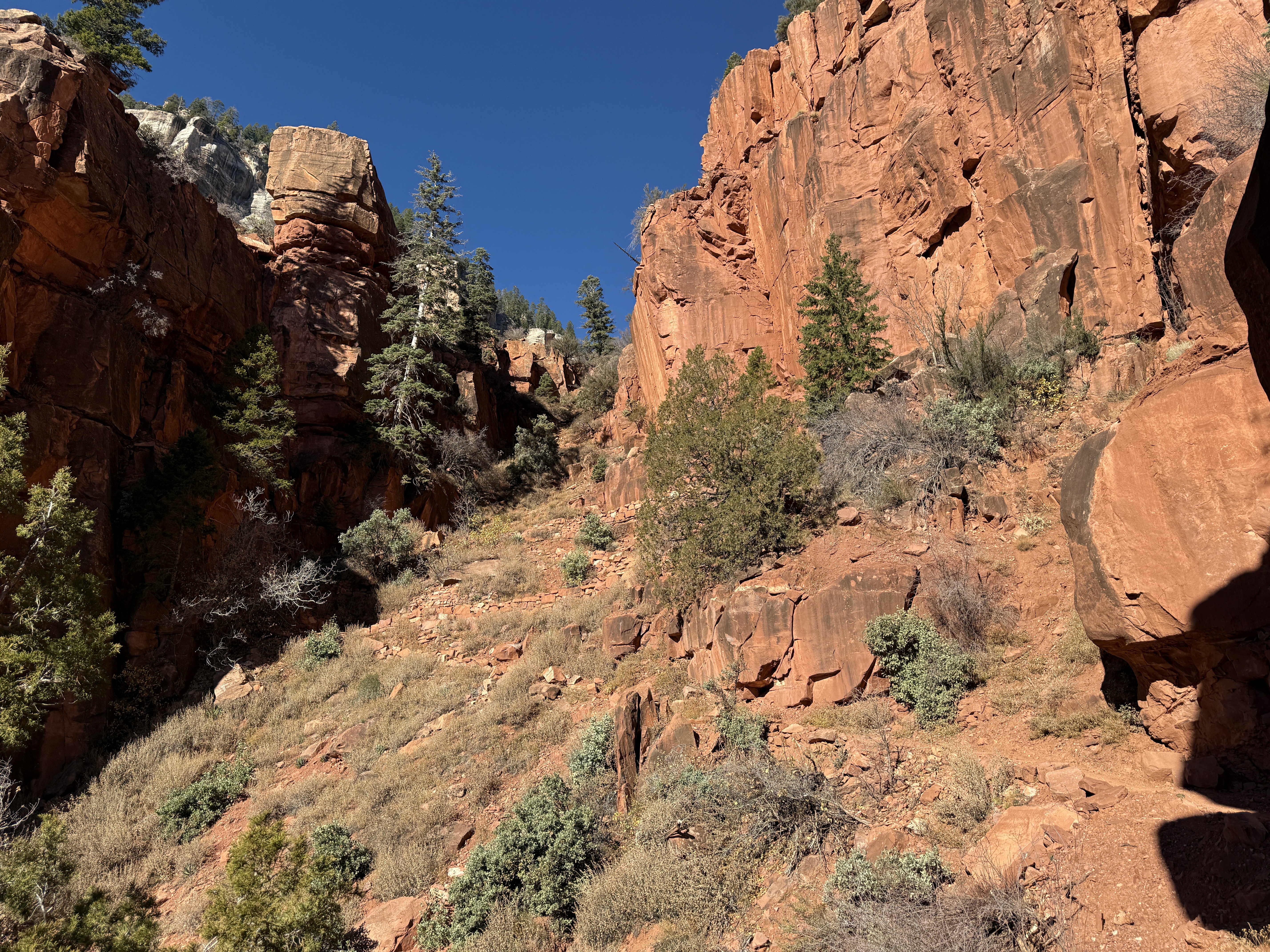
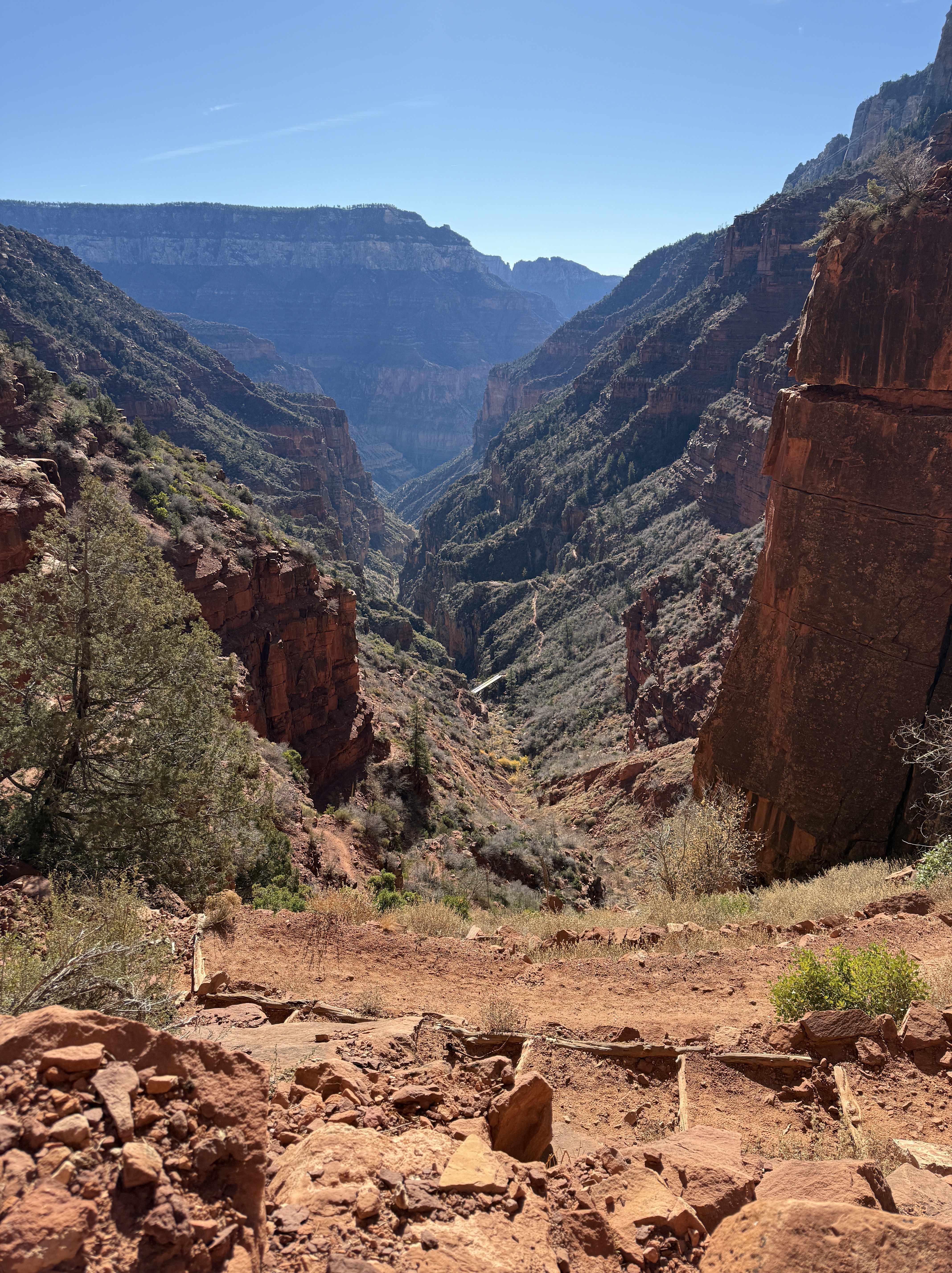
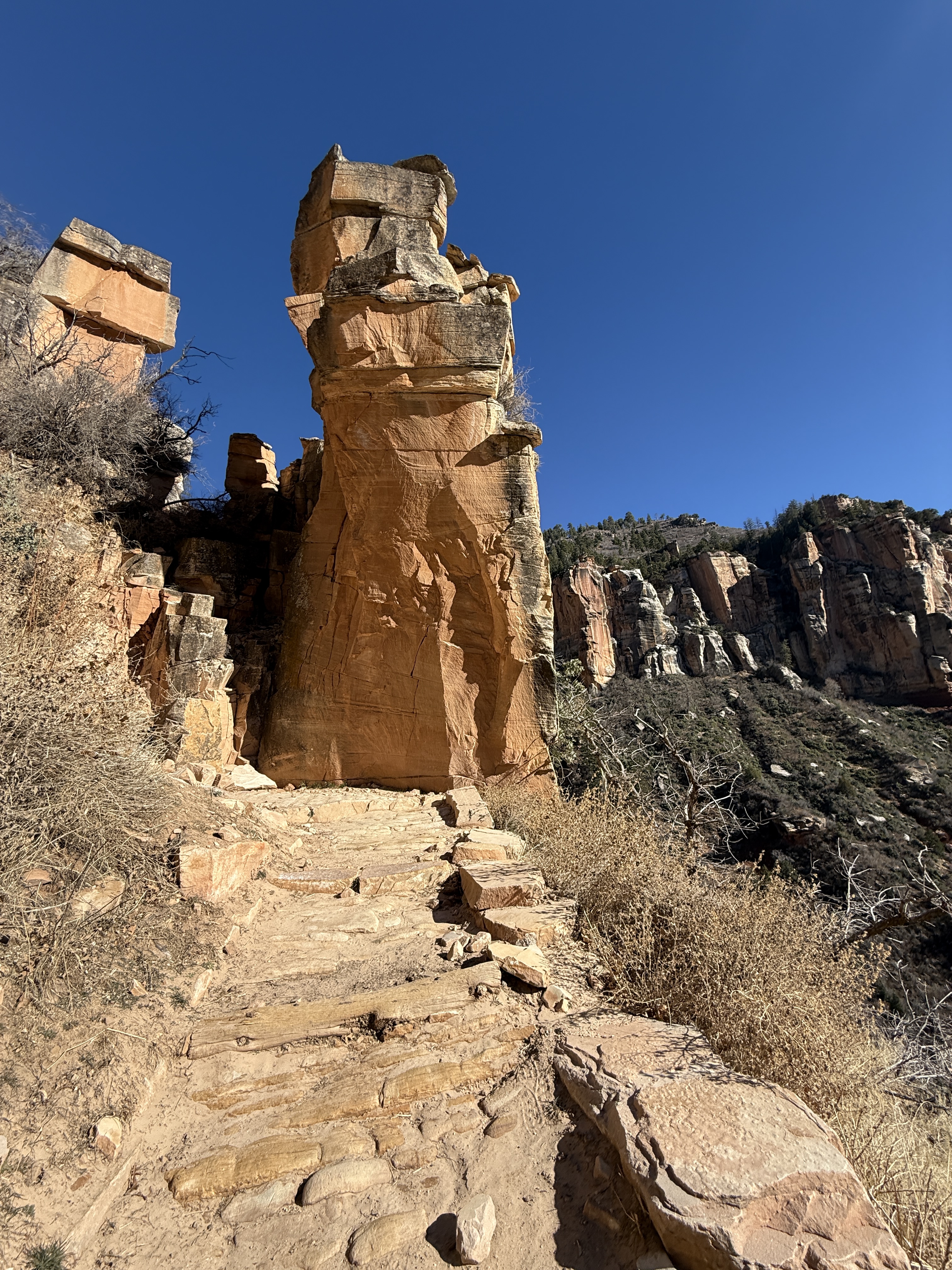
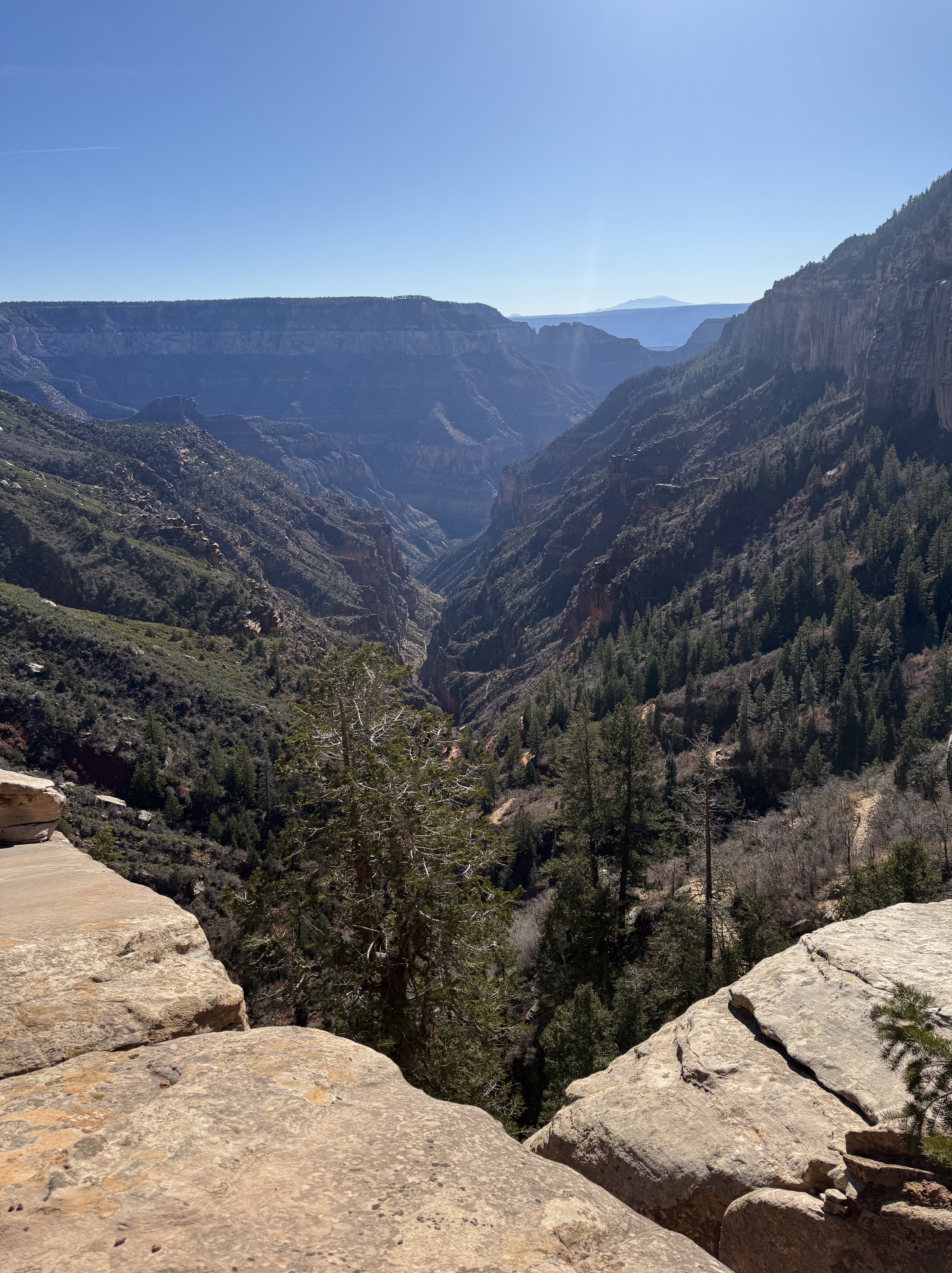
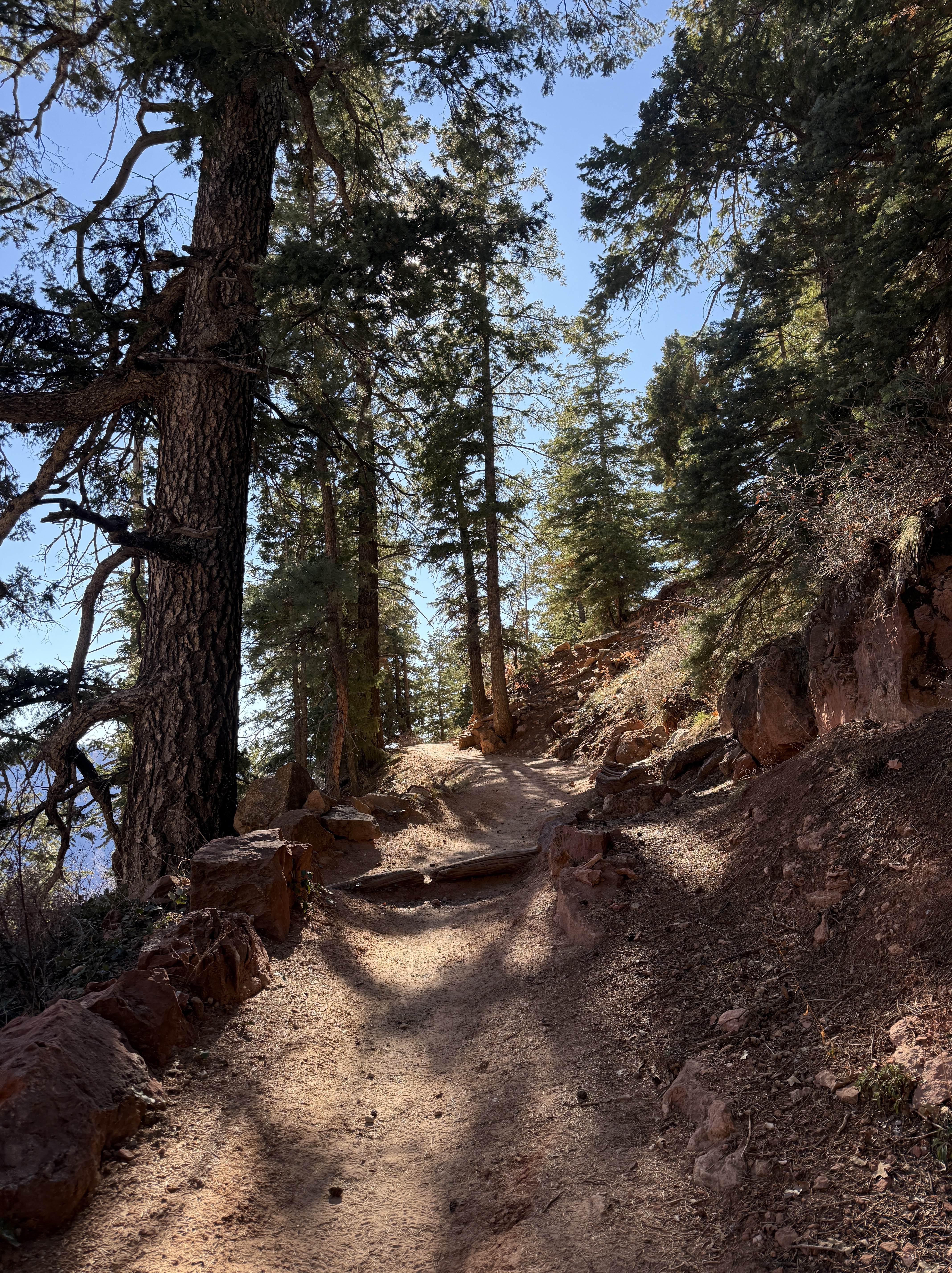
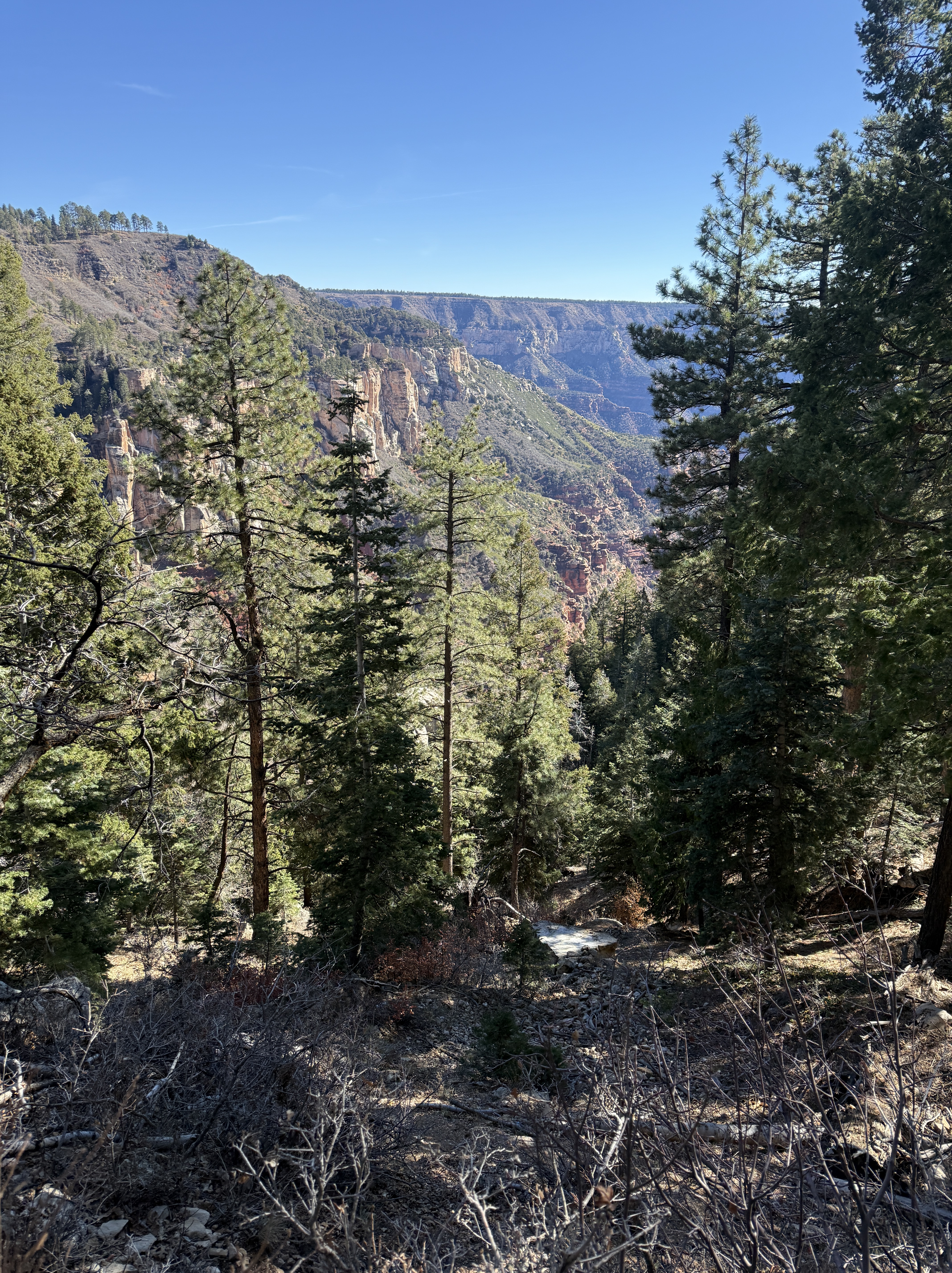
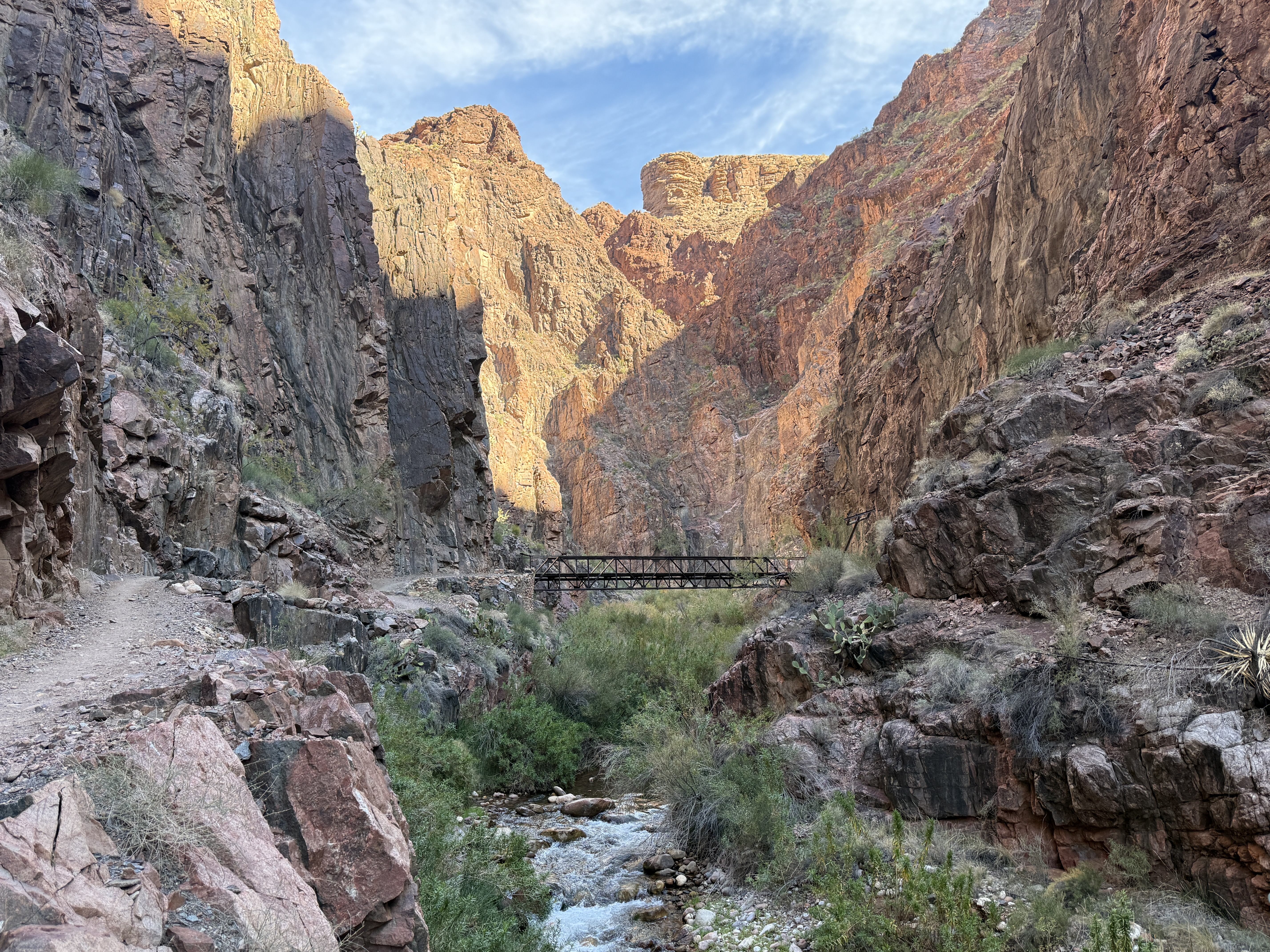
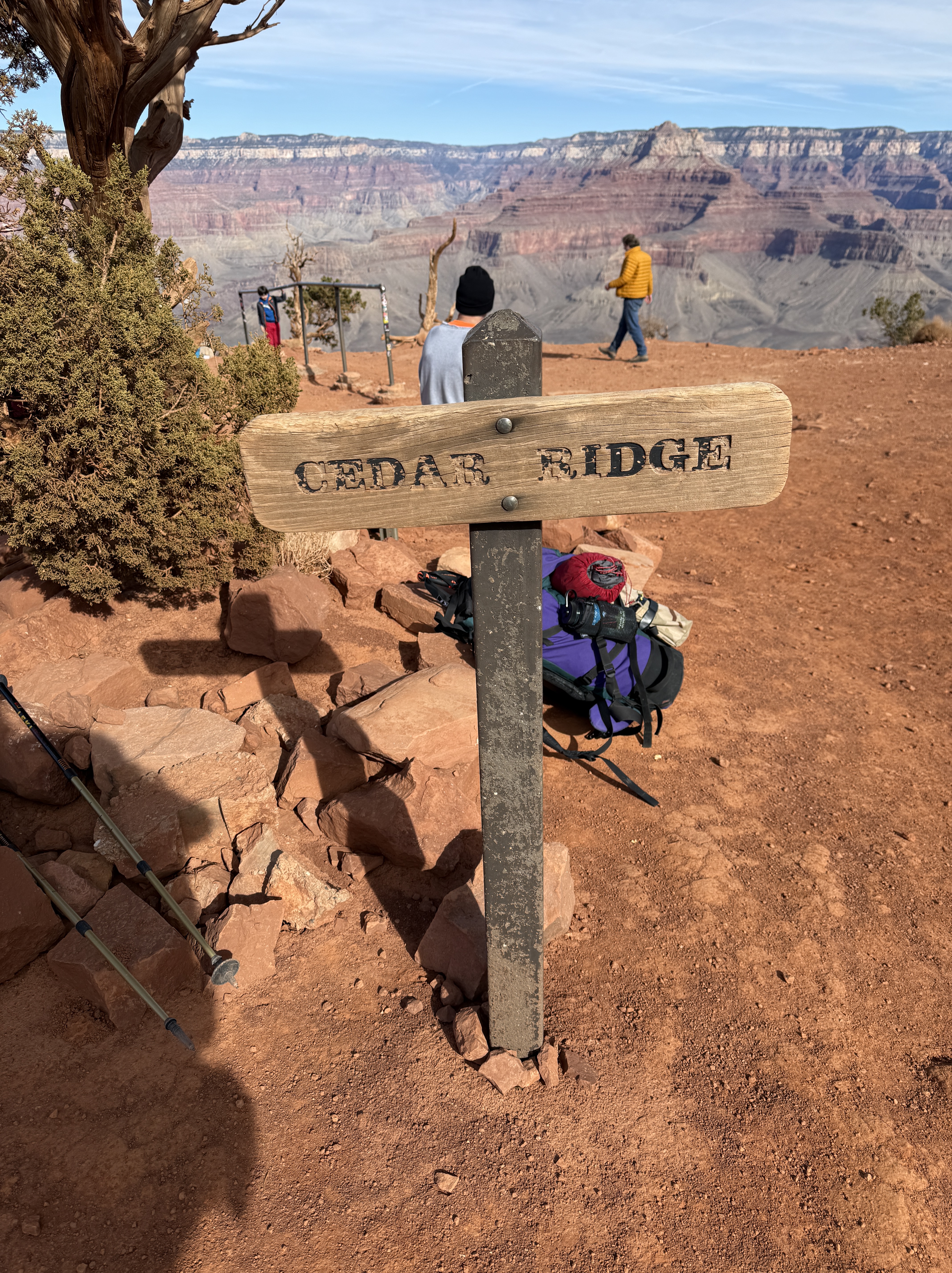
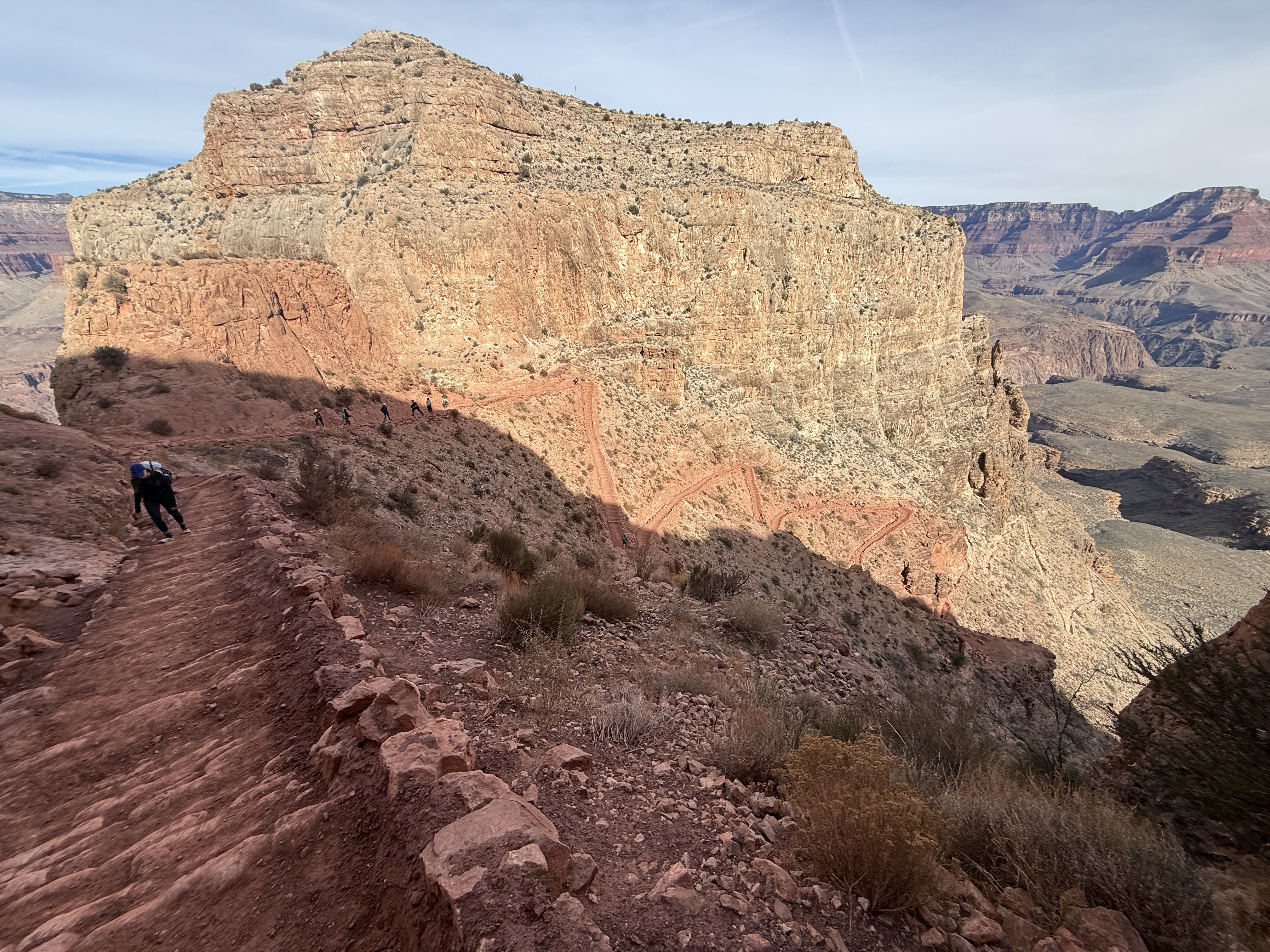
Although the sun was up, it was still in the 50s, perfect temperature for walking up the last 2000′ to the rim. Three or so miles to go. I had wished it was 30. Ascending up past Skeleton Point, I eventually ran into the first day hikers around Cedar Point. I looked down into Cremation with a familiarity of this space… a far cry from when I first entered The Canyon with no concept of what was where or what to expect. Now I could identify the Tonto Trail and Cremation; Way in the distance I could see the canyon where I had traveled through The Box and along Bright Angel Creek. I could see where the North Kaibab Trail curves up to the northwest, past Roaring Springs, I could see the Kaibab sandstone sitting atop the many rock layers below.
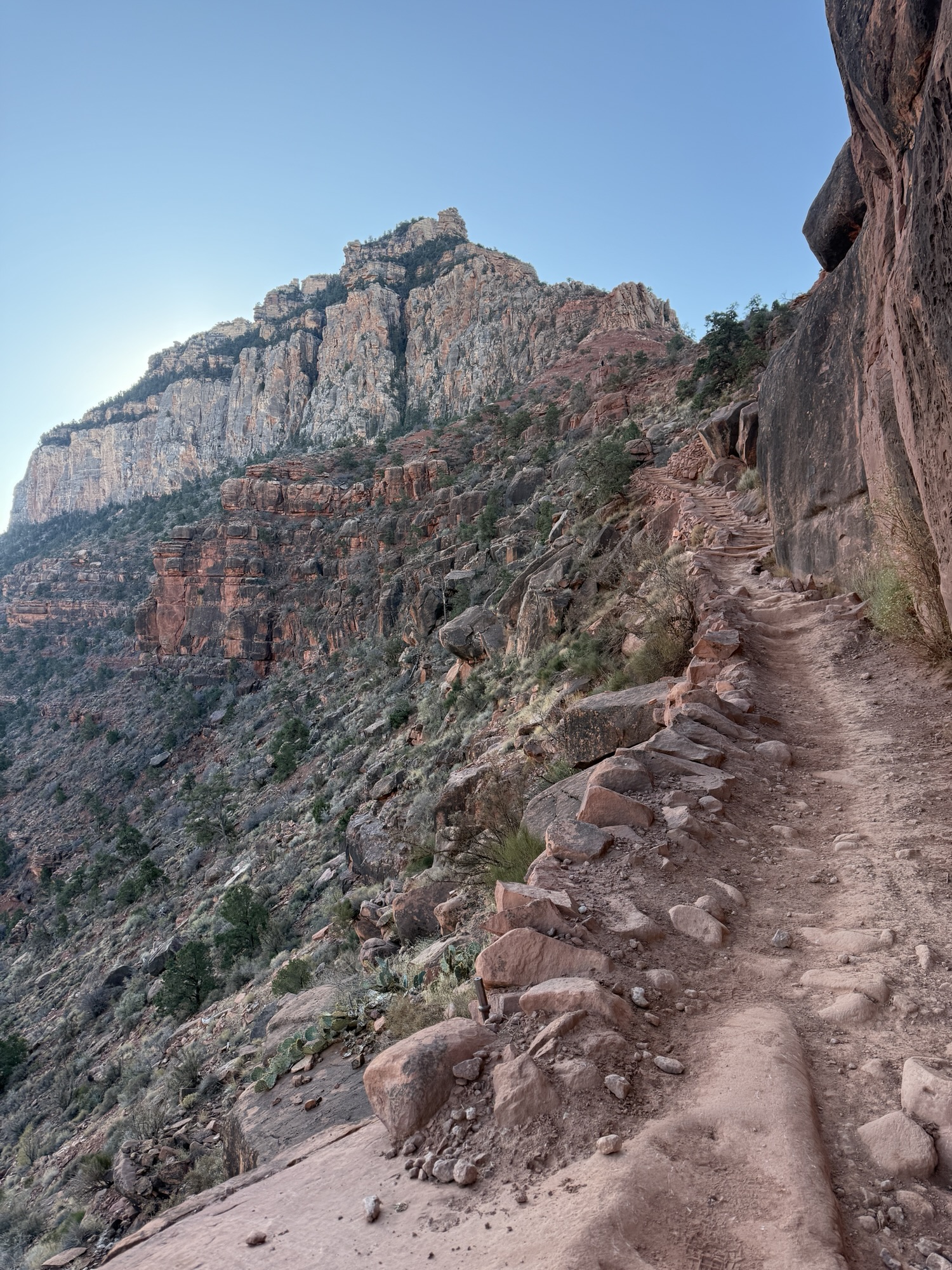
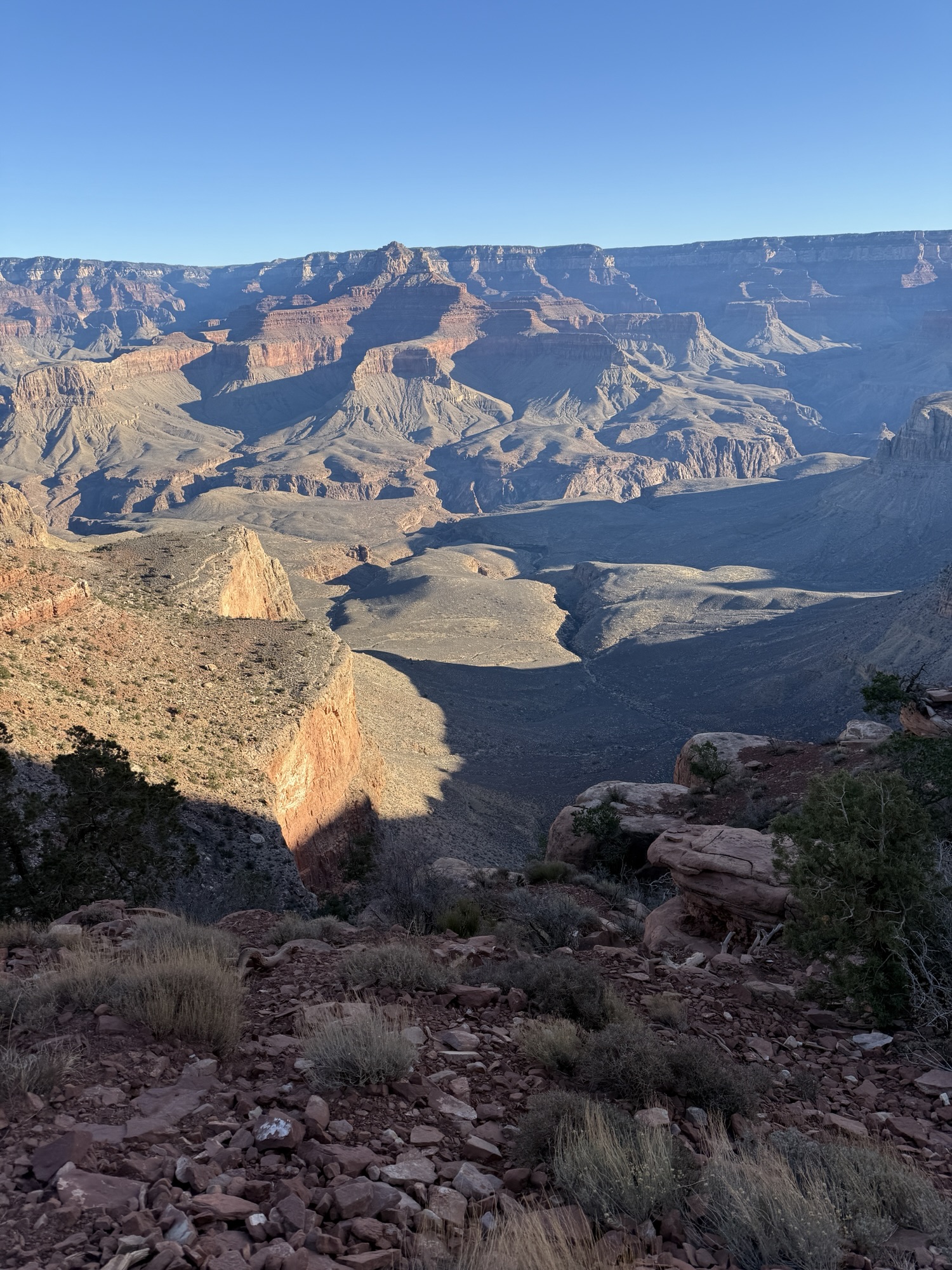
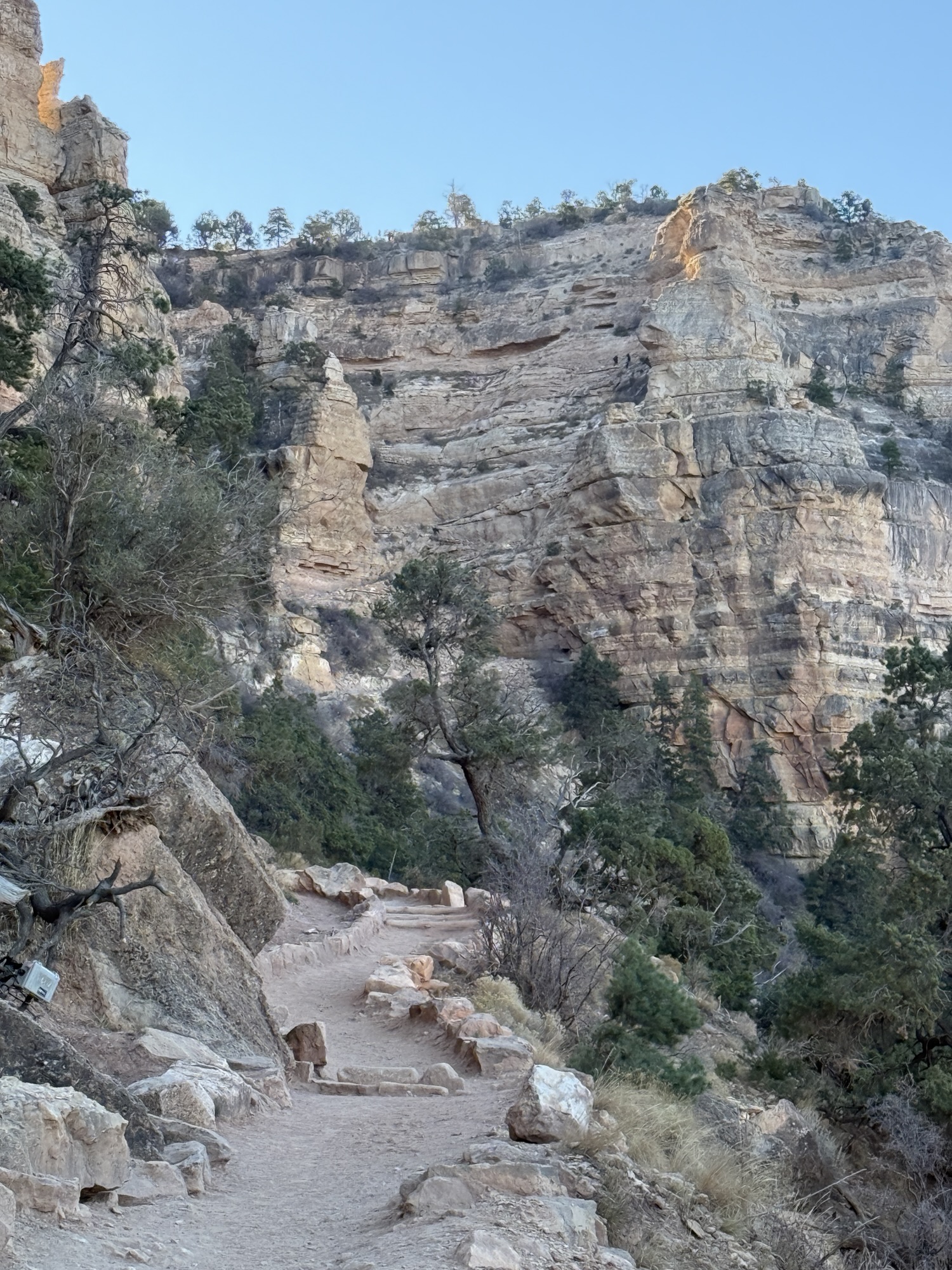
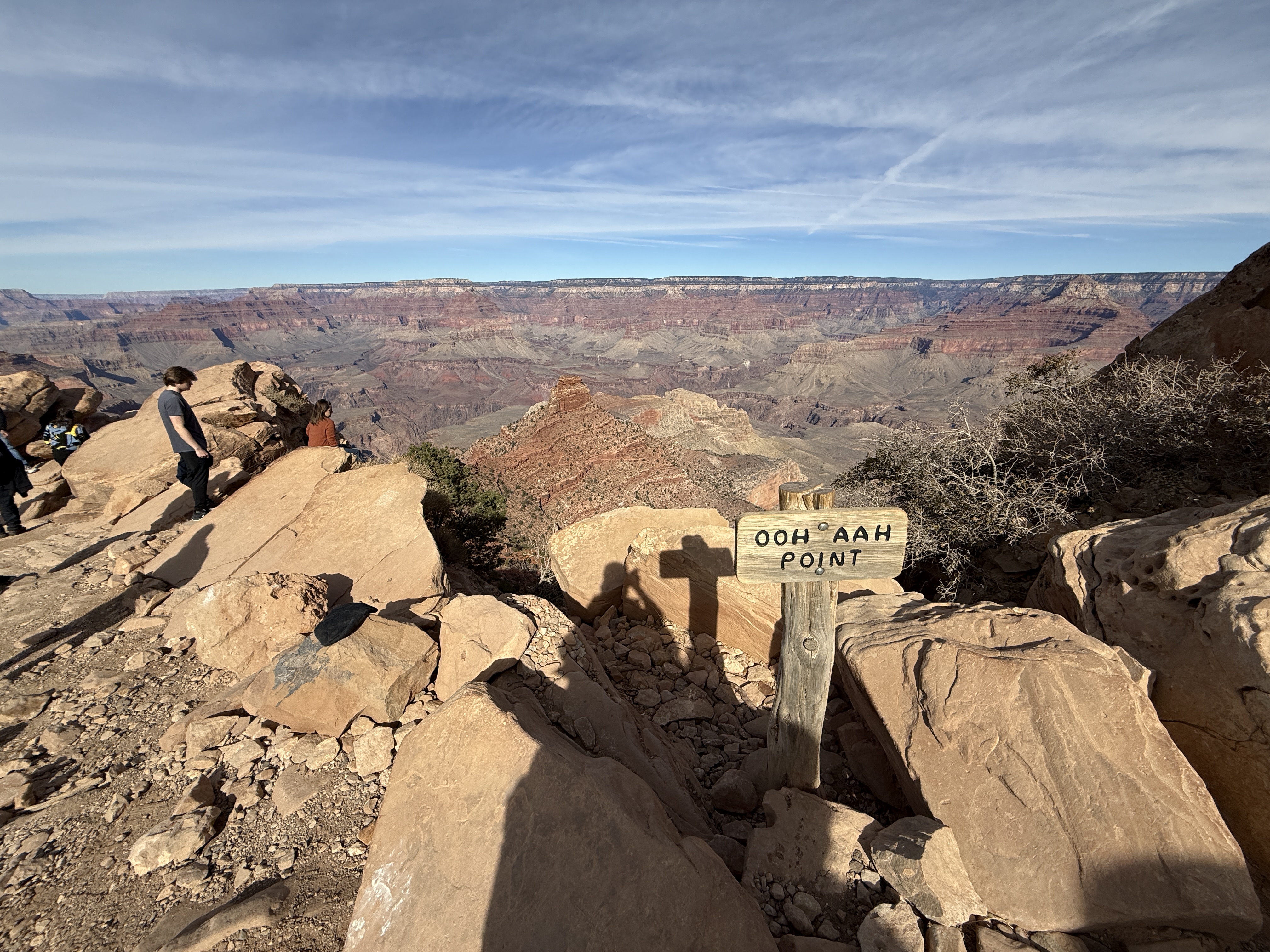
I turned away from The Canyon and focused on the trail under my feet. I didn’t want to cry again. Past Ooh-Ahh Point, I was 3/4 of a mile and less than 800′ from the trailhead. It was now 930am and I could see the throngs of day hikers starting to descend the switchbacks over the quarter mile from The Rim.
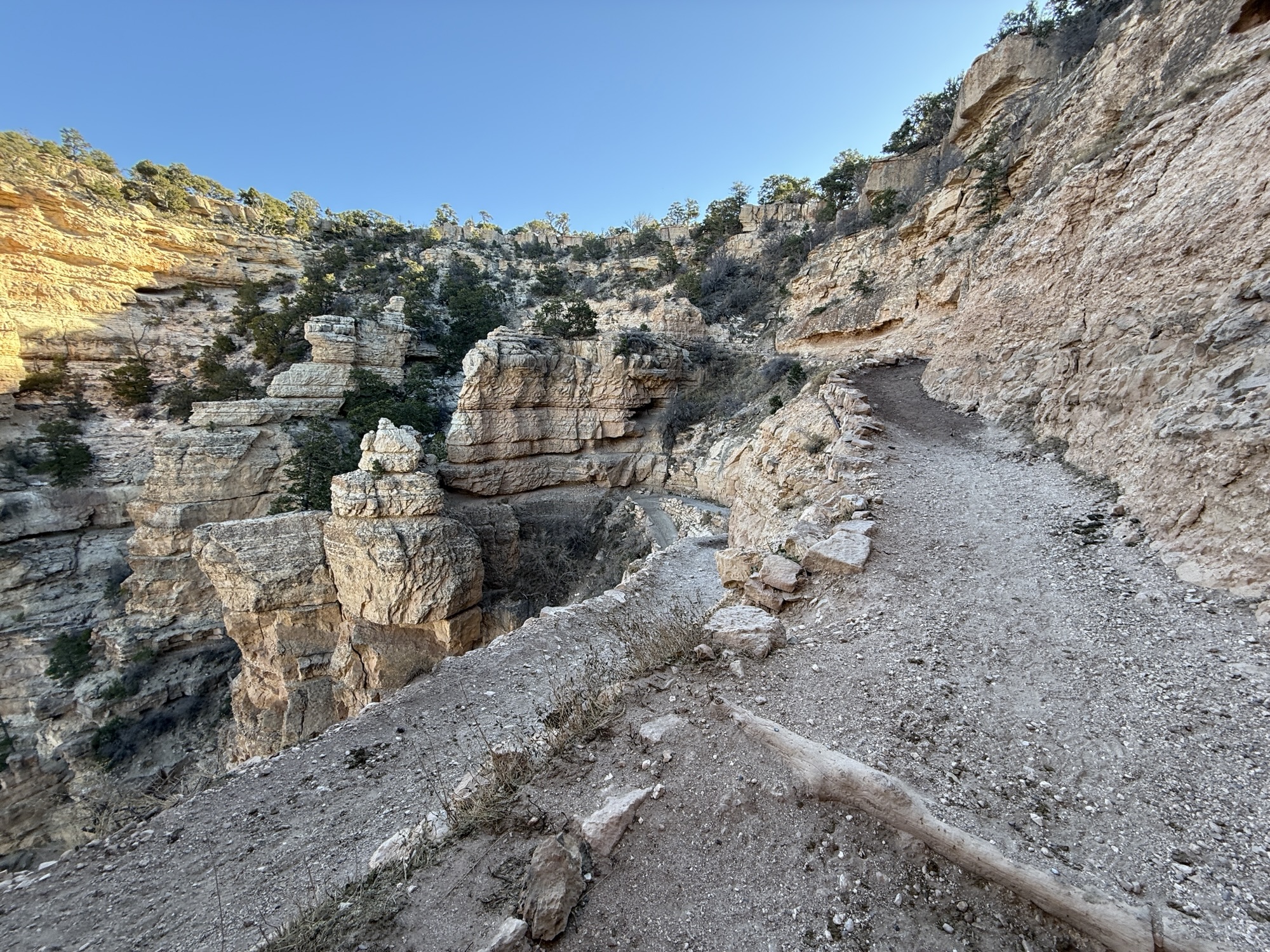
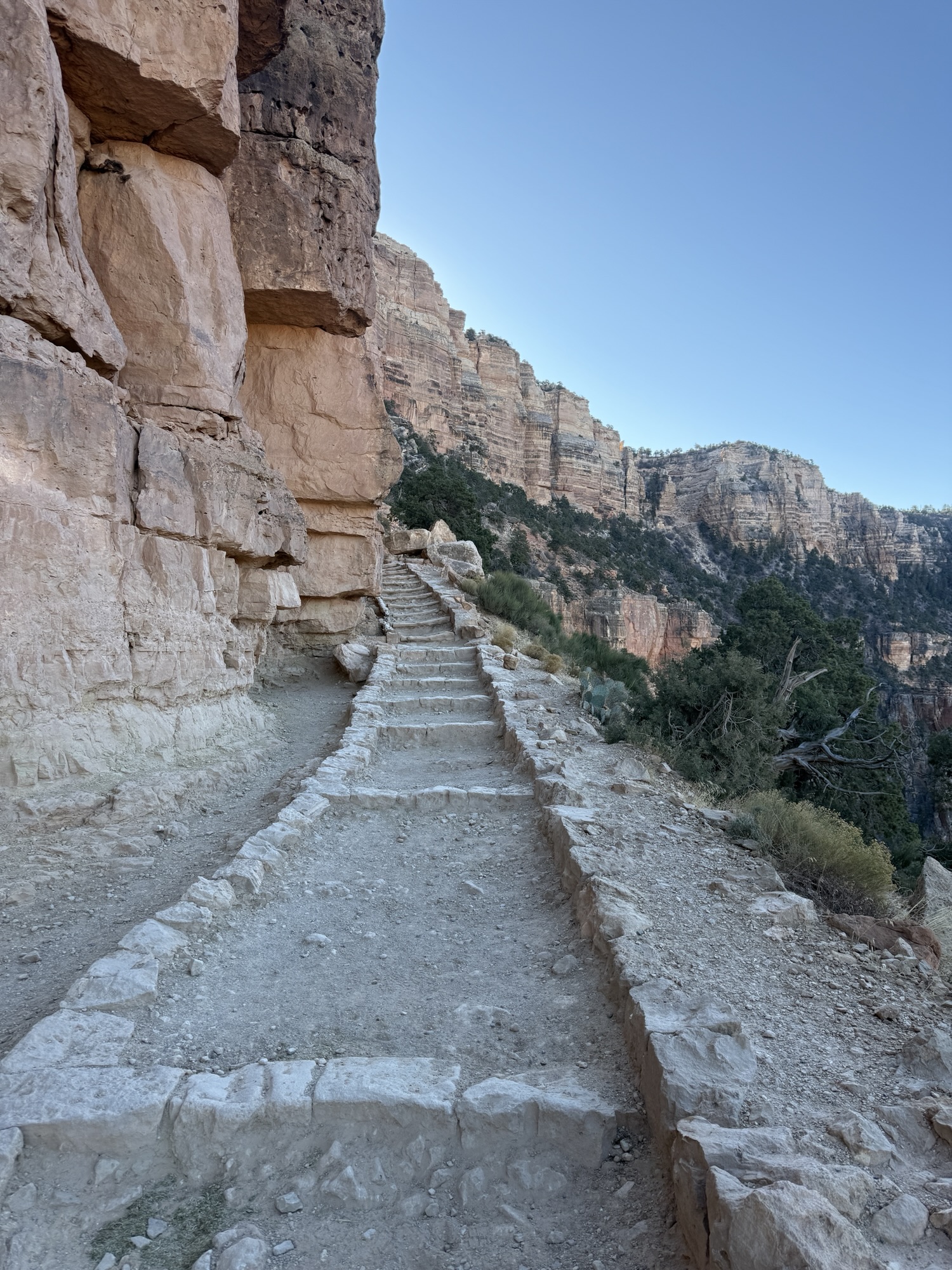
About 30 steps from the top, a nice older man struck up a conversation with me, intrigued about my solo trip, asking about what I did and what I saw. The conversation somehow transitioned to me being from Alaska and working as an engineer. This man, who had by now introduced himself as Dennis, asked if I had ever been to Gates of the Arctic, and although I hadn’t I told him I wanted to go.

He said he hadn’t been up there since the 70s, when he was working as an engineer on the builiding of the Alaska oil pipeline. My grandfather’s protege and best friend had been the project manager on that project, so, a shot in the dark, I asked if he knew Mr. Moolin. He repied with, “Frank P Moolin?!?!?” and my jaw dropped. Yes Frank P Moolin. Turned out Dennis had been his right hand man for the project. Frank died not long after the project was completed and Dennis lost touch with the family.

The irony of meeting an old family connection was incredible and it didn’t escape either of us. If I had left 5 minutes earlier that morning, I would have already been at the trailhead, and we never would have crossed paths. I departed by saying, “Serendipity is 100% real,” and Dennis replied in agreement. We wished each other well and parted ways, shocked that this interaction had just happened. Thousands of miles from either of our homes, we met just below of the rim of the Grand Canyon and spoke of people now long gone. It was just the perfect end to a perfect trip.

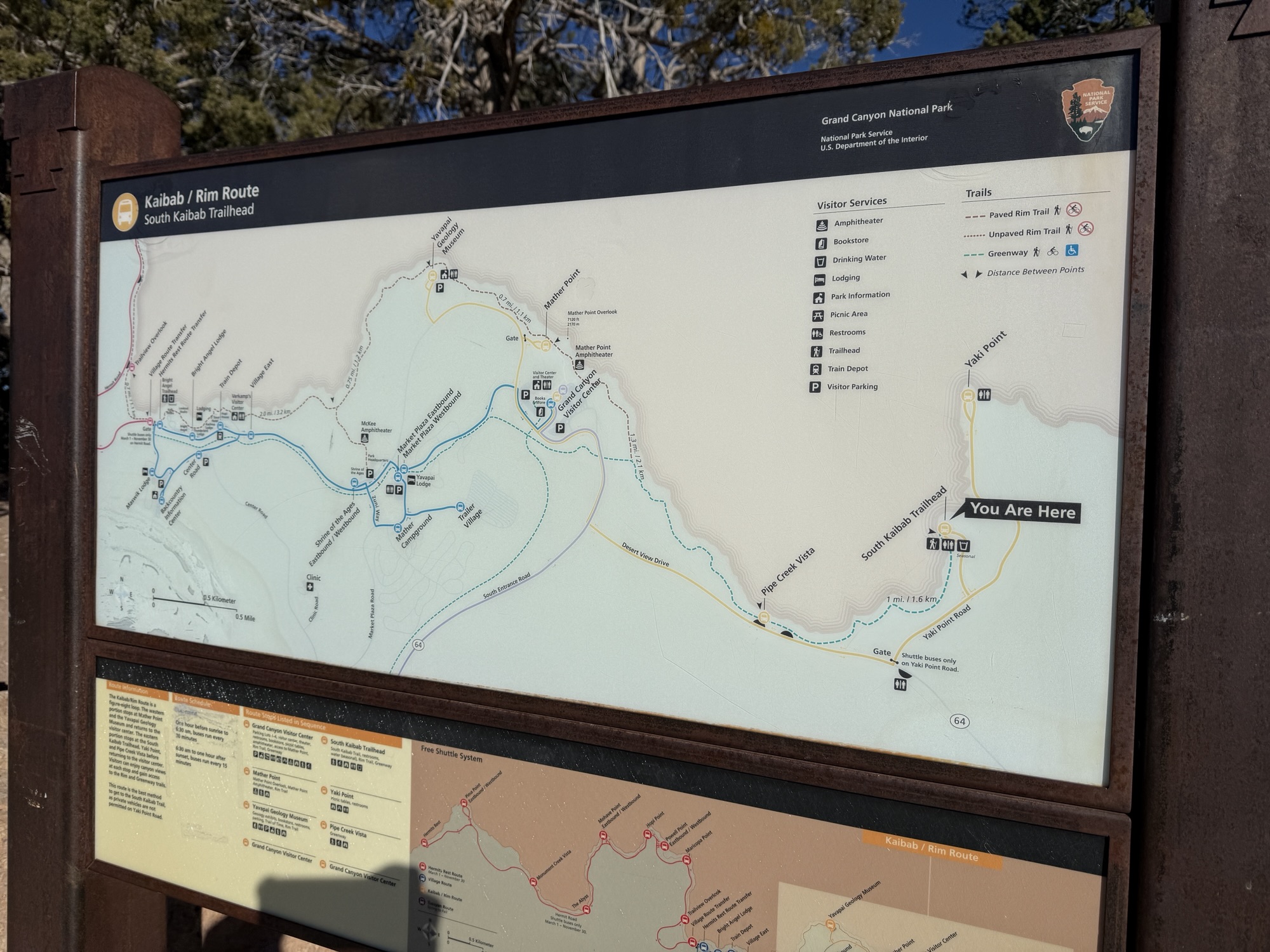
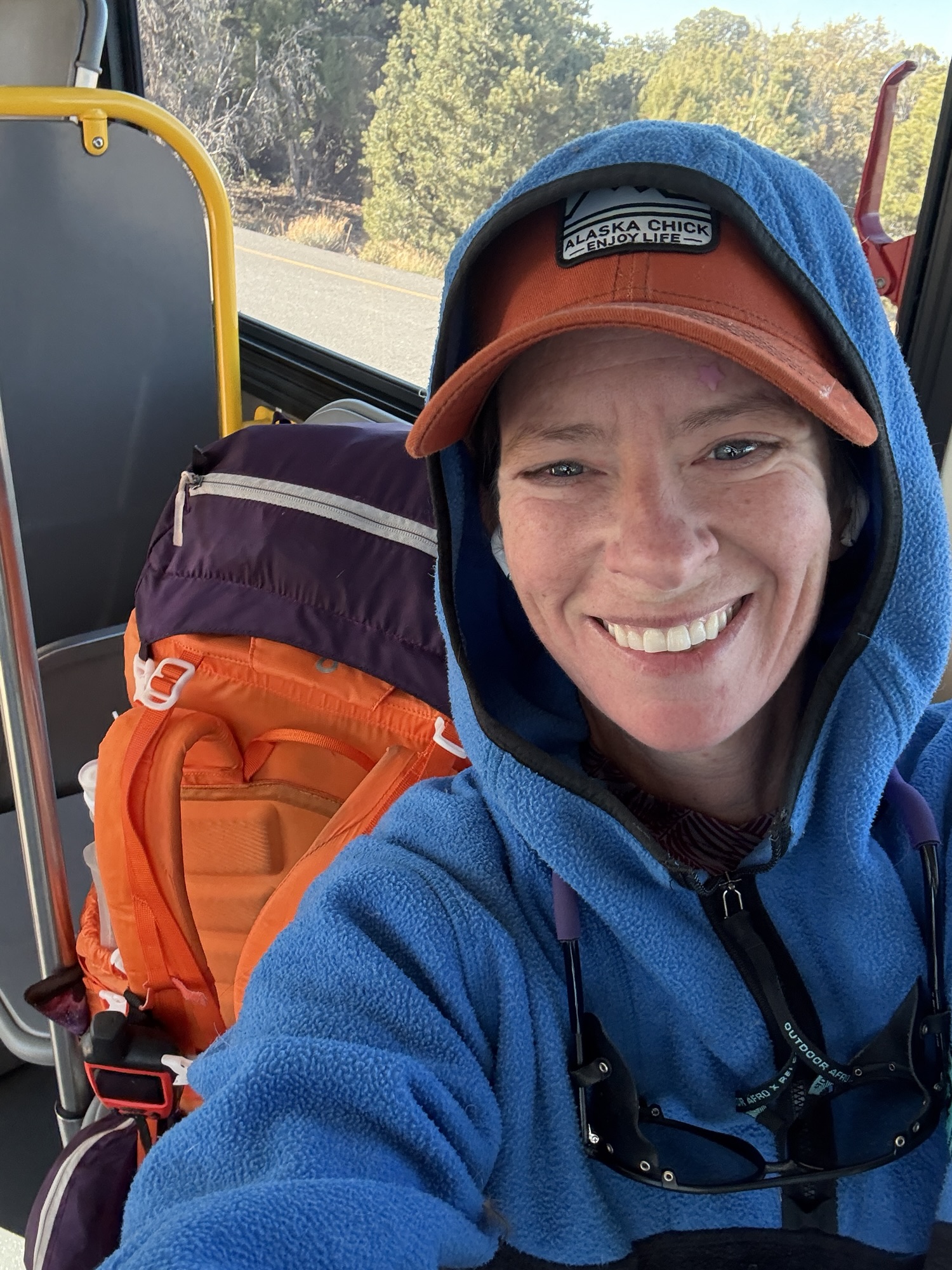
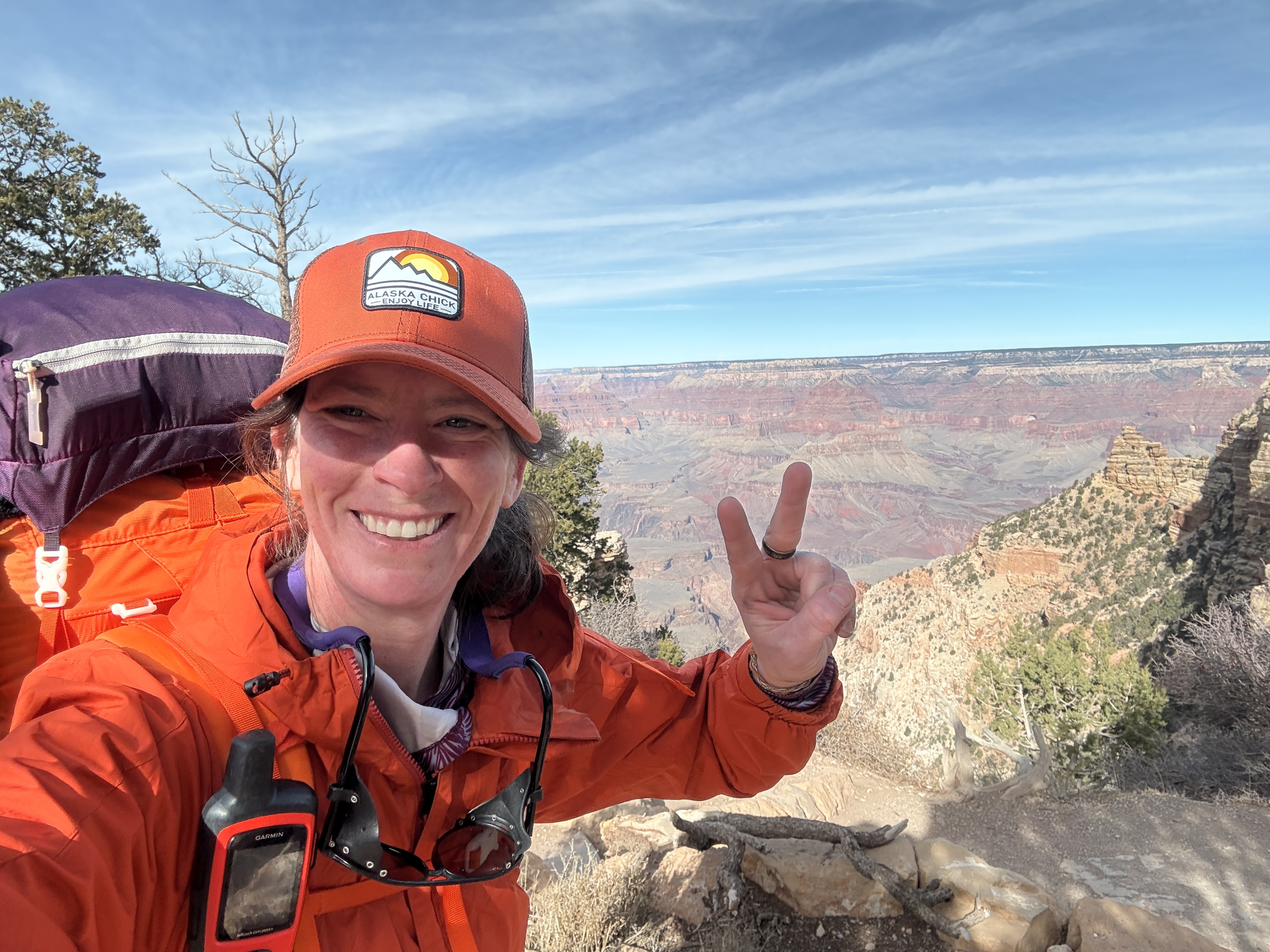
I took my last few steps up to the South Rim and realized how proud I was of myself for achieving yet another major goal. I had left my saddness behind and was now thrilled with my accomplishment, but ready for a real shower and laundry. The shuttle took us out to Yaki Point for a view, but I sat in my seat, not wanting to have my last look be from a tourist viewing point. I had seen more than 99.999% of the annual 5 million visitors would ever see. I felt complete.

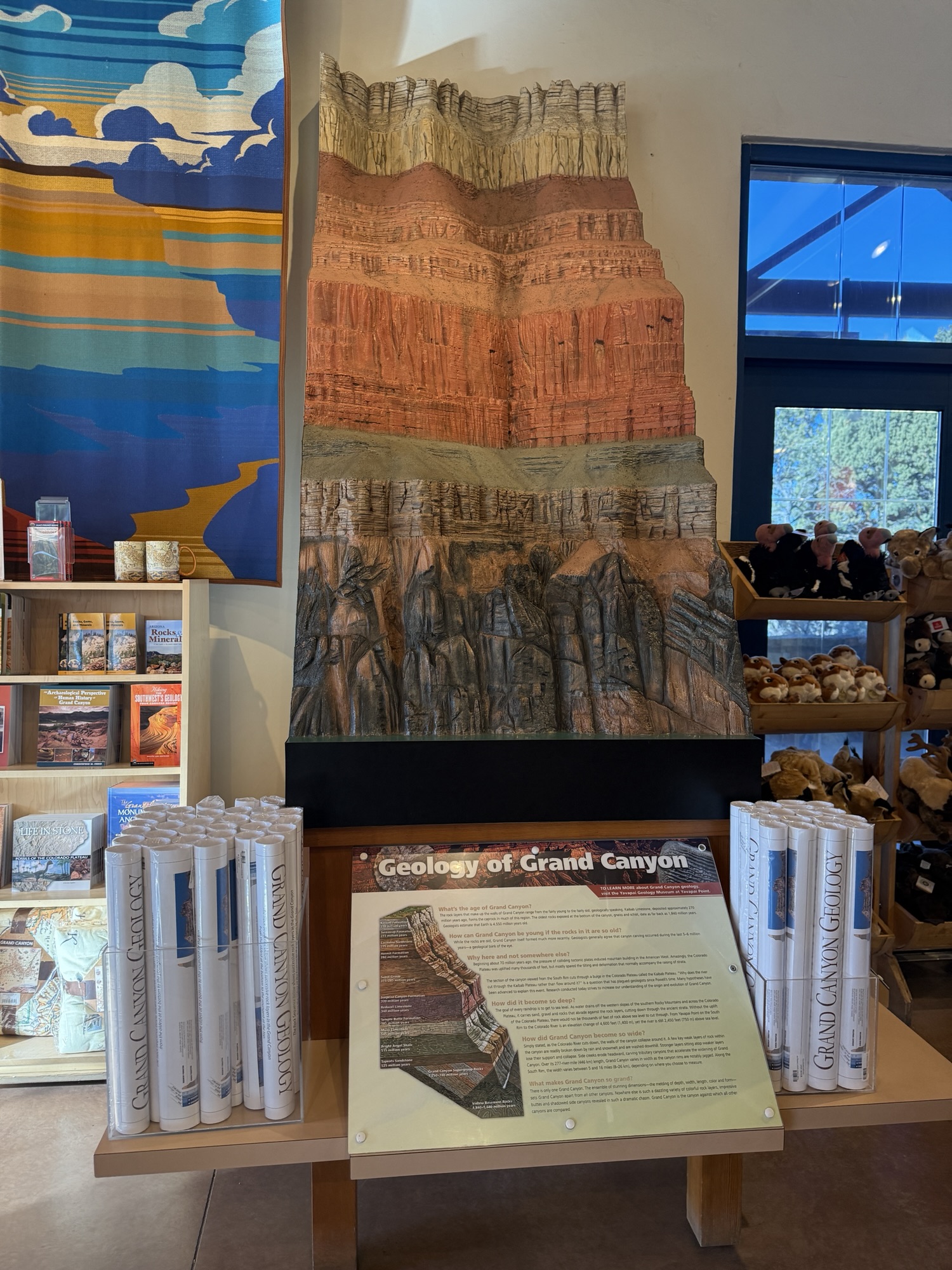
Disembarking from of the shuttle, I went immediately into the Grand Canyon Conservancy shop, dropped my now not so heavy pack in the corner, and spent an hour or more collecting interesting GC history books, a t-shirt for my daughter, and a hoodie that says, “Erosion happens,” with a graphic of all of the layers on the back. I picked out the perfect postcards for my mom, myself and my daughter and was told there was a post office right near the showers/laundromat.

I donned my pack for the last time on this trip, juggling a very full bag of memorabilia and books, and walked the short distance back to my rental Kia Soul, ready for the terrifying drive back down I17 to Phoenix.
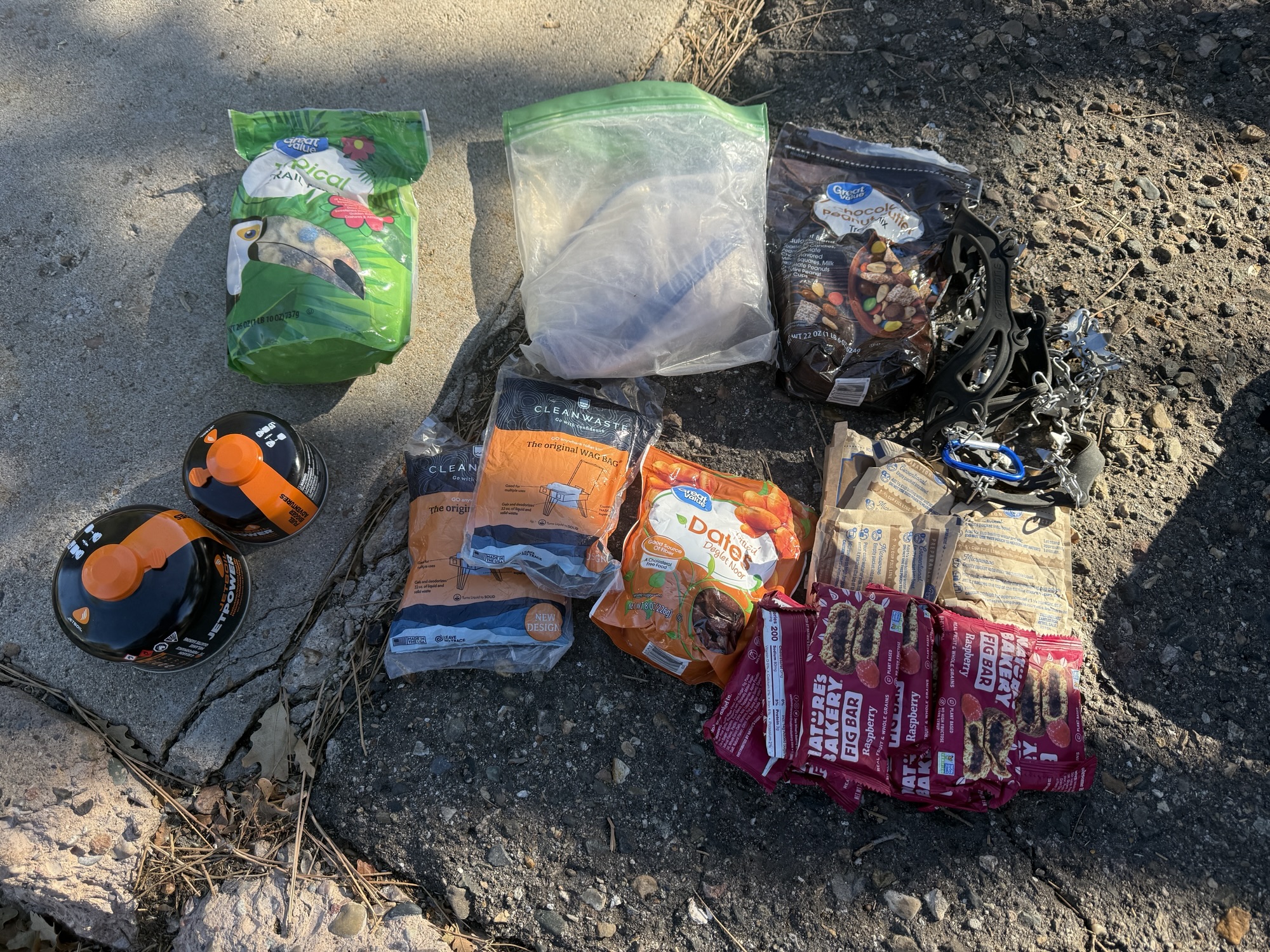
In Grand Canyon Village, I stopped by the post office and general store, buying junk food, a giant sandwich, and a magnet that says, “I hiked the Grand Canyon Rim to Rim to Rim.” The showers and laundry were nearby, and after getting clean and throwing in a load, I headed down to the Backcountry Info Office to drop off my gas cylinders that still had some life, as well as my waterproof matches. Anything that can’t go on an airplane and may be helpful to other hikers can be left here with the Ranger to redistribute.

Laundry done, I organized all of my stuff, took one last look at this beautiful place and then drove away without looking back, afraid I would start crying again. I couldn’t resist stopping in Tuyasan at the Starbucks for a real cup of coffee. The drive was uneventful, pulling over every so often to check my tire pressure and stretch my quickly stiffening legs, as I descended towards the city and the heat of Phoenix. A rainbow over the desert was once last surprise before the sun set and I pulled into Sky Harbor Airport.

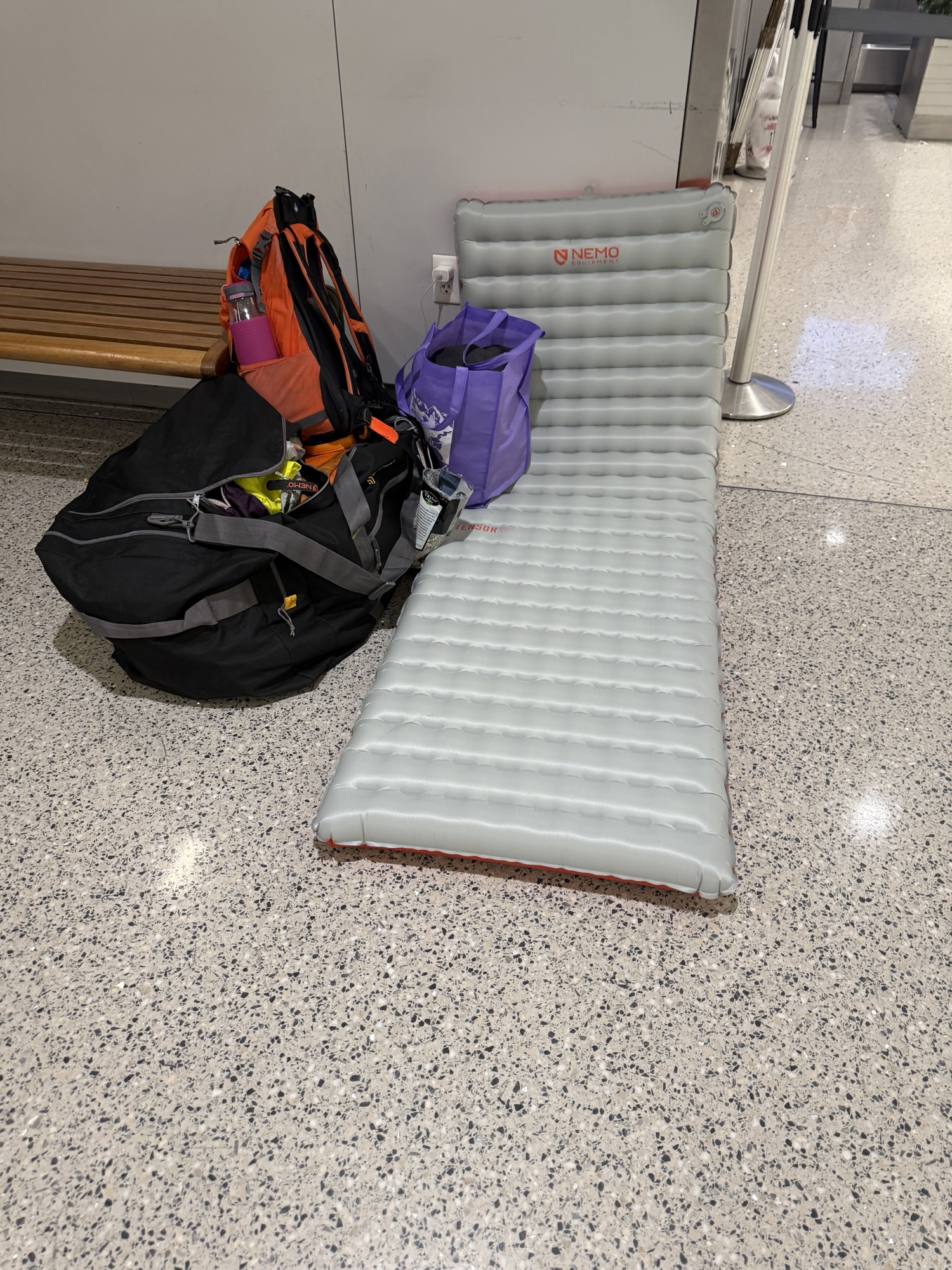
I dragged my giant duffel bag to the train and then to the AK Airlines check in kiosks. My flight wasn’t until the following morning so I inflated my Nemo pad, put on my headphones and drifted in and out of sleep until 430am when I could finally check in and go through security. I fell asleep on the plane knowing that I had just had one of the most memorable journeys of my life and would be back again the following November, no questions asked.
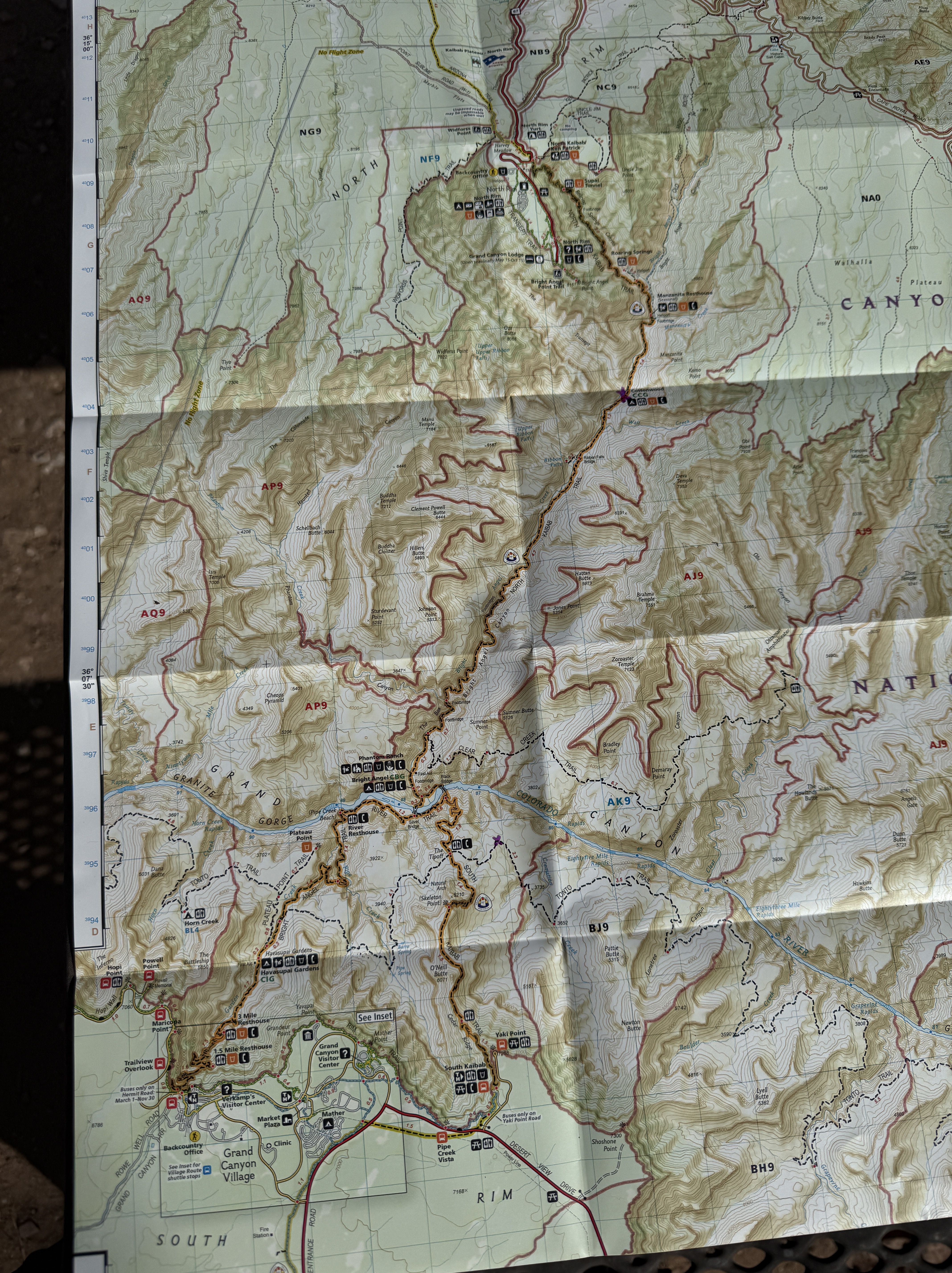

Total Trip Mileage: 50 Miles
Total Trip Elevation Gain: ~12,000′
5 Nights / 6 Days
Permits: GC NP Website

Rim To Rim To Rim AllTrails Link:
Just The Tips:

  1. Instead of flying into Phoenix, opt to fly into Flagstaff. I’ll be doing that next time instead of making the 3 hour drive each way.
  2. If you are flying in, pre order your stove fuel and other supplies online from Sportsman’s Warehouse in Phoenix or Flagstaff. I found this to be quick and easy.
  3. Be aware that your tracking devices and phone may not be able to get a satellite connection in some of the narrow canyons. Tracking may get wonky, as the vertical walls can cause a location ping, hundreds of feet above or below you.
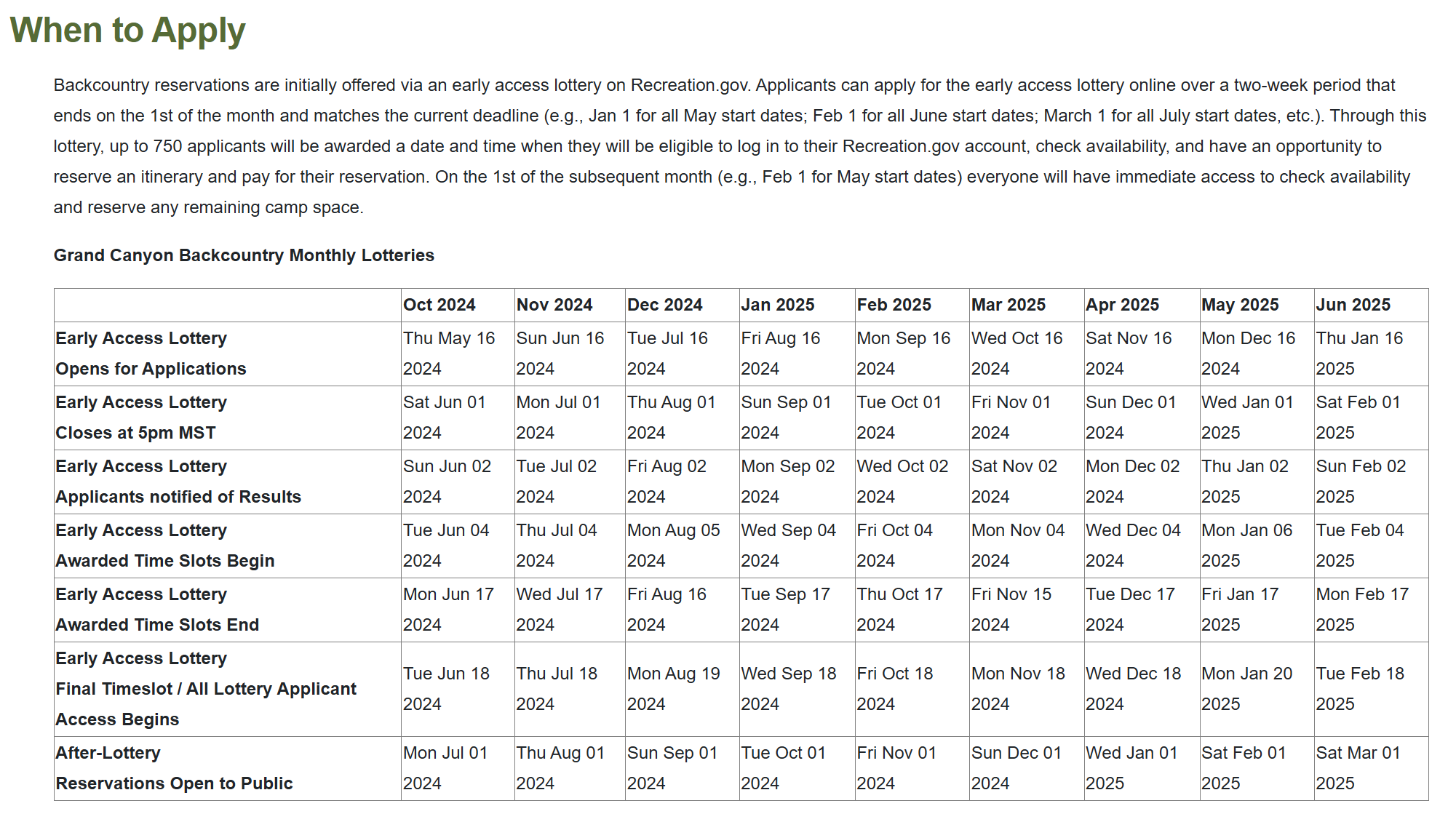
  4. Permitting for the Grand Canyon can be confusing. It is best to apply for the lottery, which opens based on the month of travel and is available for application on the 16th of the month, in the 5th month prior to your trip. For example, a September Trip lottery application period would open April 16. See this article for more information about getting your Grand Canyon permit.
  5. Give yourself more than one night at Cottonwood Campground to allow for a side trip to Chimik’yana’kya Deya’ (Ribbon Falls) or a day hike to the North Rim, plus a rest day. I found 3 nights at Cottonwood to be perfect.
  6. If hiking rim to rim to rim in the winter, know that there are no services at and no access to the North Rim. You will be one of the few people in the area, far from help. Bring hiking poles and microspikes in case of snow. Evaluate your abilities and comfort with heights honestly before traveling this stretch of trail.
  7. Carry plenty of water and a water filtration system. Don’t drink unfiltered water. It can contain bacteria even if it looks clean. Be sure to dry out your filter when you get home.
  8. Get to the park early. The entrance gets extremely backed up with traffic beginning mid-morning.
Alone in the Grand Canyon: Cowboy Camping Under the Stars

Day 5 – Cottonwood To Cremation canyon

12 Miles, -2000′, +1600′

December 3, 2024

I started the day by packing up my sleeping bag, pad and inflatable pillow while thinking about how my choice of sleeping gear had been perfect so far. I’ve had the same sleeping bag for over a decade, an absolute workhorse. I use my REI -20 down bag for all seasons in Alaska (except for maybe July). It gets regular washes and tumble drys, probably against the care instructions, which is likely why it continues to spring small holes, allowing feathers to find themselves free, often leading to what I’ve dubbed a “tent snowstorm.” Anyway, it’s a great bag and probably has many hundreds of nights of use… I bought it second hand in 2013.

My sleeping pad was new purchase, and this was its maiden voyage. I wouldn’t usually take the risk of bringing new gear on a trip of this length, but I brought a patch kit just in case. The Nemo Tensor all season wide is the greatest thing that has ever happened to my camping. Lightweight and super warm, this side sleeper is sleeping great!

I collected my tent items by the door to make everything easy to pack then made up some oatmeal and coffee. I still had so much food. Multitasking is one of my fortes, so I was fed and packed up within an hour, starting out of camp up towards the guys’ spot to drop off my filtration system. I wouldn’t be needing it for the last two days, as there is running water at Phantom Ranch and nothing to filter after that. Once again, I would just have to haul enough for that night and the next day. No big deal. By now I basically a pack mule myself!

Slowly descending to “The Box,” I followed the curves of the canyon, which eventually spit me out at Phantom Ranch. It was a cool morning, great for walking downhill quickly, and I saw I had made the 7.2 mile, -2000′ descent in just a few hours. Pretty good after a 13-mile day prior; I wasn’t even a little bit sore.

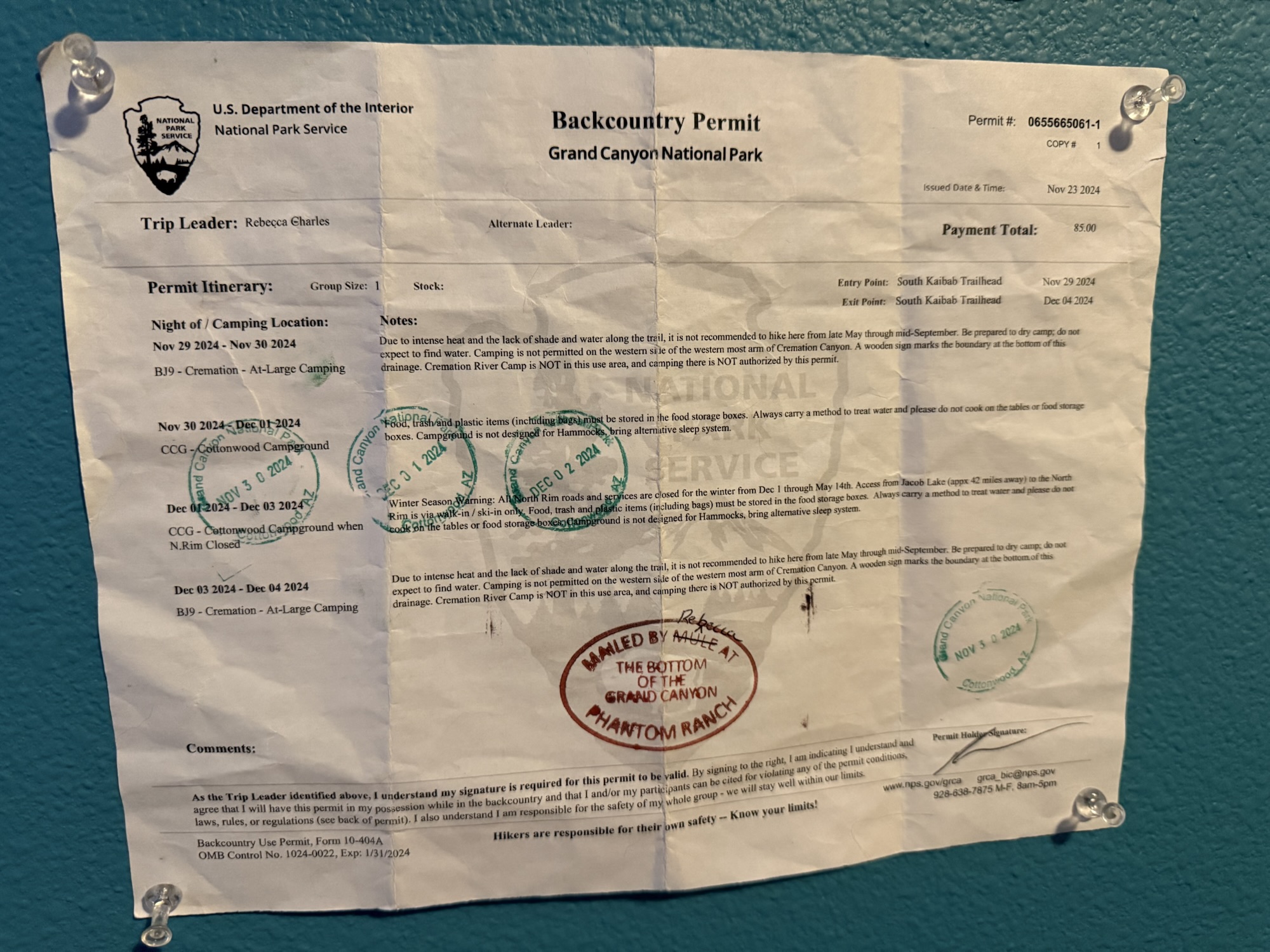
Phantom Ranch was still closed, but I was able to fill up my water bottles, now the repaired one springing a pinhole leak at the bottom. I set it into a gallon Ziplock bag and hoped for the best. I was sure I’d have at least a liter left, and with my other two-liter bottle, full, I would be fine. I’d learned it wasn’t summer desert hot this time of the year, so I decided the nearly two gallons I had carried down on day 1 was a bit excessive. I stamped my permit with the “Mailed by Mule” stamp that people put on their postcards and then crossed out mule and wrote “Rebecca.” I would have to settle to send the postcards from the South Rim.

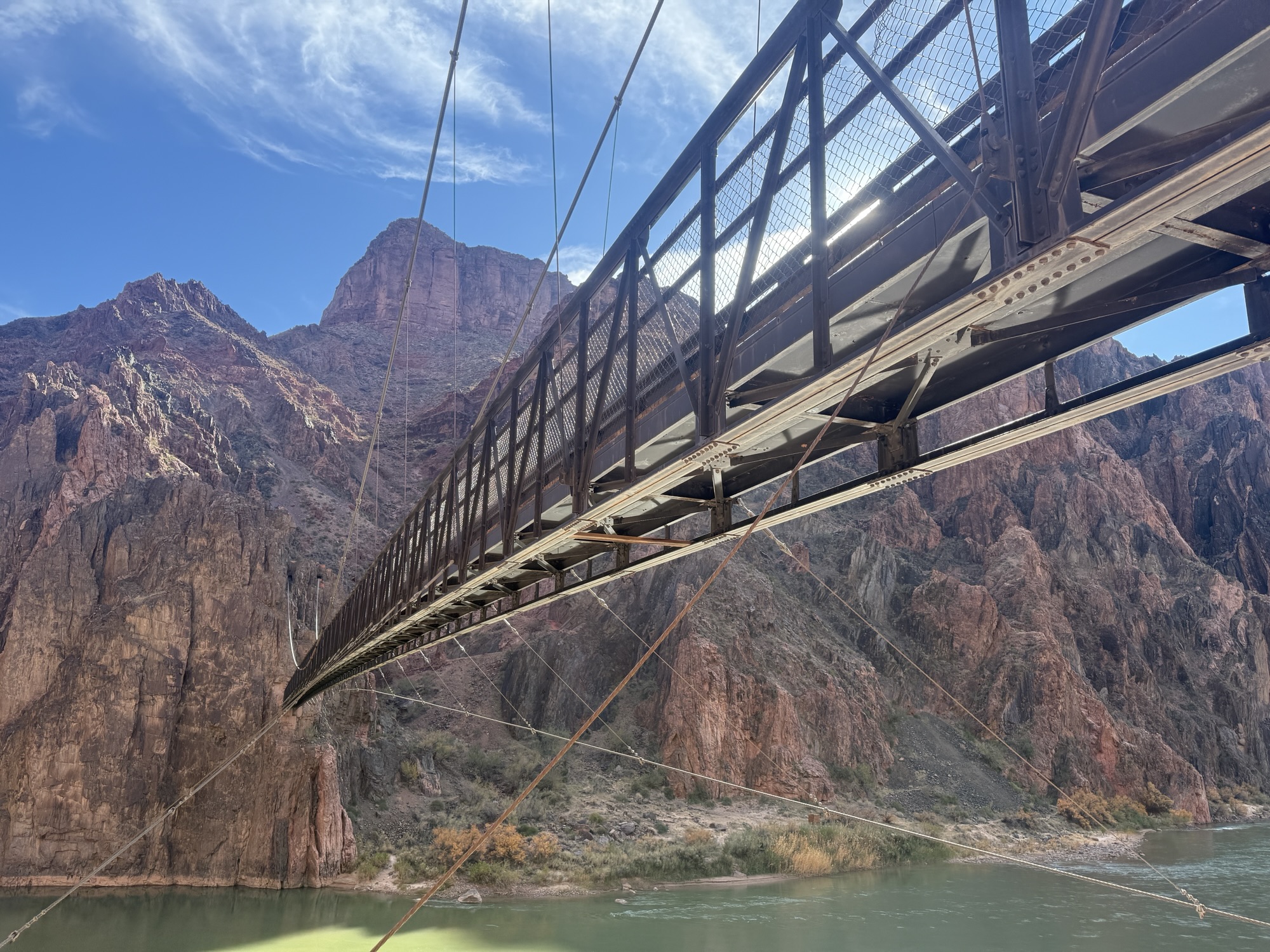
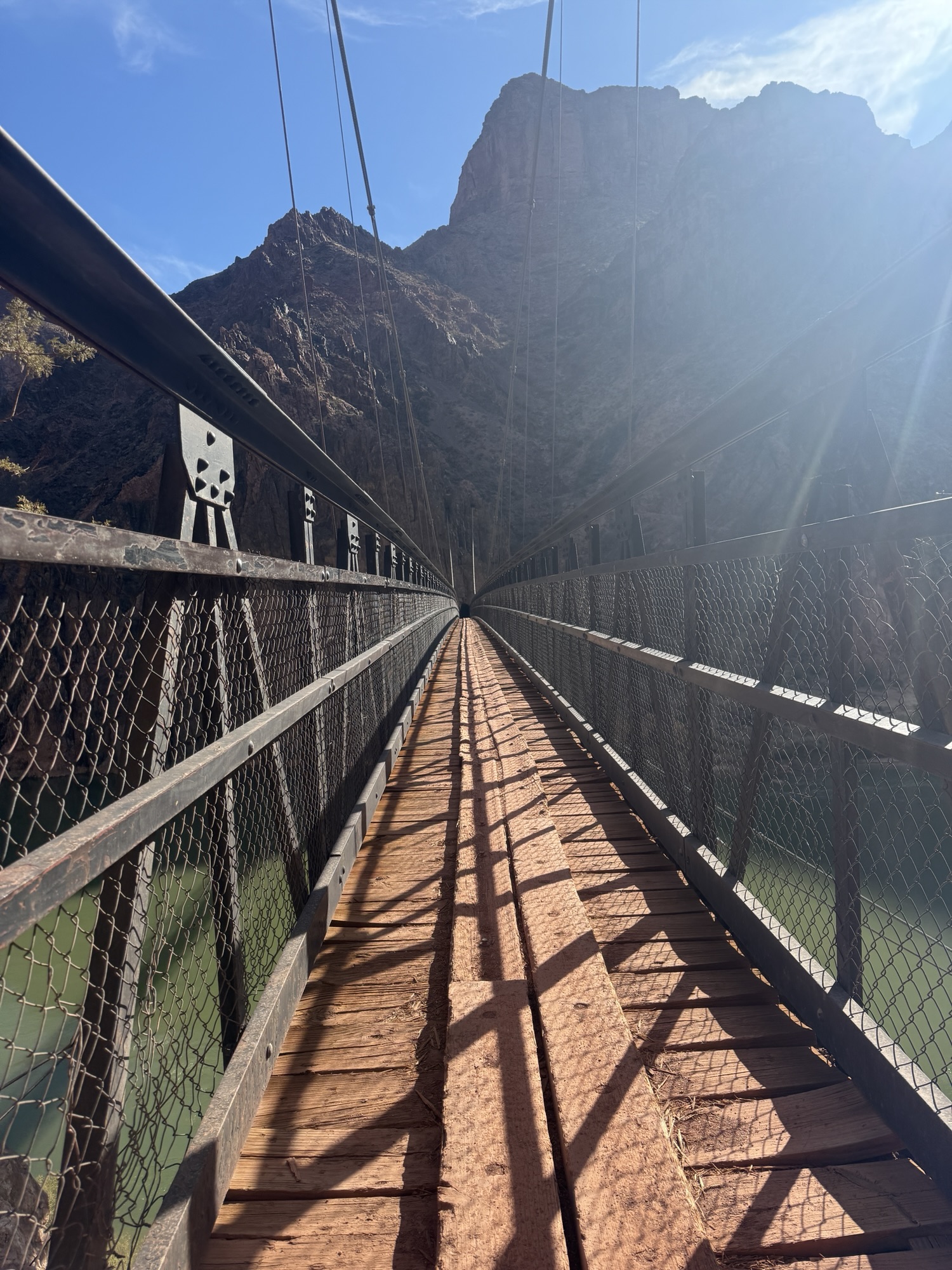
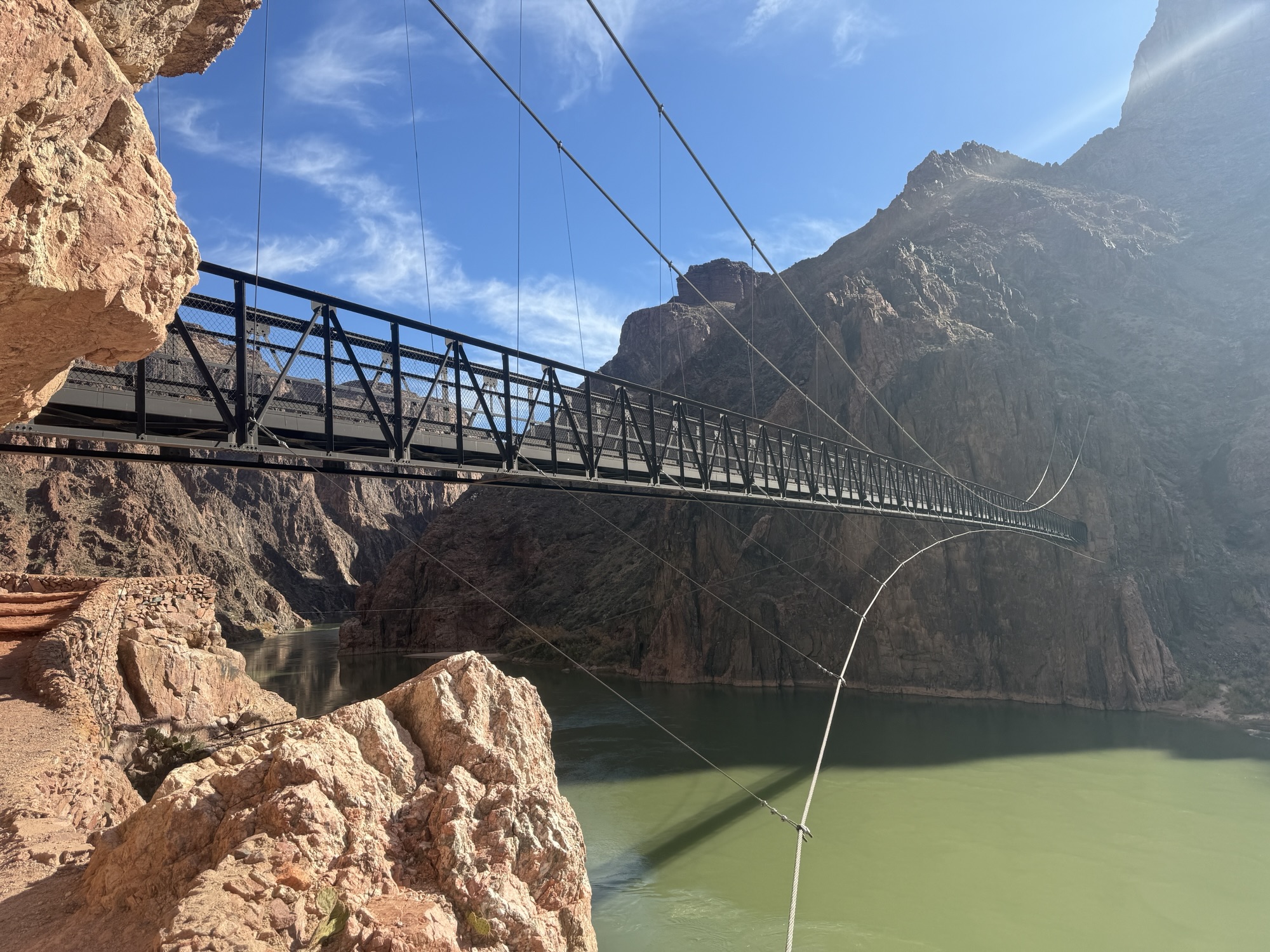
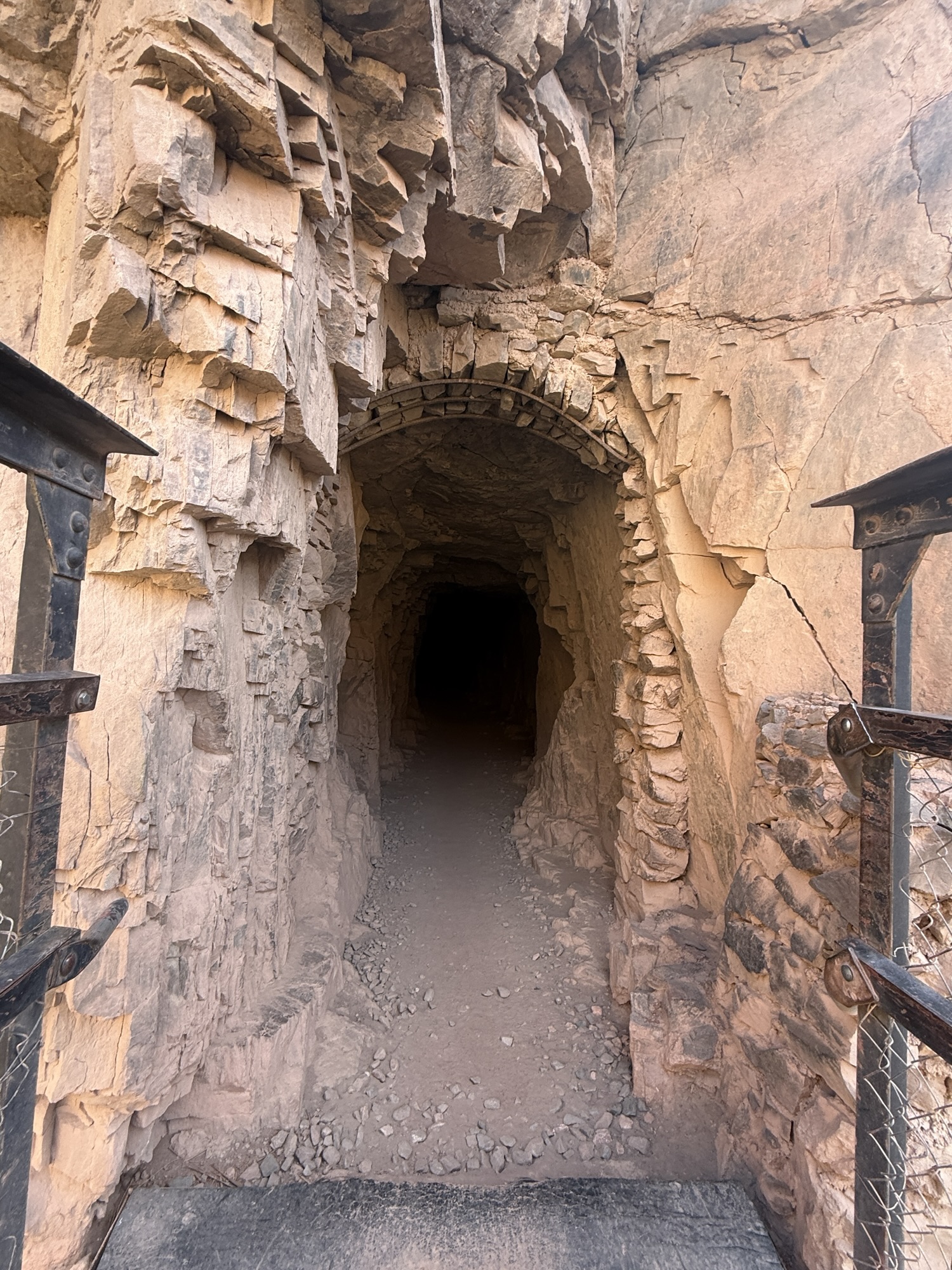
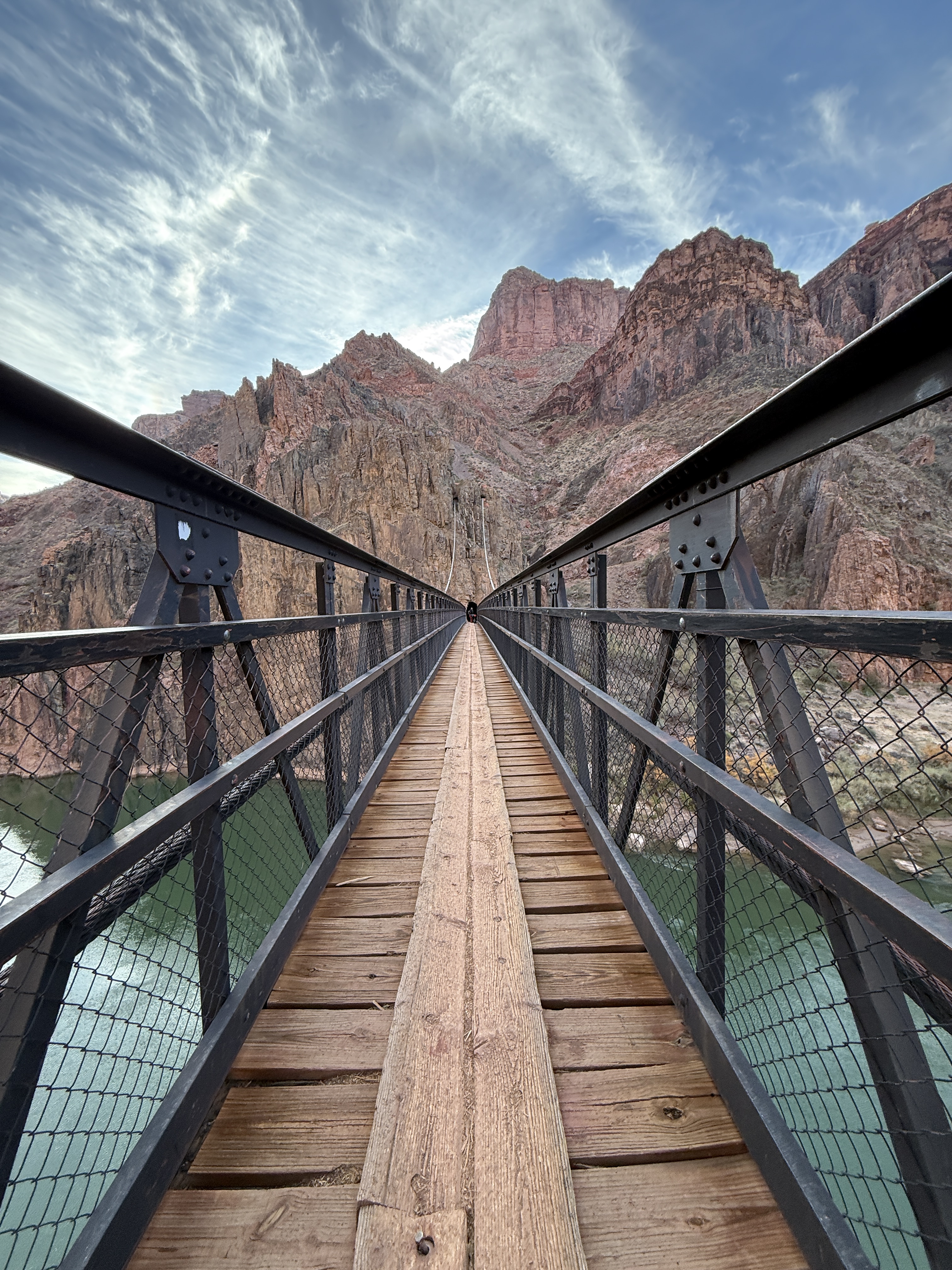
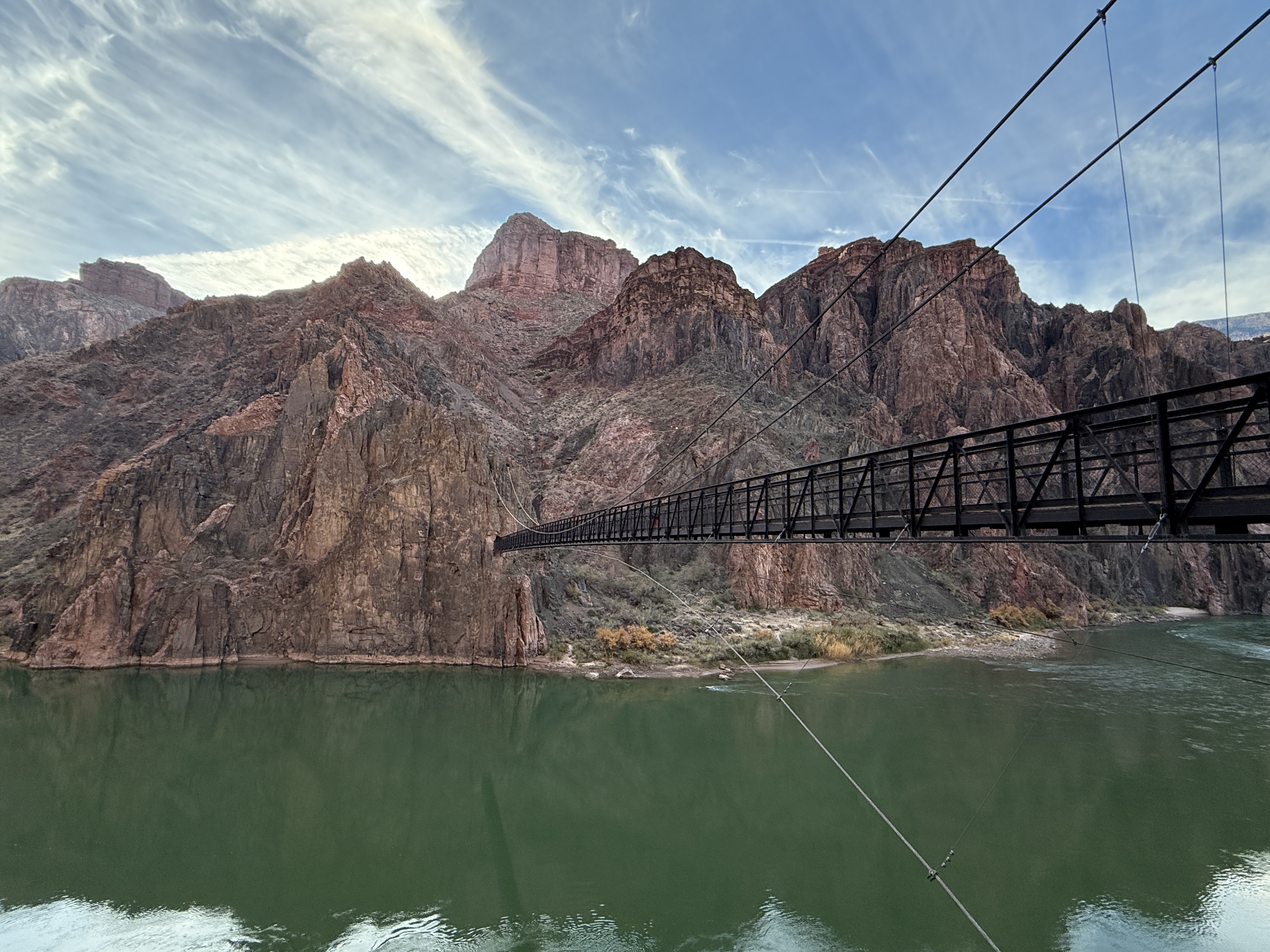
Crossing the Colorado River on the Kaibab Suspension Bridge, “The Black Bridge,” I spent some time to really admire the engineering and design, before entering the 105′ long tunnel and out the other side. I had less than 4 miles and +1800′ to go for the day, most of the climbing on the way up to Tip Off on the Tonto Plateau. I felt extraordinarily strong and made it up to Tip Off in just over an hour. I was, as we say in the snowmachining world, hauling the mail.

I took a left, due east, on the Tonto Trail, once again in the wide scrub brush and cactus covered shelf, 1600′ above the Colorado River. The miles were still going by quickly, and before I knew it, I was at the little rock outcropping I had camped at on night one. I decided to press on, energized and curious to see what was around the next corner.

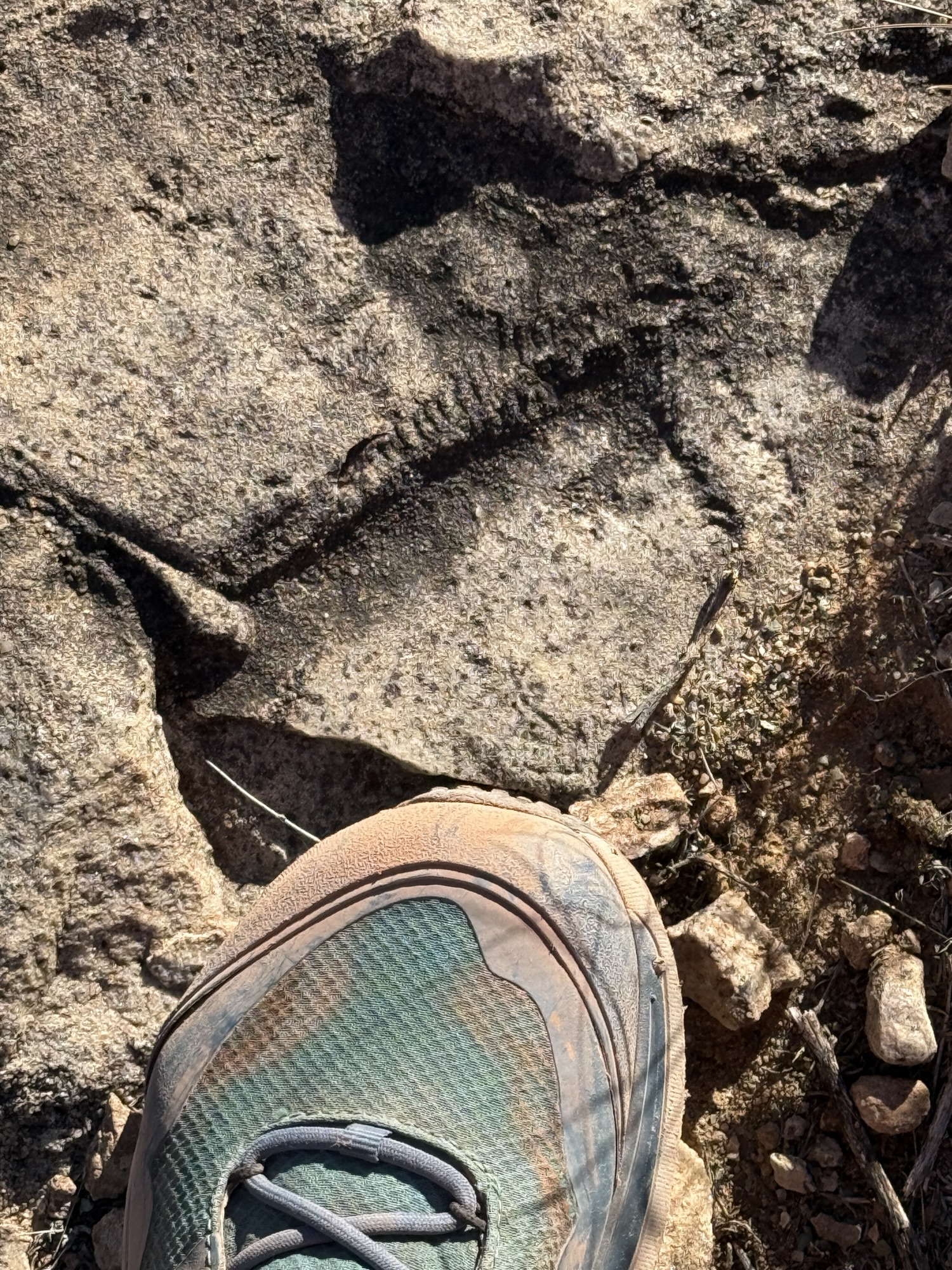
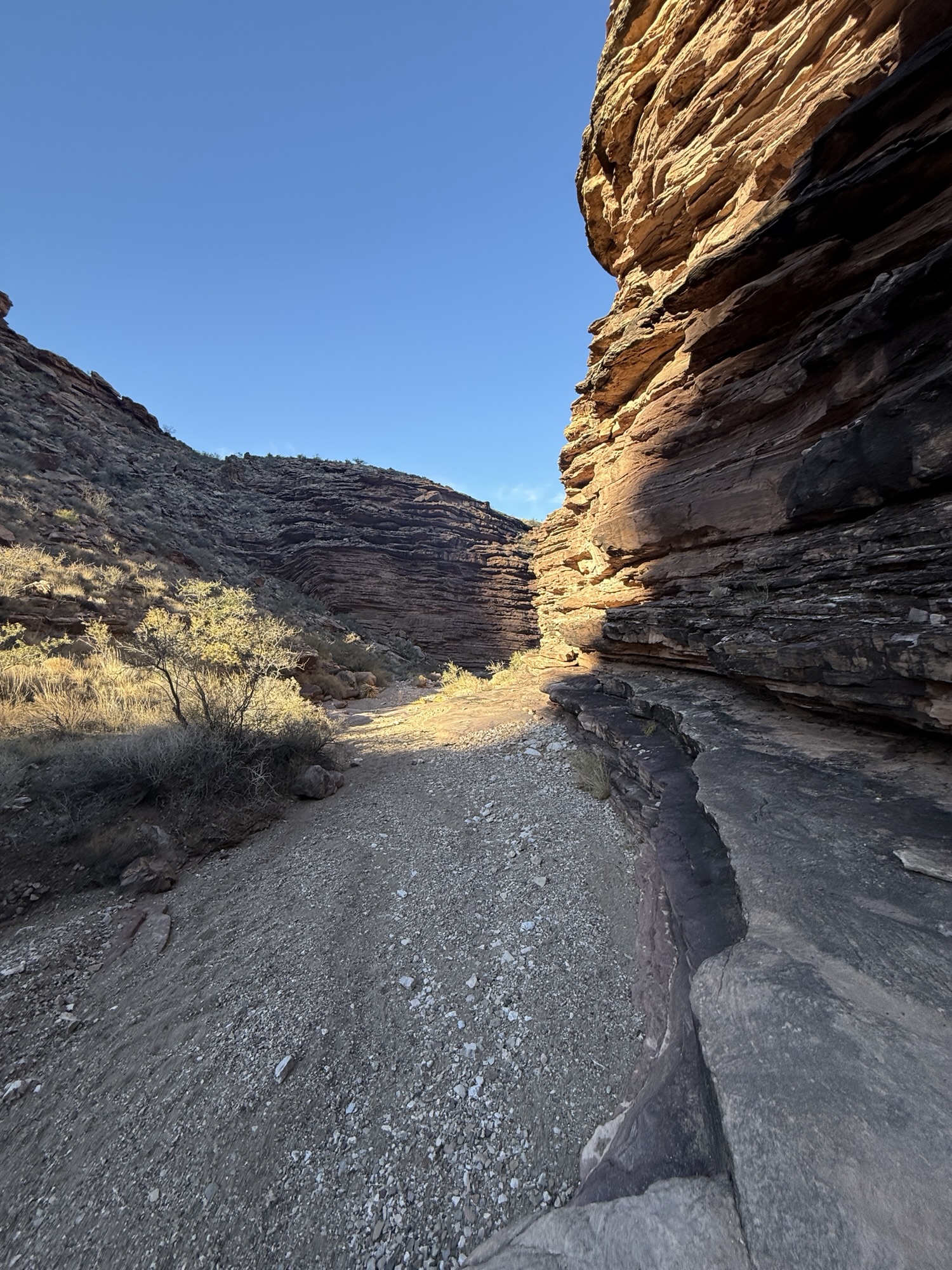
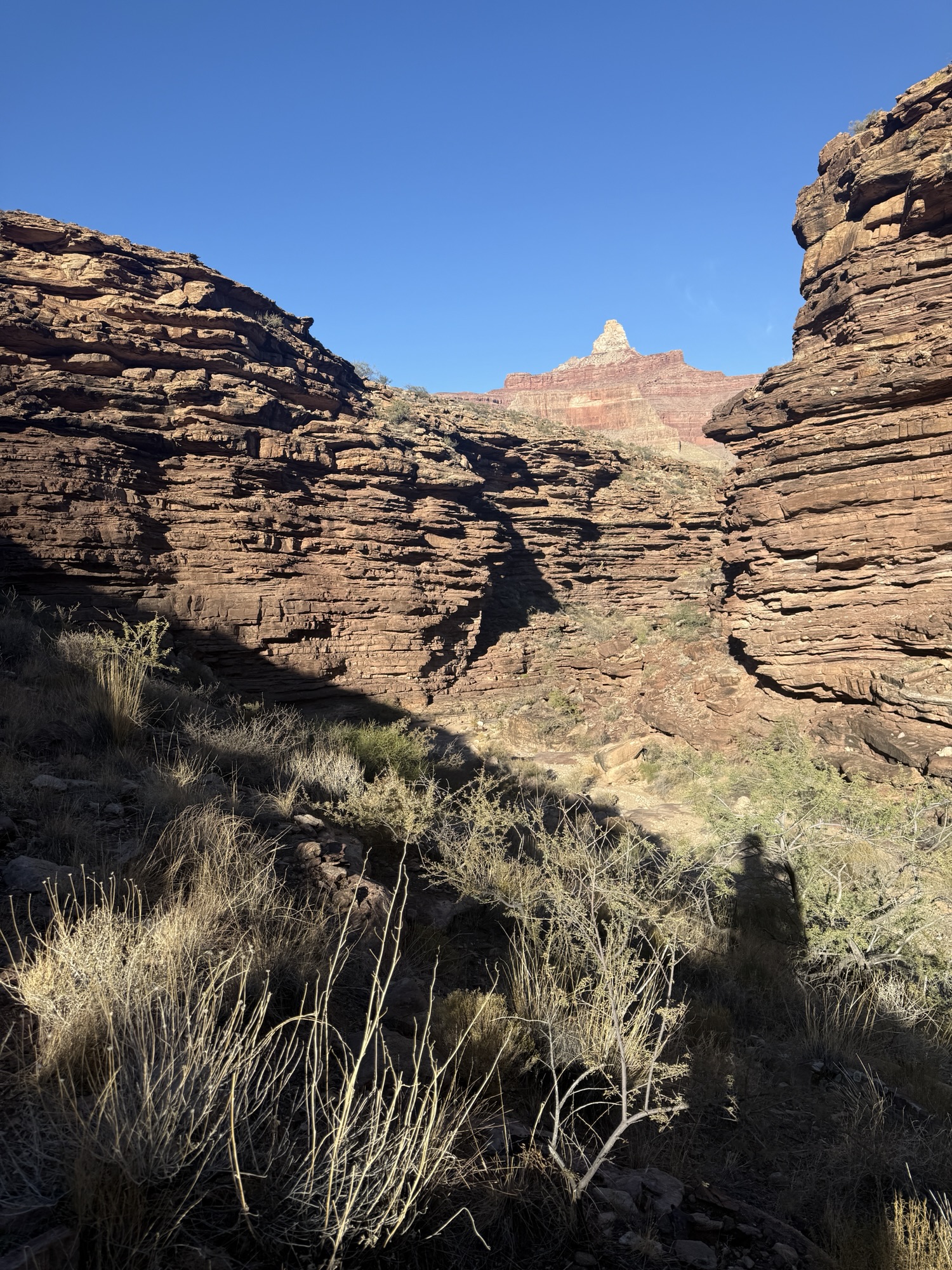
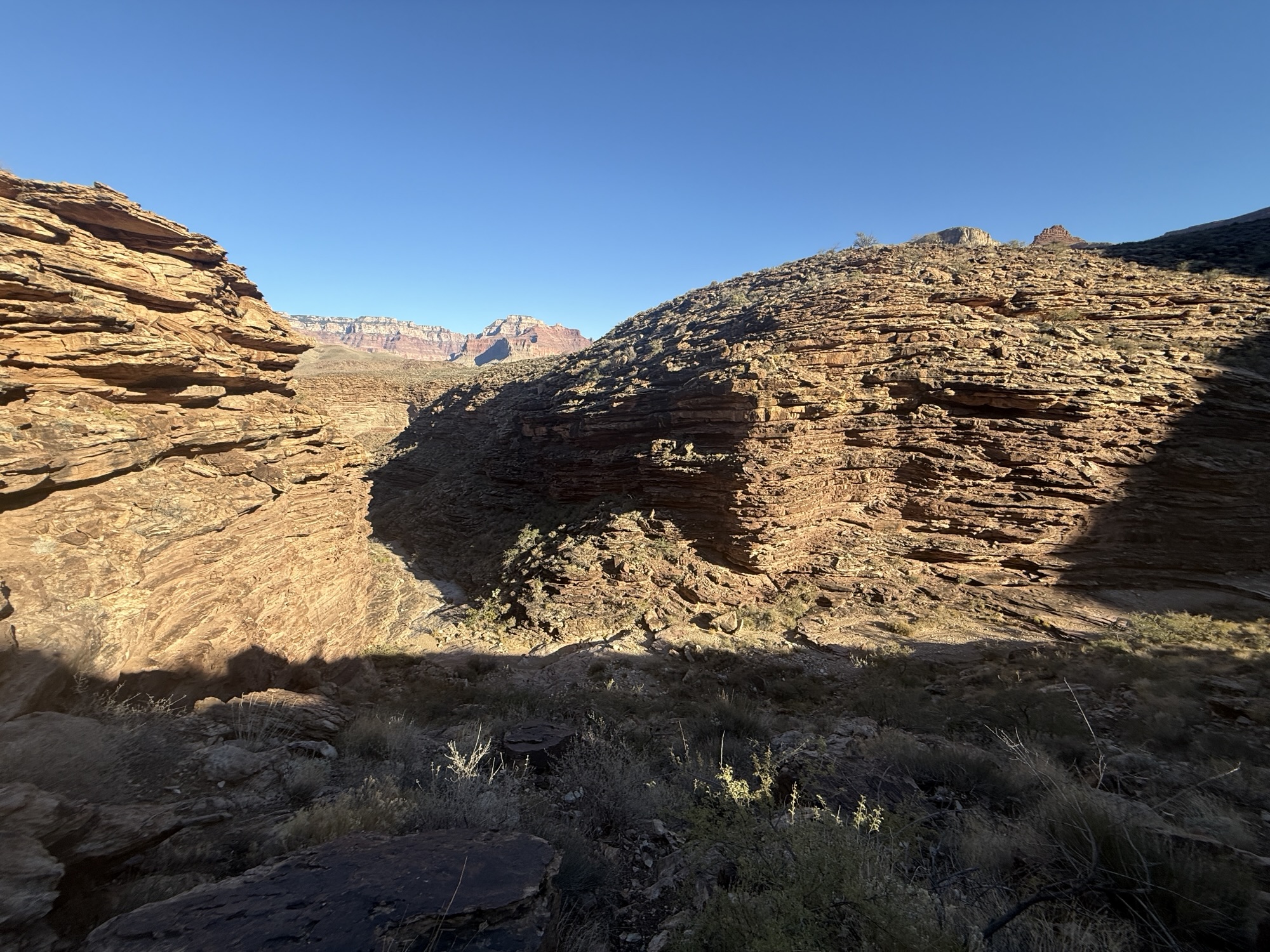
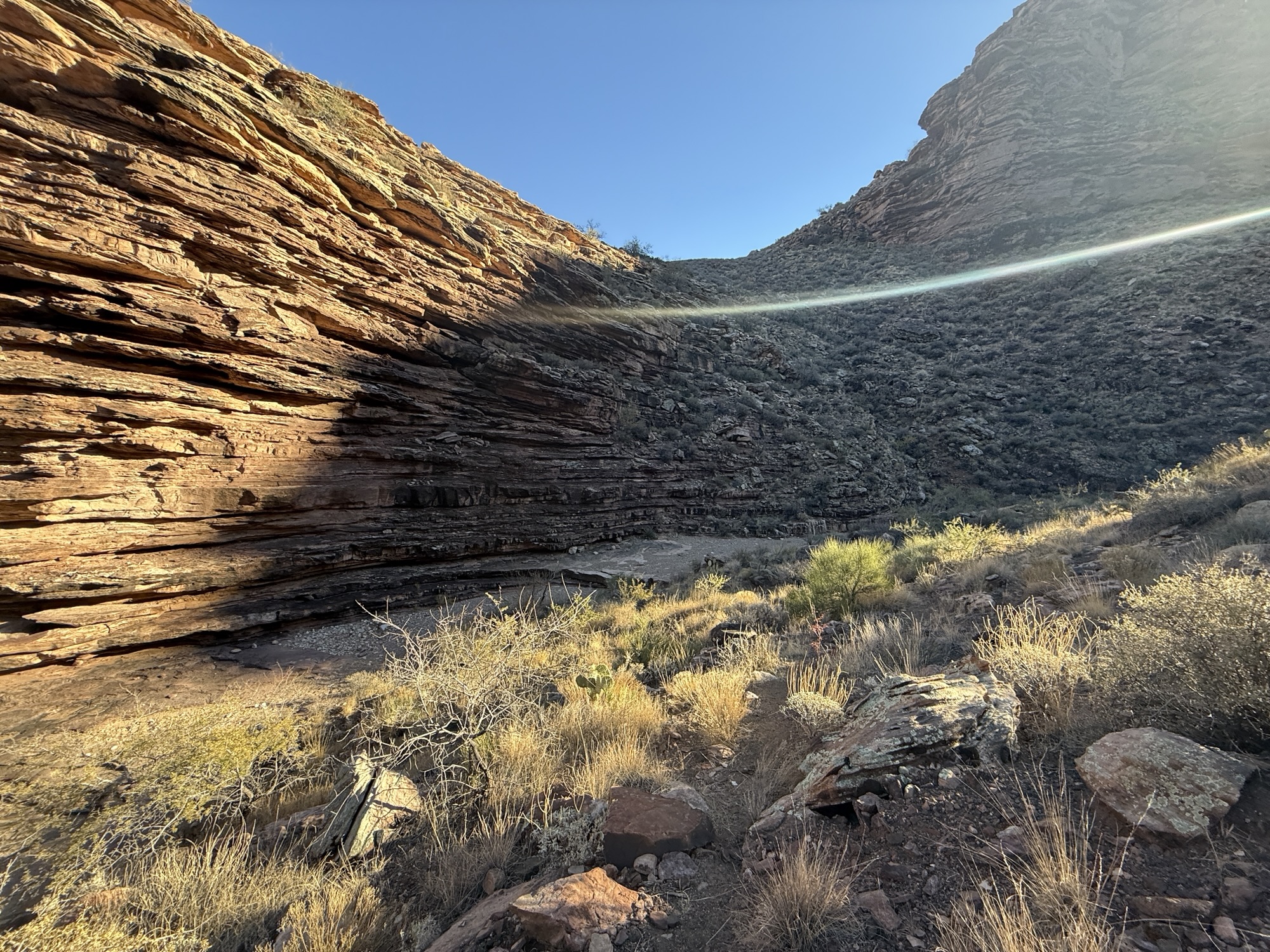
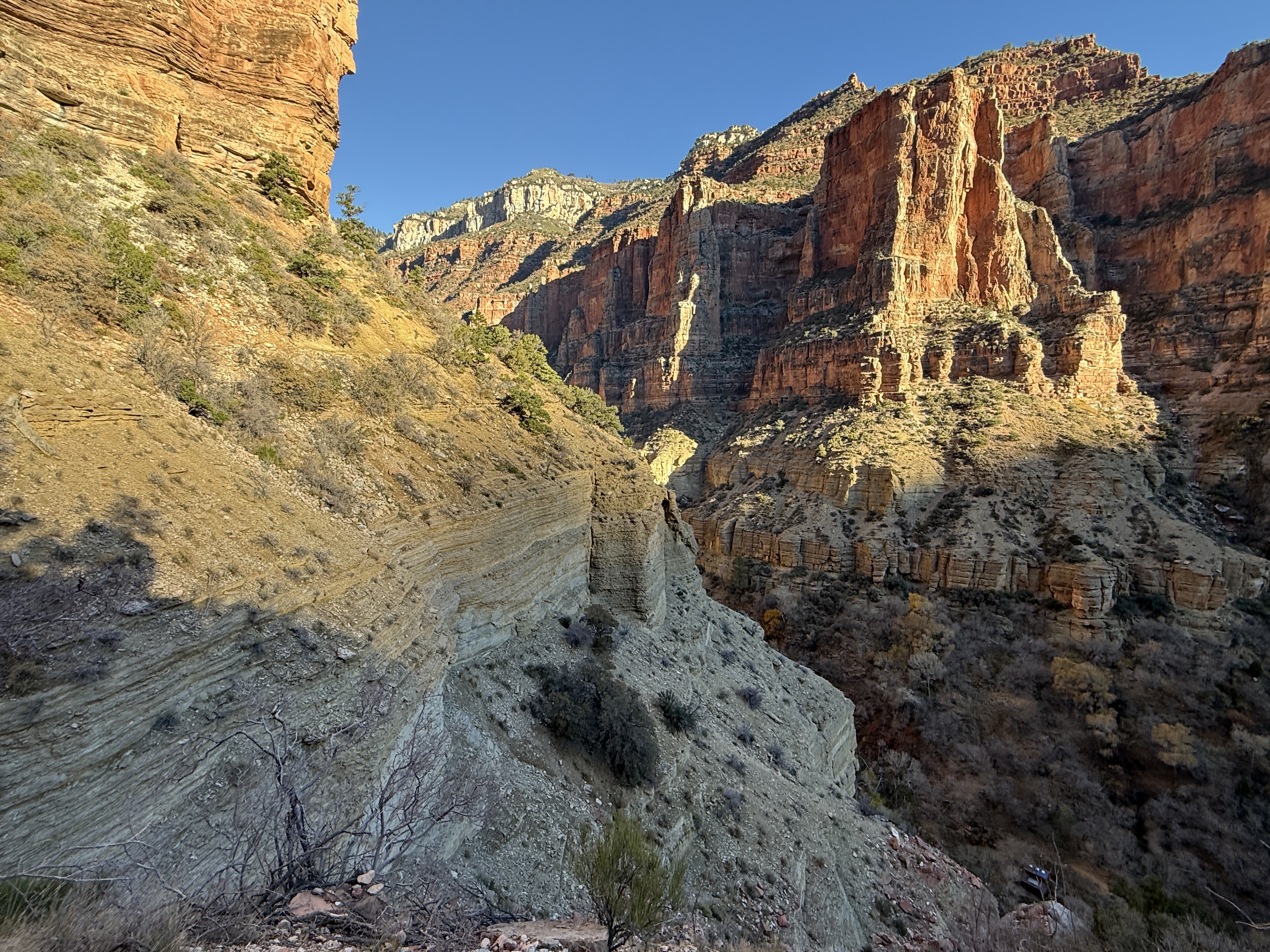
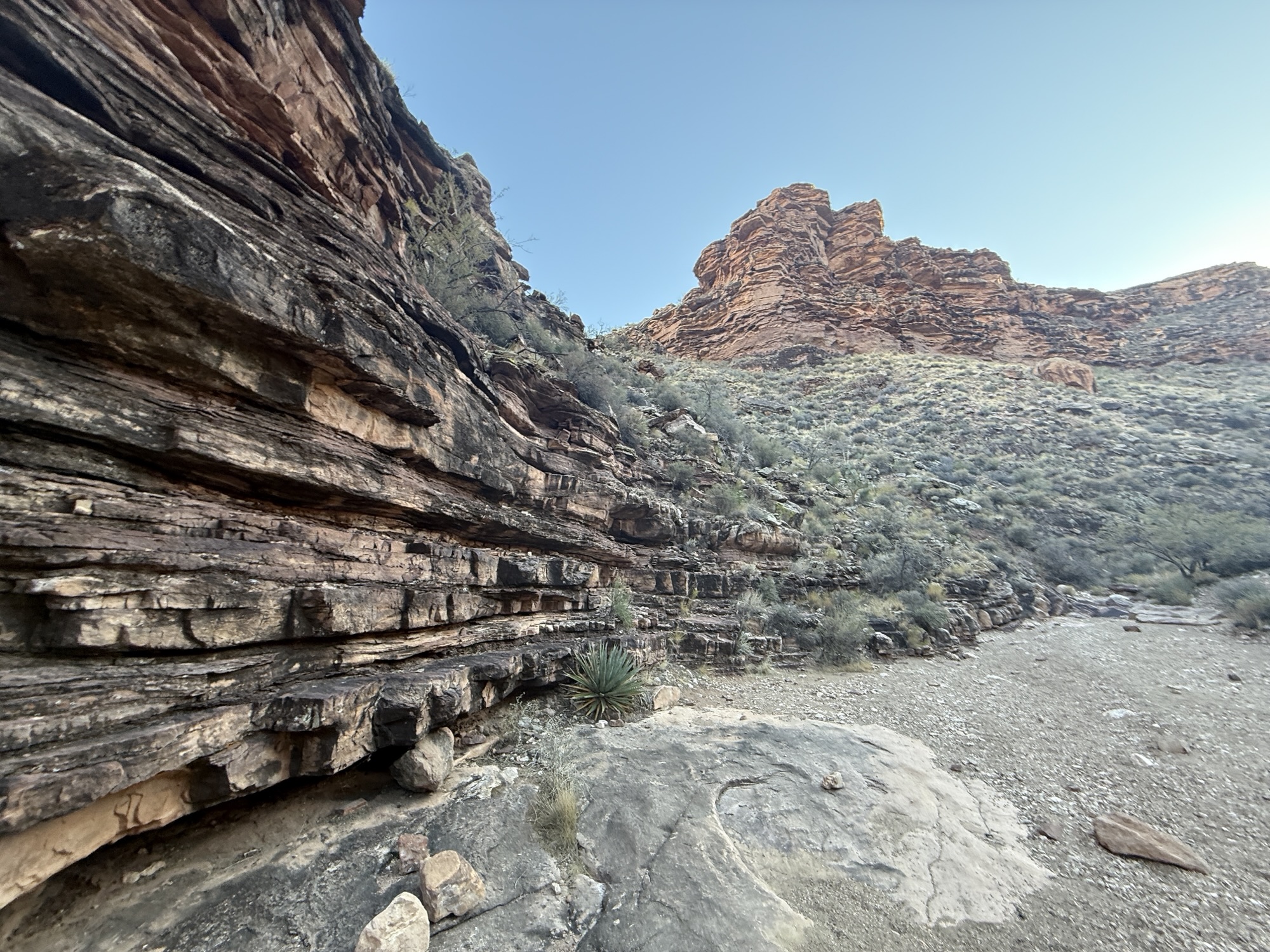
I dropped down into a mini canyon that had the most interesting, layered rock. I had seen an almost perfect marine fossil before I had descended down to this streambed. I started to climb up the other side and turned back to take another look at this geological wonder.

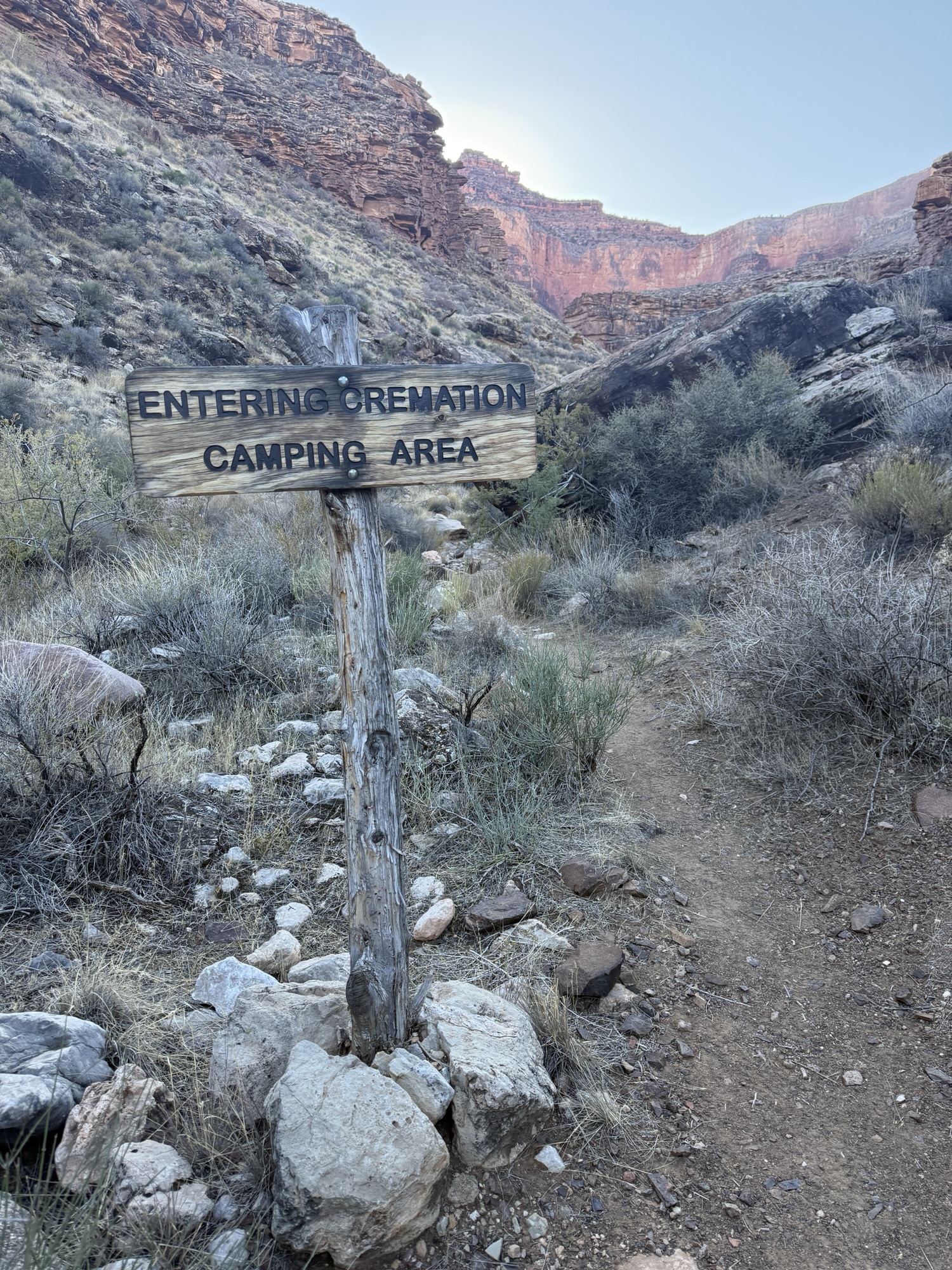
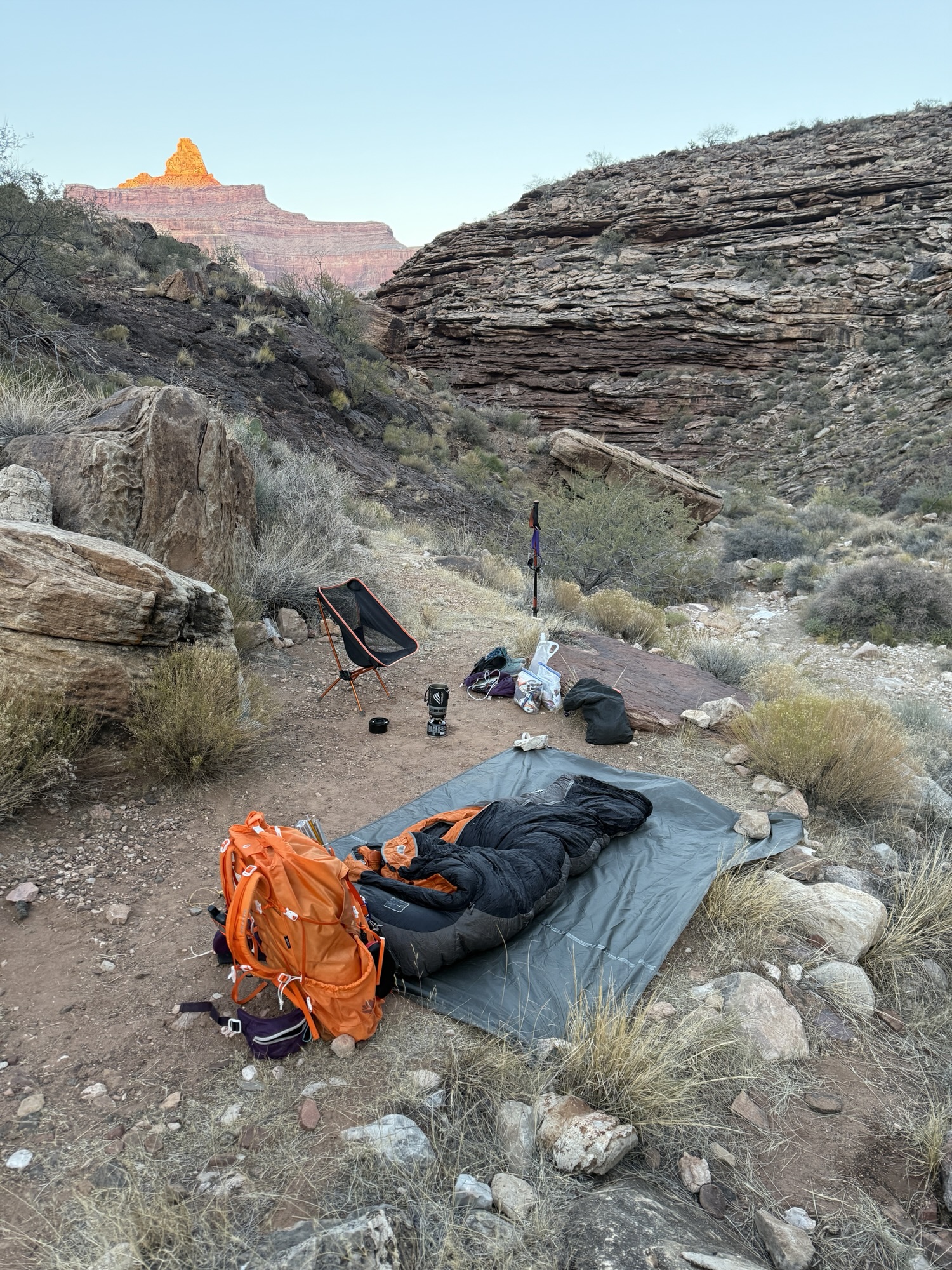
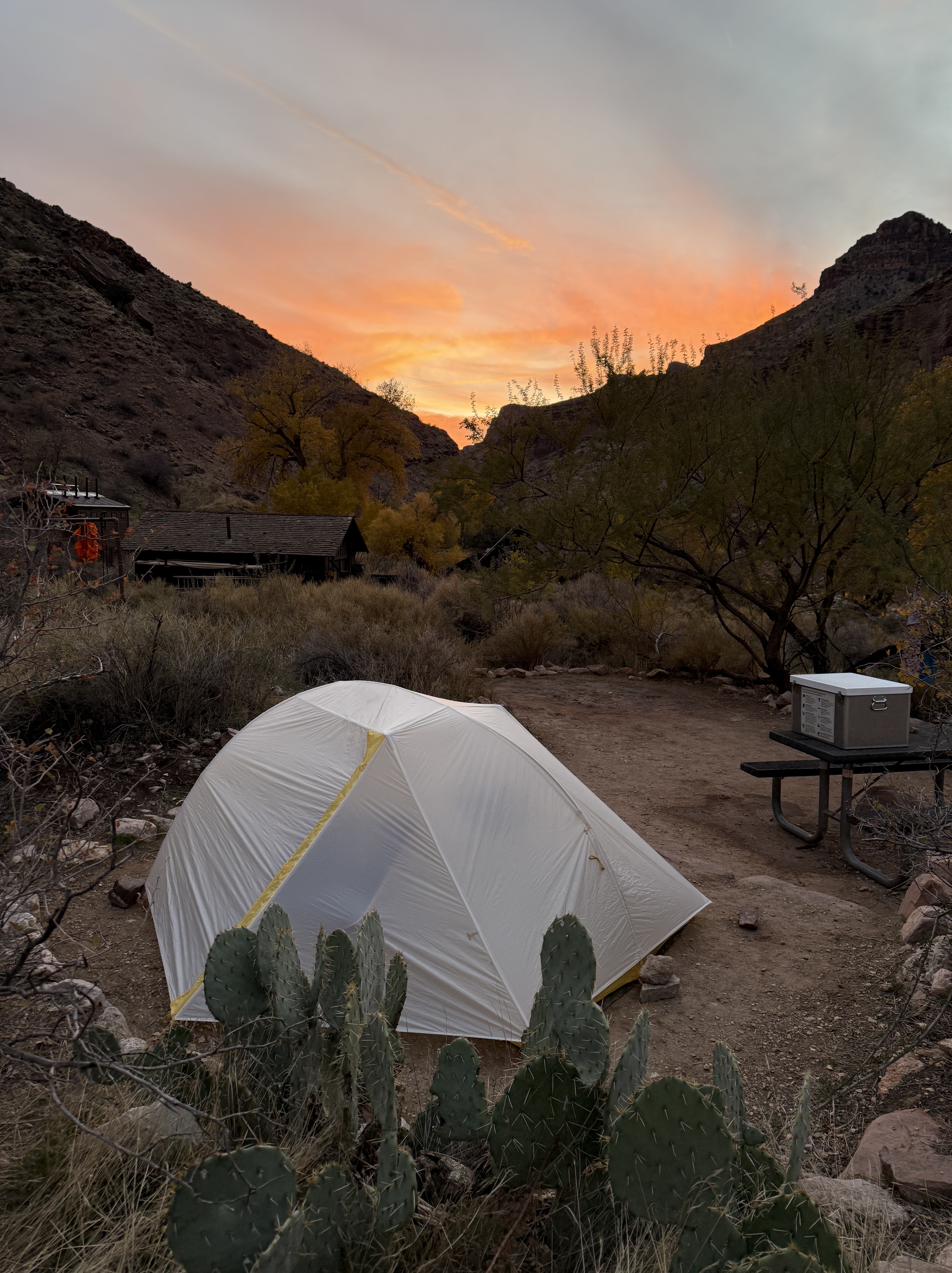
There it was. The sign. I had been 2/10 of a mile short the first night, a stone’s throw away. I spotted a perfect little clearing, out the flash flood zone, but still down in this protected canyon. I didn’t even bother to set up my tent. There wasn’t enough traffic here to draw in the mouse population, so I was going to take tonight to cowboy camp under the stars. By 330pm I was making dinner and coffee, marveling at this cozy spot far, far away from people and responsibilities.

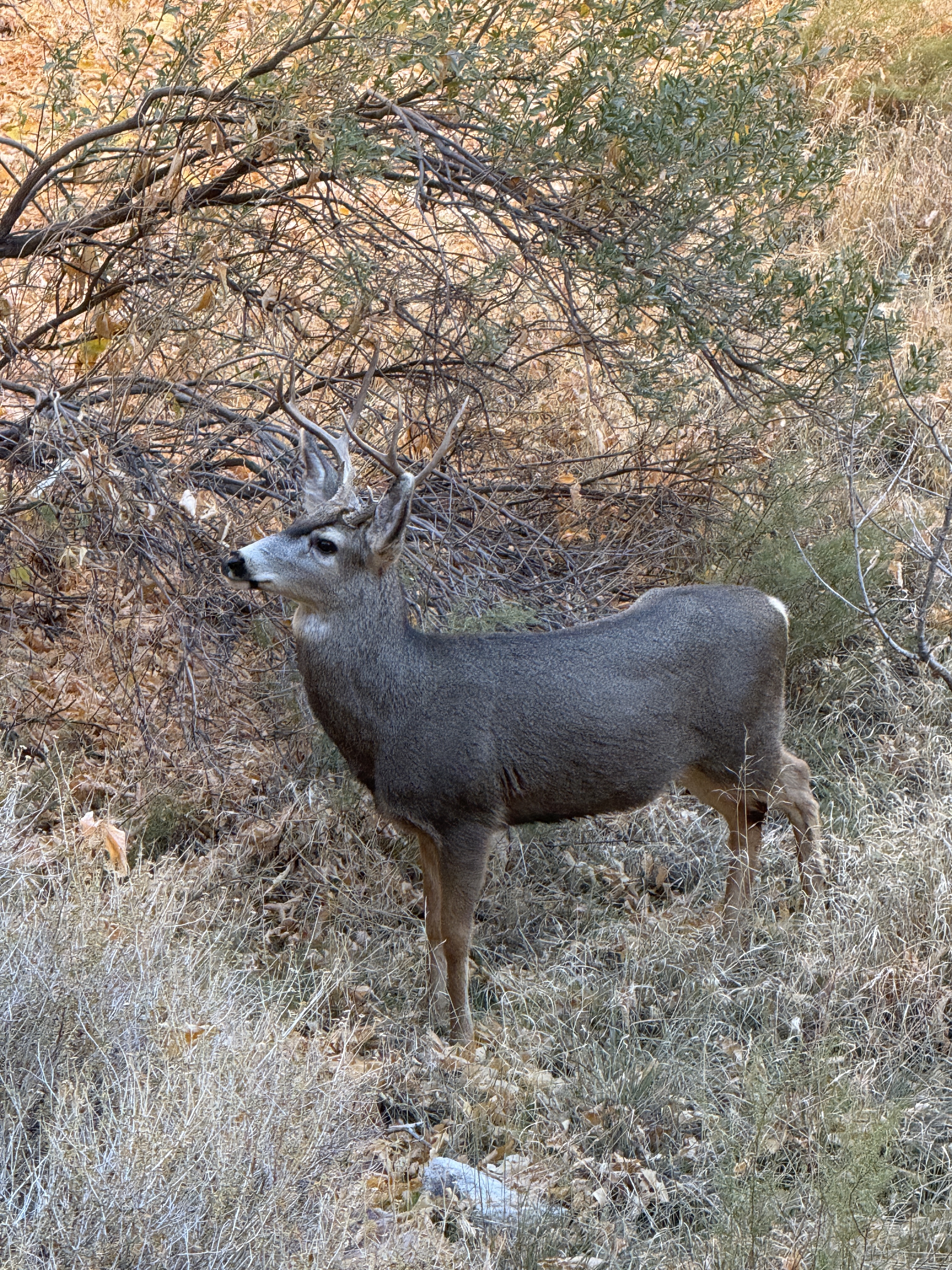
All of sudden a movement caught my attention. It was a massive mule deer buck coming down the trail I had not long ago started up. He didn’t seem to mind my presence, and ambled down the hill, seeming to have a slight limp and scar on his rear haunch. This 10-point beauty moved past my camp, although I didn’t notice if he continued down the canyon or along the Tonto Trail. I wondered where the closest water was.

In a state of continuous awe, I sat in my camp chair drinking coffee and examining every layer of the canyon’s walls. I thought about how many years this spot had been at the bottom of the ocean. Then I saw an odd shape. It didn’t fit in. I walked across the canyon and up the slope to where I was even with my camp. It was an old shoe. I knew it looked wrong. Something had torn it to shreds. I was going to assume mice. I carried it back over and added it to my very full gallon Ziplock bag of trash.

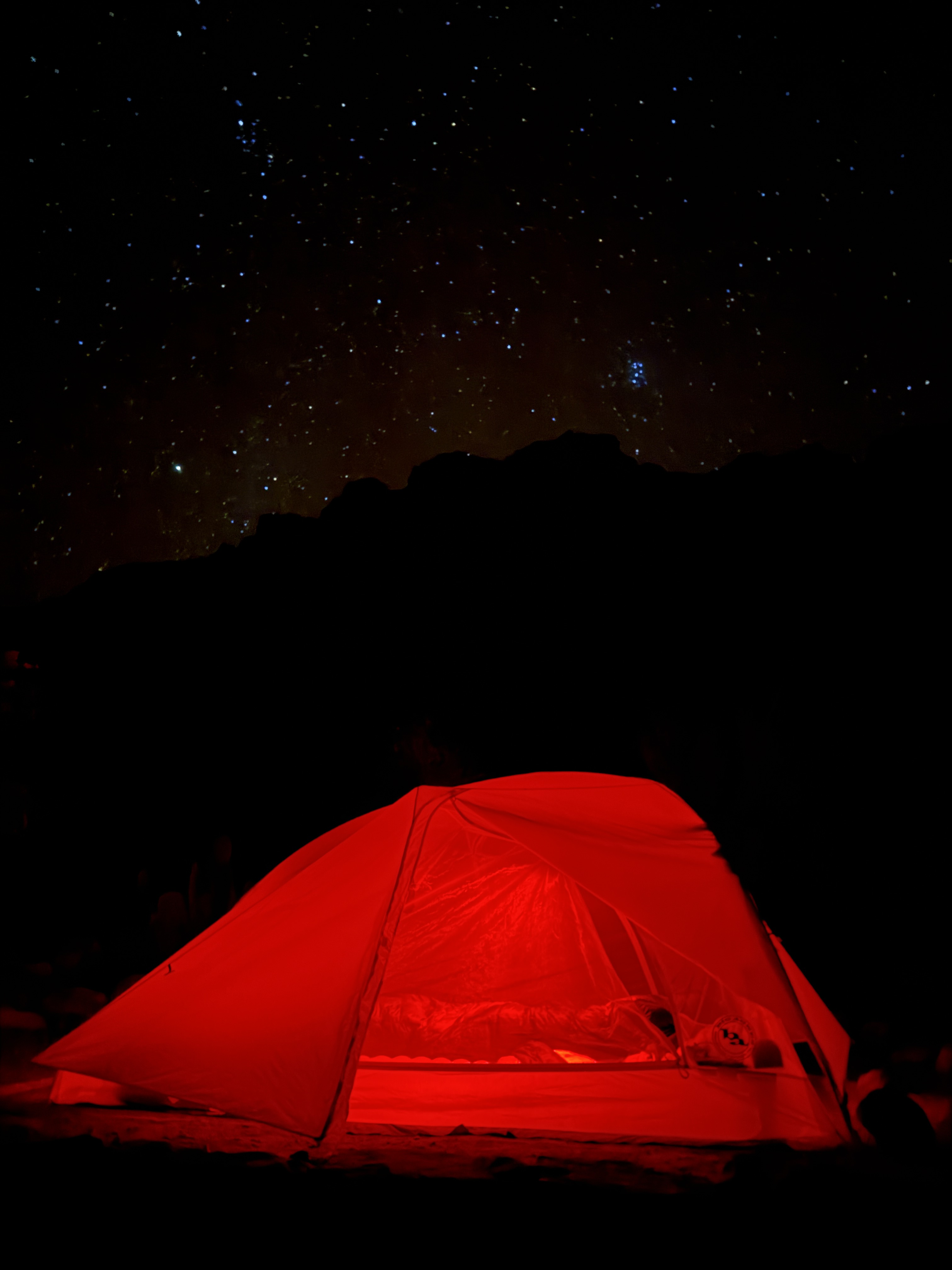
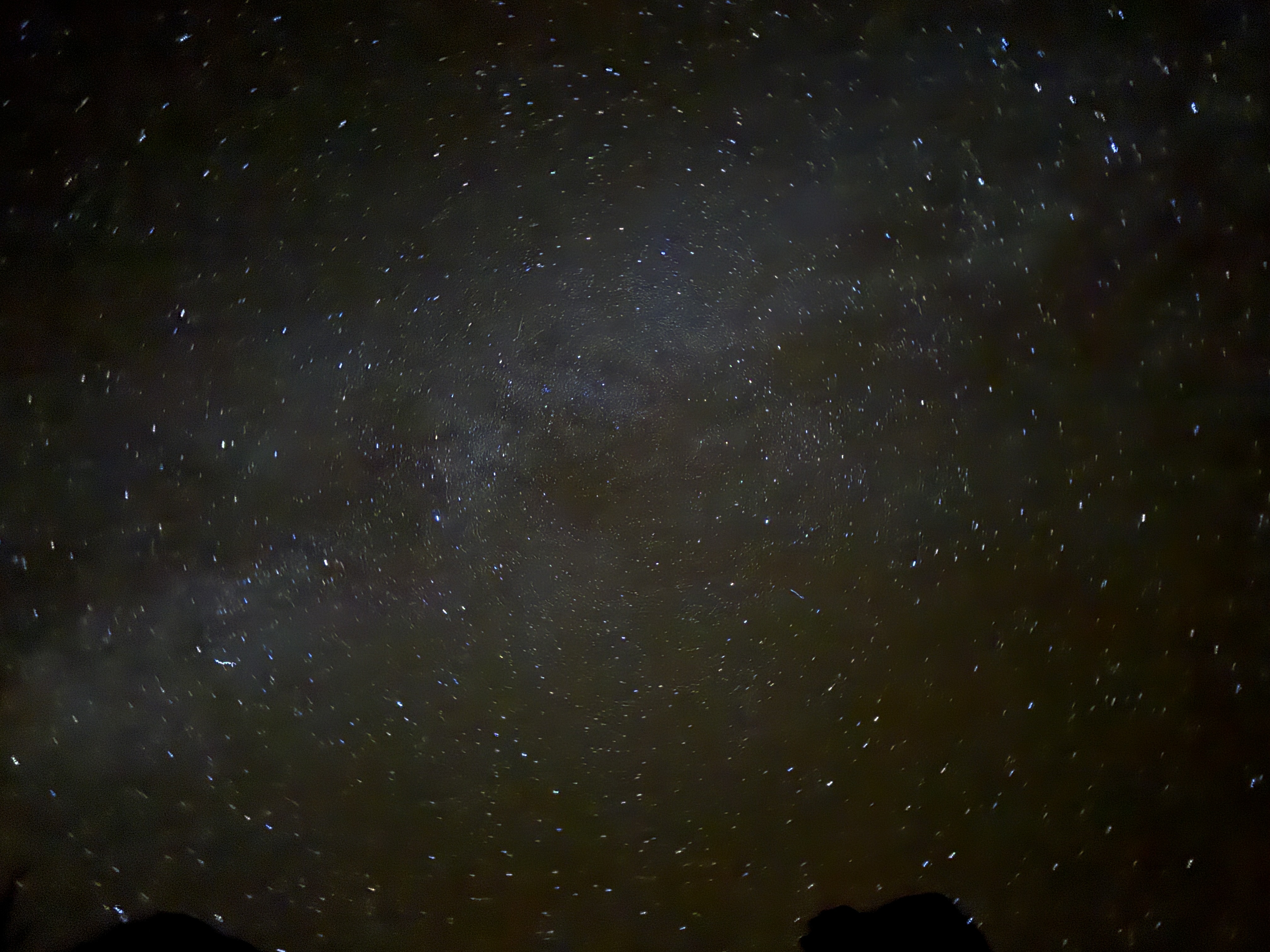
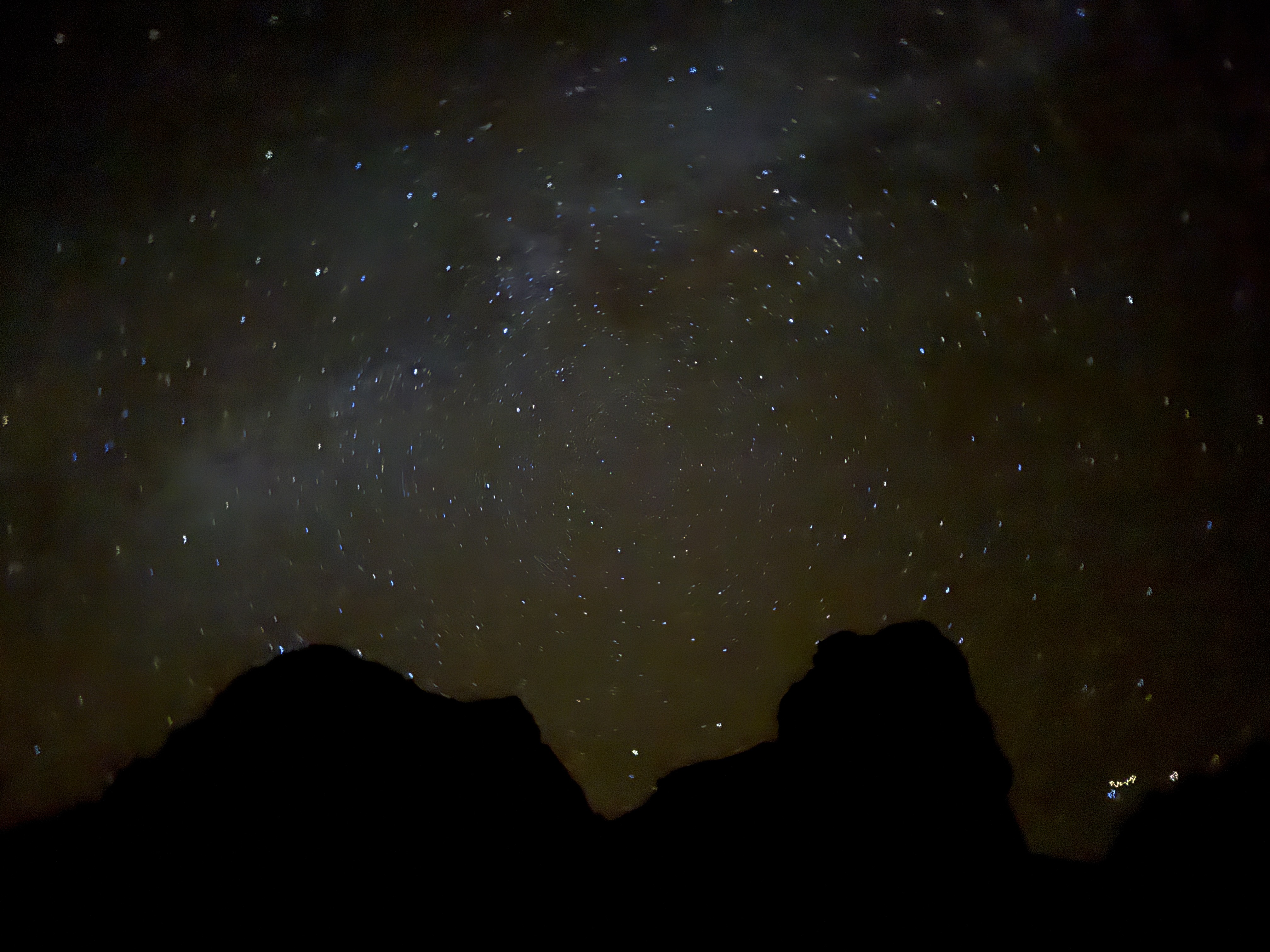
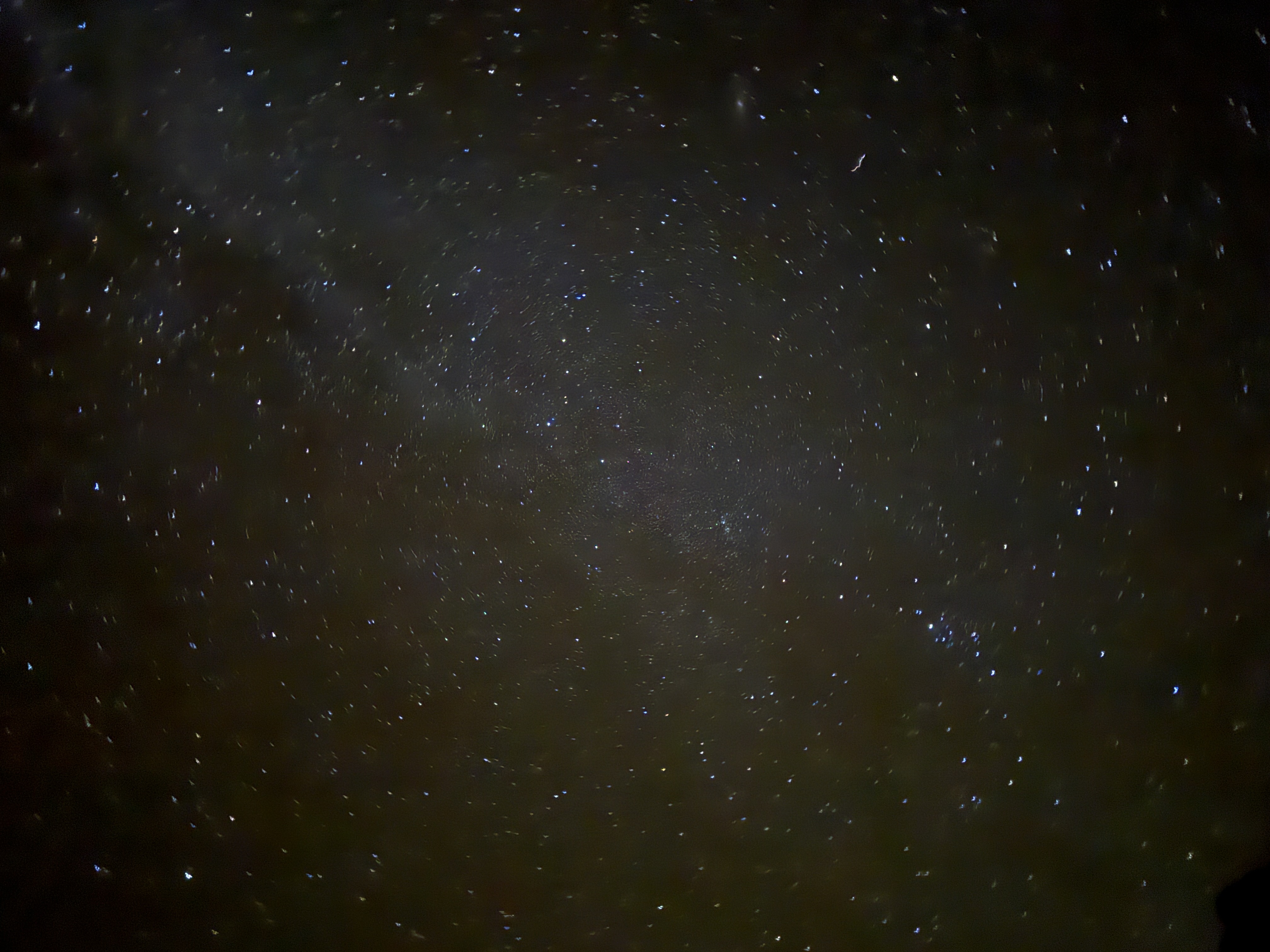
By 6pm it was dark and I was in my sleeping bag, pad laid down over my tent footprint, and I swore I had never been more comfortable in my life. I was warm, although there was a light breeze coming from the North. I watched the stars for hours, the Milky Way and constellations spinning above me. Next year I would definitely be bringing a tripod… no one can keep a phone still enough for a ten second exposure.

My last night in the canyon was bittersweet perfection.

Rim To Rim To Rim AllTrails Link:

Just The Tips:

  1. Instead of flying into Phoenix, opt to fly into Flagstaff. I’ll be doing that next time instead of making the 3 hour drive each way.
  2. If you are flying in, pre order your stove fuel and other supplies online from Sportsman’s Warehouse in Phoenix or Flagstaff. I found this to be quick and easy.
  3. Be aware that your tracking devices and phone may not be able to get a satellite connection in some of the narrow canyons. Tracking may get wonky, as the vertical walls can cause a location ping, hundreds of feet above or below you.
  4. Permitting for the Grand Canyon can be confusing. It is best to apply for the lottery, which opens based on the month of travel and is available for application on the 16th of the month, in the 5th month prior to your trip. For example, a September Trip lottery application period would open April 16. See this article for more information about getting your Grand Canyon permit.
  5. Give yourself more than one night at Cottonwood Campground to allow for a side trip to Chimik’yana’kya Deya’ (Ribbon Falls) or a day hike to the North Rim, plus a rest day. I found 3 nights at Cottonwood to be perfect.
  6. If hiking rim to rim to rim in the winter, know that there are no services at and no access to the North Rim. You will be one of the few people in the area, far from help. Bring hiking poles and microspikes in case of snow. Evaluate your abilities and comfort with heights honestly before traveling this stretch of trail.
  7. Carry plenty of water and a water filtration system. Don’t drink unfiltered water. It can contain bacteria even if it looks clean. Be sure to dry out your filter when you get home.
  8. Get to the park early. The entrance gets extremely backed up with traffic beginning mid morning.


Where the Clouds Parted: A Knoya, Kanchee and Nunaka Ridge Walk

May 31, 2025 Knoya: 4600′ – FR #17 Kanchee: 4393′ – FR #20 Nunaka point: 3780′ Mileage: ~14 Miles Elevation Gain: ~5000′ The summer wasn’t summering, and I was suffering from a bout of springtime depression that only sunshine and warm weather could cure. I dragged myself to the Klutina Trailhead to meet Jason. We…

Chasing the Wind: A Long-Awaited Victory on Peak 1216 and Ship Creek Hill

April 26, 2025 Peak 1216 AKA 3990: 3990′ Ship Creek Hill: 3842′ (chugach Front Range Peak #24) Mileage: 15 Miles Elevation Gain: 5,700′ The majority of the Southcentral Alaska winter of 2024-25 was uncharacteristically warm and relatively snow free, but here we were in April, with record breaking snowfall around Anchorage. The ridges and peaks…

Alone in the Grand Canyon: Trekking Canyon Walls to the North Rim

Day 4 – Cottonwood Camp To North Rim and Back

13 Miles, +4000′, -2000′

December 2, 2024

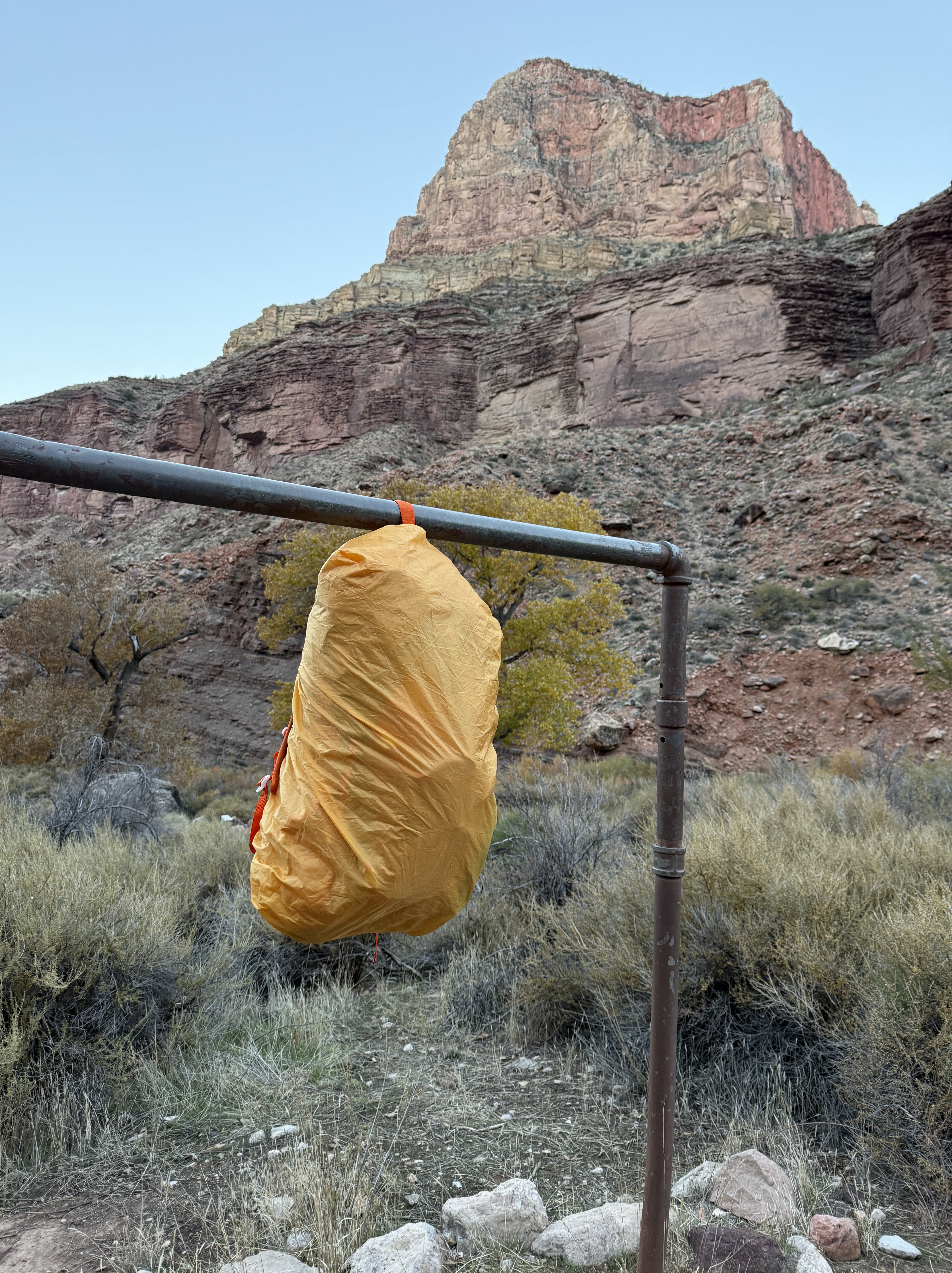
It was a nice feeling to get out of bed and be able to walk normally again. I rose early, very excited for the day ahead, and quickly consumed my oatmeal and coffee. I knew the mice would come around while I was gone, so I packed everything from my tent into my backpack and hung it from the metal post in my campsite. Opening the doors to my tent so as not to find holes chewed upon my return, I was confident I critter proofed everything before donning my fanny pack and heading to the North Rim!

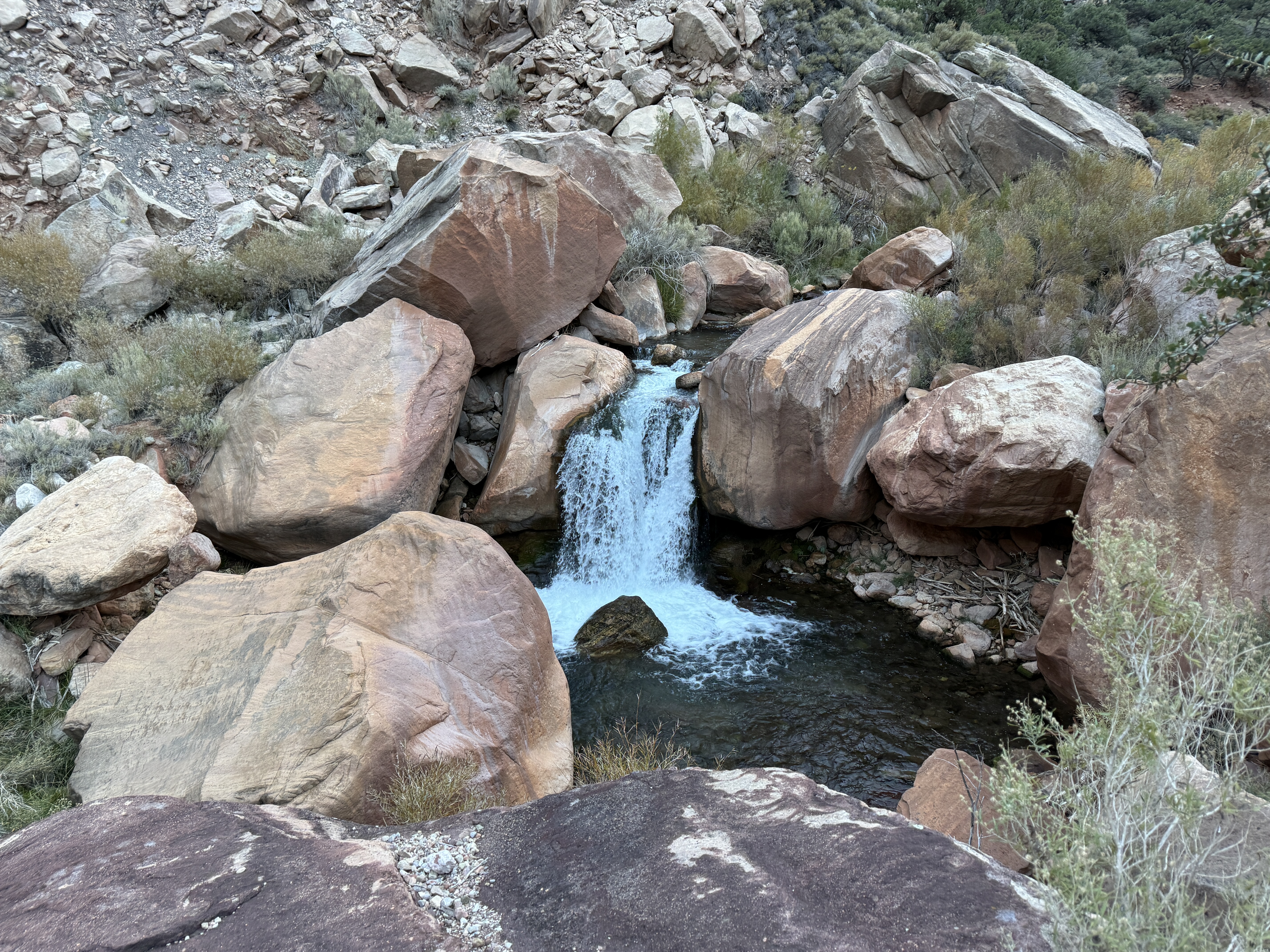
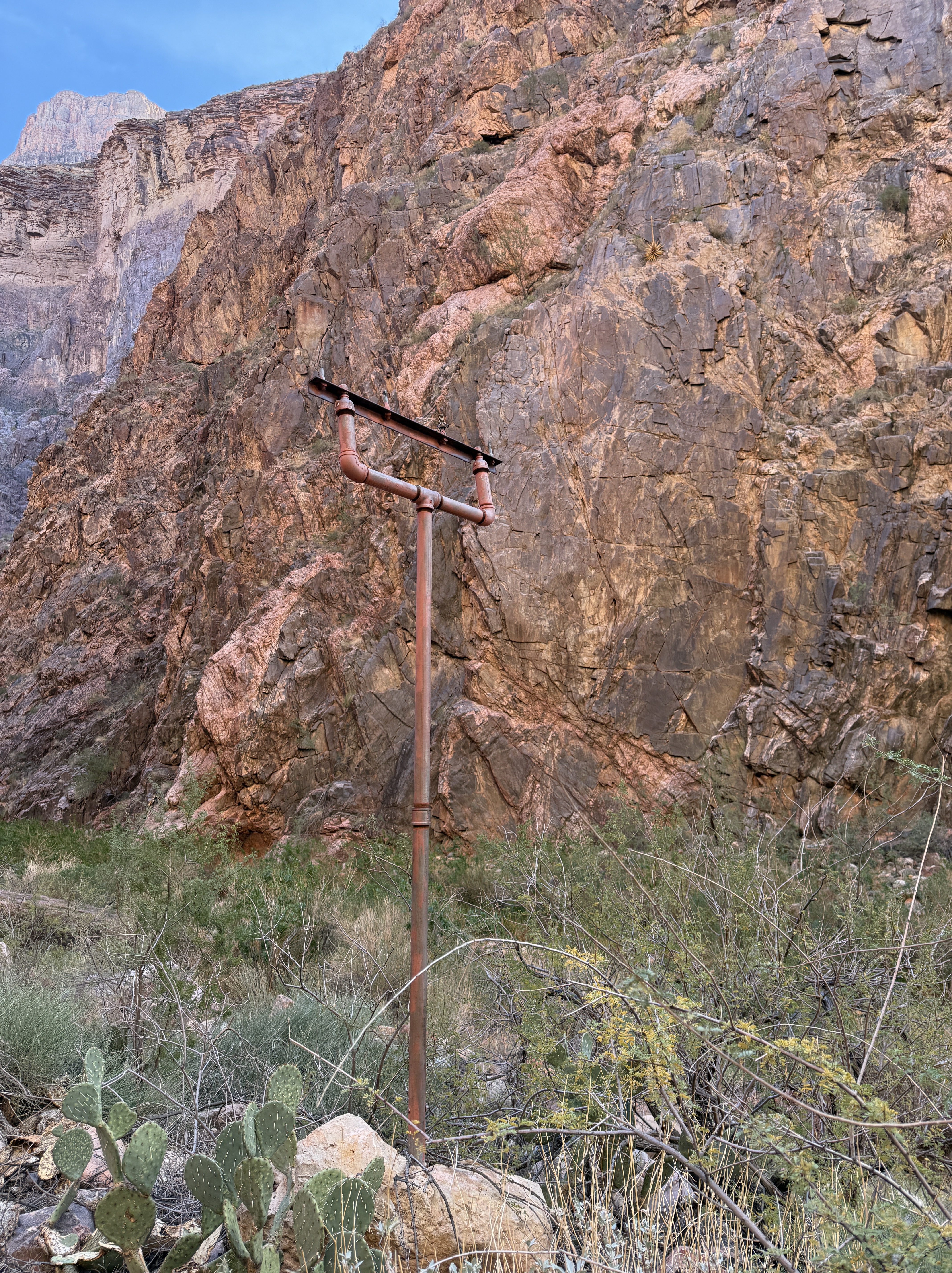
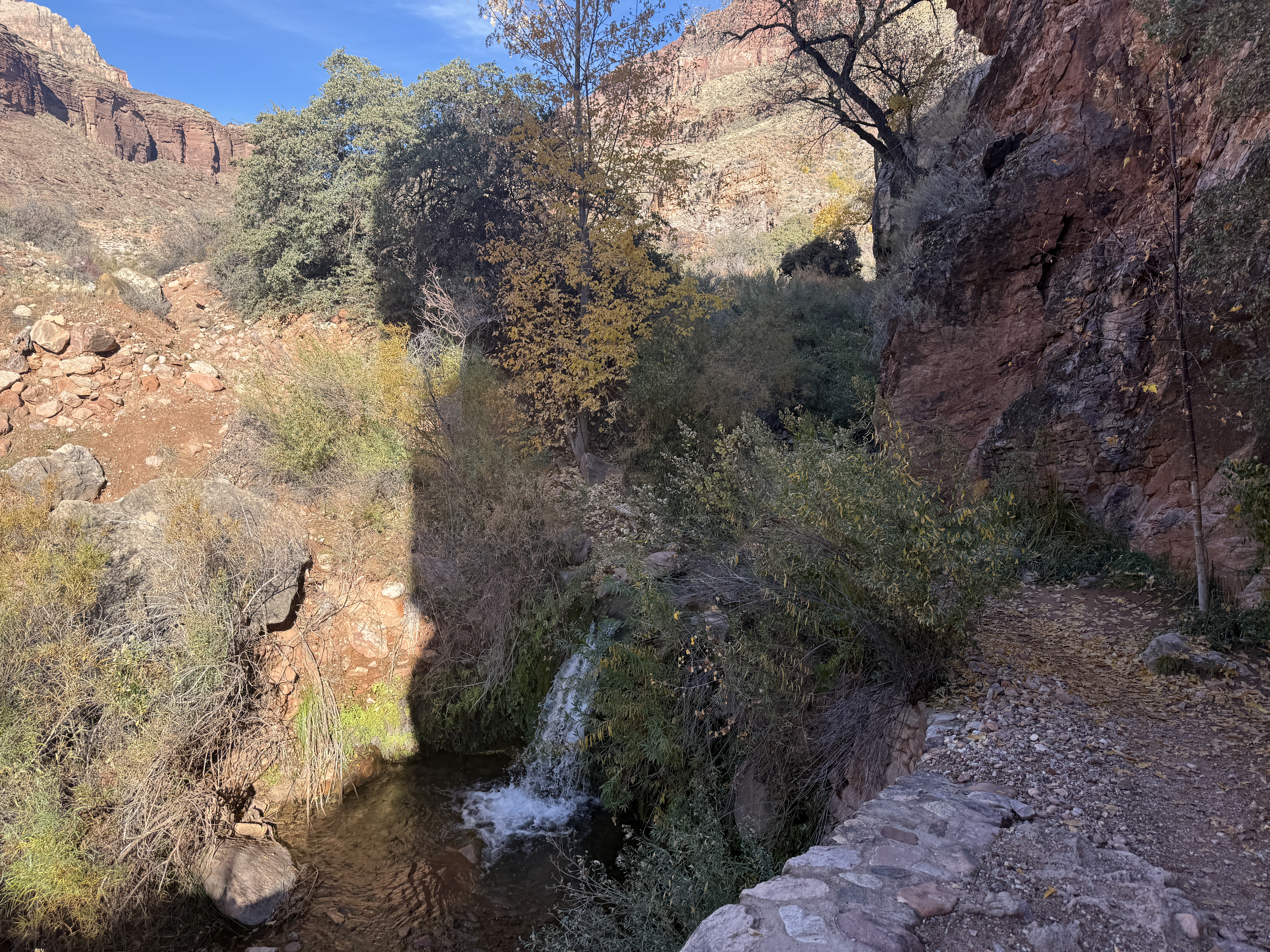
I passed by the other campsites, many of them devoid of people and gear, except for the last site before exiting the boundary of the campground. It was only 730am, so I assumed they were probably still sleeping. The sun would not reach the bottom of the canyon for a couple more hours. Passing by more old telegraph poles and a beautiful little waterfall, the trail continues, as it did before Cottonwood Camp, to wind along Bright Angel Creek, gaining 700 feet over the next mile and a half.

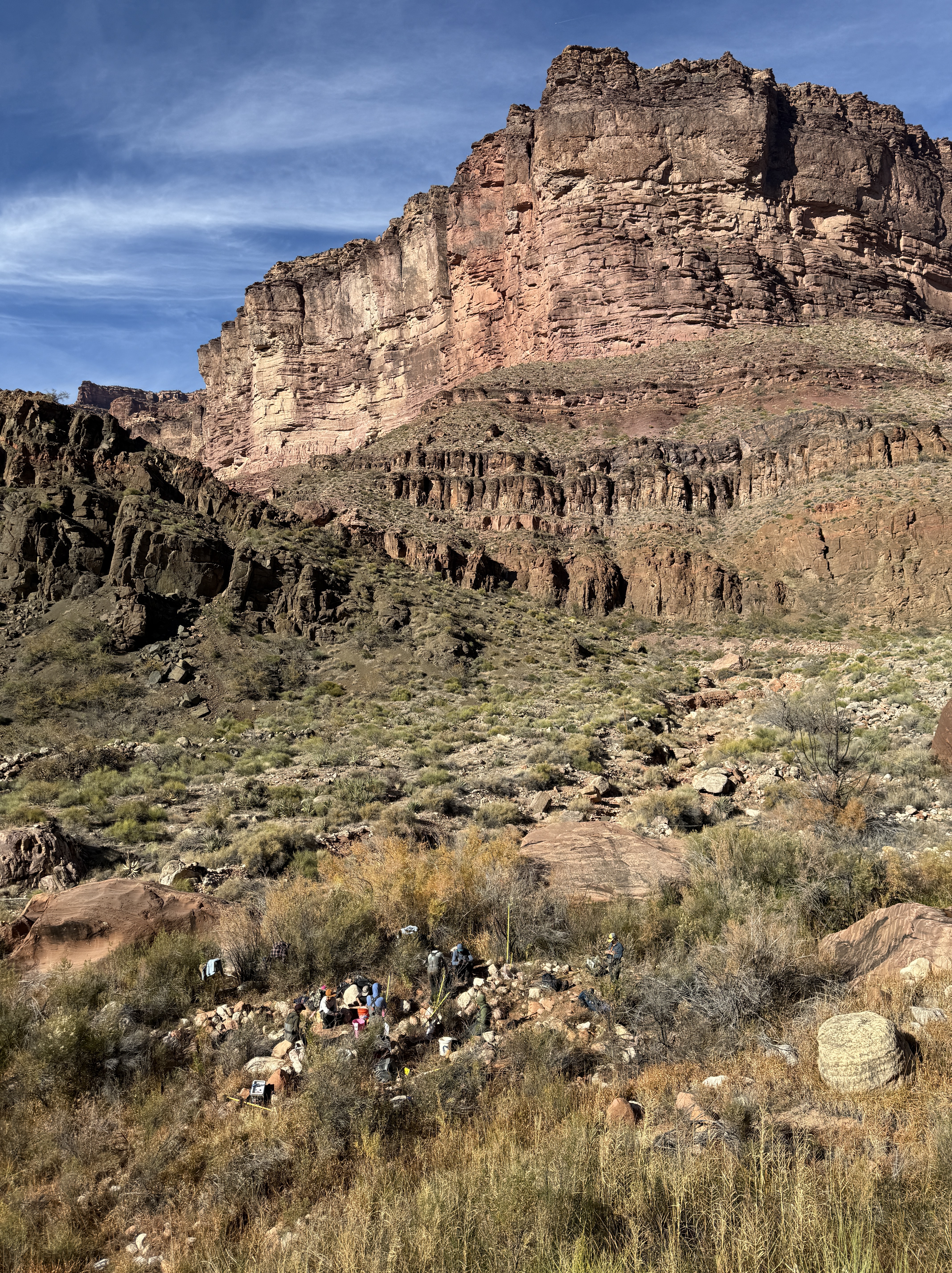
Surprisingly, I ran into a handful of people, and they explained to me that they lived at Manzanita Ranger Station for two weeks at a time and were the ones doing the fish studies below Cottonwood Camp. They made the daily trek to their work site and then would hike out to the South Rim for their time off. It reminded me of my wildland firefighting days, living and working in the remote wilderness for weeks at a time.

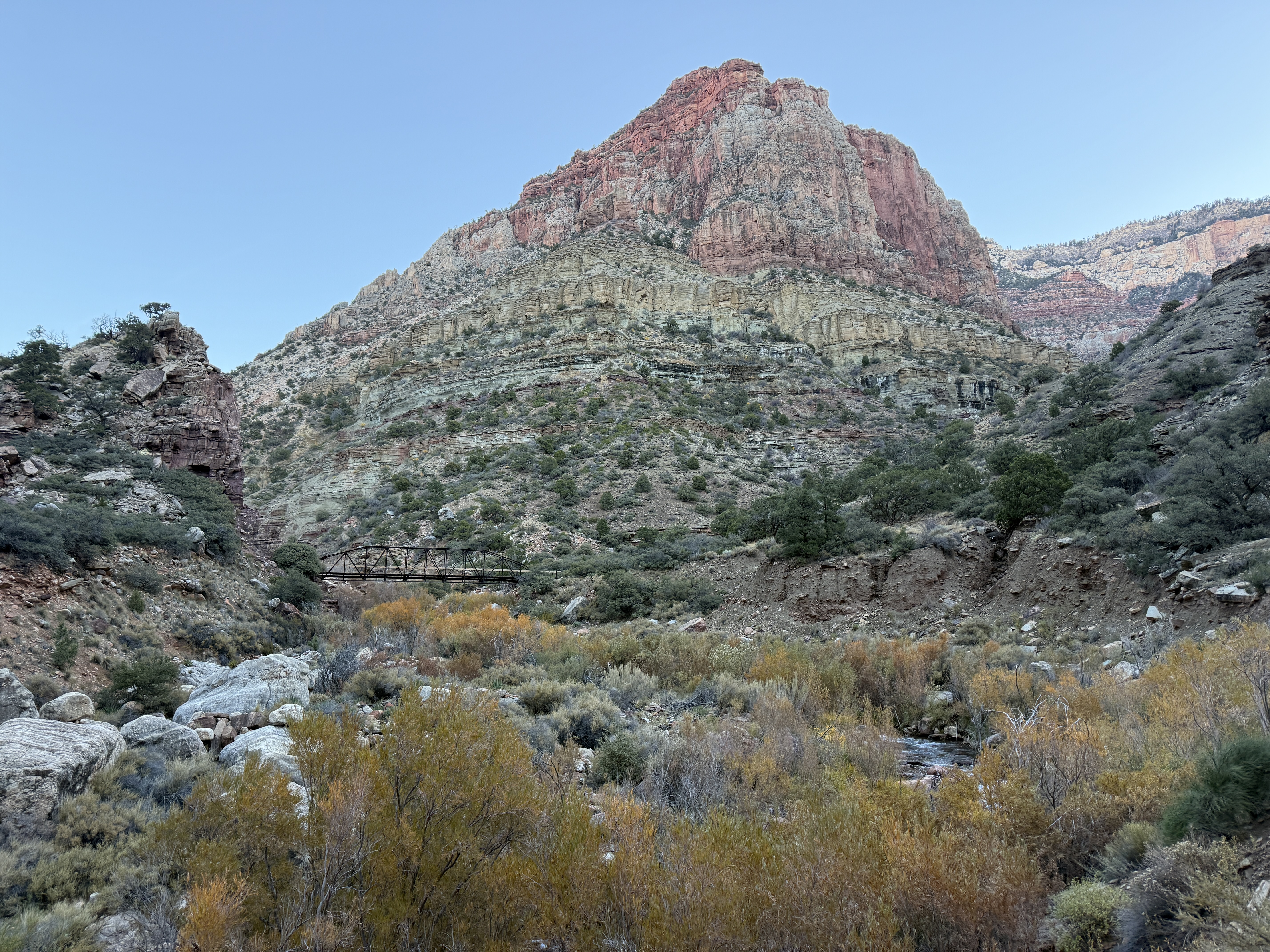
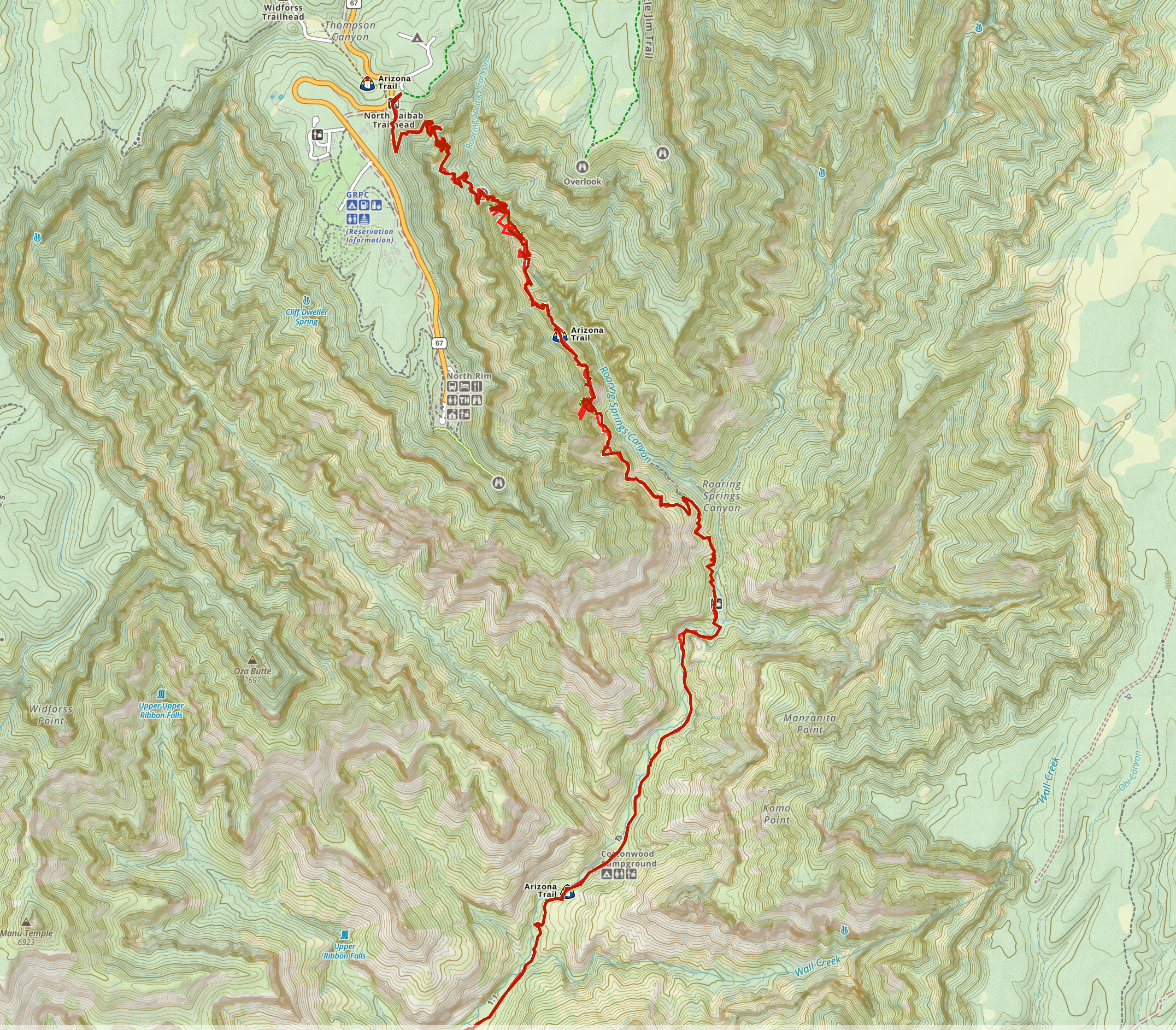
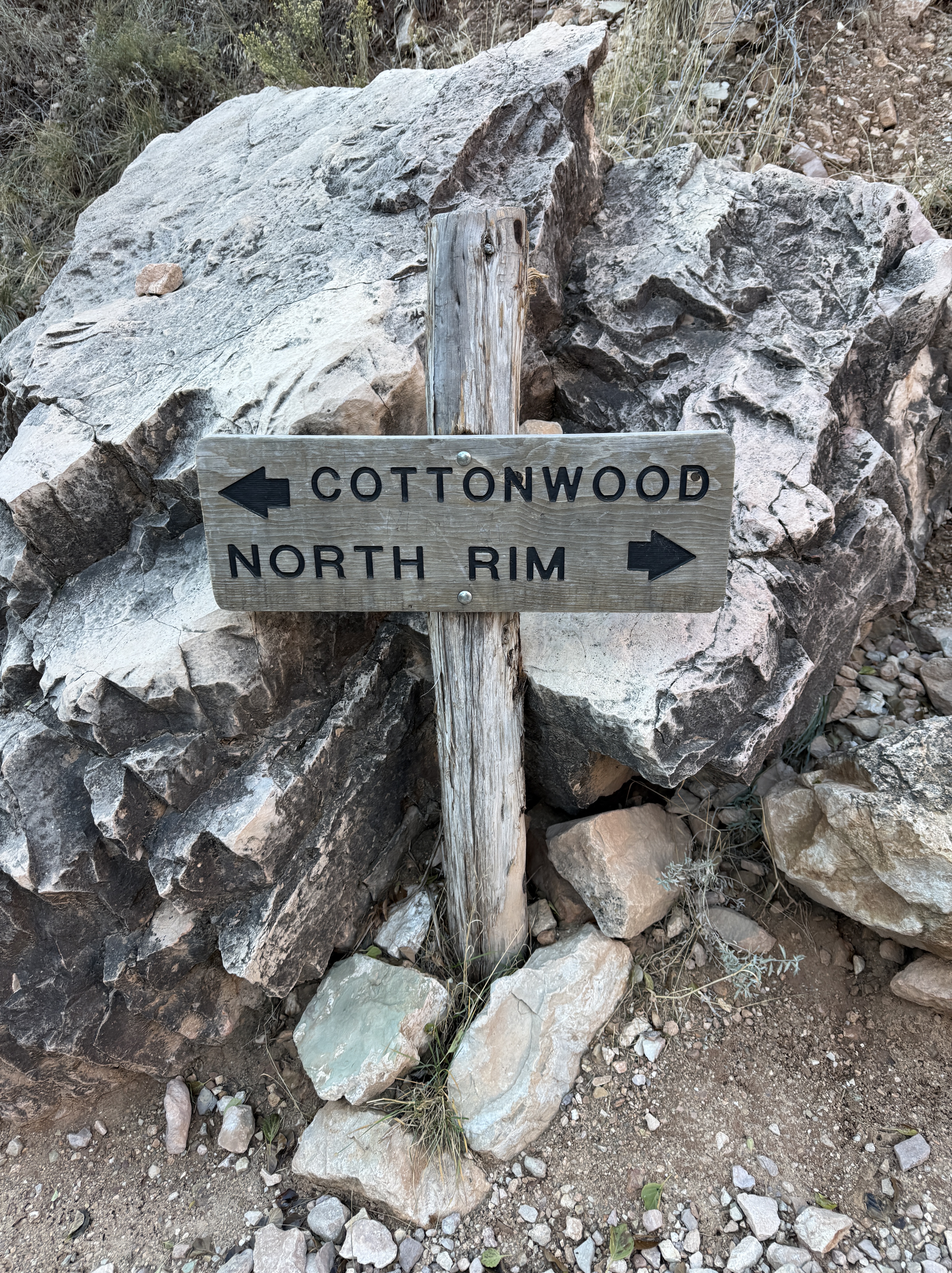
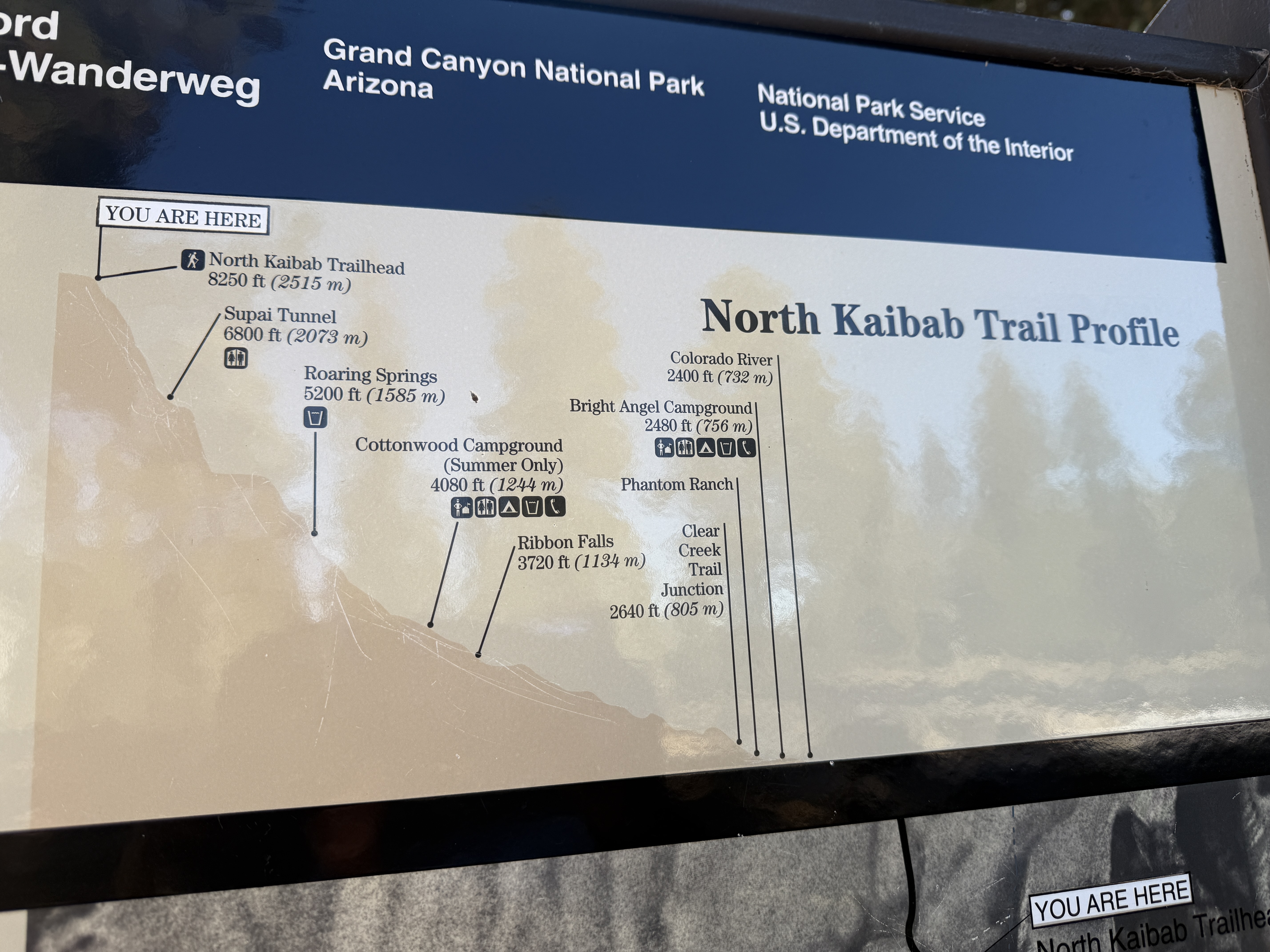
About a half an hour after leaving camp, I came upon a stout truss bridge that crossed from east to west over Bright Angel Creek. It is here that I would leave the pre-1928 trail, AKA “Old Bright Angel Trail”, that continued up to the rim along Bright Angel Creek. This historic trail was deemed too hazardous and ill-maintained to become the main hiking and pack mule route in the National Parks Service’s bid to bring more tourists into the Canyon, and the North Kaibab Trail that we know now was constructed in the winter months between 1926 and 1928. It was maintained and improved by the CCC in the 1930s. The efforts expended were well worth it; the North Kaibab trail is one the most incredibly engineered and well-maintained trails in the world.

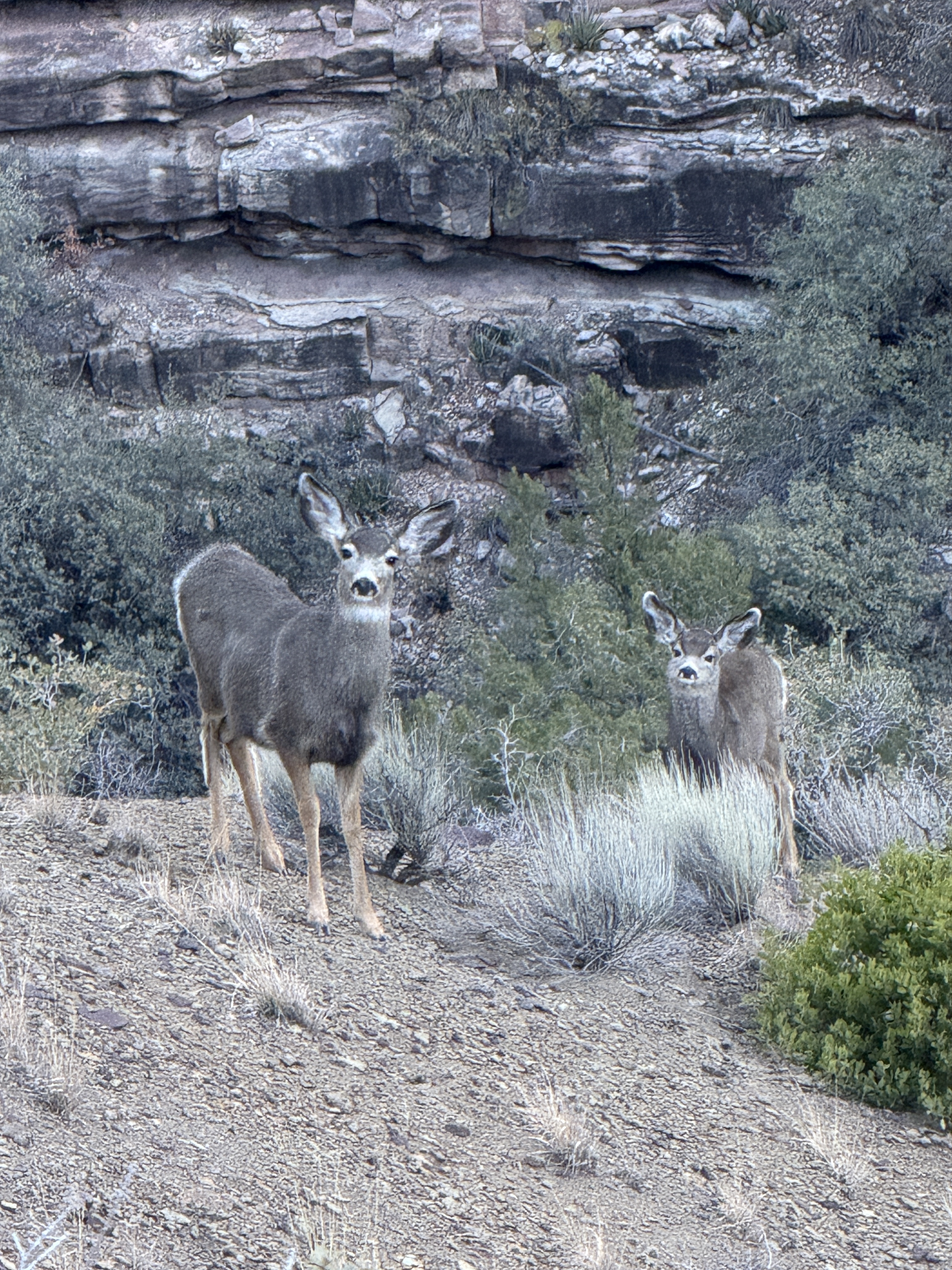
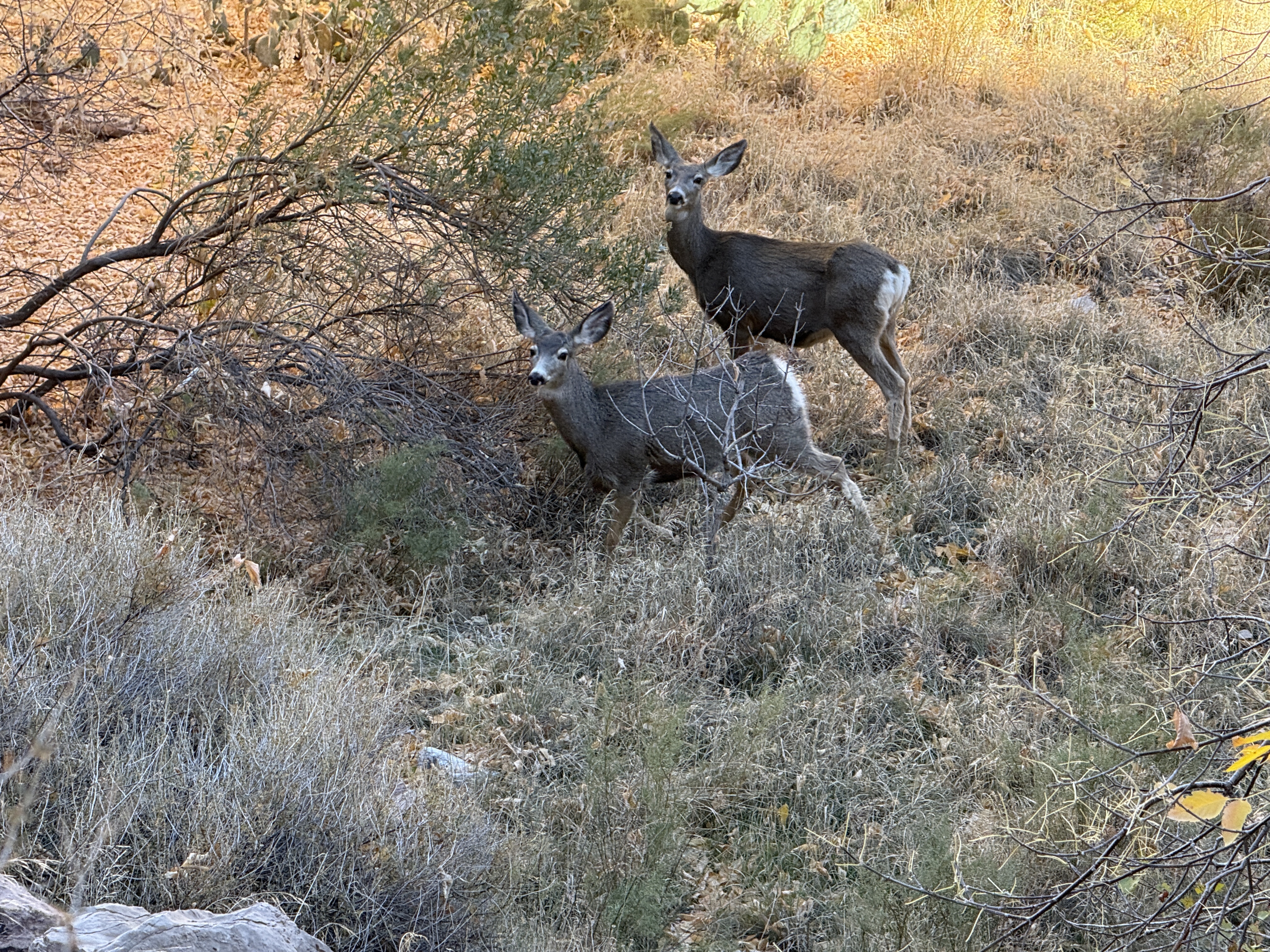
Manzanita Ranger Station was just past the bridge, offering hikers a place to rest, a composting toilet, and, during the tourist season, running potable water and a Ranger to answer all of your burning questions. I stopped to take photos of a herd of mule deer that were mulling around and was surprised when I looked up and saw two young men taking a break. We struck up a conversation and I learned that they were the people camped at the last site at Cottonwood, apparently having gotten up and moving before me and not, in fact, still asleep in their tent. They had the same intention as I did, to hike the 13 miles and +4,000′ to the North Rim as a day hike, although one of them had a knee that was giving him trouble.

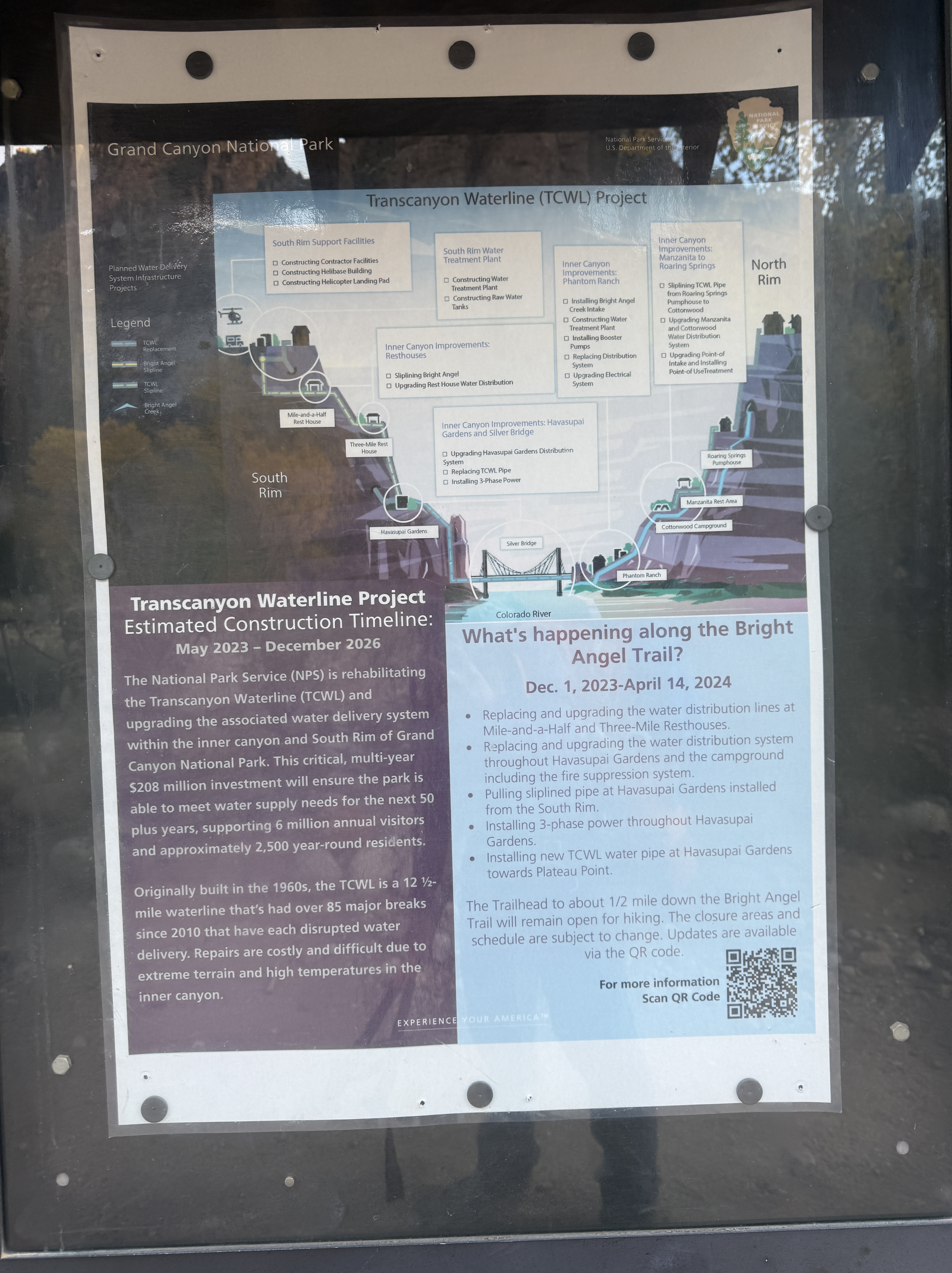
We traveled along together, passing Roaring Springs, the main water source for the Grand Canyon corridor and South Rim. This giant waterfall sprouts from the middle of the canyon wall, spilling hundreds of feet to feed the Transcanyon Waterline. The waterline runs down to the Colorado River and once the head pressure dissipates on the Tonto Plateau at Havasupai Gardens, it is pumped to the top of the South Rim; an amazing feat of engineering that was completed in the 1960s. The much-needed upgrades that were happening during and after my trip, throughout the winter of 24/25, would hopefully eliminate the constant need to repair the aging pipes and offset the high cost to do so, much of the pipe only being accessible by helicopter, foot, or mule.

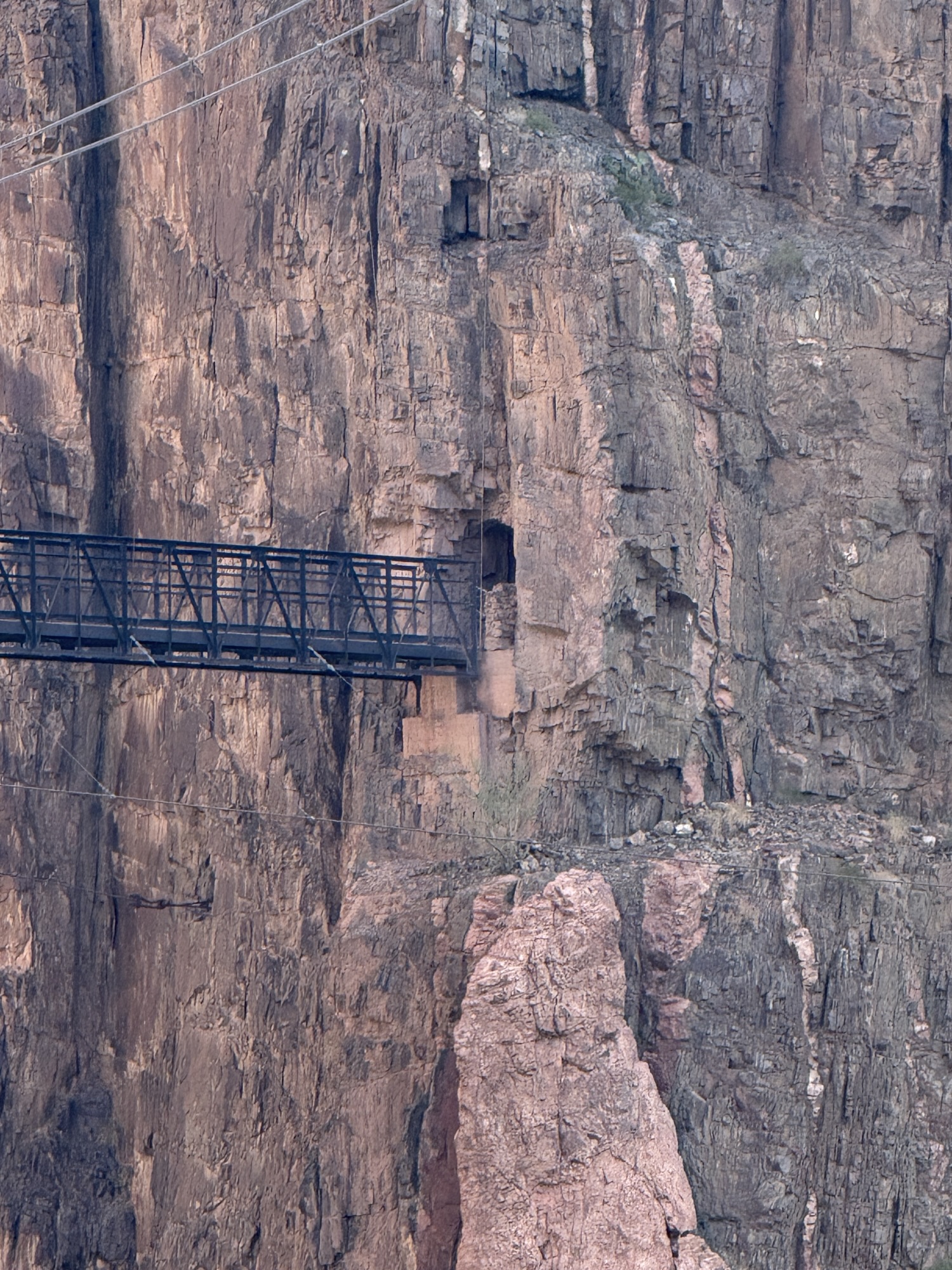
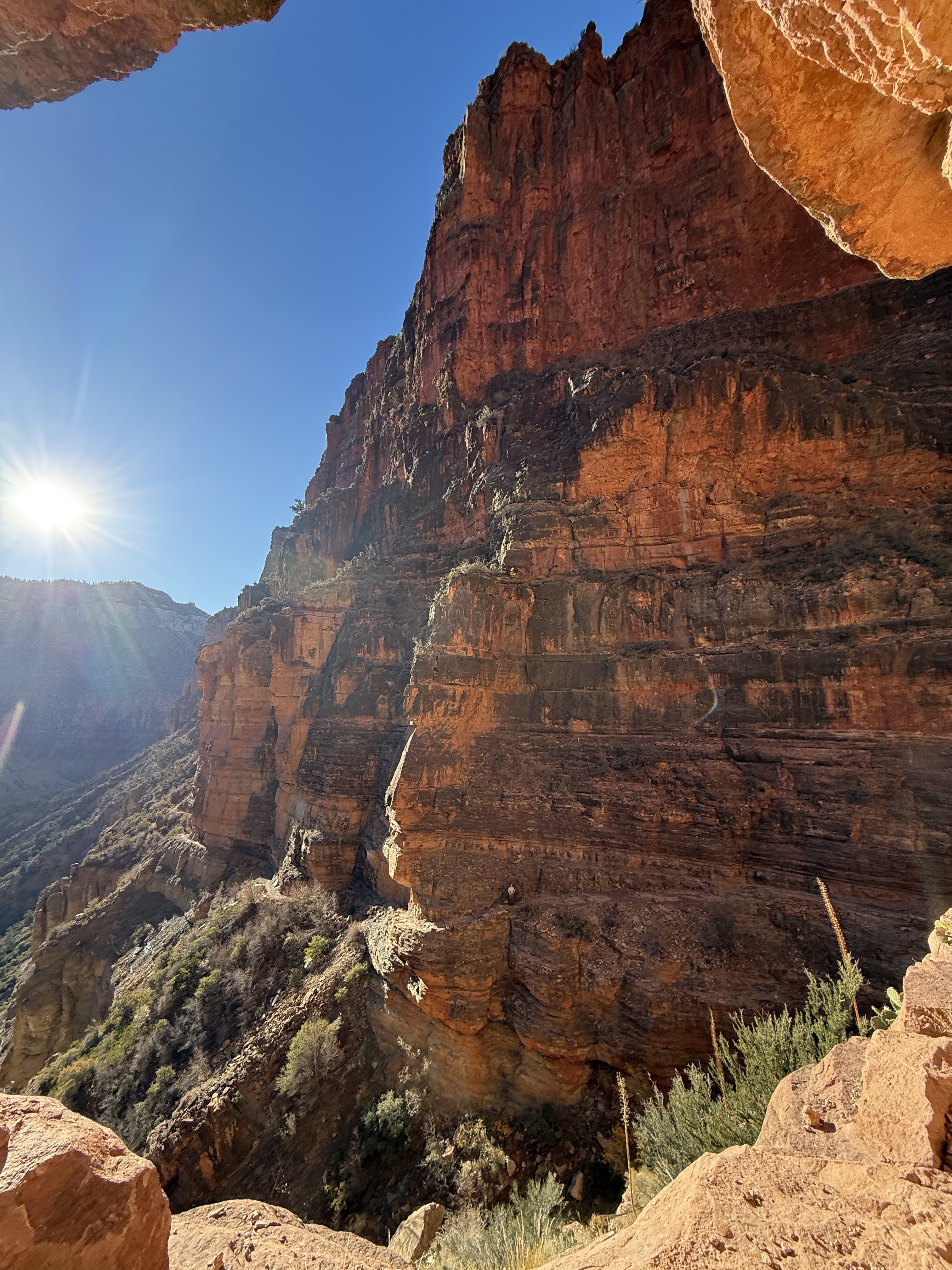
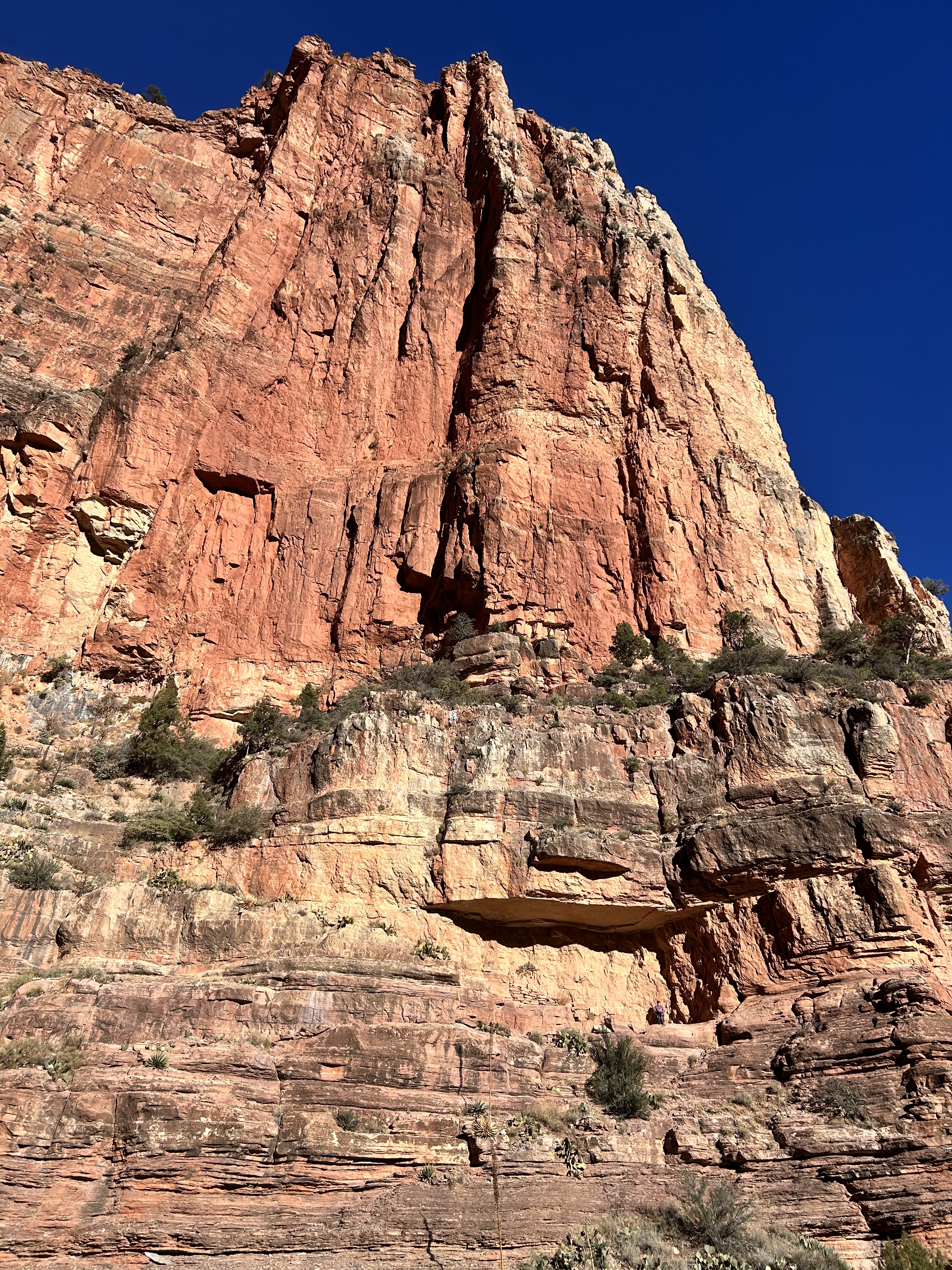
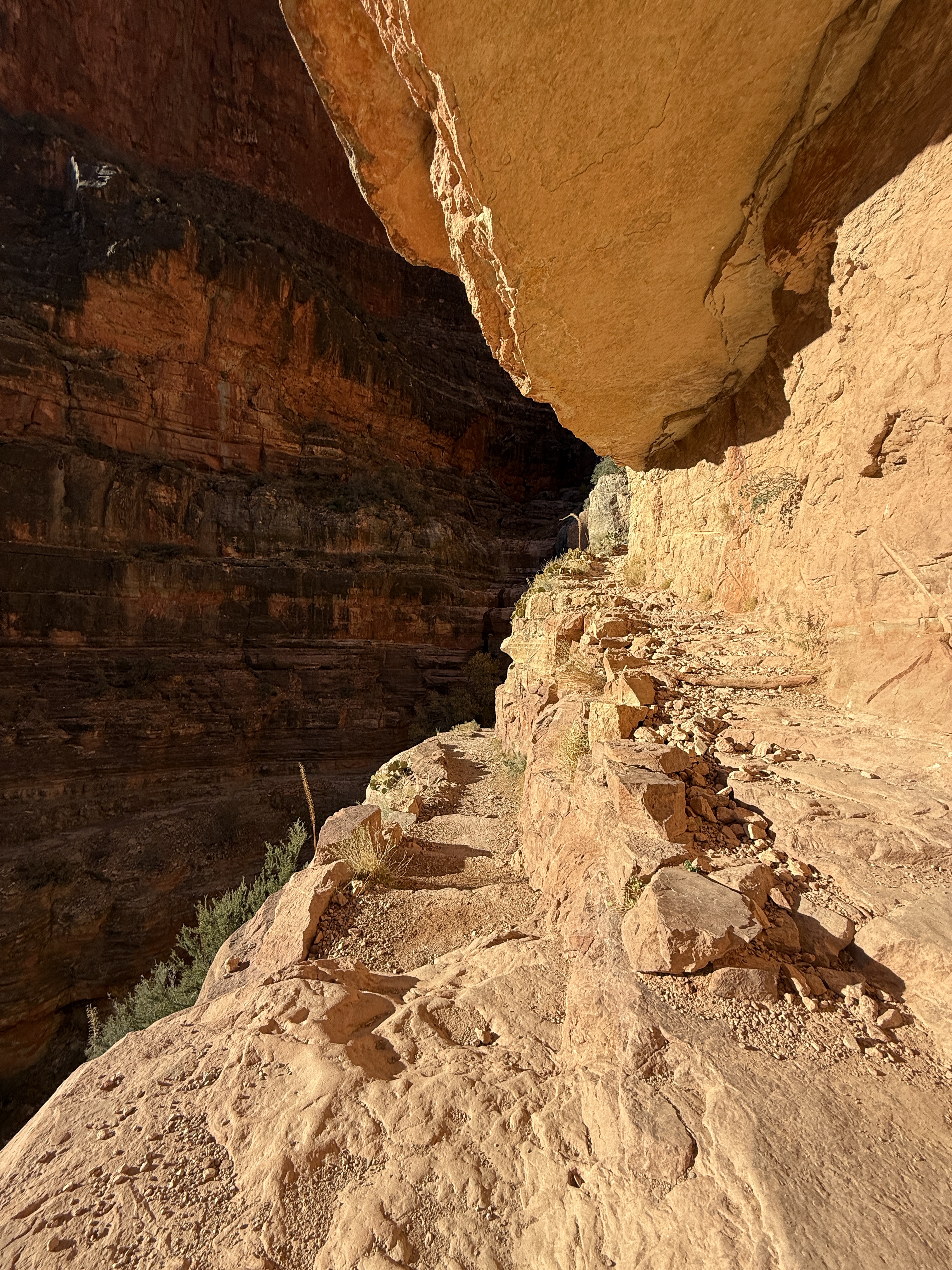
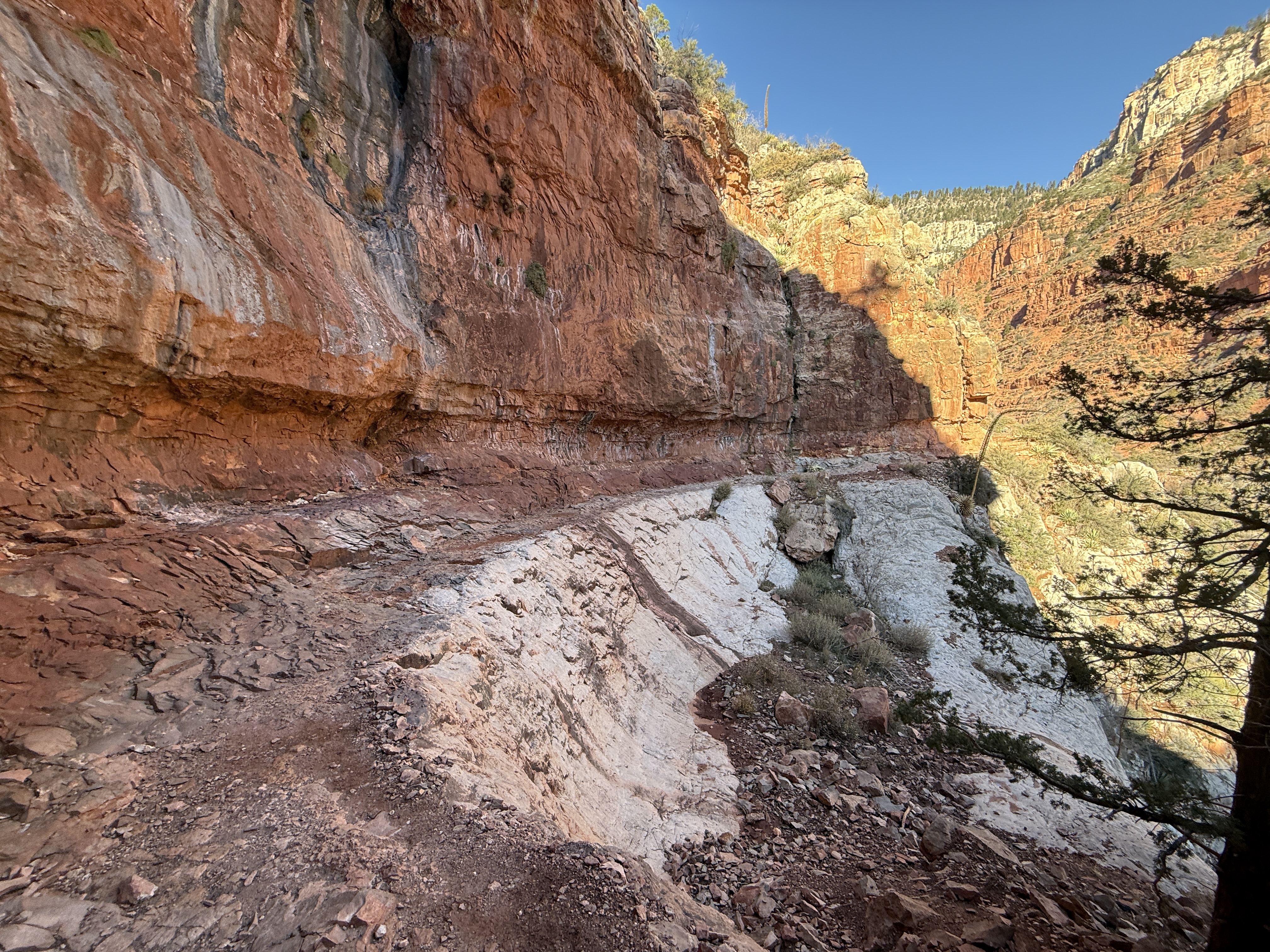
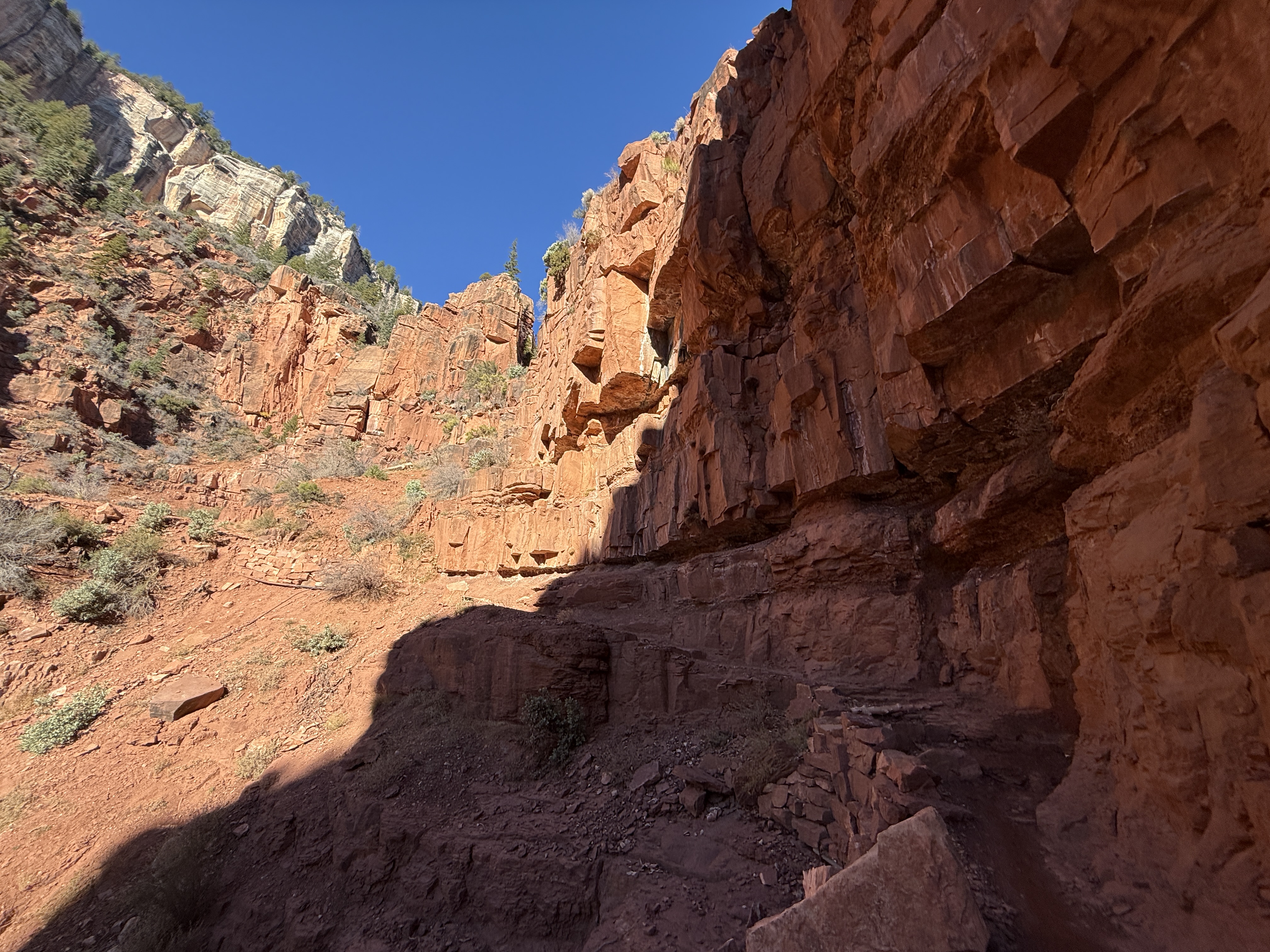
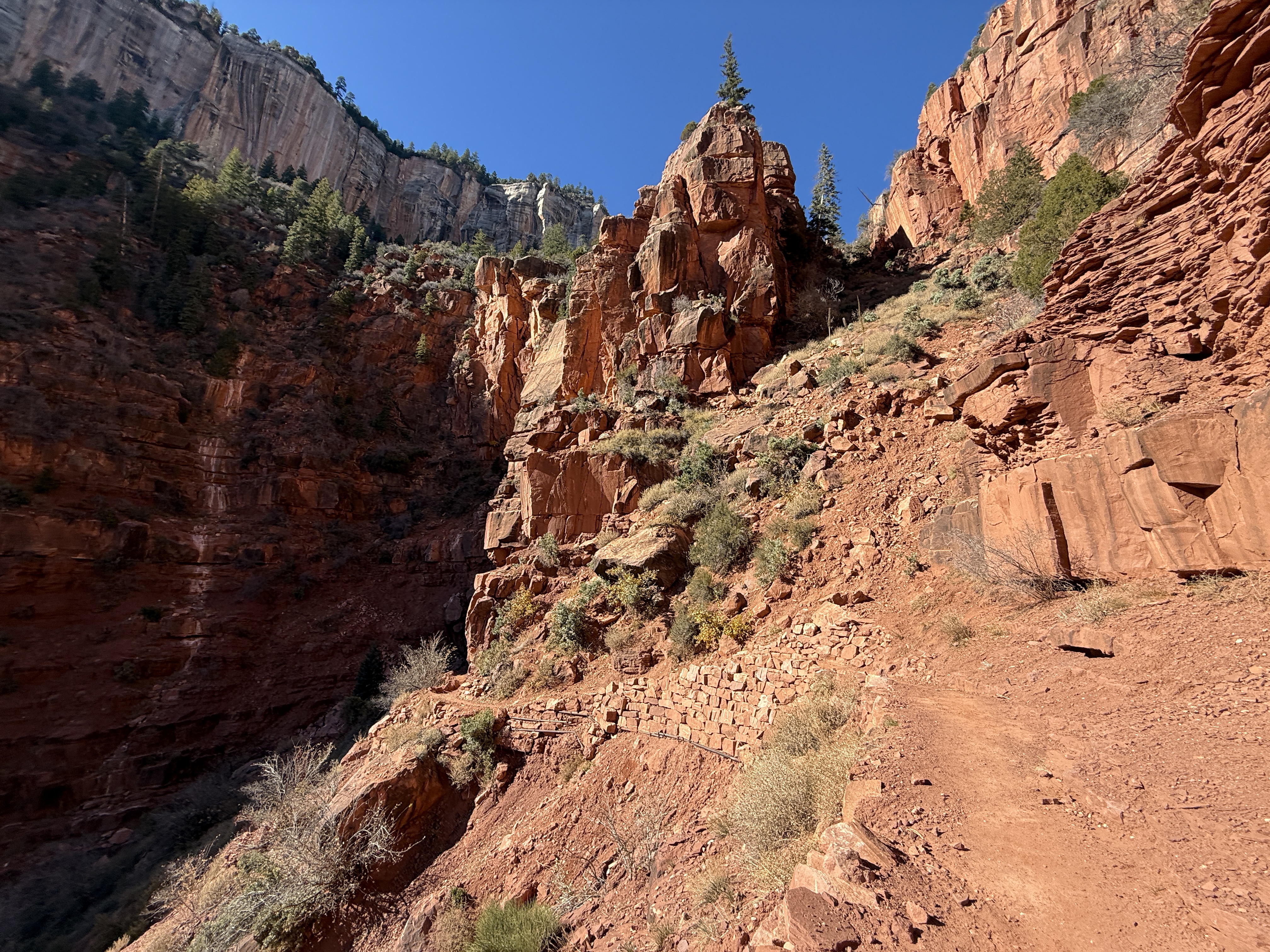
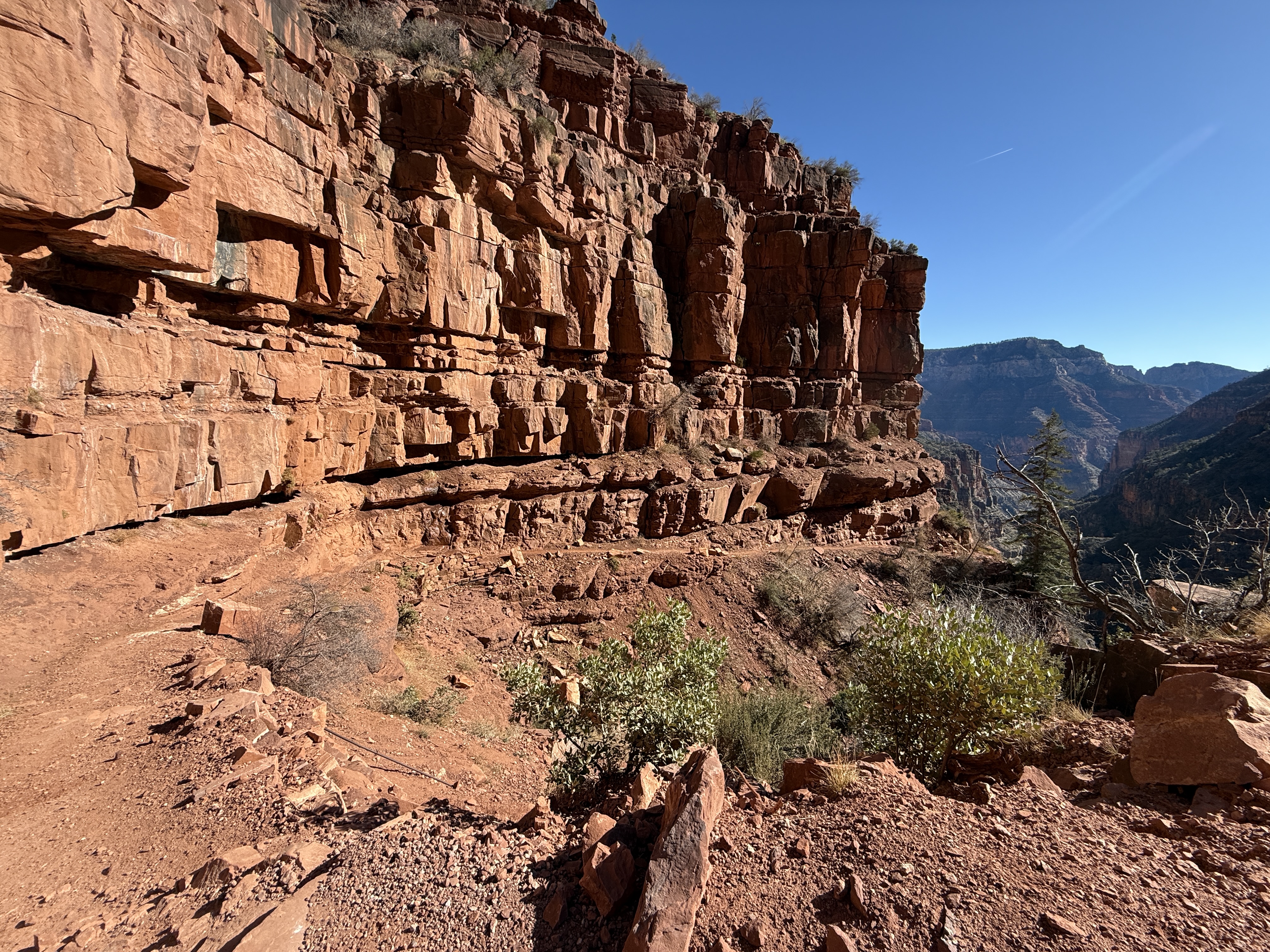
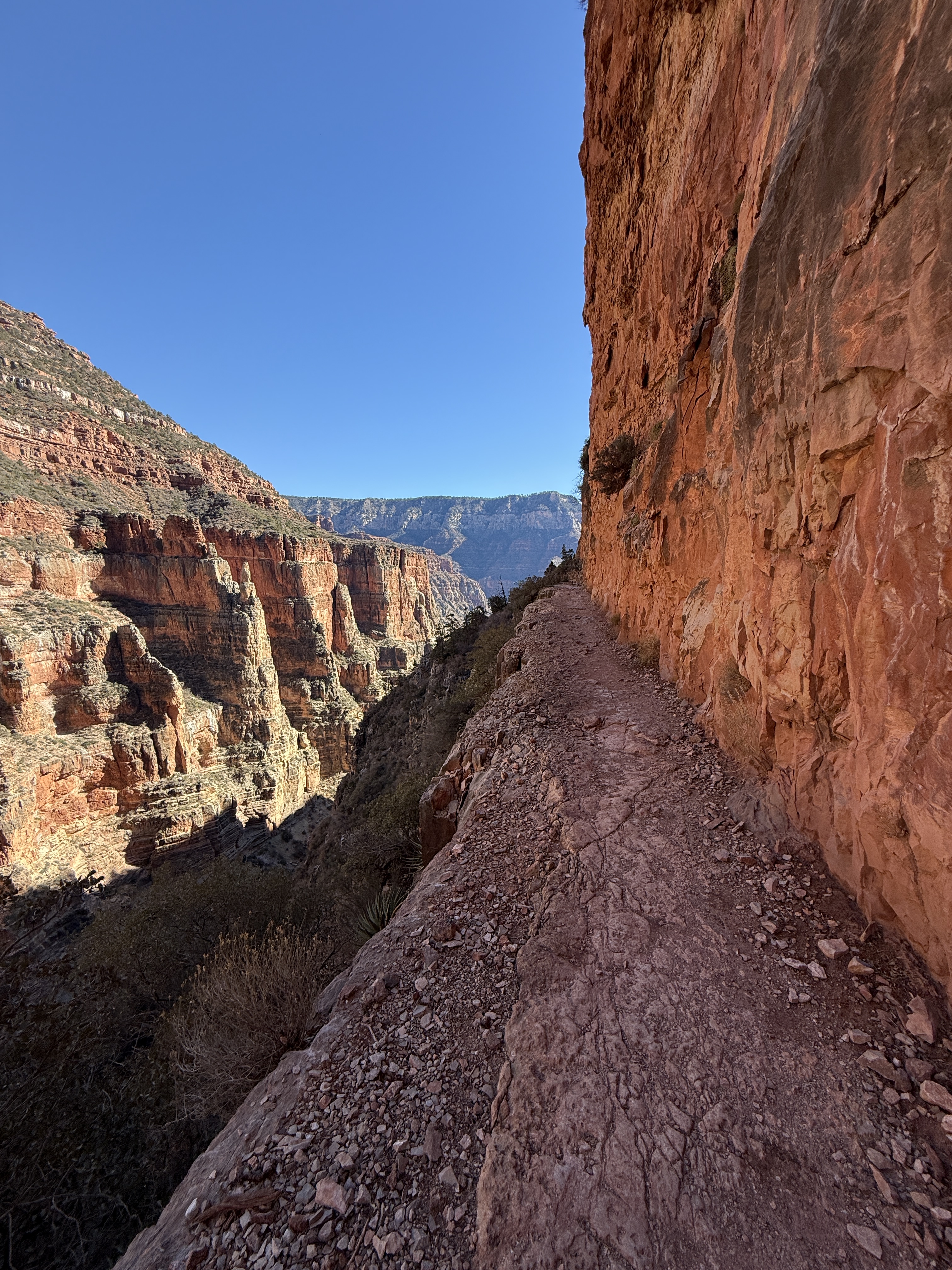
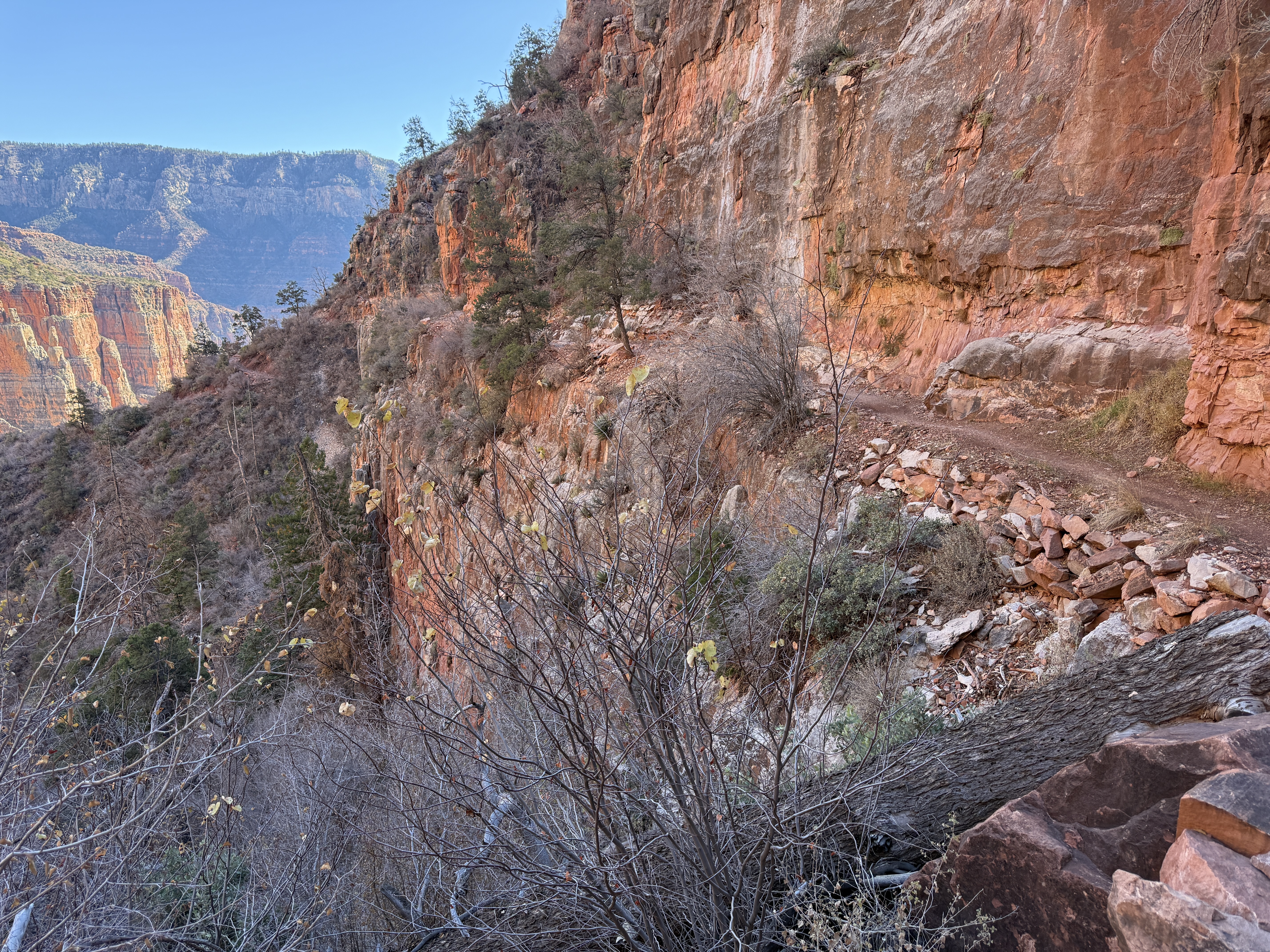
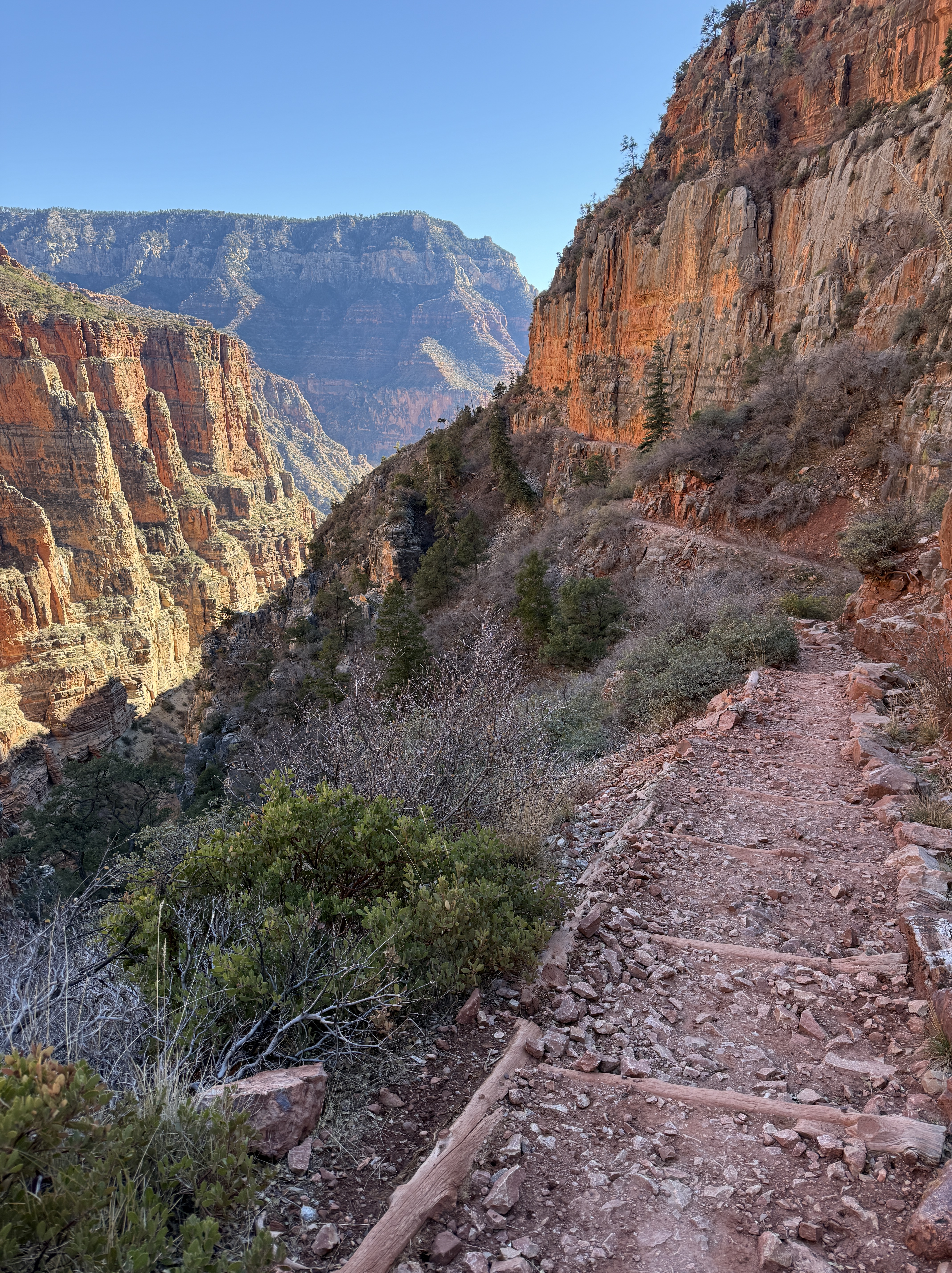
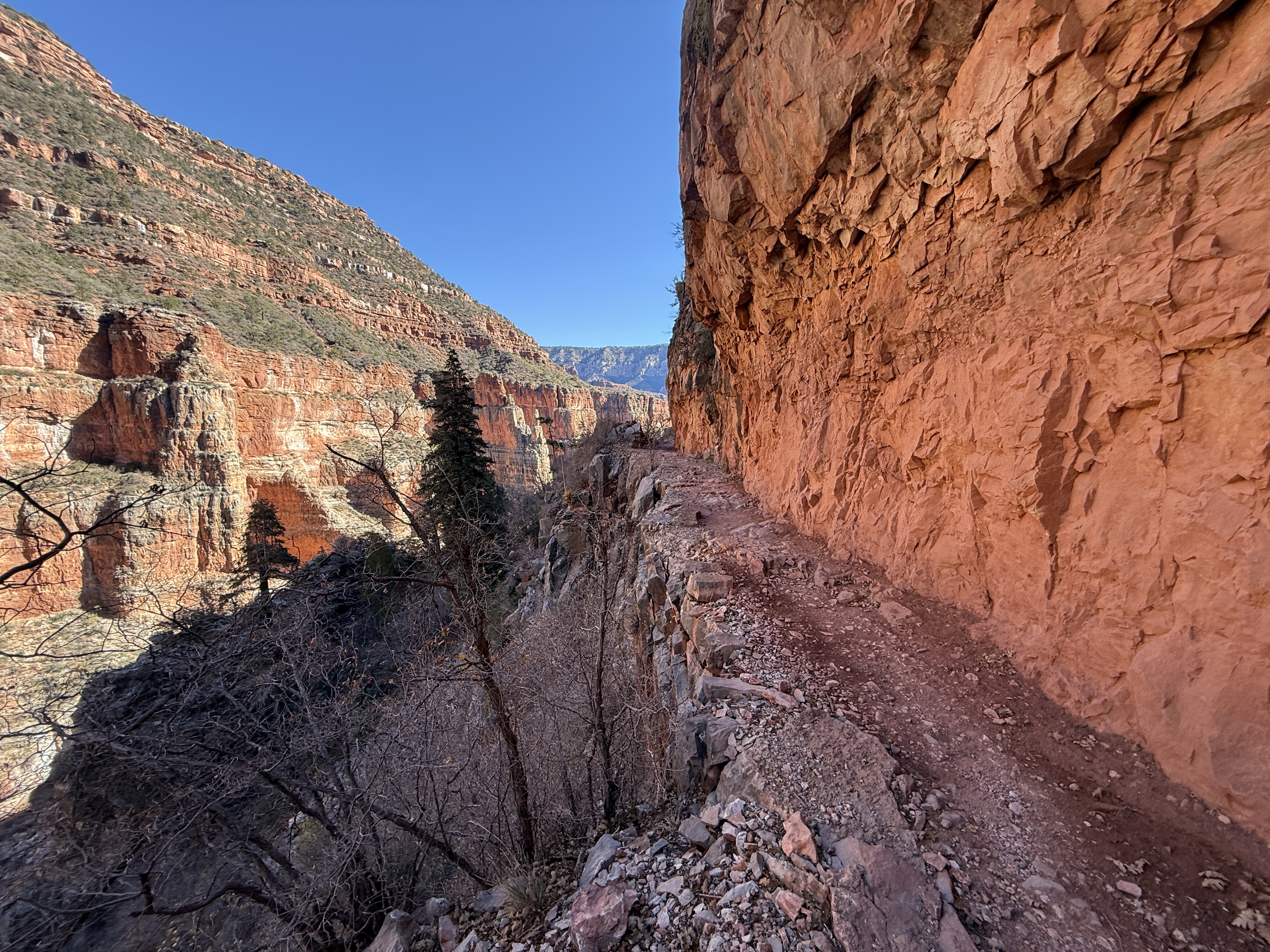
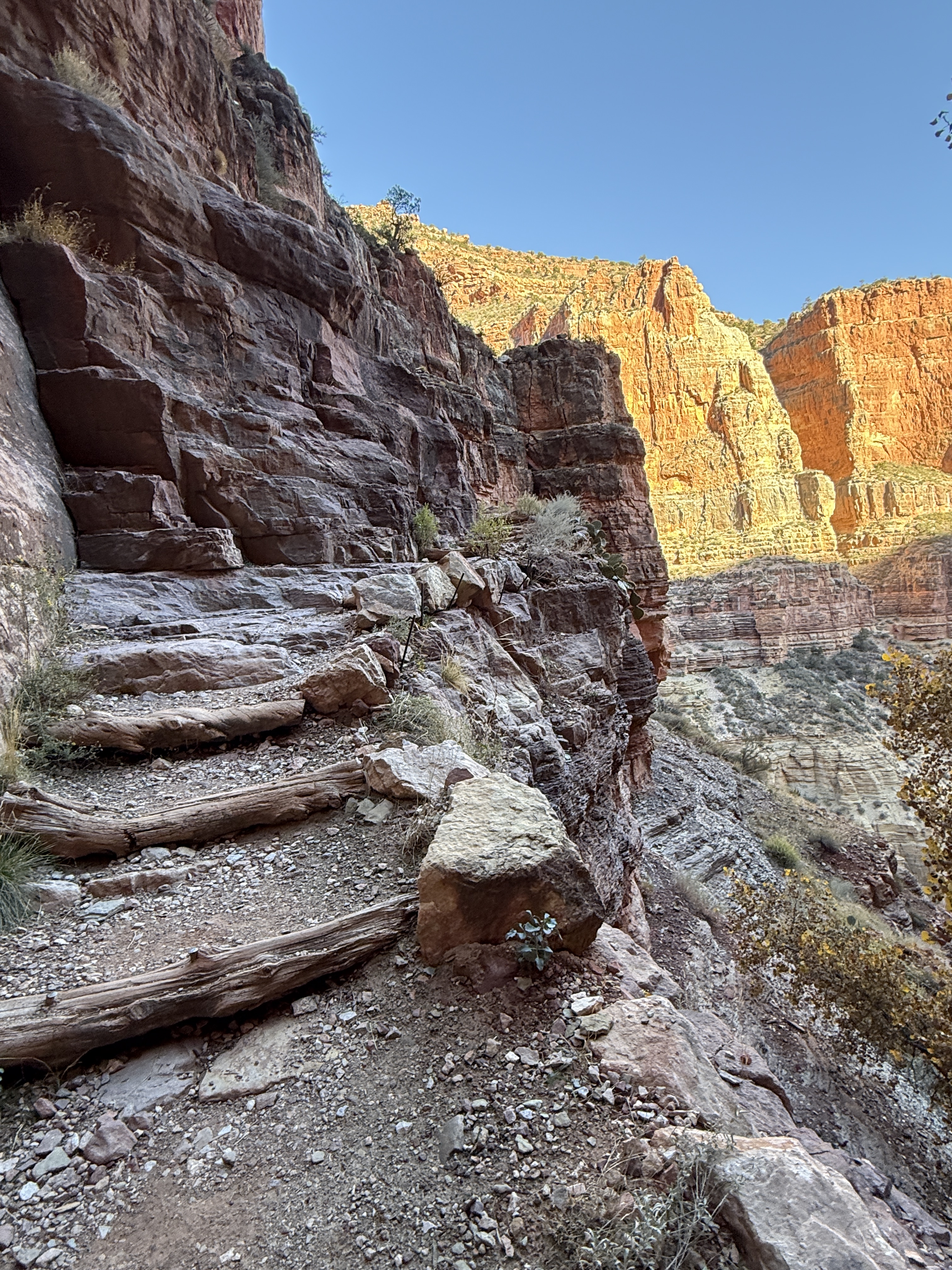
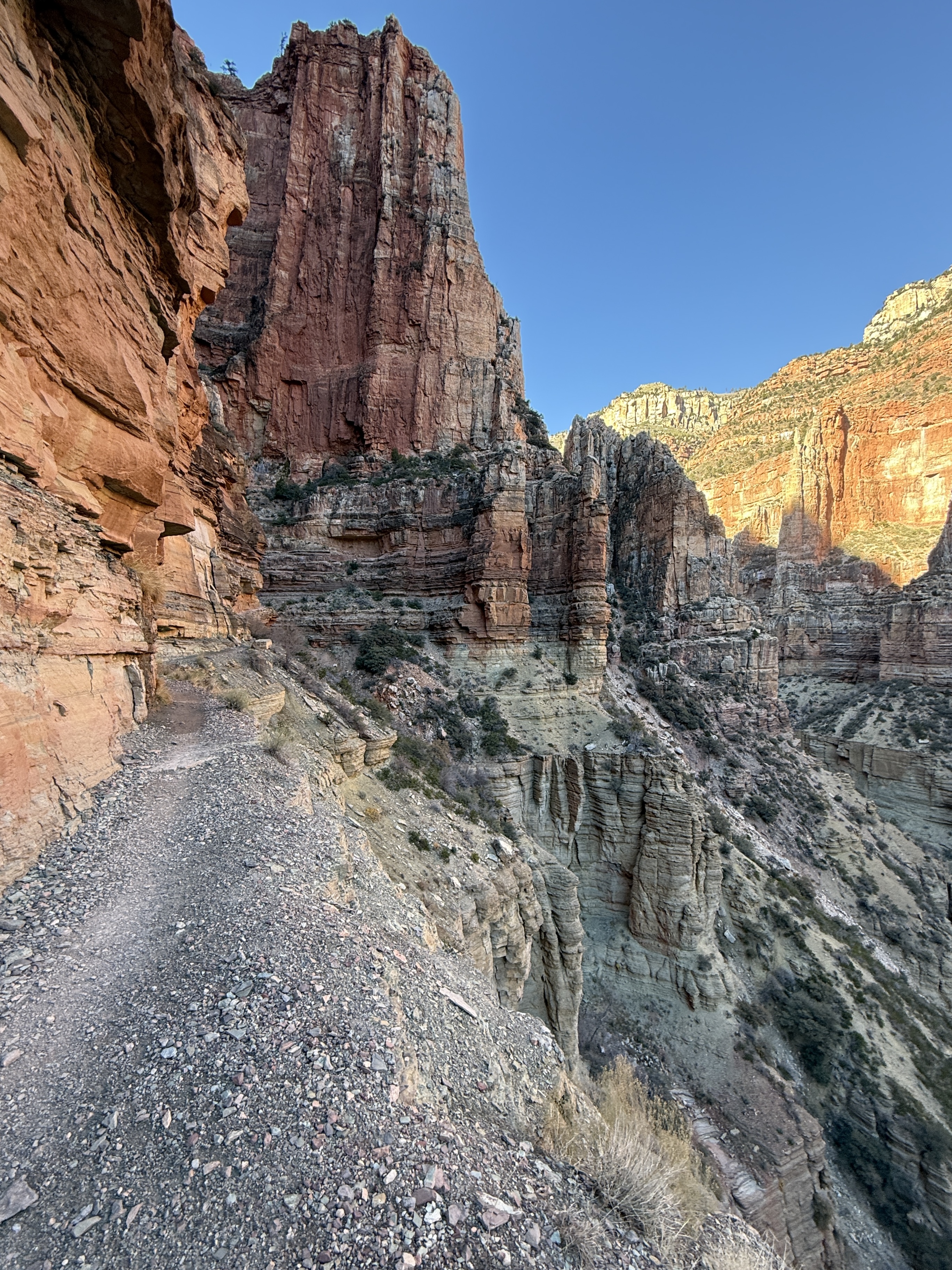
We climbed out of the bottom of the canyon and onto the face of the canyon walls, and although the trail is wide and flat with excellent footing, anyone with a fear of heights would be nervous about walking along this path with a vertical wall on one side and a fatal fall drop-off on the other. As we rounded a corner, we tried to decipher exactly where the trail was. It looked like sheer cliff face with no chance of a path existing there, until we looked very closely and saw a rectangle shaped excavation in the wall. That had to be the trail, and I got butterflies just looking at it!

I ran up to the cut, noticing the dizzying drop to my right, while one of the guys stayed on the other side so we could take pictures of each other, tiny flies on a gigantic wall. I waved and hustled on alone; I would run into them on the way back and we could exchange photos then. The trail continued rise above the canyon floor, getting a bit narrower and more exposed, at some points nearly 1,000 feet above the bottom of Roaring Springs Canyon. The pictures really do speak for themselves. I was having the time of my life!

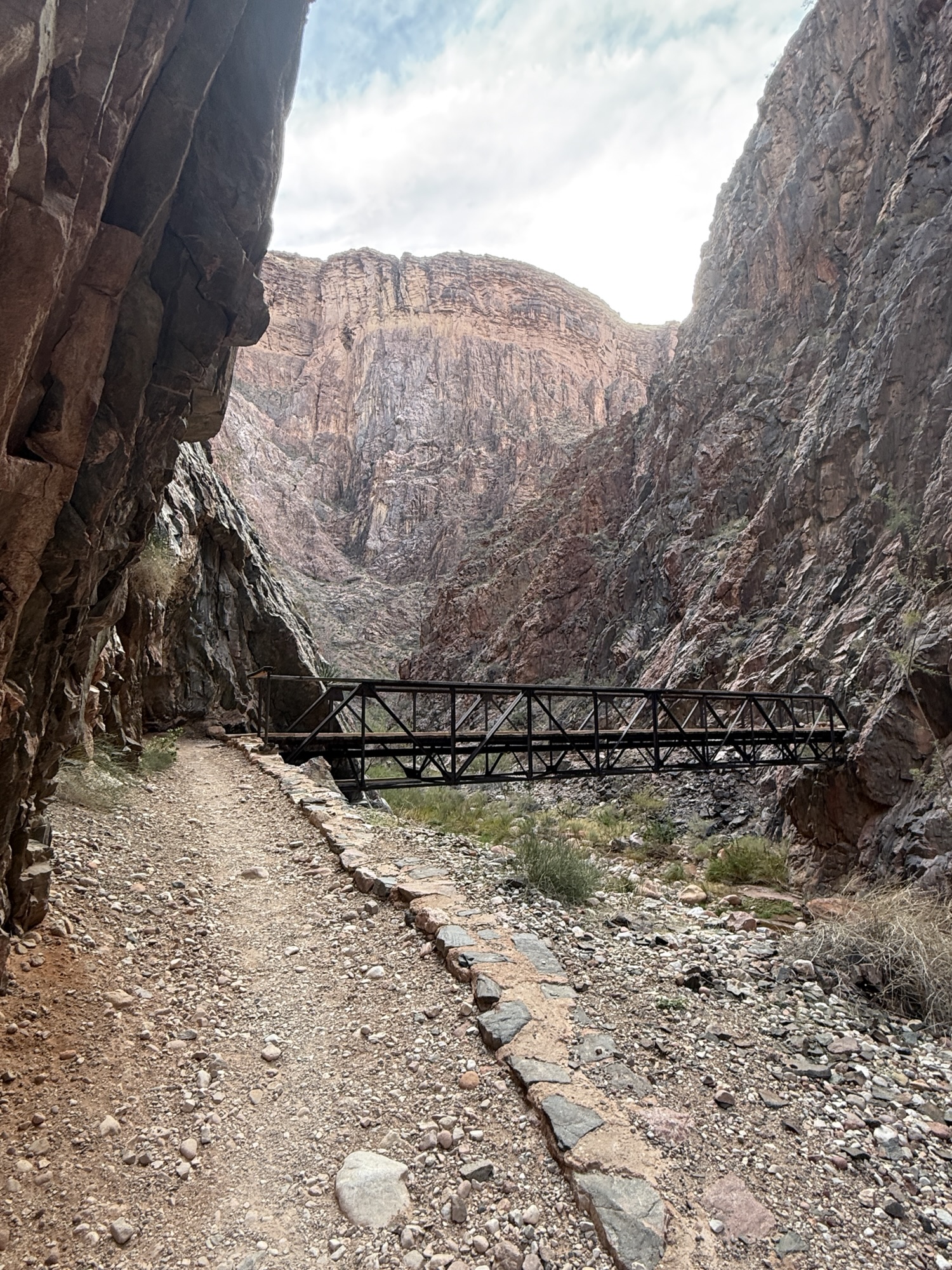
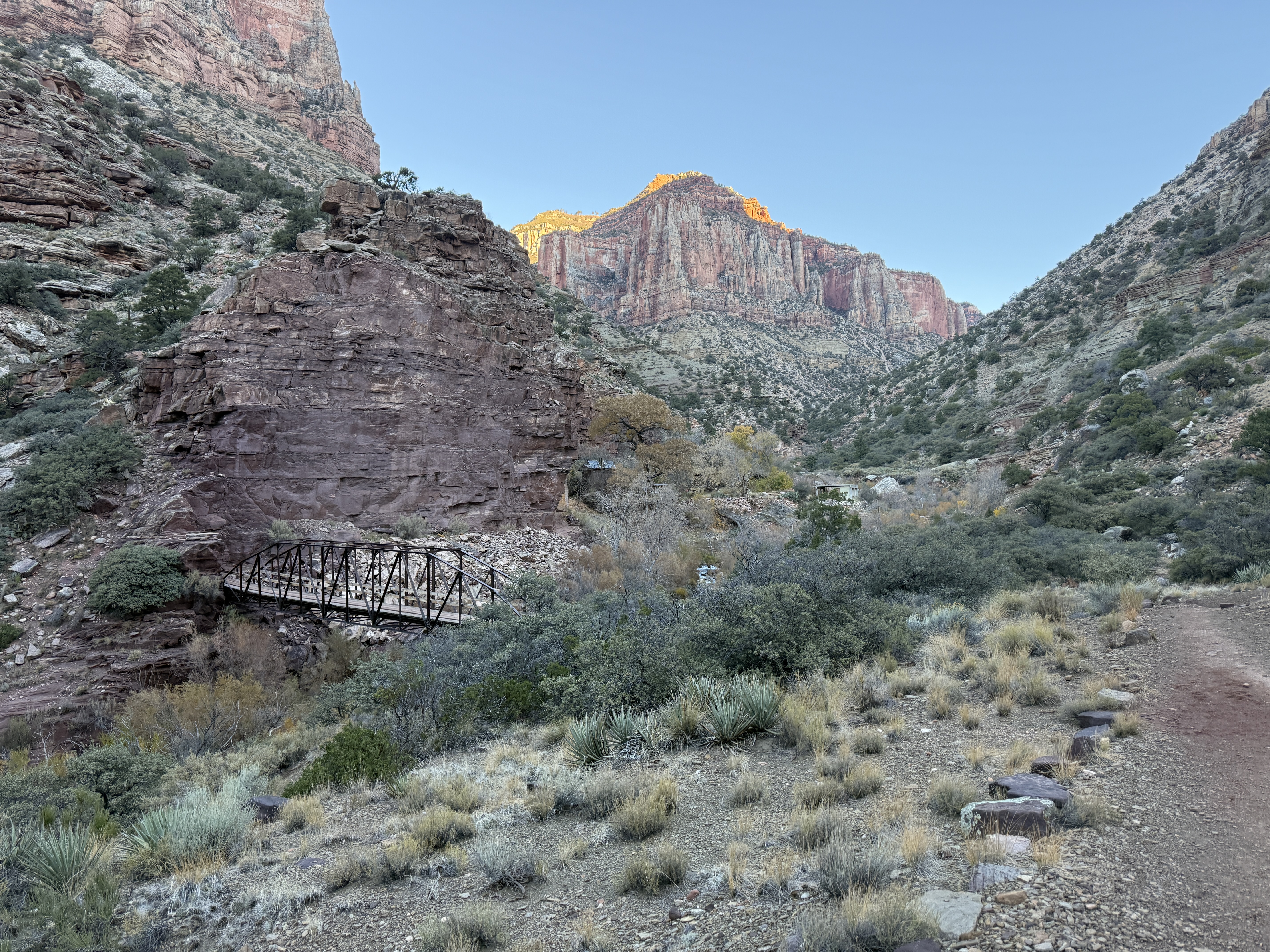
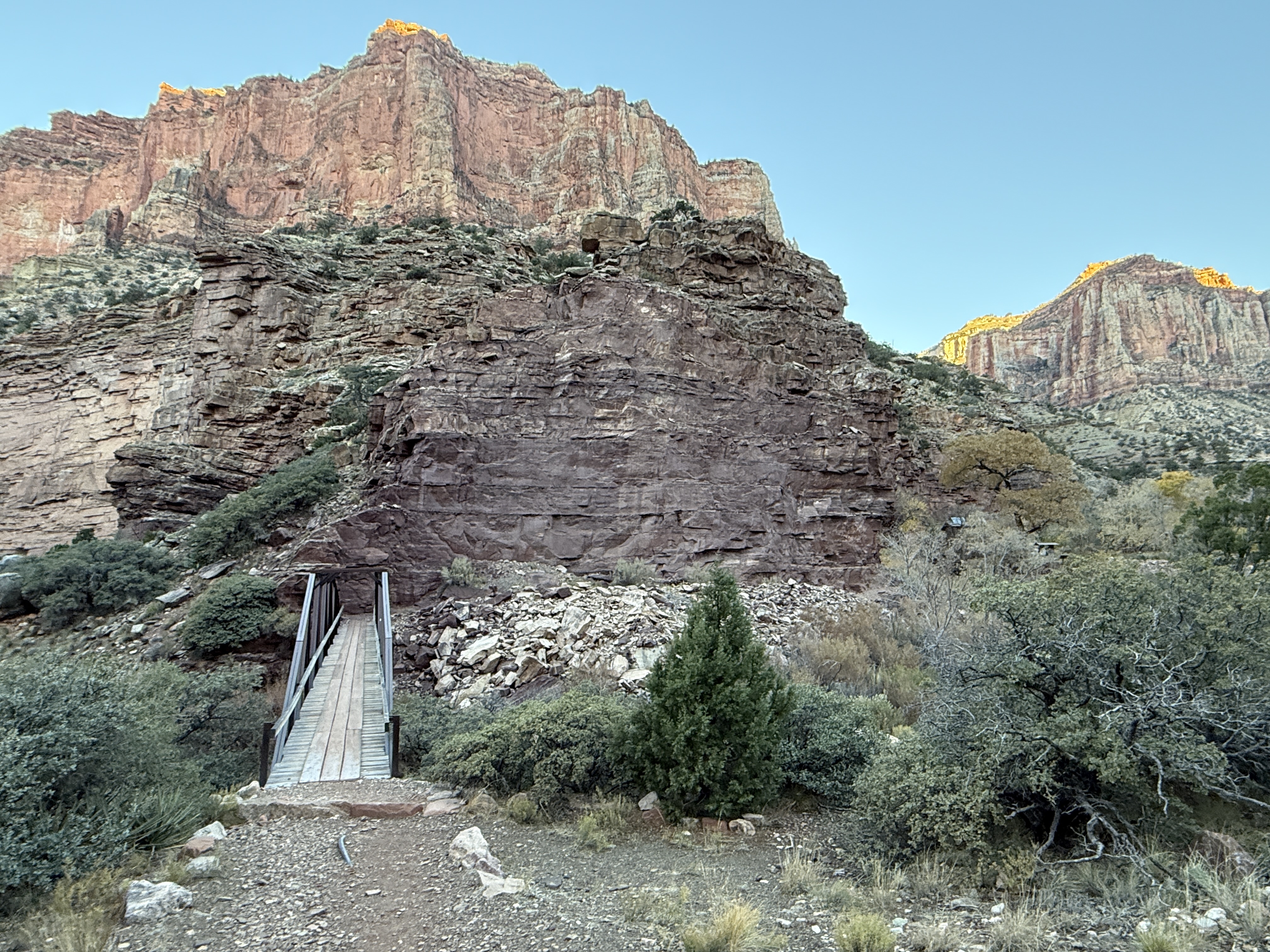
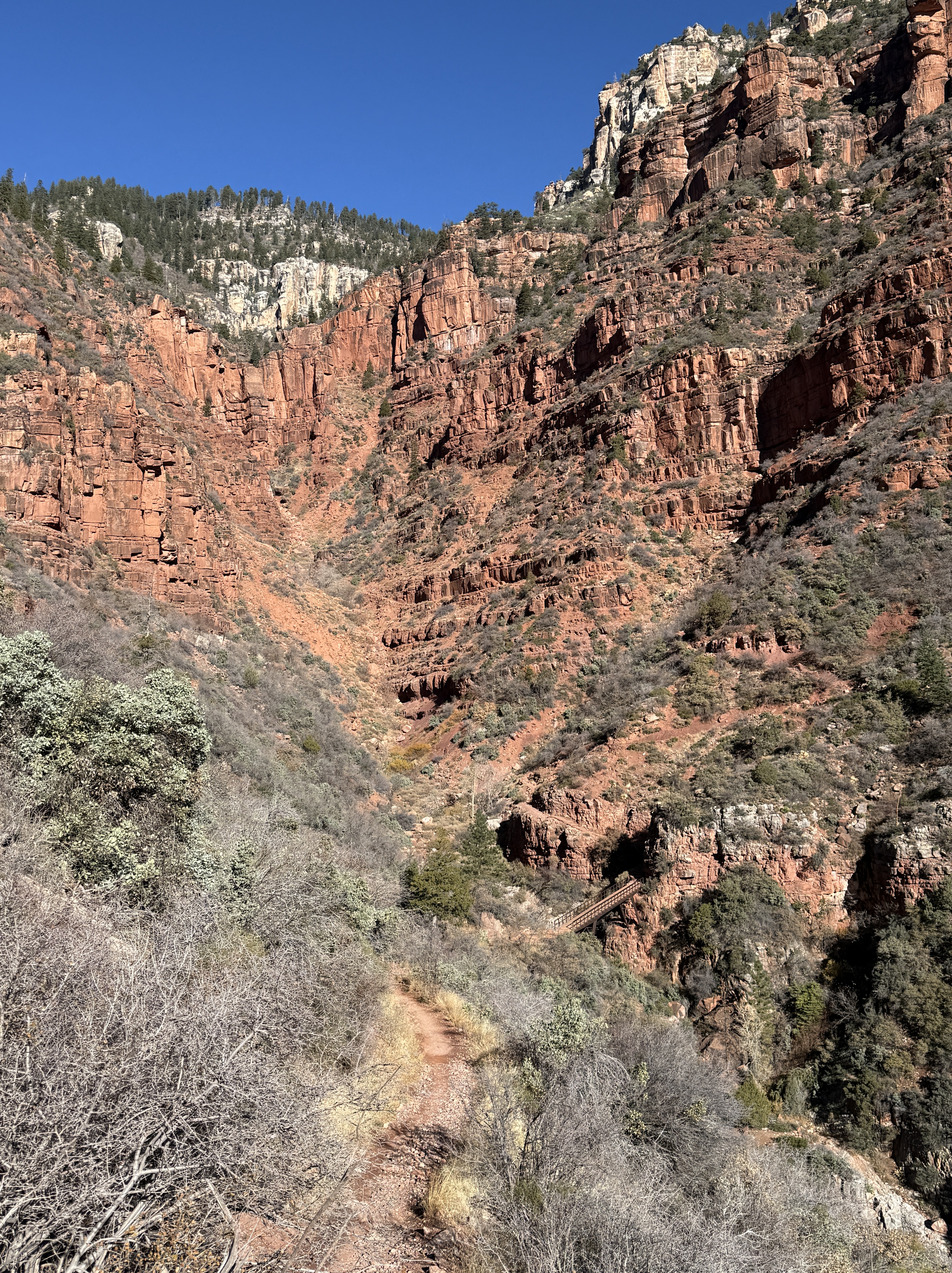
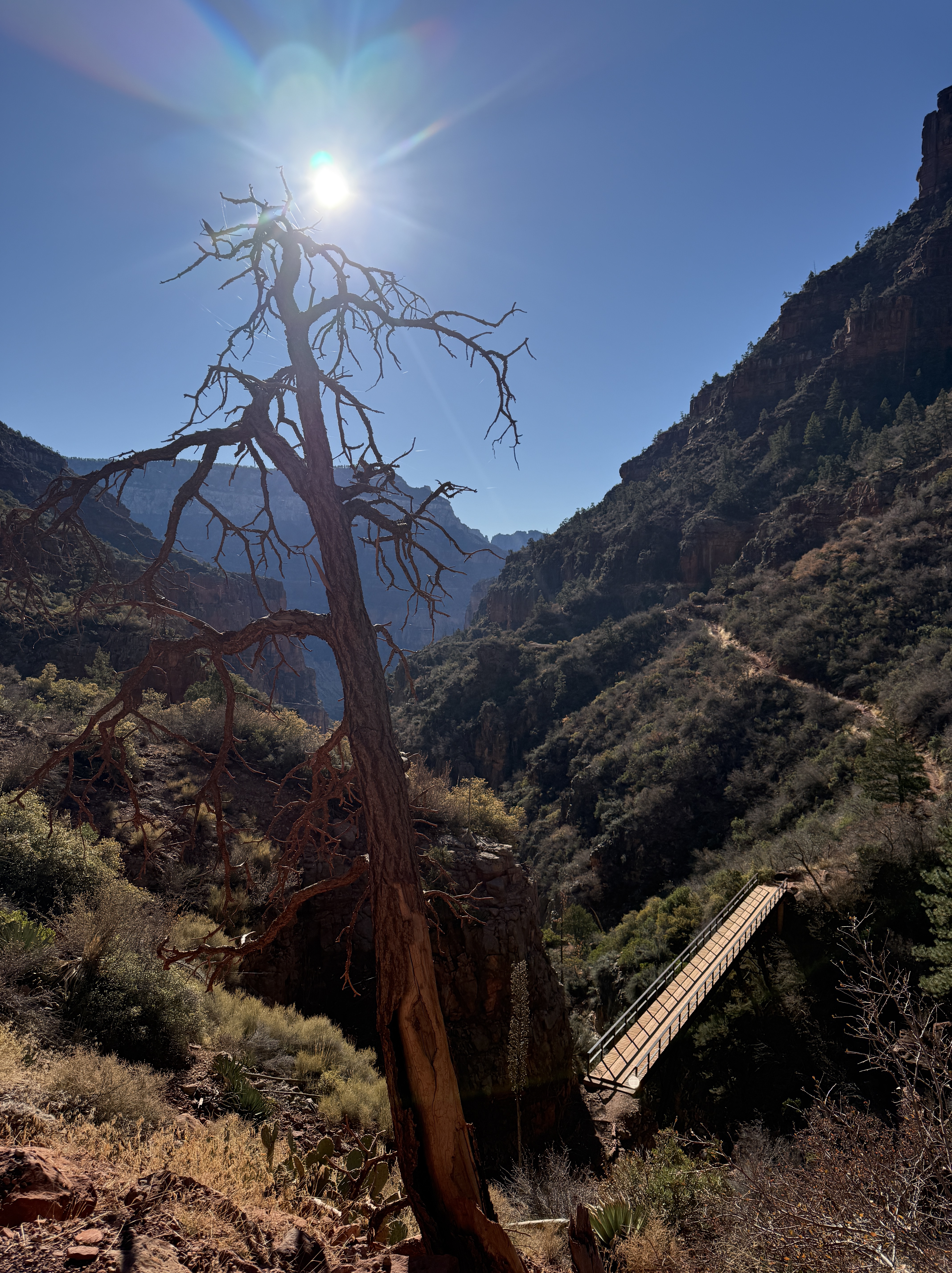
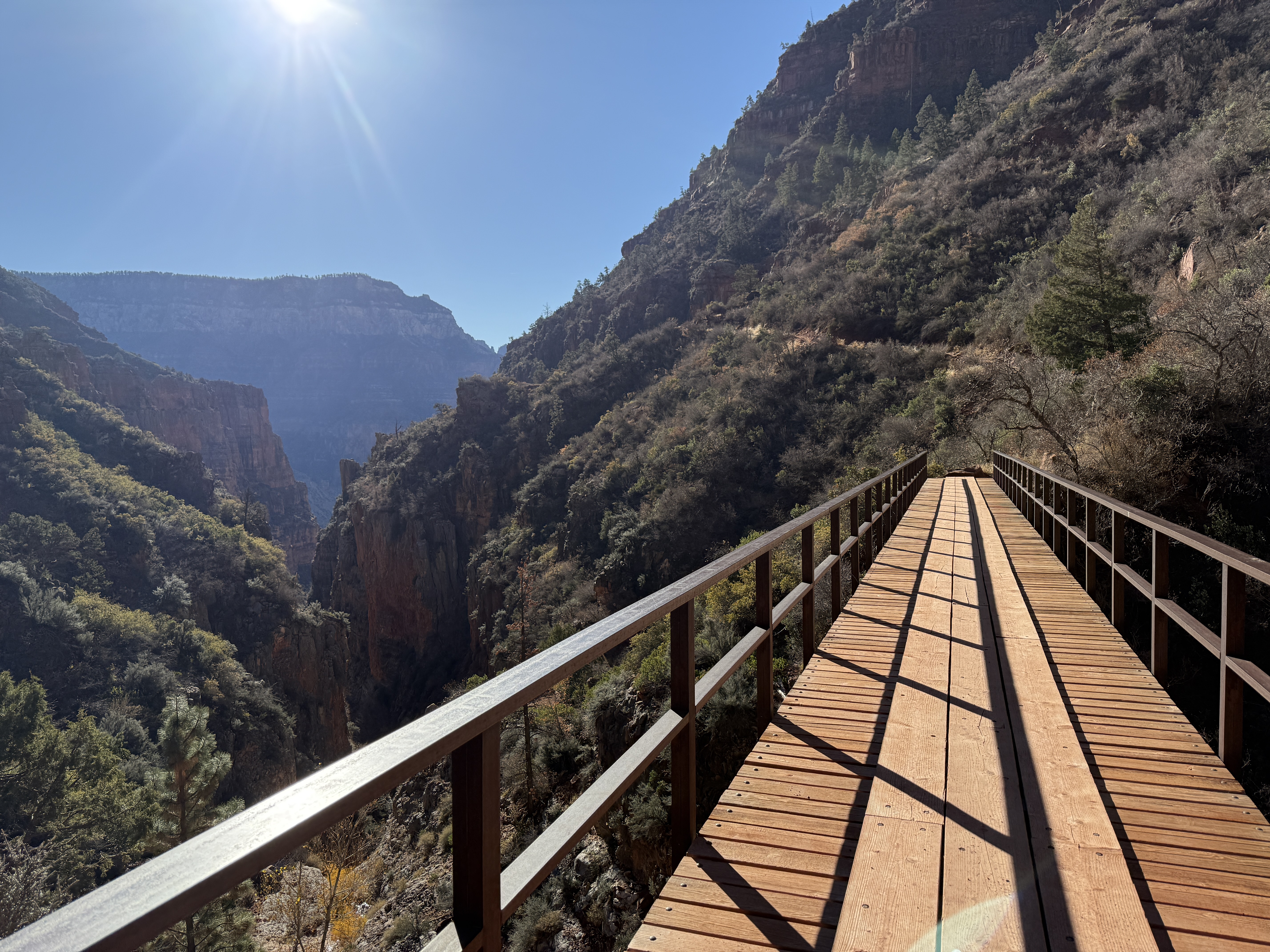
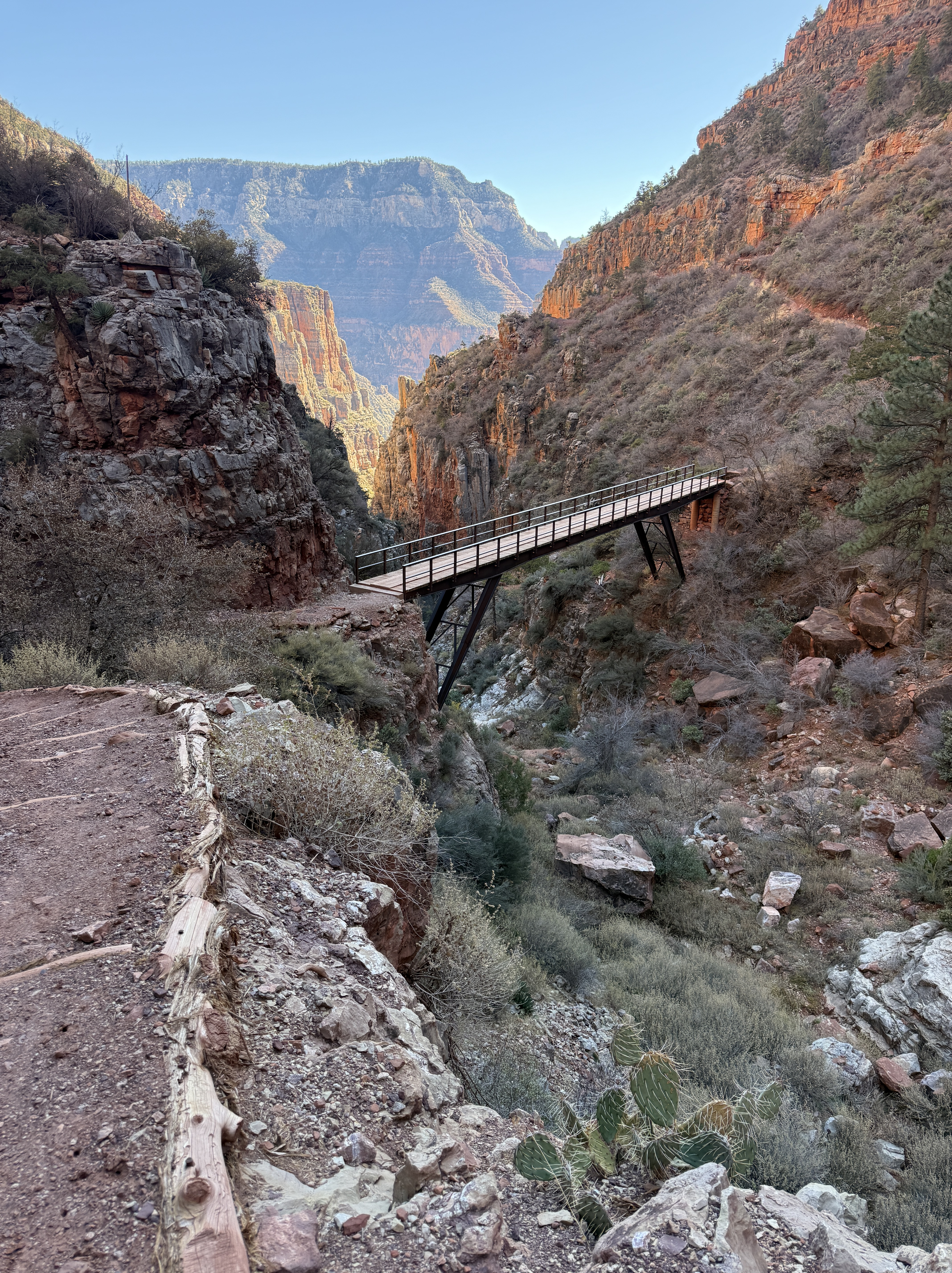
A mile beyond the rectangle cut, the canyon narrows, its floor rising up to meet the trail, and a beautiful little foot bridge spans the now only 50-foot-deep gap. A trail runner passed me heading to the North Rim. He had started at the South Rim early that morning and planned to get back before dark. It was only 10am and he had a little more than 20 miles to go, but he looked strong and was making good progress.

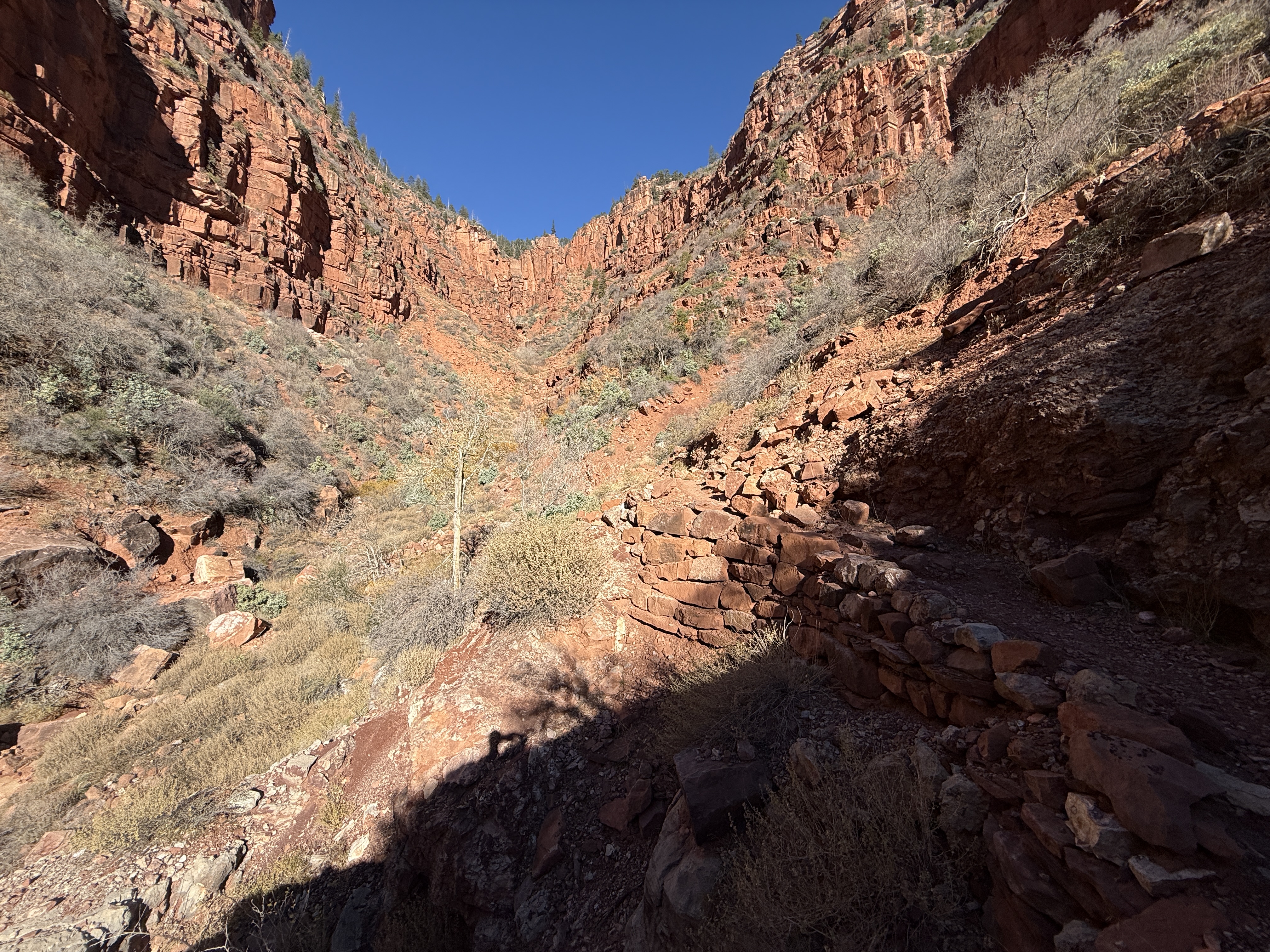
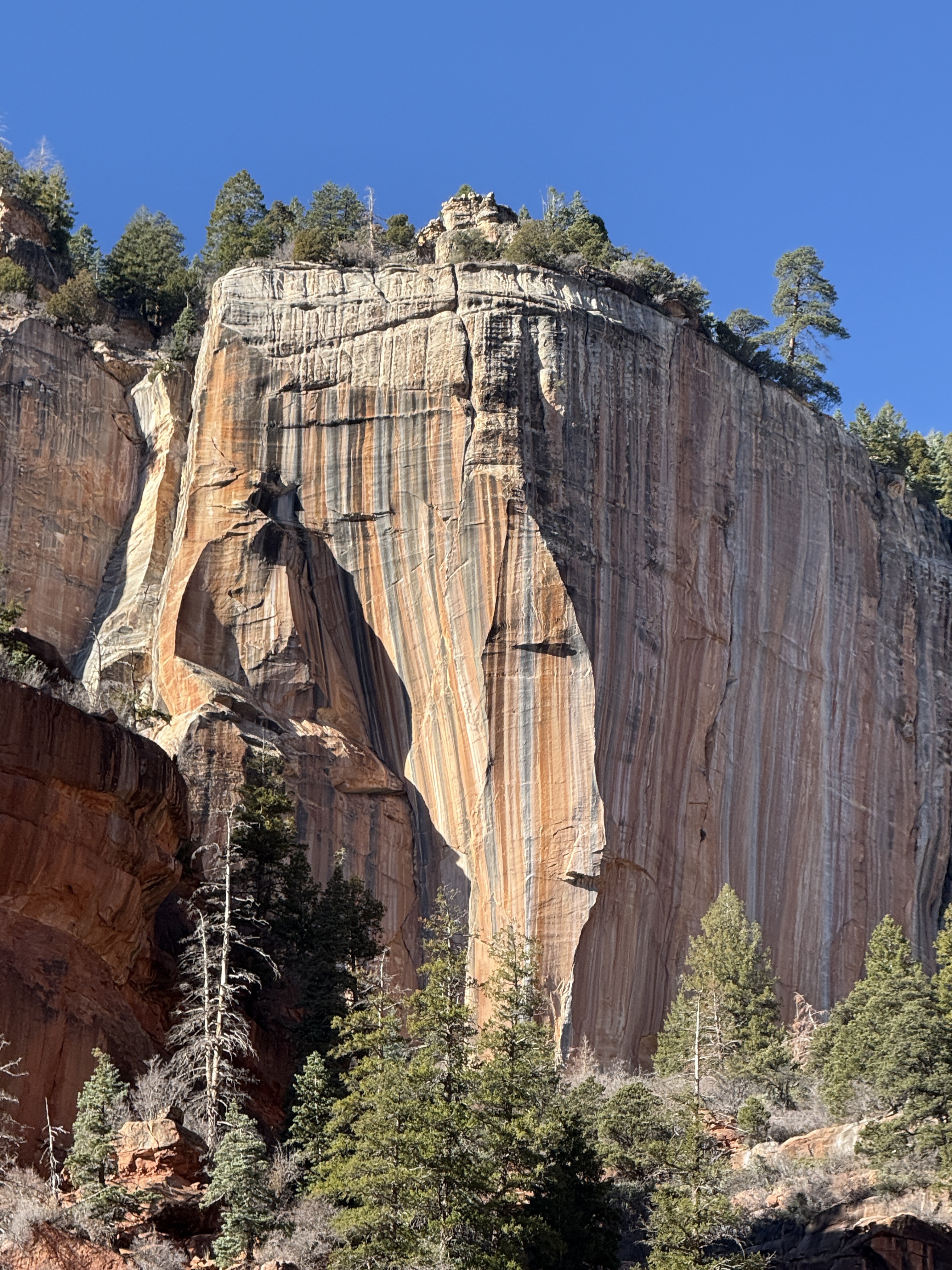
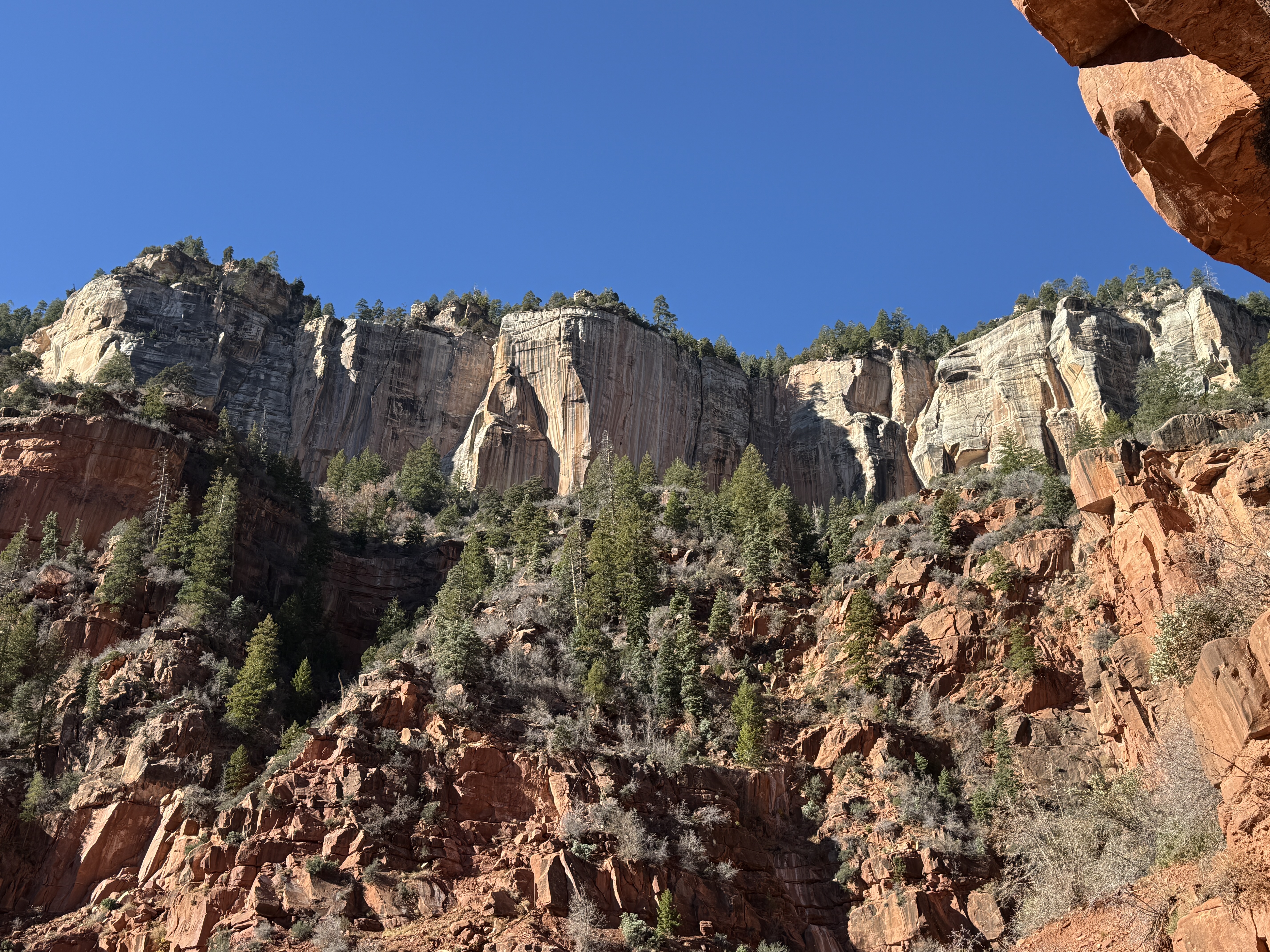
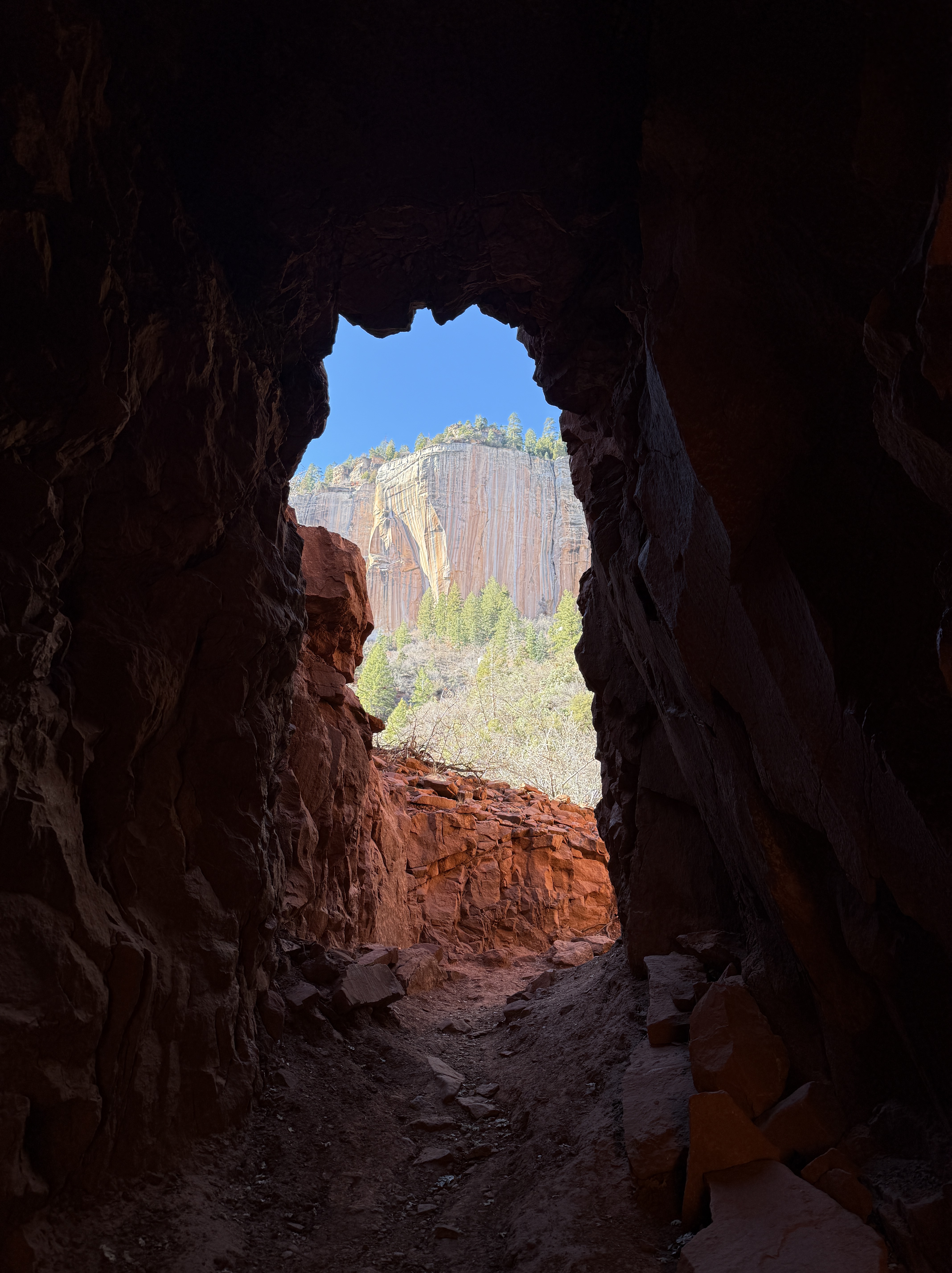
The trail past the bridge transitions to rock wall retained switchbacks, climbing up towards the beautiful, vertical striped stone of the Kaibab Formation and into the tree line. After passing through Supai Tunnel and past Supai Rest Area, another space with composting toilets and potable water (on during the tourist season), I was within a couple of miles of the top of the North Rim. Like the trail runner, I, too, was making excellent time. Especially for already haven taken 250 photos and videos, LOL!

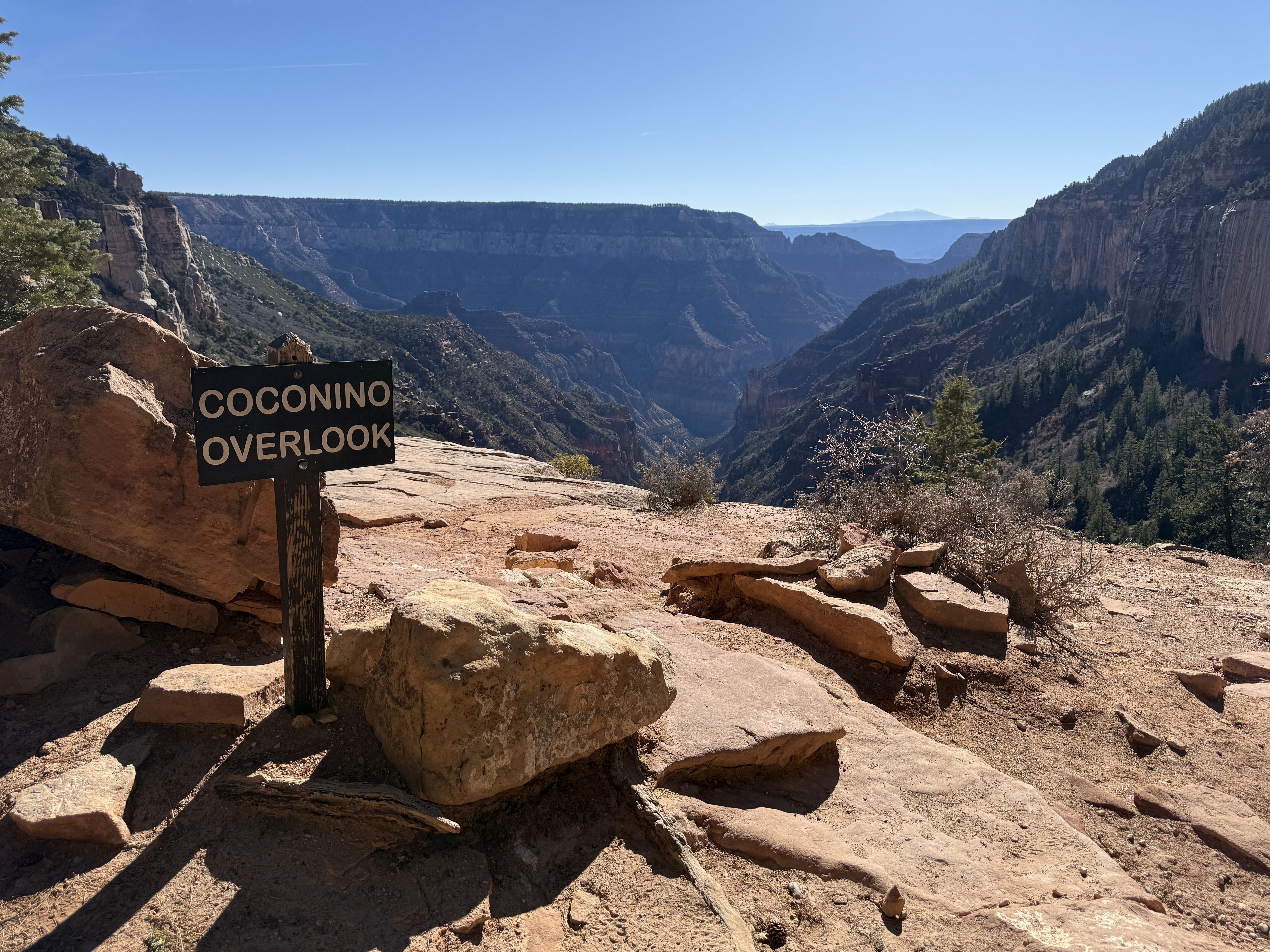
The red dirt of the Coconino Sandstone was a brilliant ochre in the sun, soon melting into the browns of the Toroweap Formation and the greens of the now prolific pine trees. A few more switchbacks and I was at the Coconino Overlook, only 500 feet below the North Rim. I could see the tallest mountain in Arizona in the distance, snowcovered and hulking, reminiscent of some of my favorite Chugach mountains, with a ridgeline that goes on for miles. I would absolutely have to come back and hike Humphrey’s Peak. The trail runner had made good time to the top and was on his way back down. I wished him luck on his journey and went our separate ways.

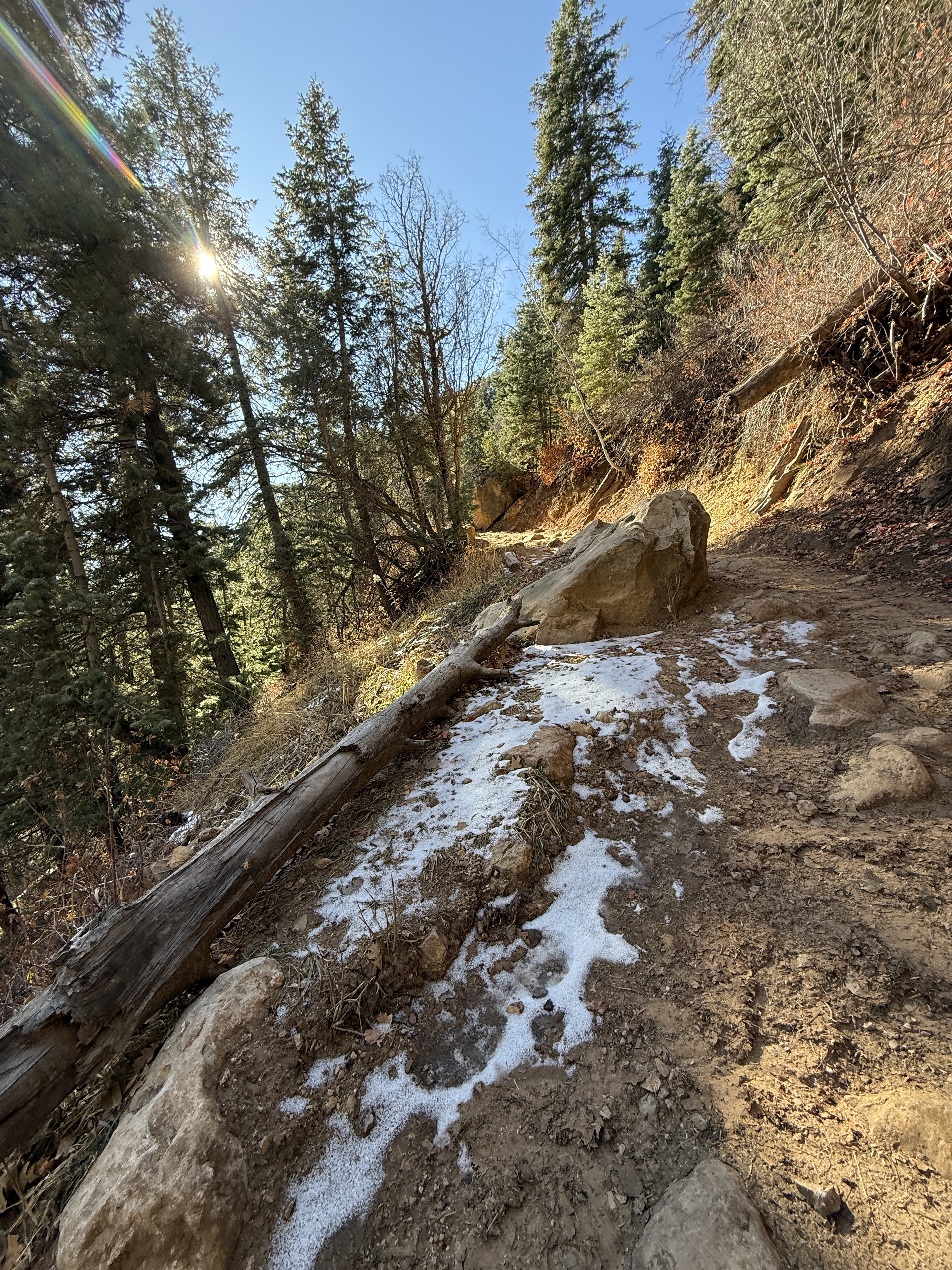
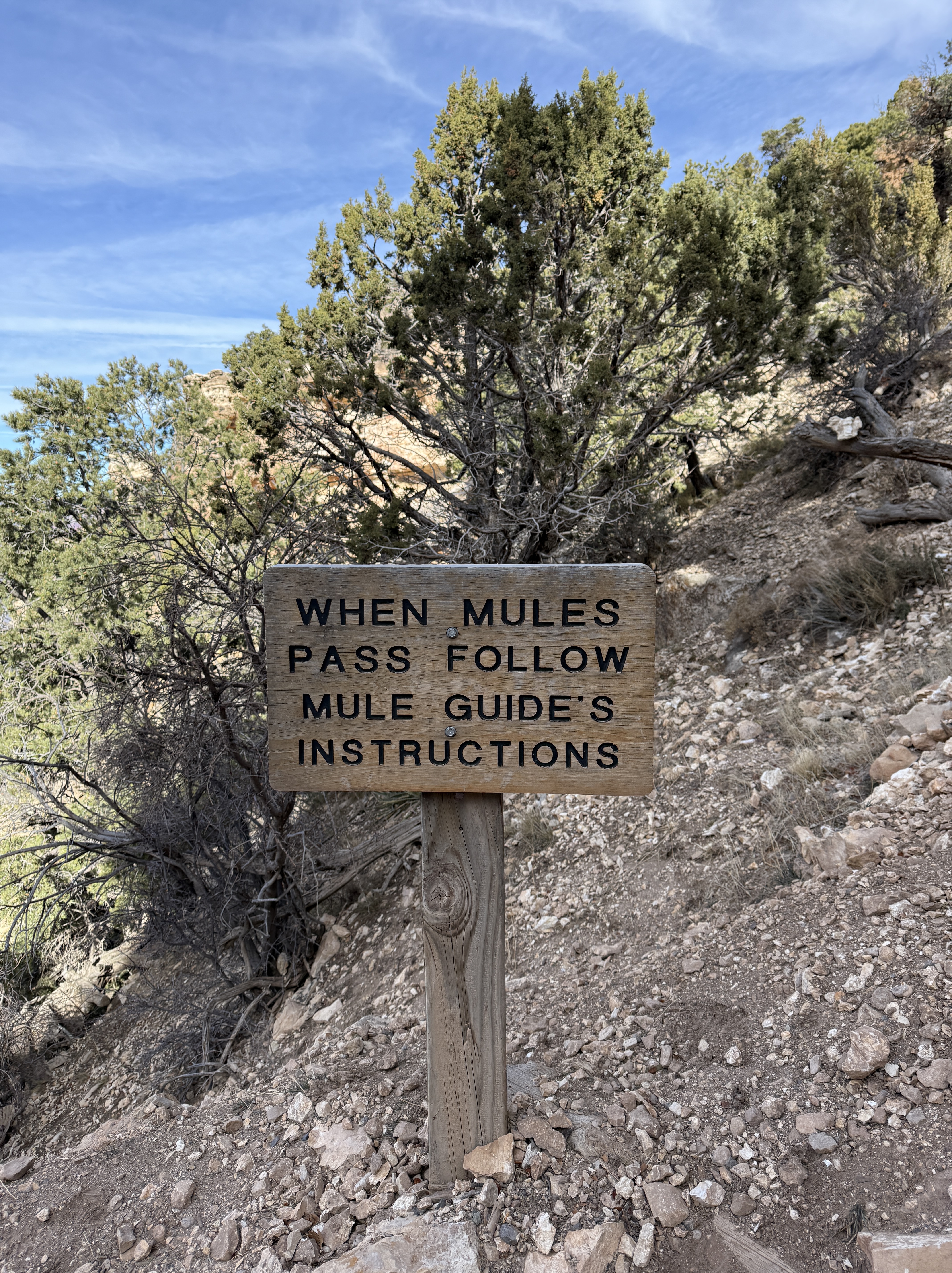
Now in the trees, the Canyon was hidden from view; I quickly made my way past one tiny patch of snow in the shade and signage warning the southbound hikers to give way to mules. I had brought microspikes with me just in case there was ice and snow but left them at Cottonwood after reports from southbound hikers that the trail was mostly clear. I realized I was at 8,000’ but felt incredible; no side effects from being more than mile and a half above sea level. I felt unstoppable!

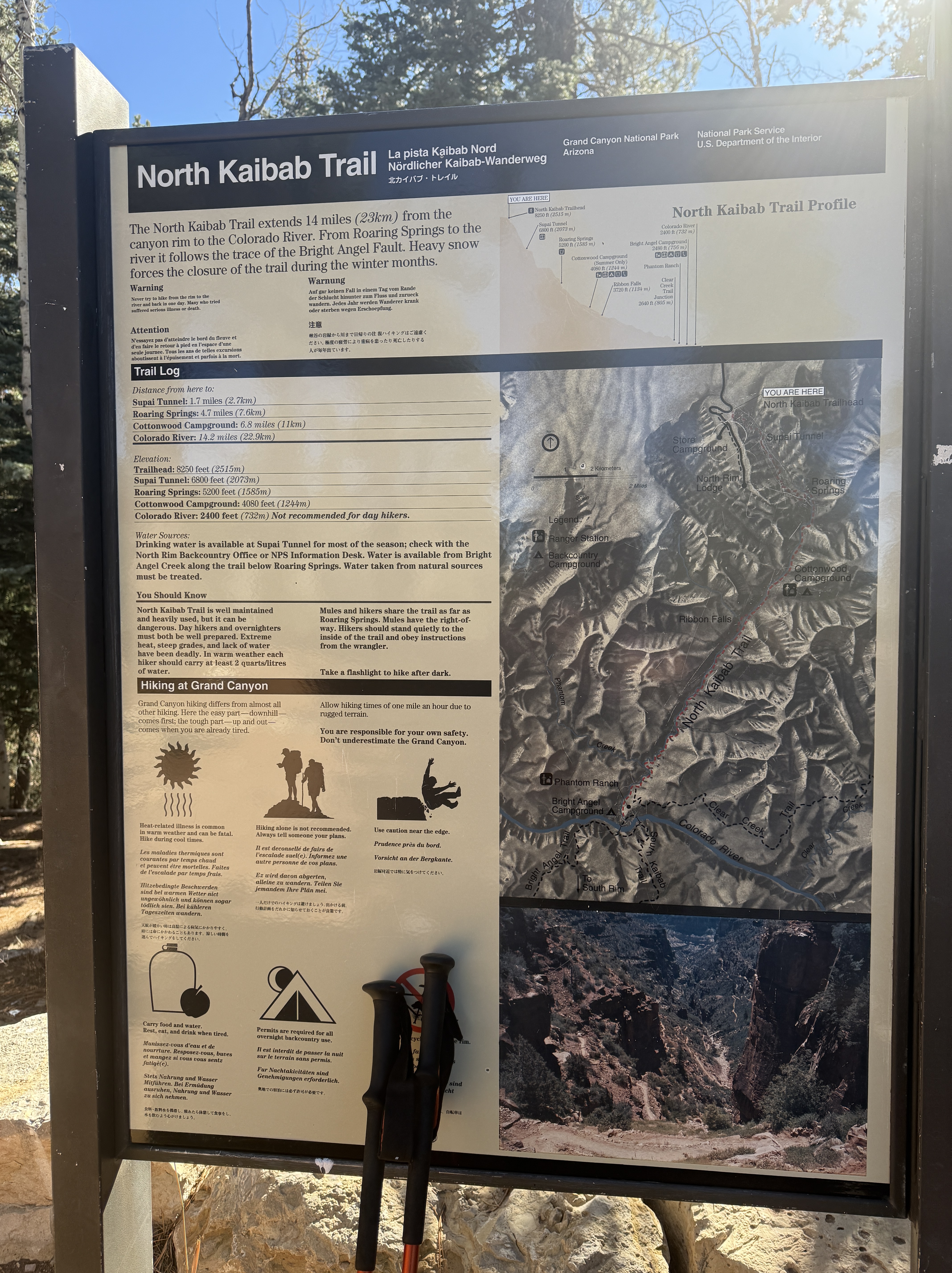
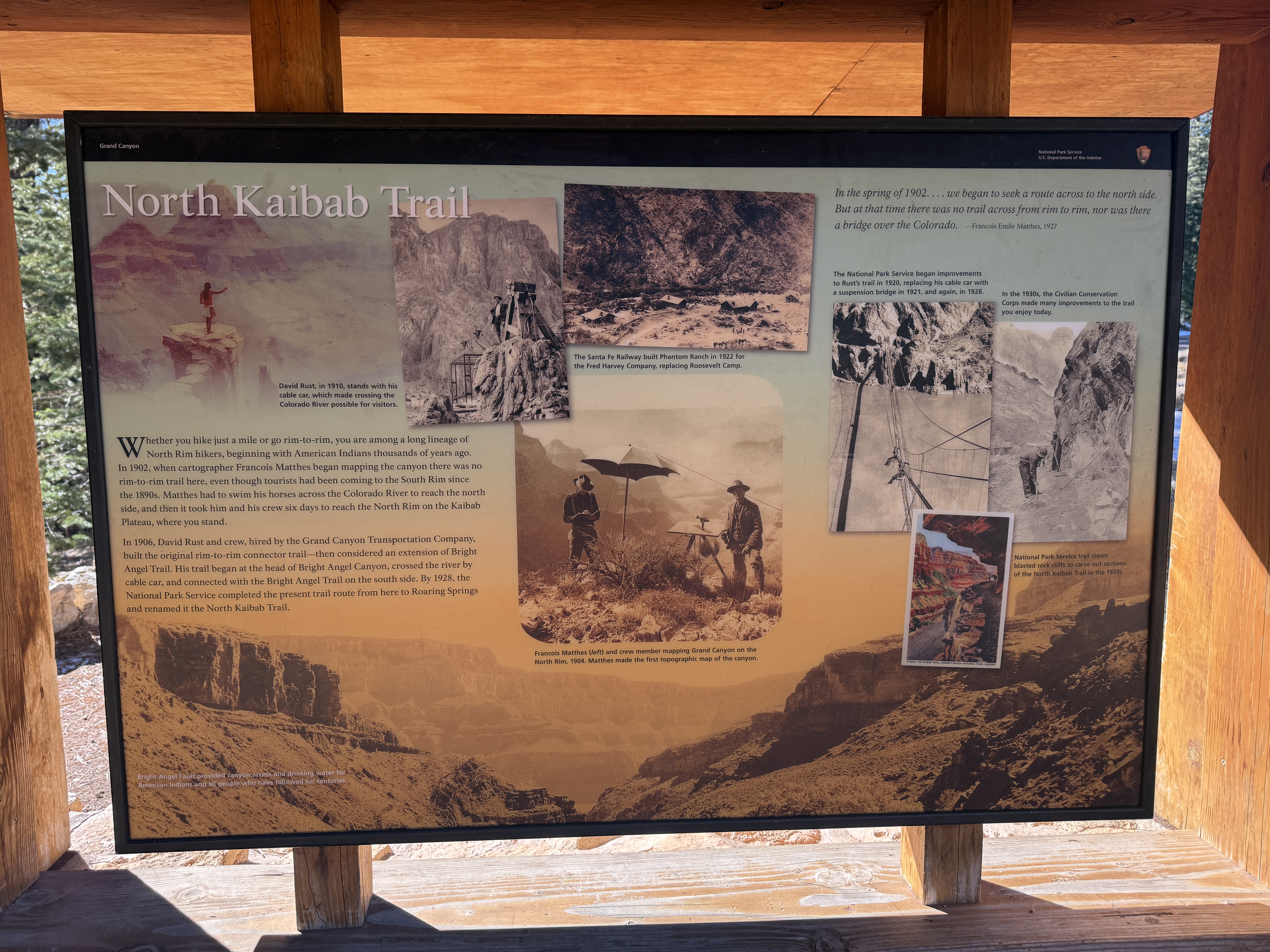
There were informational kiosks now in sight and within minutes I was having a snack and reading all I could about the history of the construction of the North Kaibab Trail, having reached the North Rim.

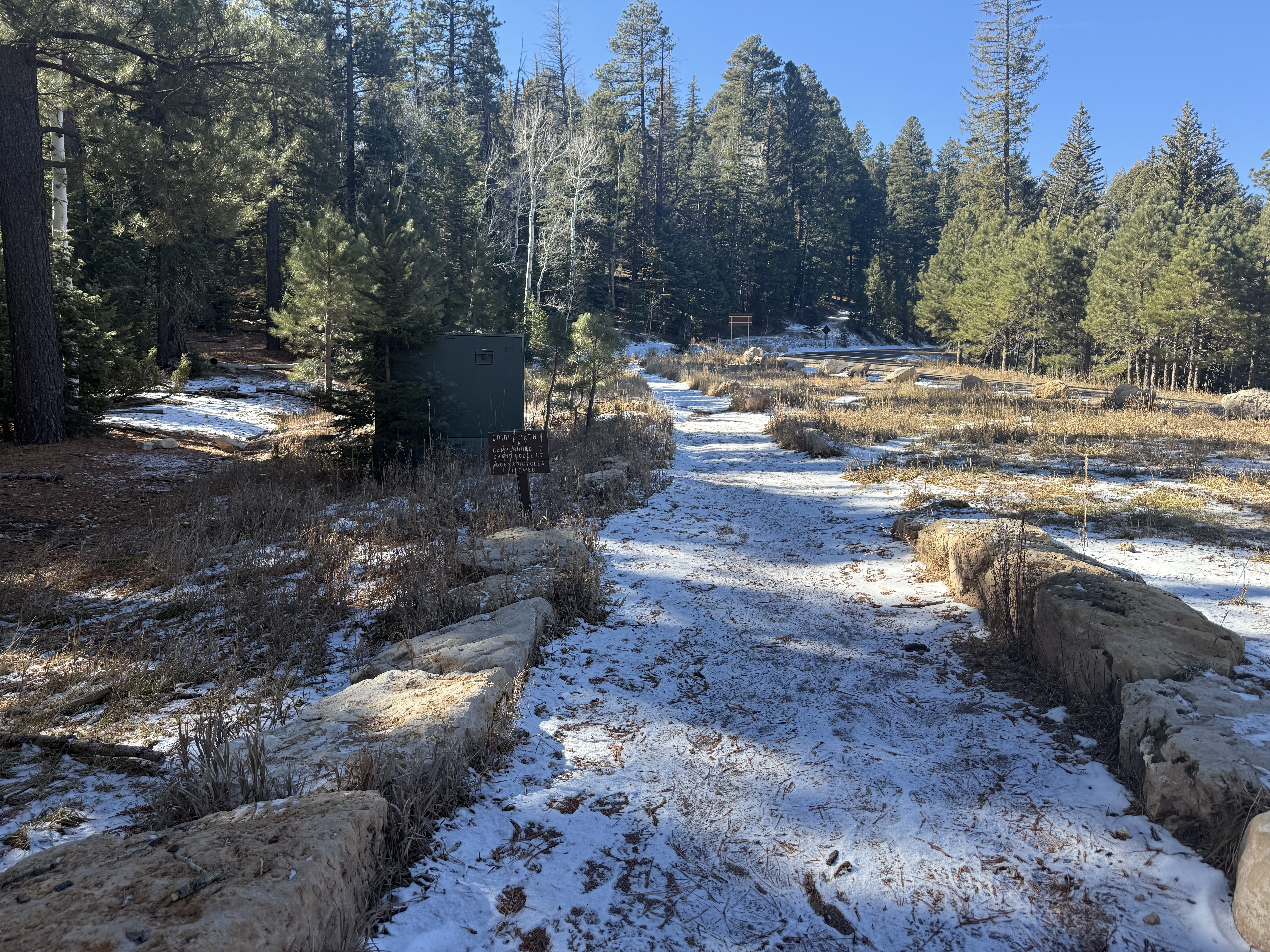
A dusting of snow covered the ground and there were no vehicles to be seen. The North Rim roads had shut down on December 1, so it was literally a ghost town. I was alone, but definitely not lonely. This had already been a day to remember, I might wager to say one of the best I had ever experienced… and I was only halfway there. I sent InReach messages to the friends and family I had promised to keep updated, now that I was out of the canyon and had excellent satellite connection, then quickly headed back down the trail, eager for more of those incredible views and butterfly inducing sections of trail.

Not even two dozen steps down from rim, I ran into the guys, the troublesome knee loosened up, but still causing slow progress. We chatted about how their water filter system was moldy, an unfortunate side effect of not completely drying out the filter fabric after every trip, and since I wouldn’t need my filtration system once I left Cottonwood the next morning, I would drop it off with them tonight after filling all of my containers. They could mail it back to me once they got home. We agreed to meet up that evening and I once again started down into the canyon, jogging a moderate pace.

The nicest part about this 4000′ gain is that it never seems too steep, a fairly gradual slope rising just over 600′ per mile, a far cry from some of the uphill slogs I’ve done on my home mountains. I made steady progress on the way back, even while taking another 200 photos and videos to add to the hundreds I had already snapped that day. I wanted to document every step of this incredible journey.

Past the sheer cliffs, past the rectangle cut, past Roaring Springs and more mule deer at Manzanita, past the stout bridge and the abandoned telegraph poles, I jogged into camp at 315pm, a sub-8-hour, 13-mile round trip. Not bad for a 44-year-old woman who couldn’t walk the day before. Besides the biologists at the very beginning of the day, I had only encountered 5 people on the trail (there was a woman who passed me earlier in the day, though I can’t quite recall when or where and never saw her return down into the Canyon).

I was high on adrenaline, incredulous that I was done with that glorious section of trail, probably my favorite trail that I had ever traveled. A visit to the creek for a soap free bath and a top off on my filtered water was followed by dinner, I can’t remember if it was Chili Mac or a Ramen Bomb, and coffee. I patched a hole I found in the floor of my tent then took a walk up to the guys’ campsite, but they still hadn’t made it back. I was ready to settle in, so I would swing by in the morning and drop off the filtration system for them.

I sat with my chair facing down Bright Angel canyon, looking towards the South Rim, and watched the sun drop behind the canyon wall. The mice had apparently learned that I wasn’t the one and had not caused me any trouble since the first night, affording me the opportunity to sit outside and marvel at the stars. As they say, “Half the Park is after dark!”

Tomorrow I would head back the way I came, descending to the Colorado River, back up to Tip Off, on the Tonto Plateau, and then back out to Cremation Canyon. Another 12-mile day, but the pack would be a little lighter than the first trip over this ground. I had been eating non-stop and could travel light on water until Phantom Ranch.

My last night at Cottonwood Camp and my last night on the north side of the Colorado River, for this trip at least. I was too pumped up to sleep, so I went through some of the day’s photos, reminiscing about a time not too far gone. I finally fell asleep, grateful for an unforgettable day.

Rim To Rim To Rim AllTrails Link:

Just The Tips:

  1. Instead of flying into Phoenix, opt to fly into Flagstaff. I’ll be doing that next time instead of making the 3 hour drive each way.
  2. If you are flying in, pre order your stove fuel and other supplies online from Sportsman’s Warehouse in Phoenix or Flagstaff. I found this to be quick and easy.
  3. Be aware that your tracking devices and phone may not be able to get a satellite connection in some of the narrow canyons. Tracking may get wonky, as the vertical walls can cause a location ping, hundreds of feet above or below you.
  4. Permitting for the Grand Canyon can be confusing. It is best to apply for the lottery, which opens based on the month of travel and is available for application on the 16th of the month, in the 5th month prior to your trip. For example, a September Trip lottery application period would open April 16. See this article for more information about getting your Grand Canyon permit.
  5. Give yourself more than one night at Cottonwood Campground to allow for a side trip to Chimik’yana’kya Deya’ (Ribbon Falls) or a day hike to the North Rim, plus a rest day. I found 3 nights at Cottonwood to be perfect.
  6. If hiking rim to rim to rim in the winter, know that there are no services at and no access to the North Rim. You will be one of the few people in the area, far from help. Bring hiking poles and microspikes in case of snow. Evaluate your abilities and comfort with heights honestly before traveling this stretch of trail.
  7. Carry plenty of water and a water filtration system. Don’t drink unfiltered water. It can contain bacteria even if it looks clean. Be sure to dry out your filter when you get home.
  8. Get to the park early. The entrance gets extremely backed up with traffic beginning mid-morning.

Alone in the Grand Canyon: Rest Day

Day 3 – Rest Day

December 1, 2024

It became apparent immediately after I woke up that I would be taking a rest day and saving my day hike to the North Rim for tomorrow. I unzipped my tent and tried to stand. The overpacking had finally caught up to me. My legs were locked up, despite taking magnesium, electrolytes and staying hydrated. I crawled over to the picnic table and collected my supplies for morning coffee and breakfast. I would need to eat all day to get my load to something within reason for the last half of my trip.

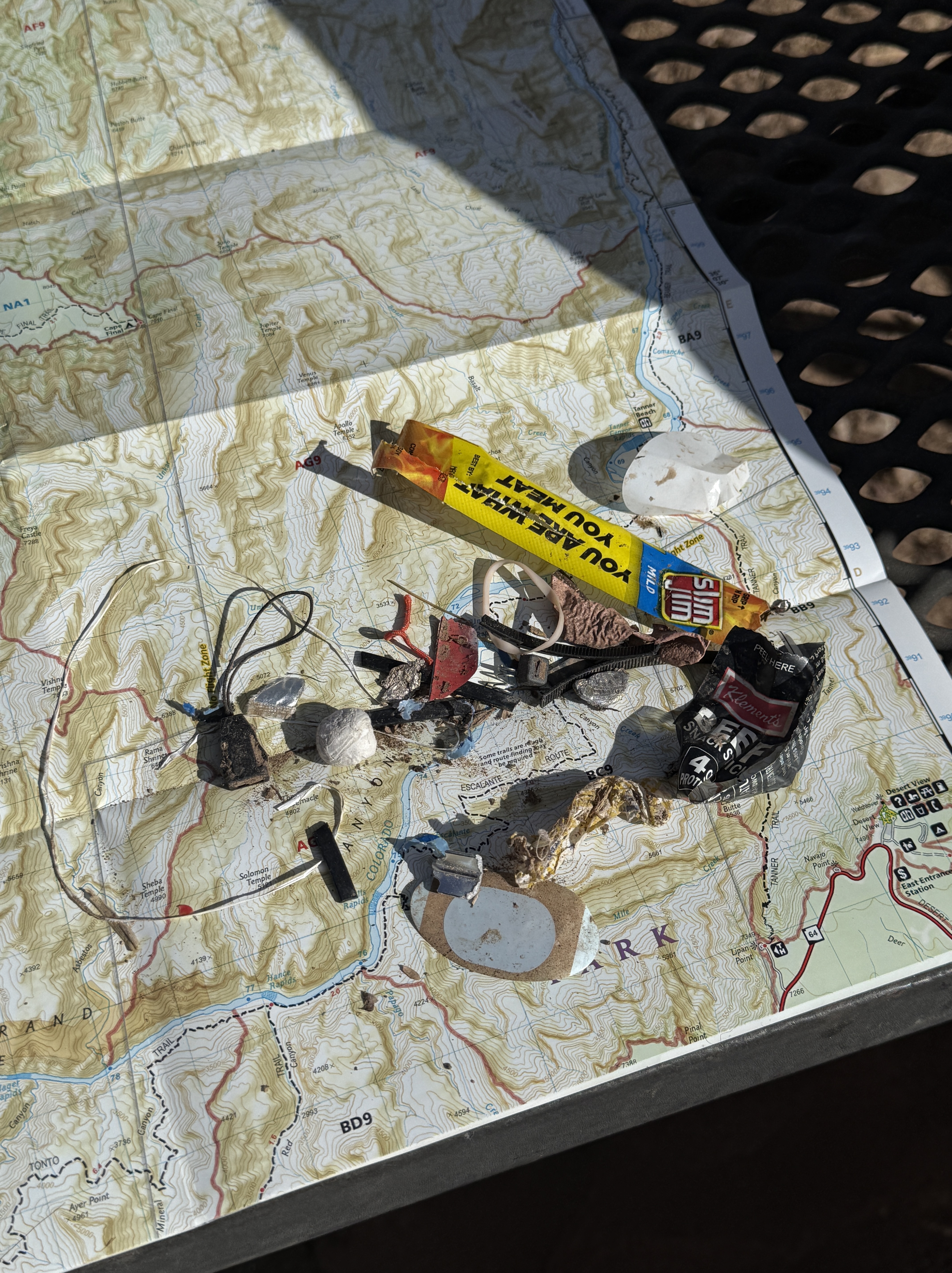
I spent time stretching and enjoying the scenery, eating as much as I could physically handle. Tinkering around camp, I pulled off my rain fly and lifted the footprint of my tent to dry out the little moisture that had accumulated. I have a habit of scouring my campsites for micro trash, tiny pieces of garbage that are easily missed by even the tidiest of campers. Whenever camping at established campsites, I always encourage my friends to spend 15 minutes focusing on looking for bits of garbage and it never fails that we end up with a good-sized pile.

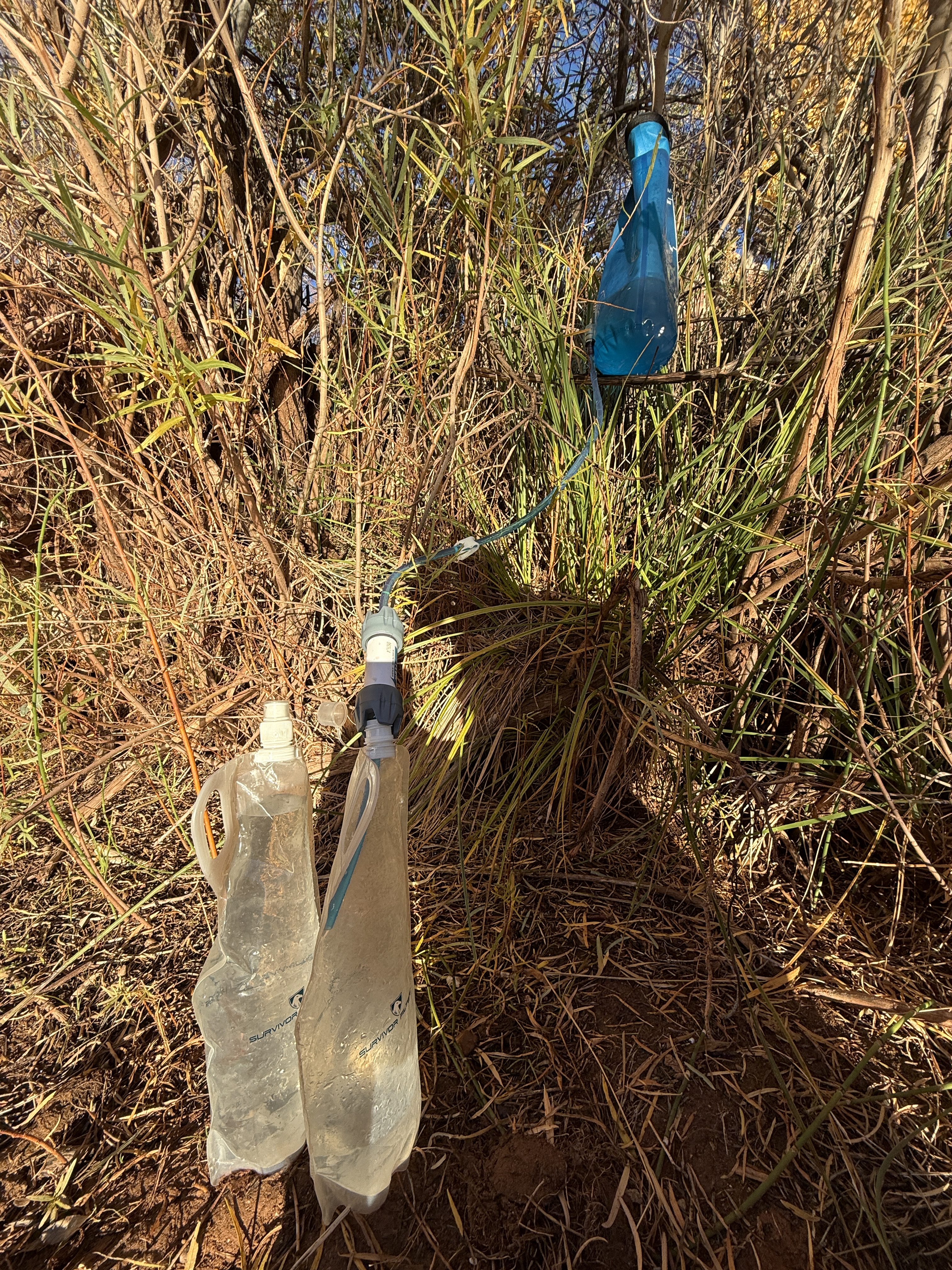
I rummaged in my med kit for anything that may be helpful in repairing my busted water bottle and in making a temporary 0-ring for my water filter bladder. I ended up twisting up some medical tape and wrapping it around where the o-ring would be. I plugged in the hose and it worked! The water bottle was a more difficult matter. I wasn’t terribly worried since the crack was on the top, but I would need to use this to carry a full 2L of water for when I camped at Cremation Canyon on the way out. The medical tape again came in handy, with a waterproof bandage for good measure.

I made a good dent in my book before deciding to head down to the creek for more water. My legs were finally working, although you’d think I was an elderly woman and not someone who could backpack across the Grand Canyon and back. My walk was more of a shuffle, made worse by the fact that I was wearing thin soled slippers. I was too tired to put on real shoes for the short walk.

After dinner and an incredible sunset, I settled into my tent early to get rest before my 13-mile, +4000′ round trip hike the next day to see this canyon from the North Rim. I didn’t hear any mice running over my tent while in my deep sleep.

Rim To Rim To Rim AllTrails Link:

Just The Tips:

  1. Instead of flying into Phoenix, opt to fly into Flagstaff. I’ll be doing that next time instead of making the 3 hour drive each way.
  2. If you are flying in, pre order your stove fuel and other supplies online from Sportsman’s Warehouse in Phoenix or Flagstaff. I found this to be quick and easy.
  3. Be aware that your tracking devices and phone may not be able to get a satellite connection in some of the narrow canyons. Tracking may get wonky, as the vertical walls can cause a location ping, hundreds of feet above or below you.
  4. Permitting for the Grand Canyon can be confusing. It is best to apply for the lottery, which opens based on the month of travel and is available for application on the 16th of the month, in the 5th month prior to your trip. For example, a September Trip lottery application period would open April 16. See this article for more information about getting your Grand Canyon permit.
  5. Give yourself more than one night at Cottonwood Campground to allow for a side trip to Chimik’yana’kya Deya’ (Ribbon Falls) or a day hike to the North Rim, plus a rest day. I found 3 nights at Cottonwood to be perfect.
  6. If hiking rim to rim to rim in the winter, know that there are no services at and no access to the North Rim. You will be one of the few people in the area, far from help. Bring hiking poles and microspikes in case of snow. Evaluate your abilities and comfort with heights honestly before traveling this stretch of trail.
  7. Carry plenty of water and a water filtration system. Don’t drink unfiltered water. It can contain bacteria even if it looks clean. Be sure to dry out your filter when you get home.
  8. Get to the park early. The entrance gets extremely backed up with traffic beginning mid-morning.
Alone in the Grand Canyon: Crossing the Colorado

Day 2 – Cremation to Cottonwood Camp

12 Miles, -1600′, +2000′

November 30, 2024

I woke before the daylight, rested and excited to see what was to come. As the pink clouds signaled the rising of the sun, I made some coffee and oatmeal and ate and drank as I broke down camp. There are no bathroom facilities in this remote area so I carried wag bags, but decided I could make it the almost two miles back to Tip Off, where there is a composting toilet. If not, I would have to carry the used wag bag for the next 5 days. I could hold it. I poured out some of my excess water, knowing that I could refill in about 5 miles at Phantom Ranch, and my legs were very happy about that!

Surprisingly, I felt strong, and I made excellent time back to Tip Off. The mule pack train got an early start and was making their way down to the Tonto Plateau, before continuing on with supplies for Phantom Ranch. After a quick use of the facilities, I looked up towards the South Kaibab trail; I could see the day hikers who had a goal of reaching Phantom Ranch starting to make their way down, so I hustled ahead to avoid as many people as possible.

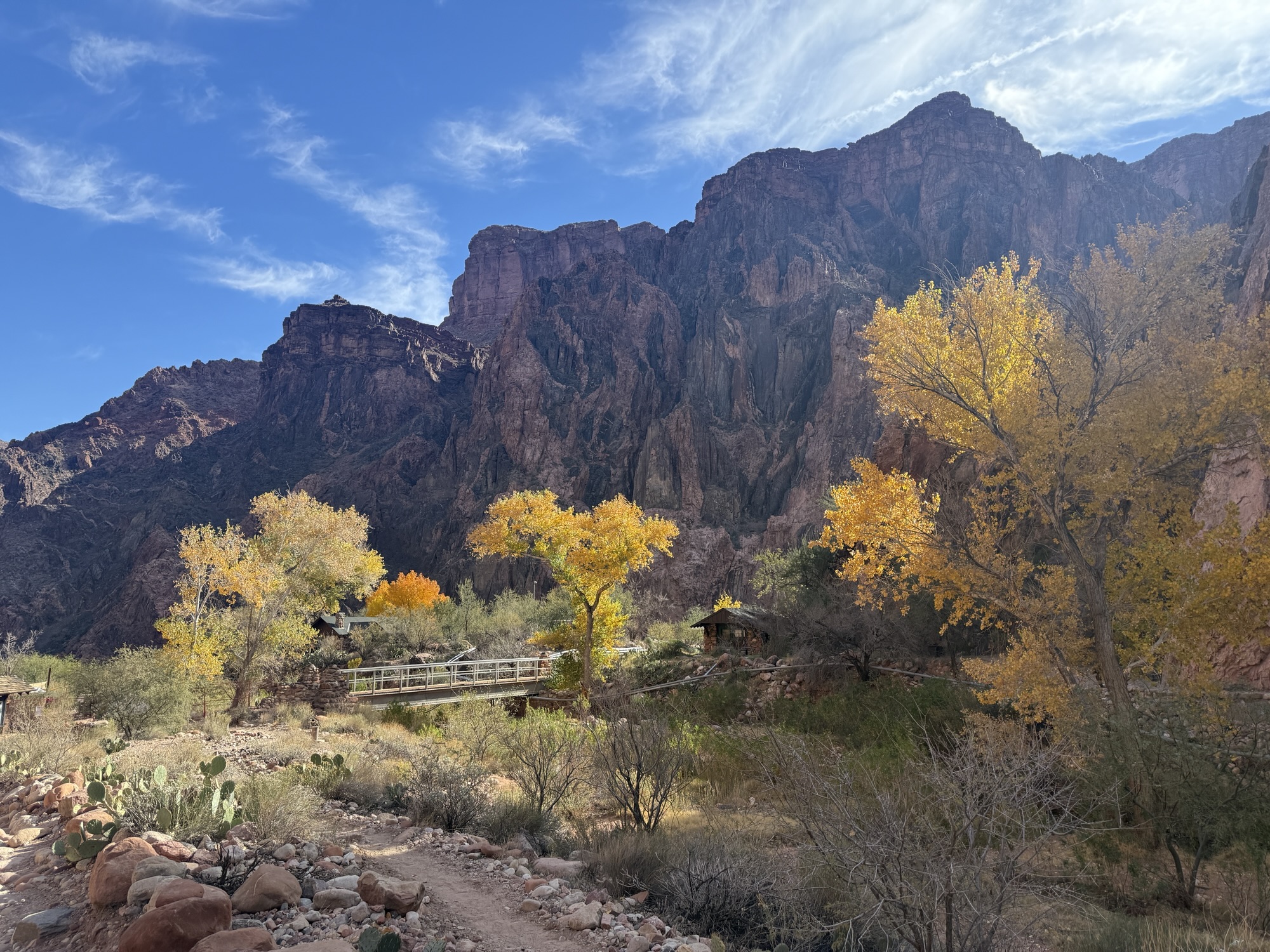
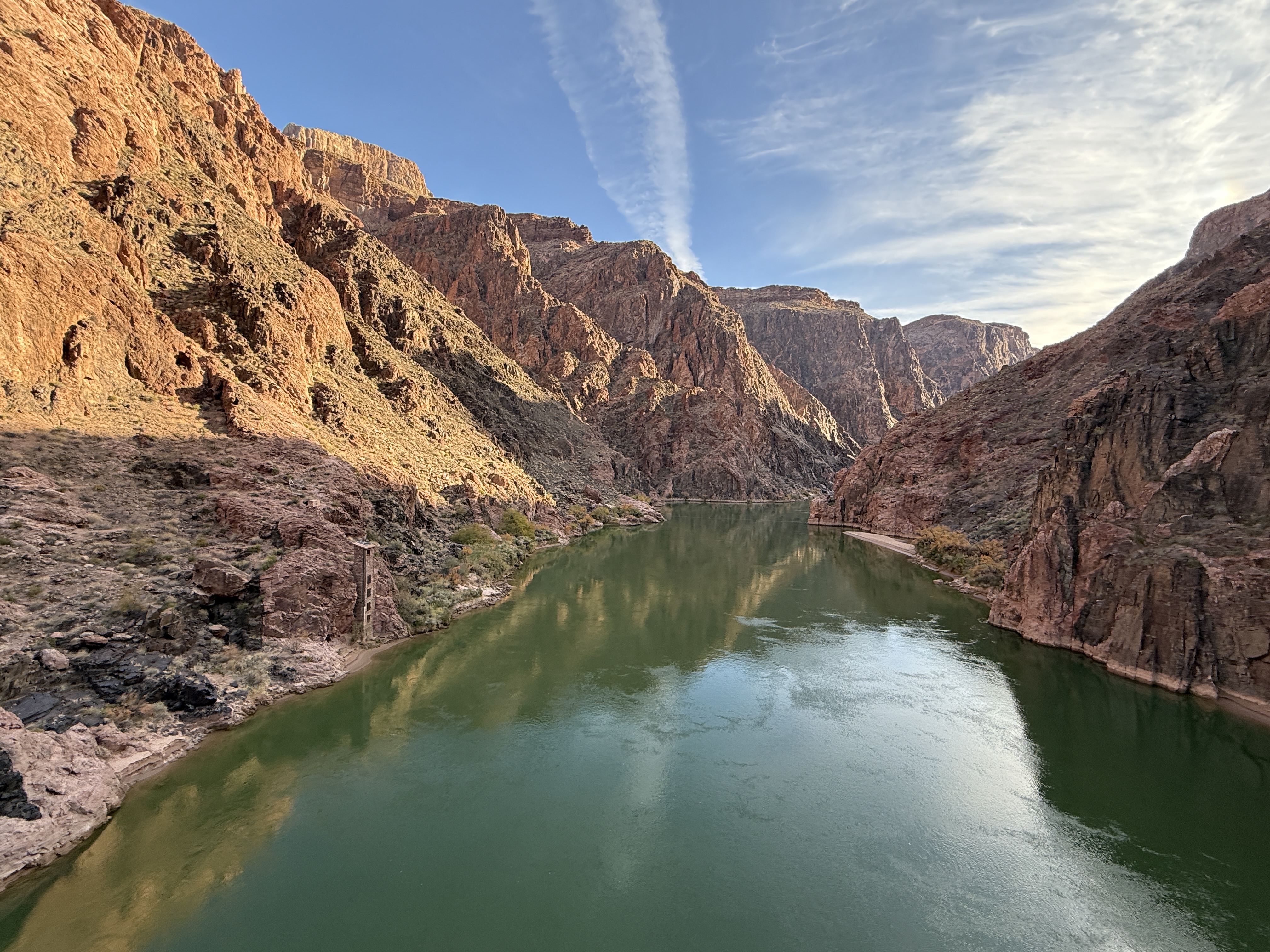
The trail from Tip Off down to the Colorado River is a well-engineered path, descending from 4000′ to 2400′ at the Colorado River. I probably took twice as long as I should have on my way down to the “Black Bridge,” stopping every few steps to get another picture or video. My mind was blown. The ochre-colored dirt was a beautiful contrast to the blue green tone of the Colorado River and the yellow of the Cottonwood trees at Phantom Ranch.

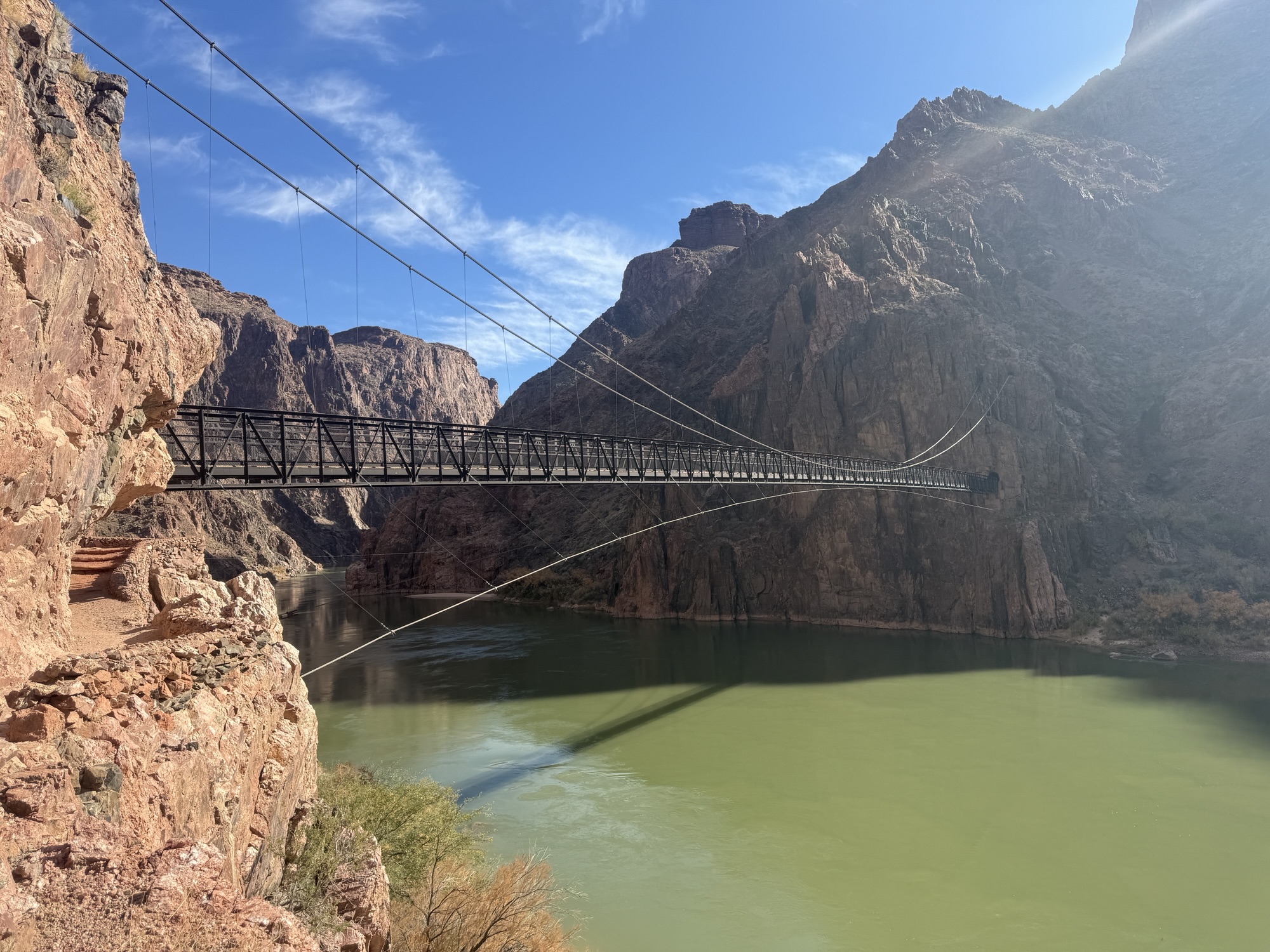
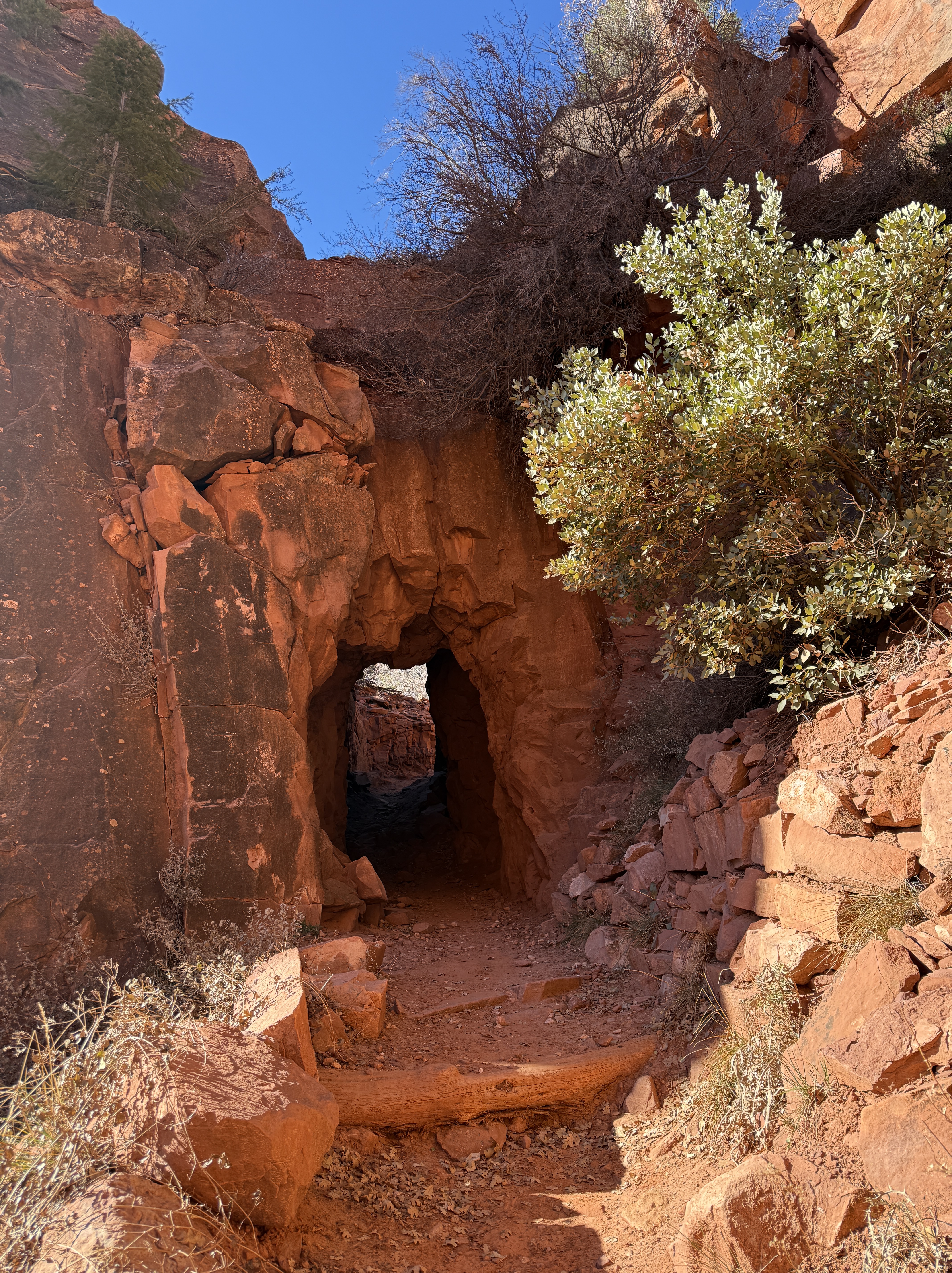
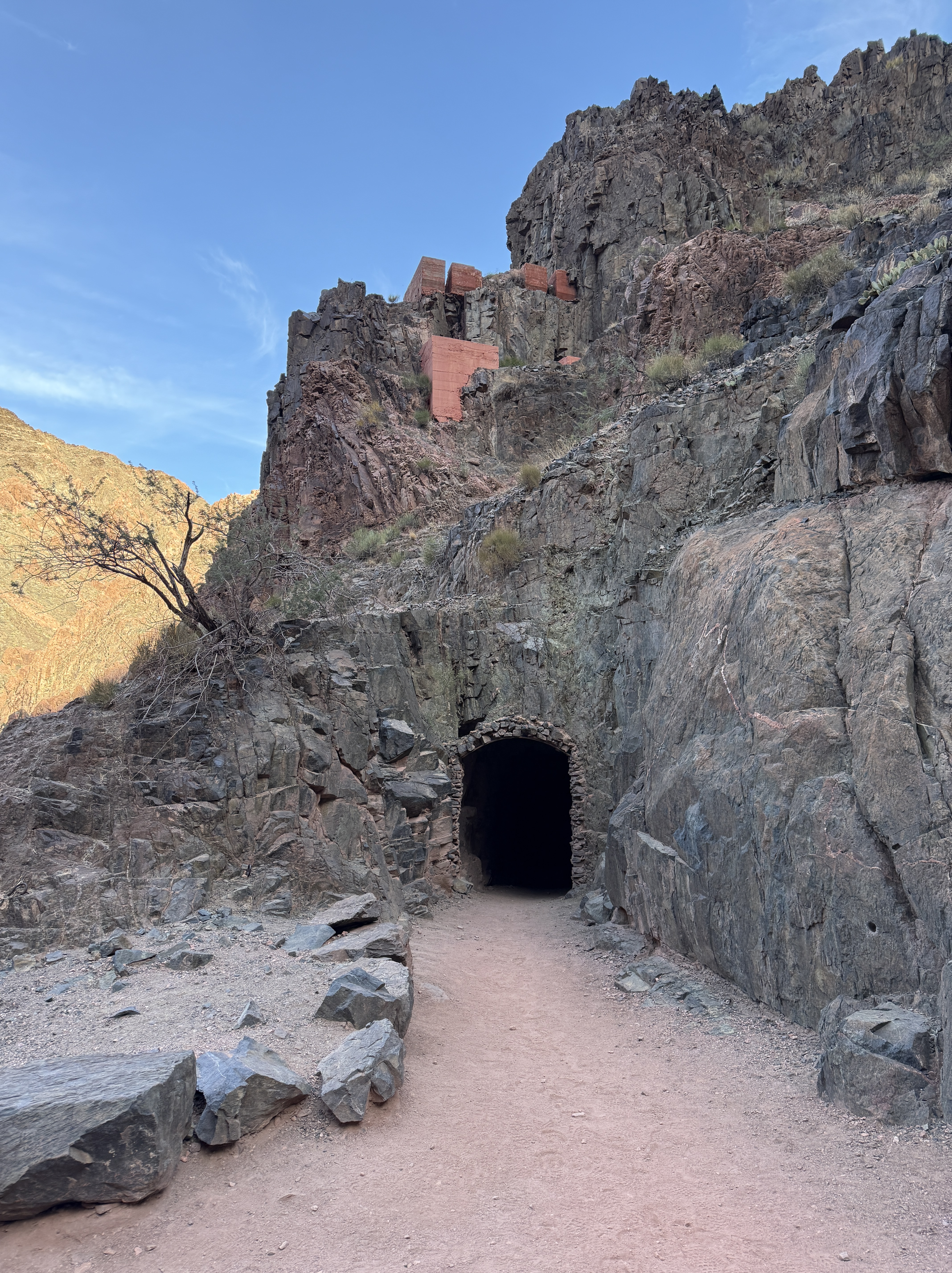
I was descending into the depths of the second largest canyon in the world to a river that I had known many years ago when I was just a teenager whitewater rafting from Moab to Lake Powell. I could feel it welcoming me like a friend long missed. The winding path brought me to the opening of a tunnel, the entrance framed with stacked stones; a portal to a civil engineering feat, the Kaibab Trail Suspension Bridge, AKA The Black Bridge.

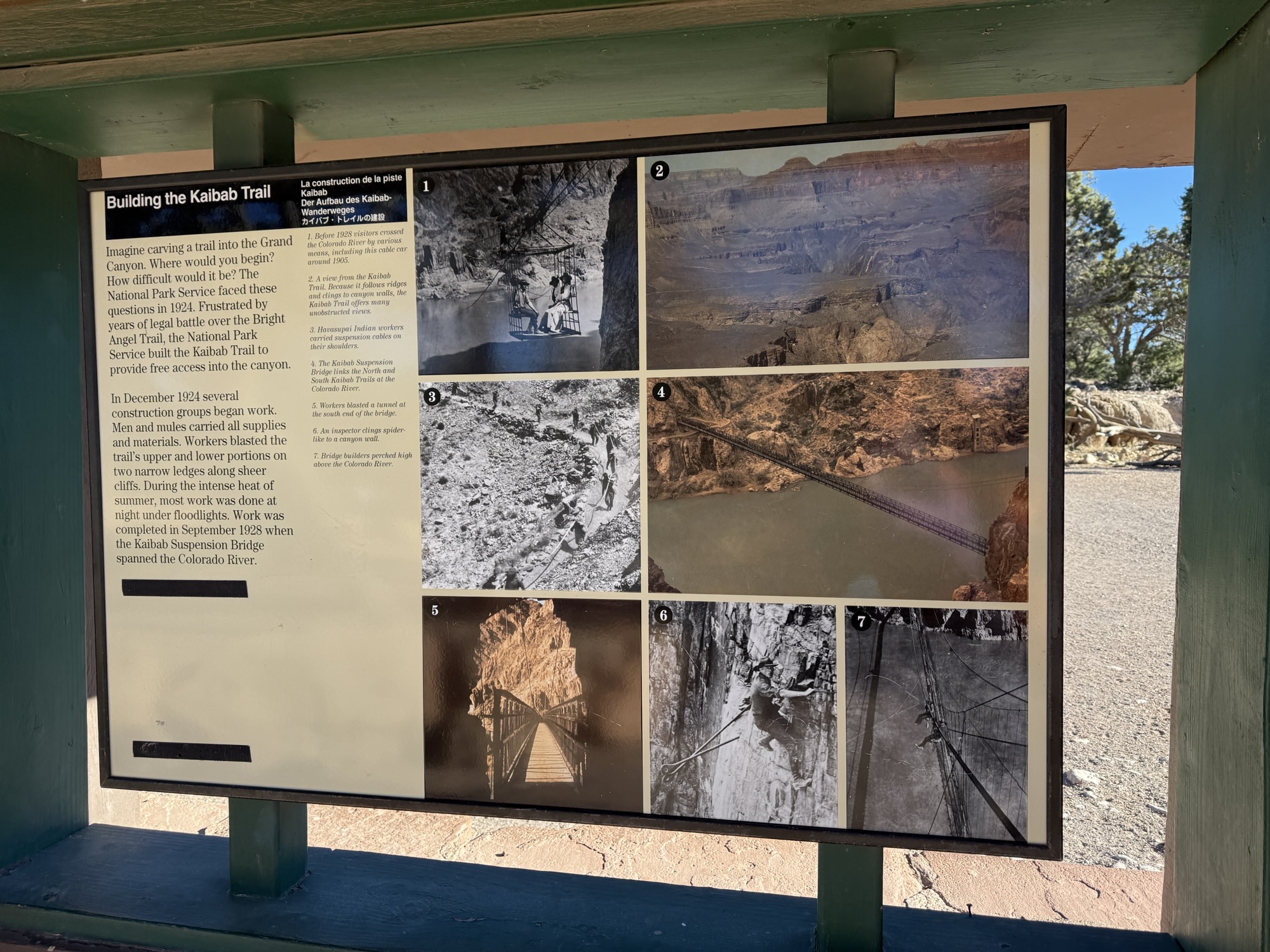
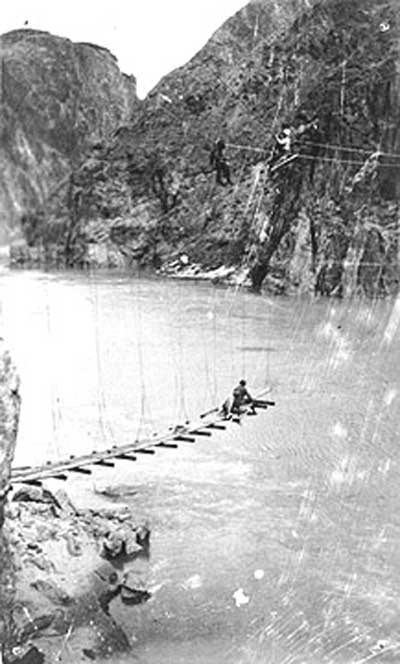
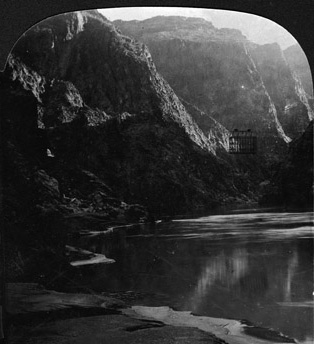
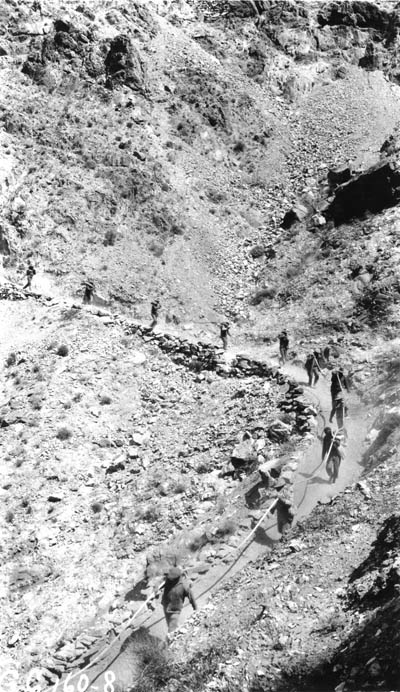
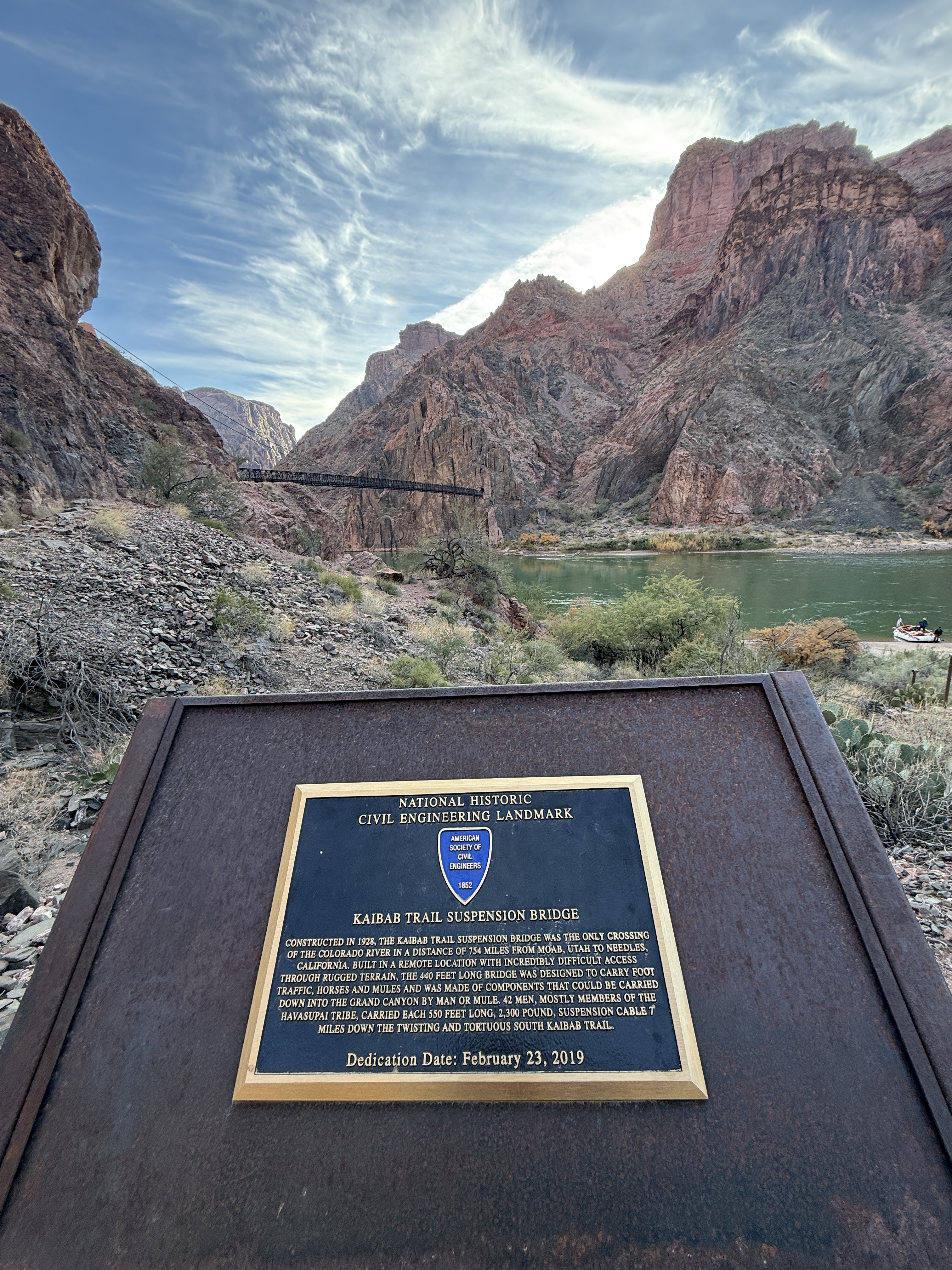
Until this 440-foot-long bridge was built in 1928, crossing the Colorado here was treacherous, first requiring a boat, then in 1913 a cableway, and in 1920 a suspension bridge that was deemed unsafe due to lack of structural stiffness. Being that there were no roads to access the site, all of the 122 tons of building materials for The Black Bridge were brought down 9 miles from the South Kaibab Trailhead, by human and mule, including the one ton, 550 long suspension cables that were carried by 42 single file walking Havasupai Tribesman.

The Silver Bridge, just downstream, was built in the late 1960s, connecting the Bright Angel Trail to Phantom Ranch. These are the only engineered crossings over the Colorado River for hundreds of miles. Unfortunately, this bridge was closed during my trip, but I’m looking forward to crossing it on my next visit.

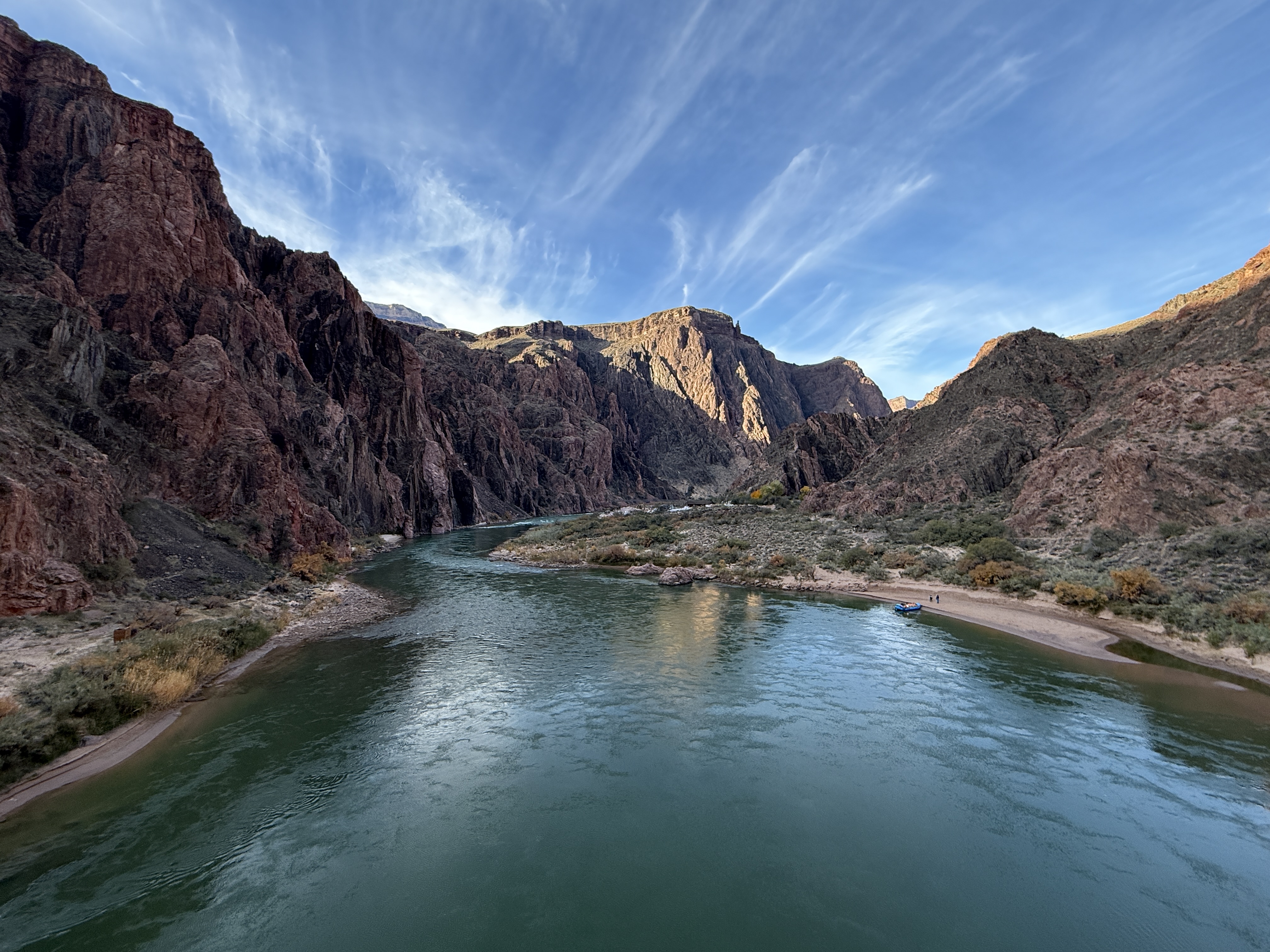
Entering the dark tunnel, I continued on for 105′ before being spit out on The Black Bridge, 50-some-odd feet above the Mighty Colorado. After a little less than 4 miles of hiking, I was nearing the lowest elevation on my journey. Below me, whitewater rafting boats slowly glided along, coming to rest on the beach between the bridges. Many parties stop here for a break at Phantom Ranch, which offers everything from running potable water to a snack canteen to steak dinners and hearty breakfasts. I was looking forward to mailing a postcard via mule.

On the far side of the bridge, I looked back and marveled at the engineering wonder I had just crossed. As a civil engineer, I have great appreciation and respect for all who were involved in the construction of this bridge, listed as a National Historic Civil Engineering Landmark in 2019. I passed a plaque that spoke of the great feat and of the importance of the work. For many years, it had been the only bridge over the Colorado for 754 miles, from Moab, Utah to Needles, California.

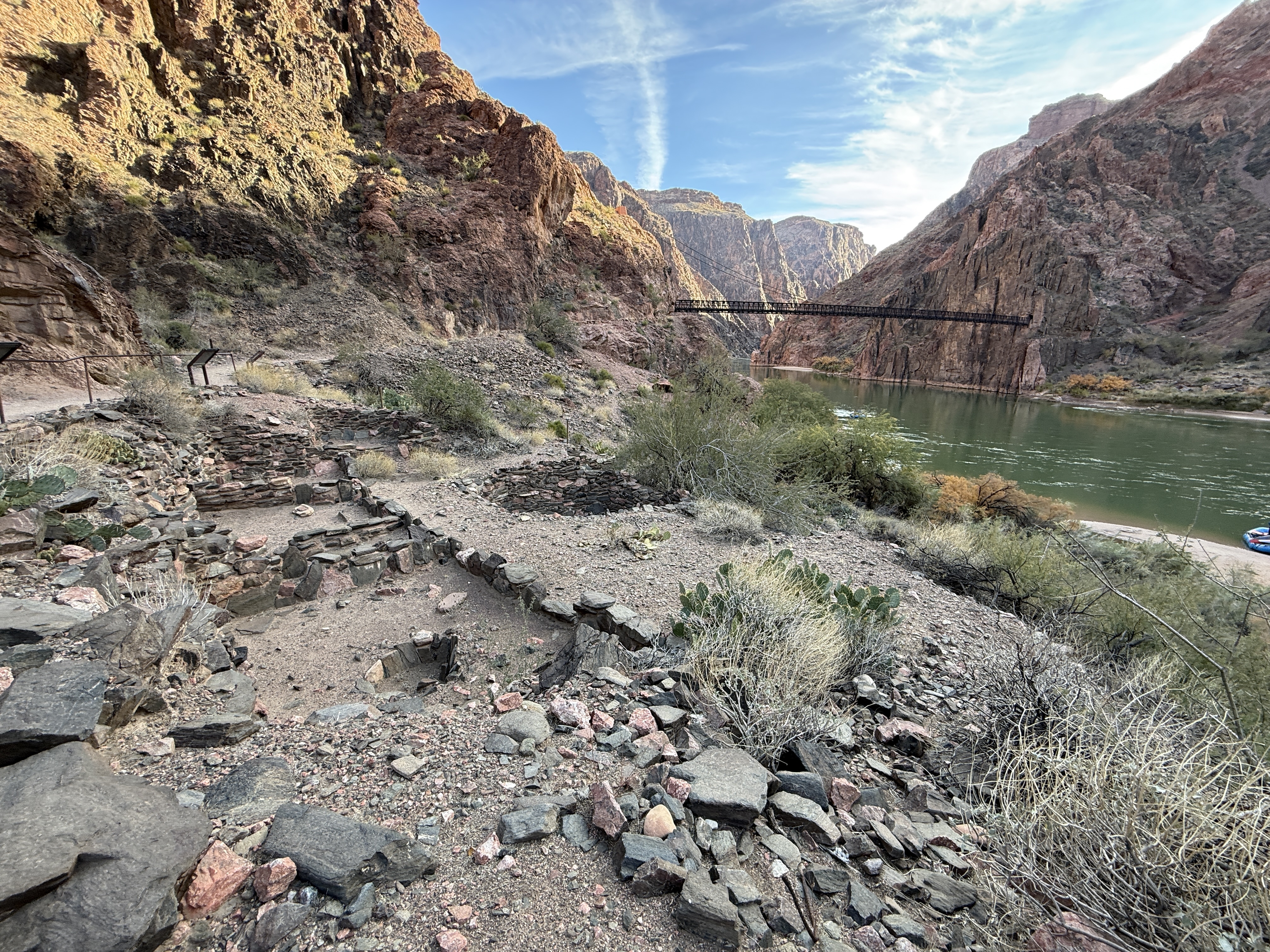
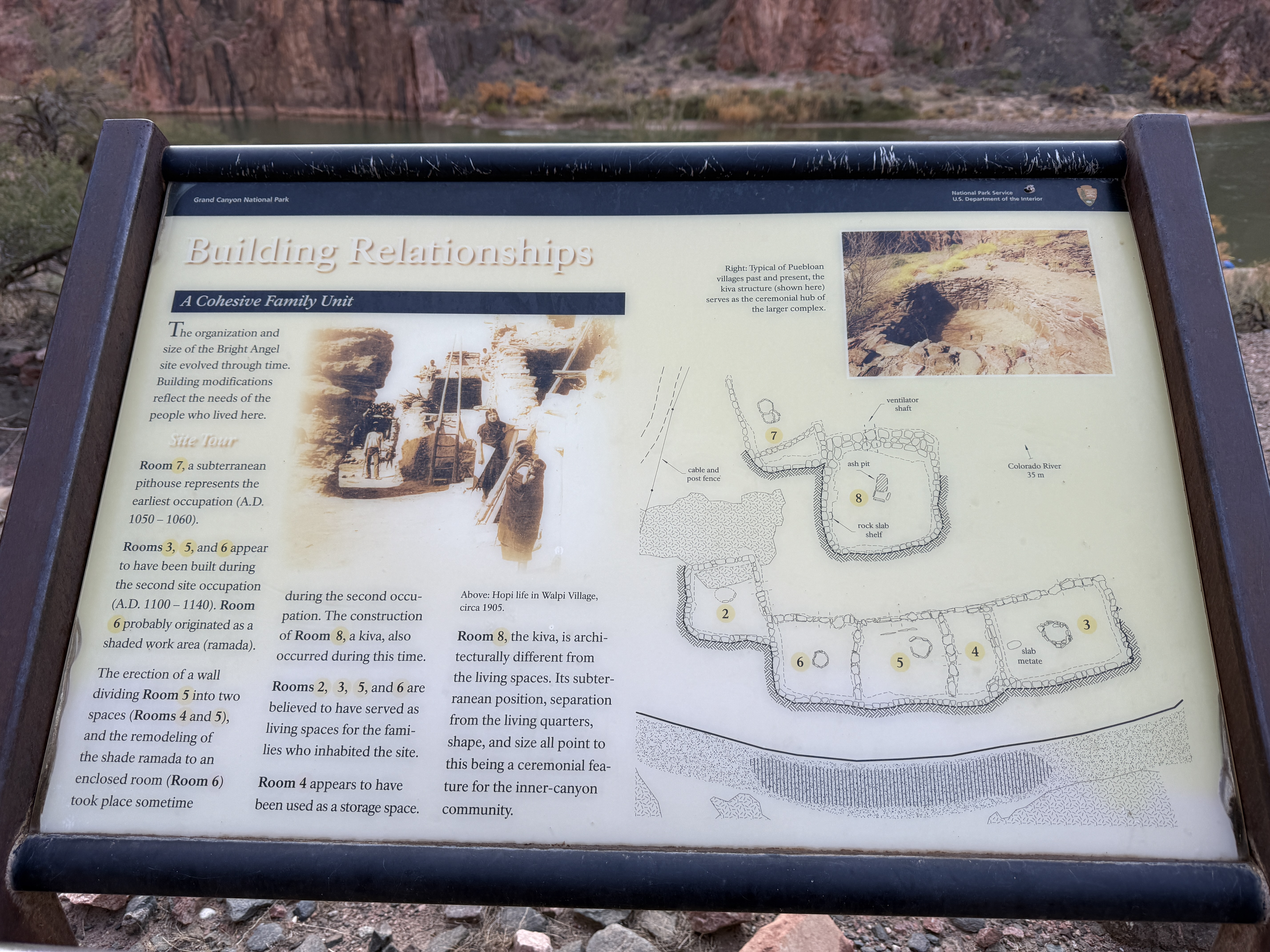
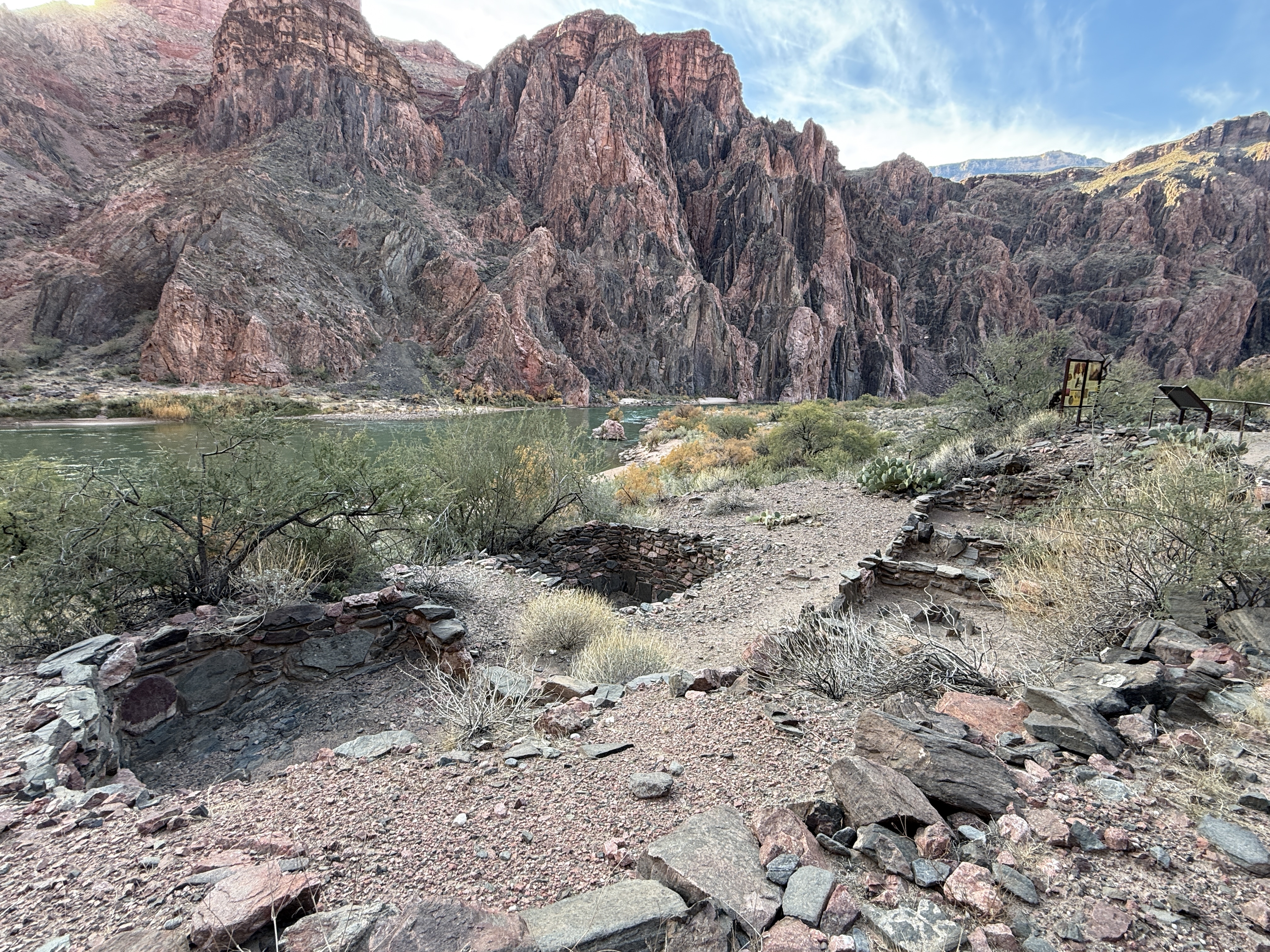
Not far along, another engineering marvel is bordered with a wire cable and informational placards. Pueblo ruins, already abandoned and crumbling by the time John Wesley Powell led the first expedition along the length of the Colorado River in 1869, spoke of a time when the ancestral people farmed and harvested crops between the years of 1050-1140 AD. You can make out the 8 different rooms, including a Kiva, a ceremonial space for this community.

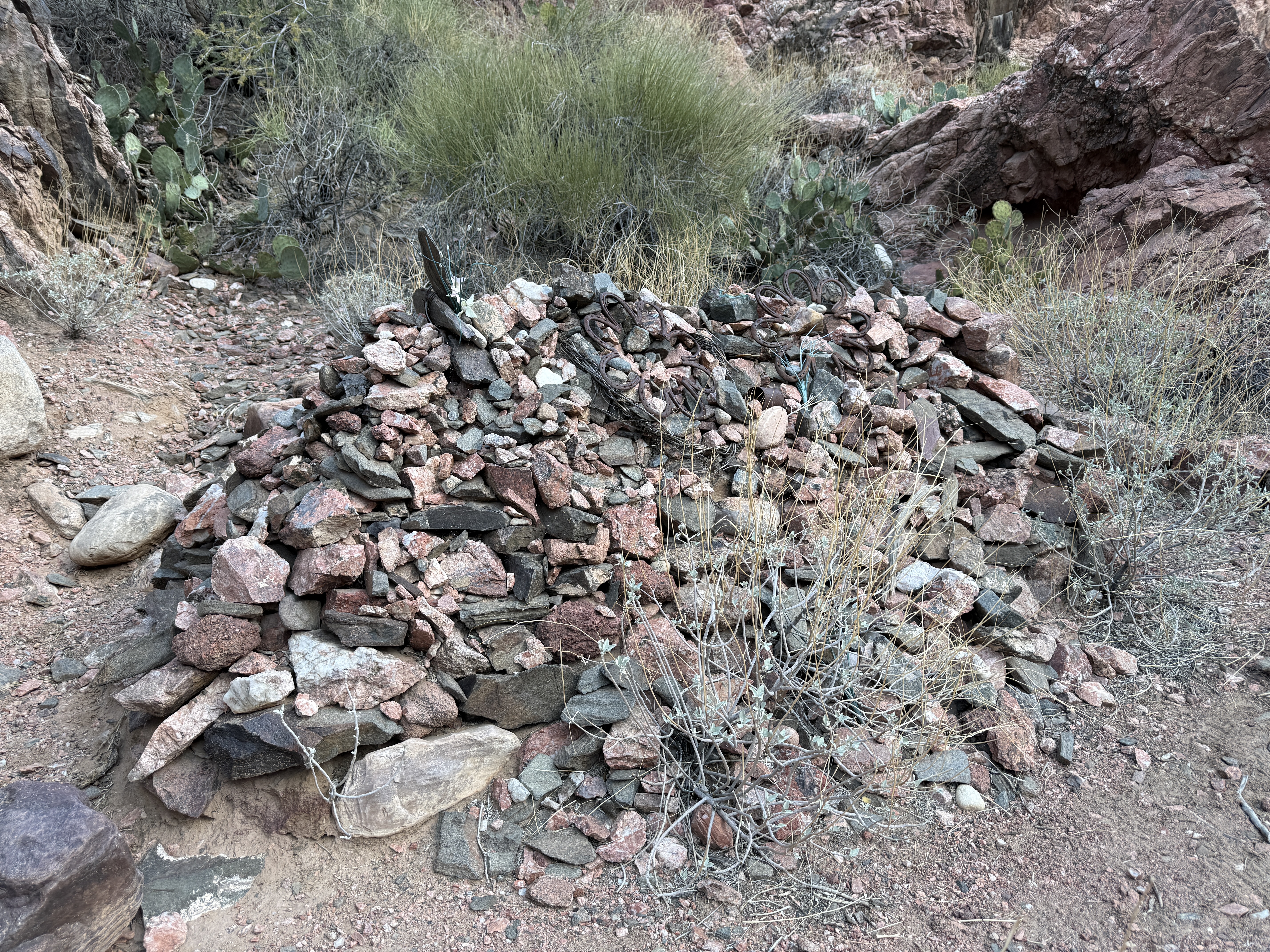
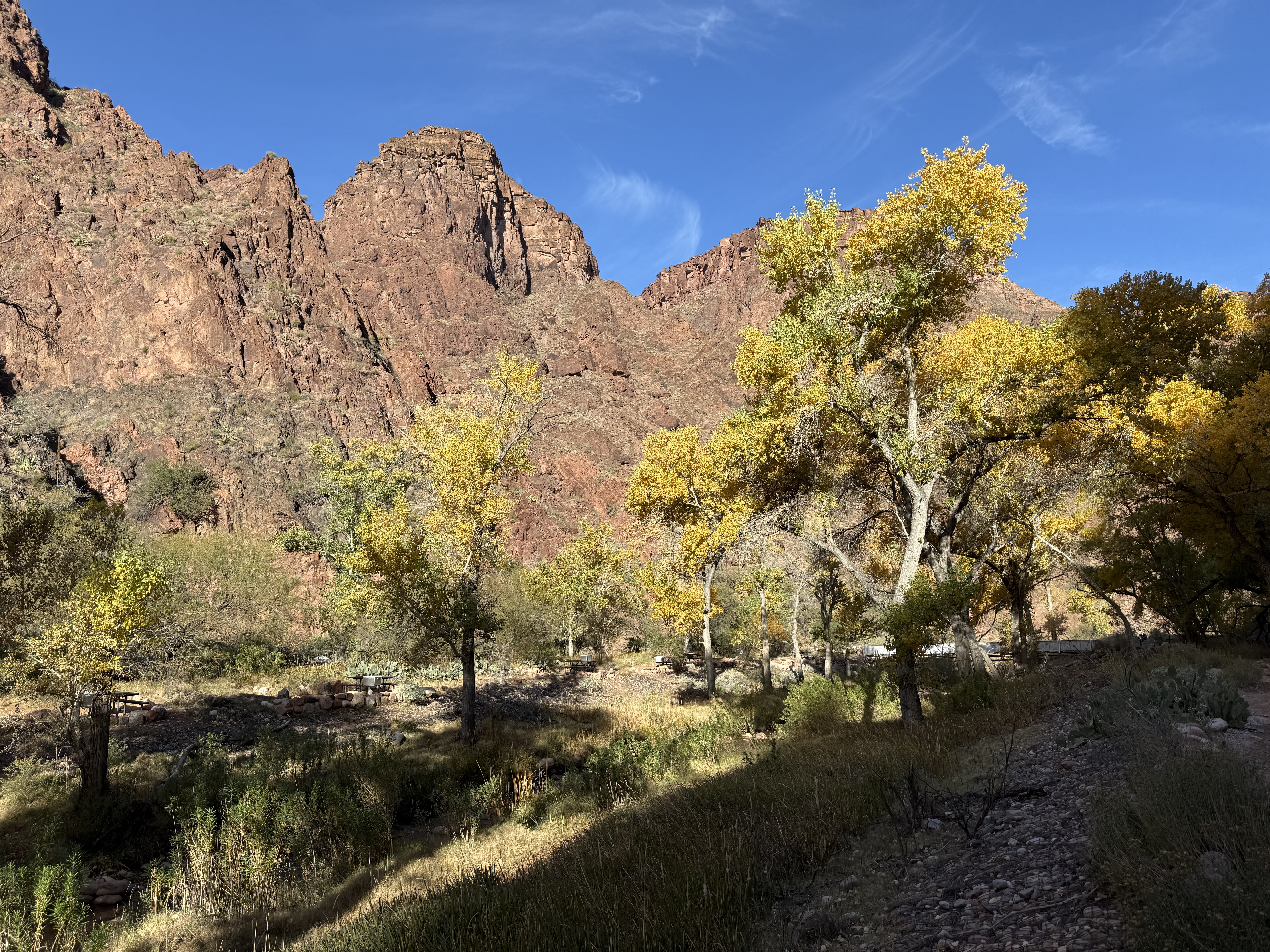
I pulled myself away from the history and sauntered on towards Phantom Ranch, now less than a mile away. Passing a pile of rocks adorned with horseshoe flowers, likely a monument to a well-loved mule, the scenery changed drastically, from brown desert to lush cottonwood forest. I could see Bright Angel Campground across the creek and knew I would have to come back one day and camp here.

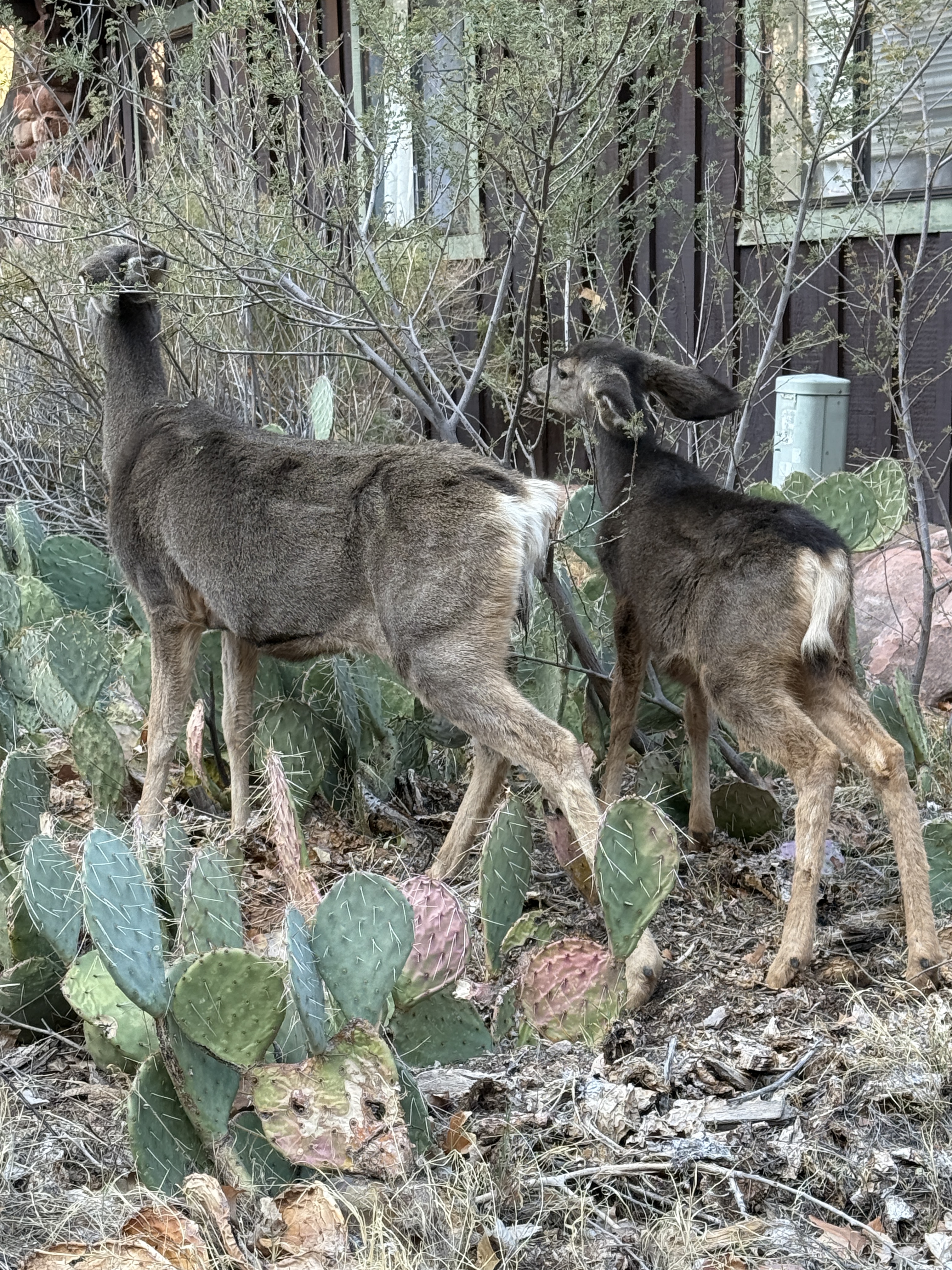
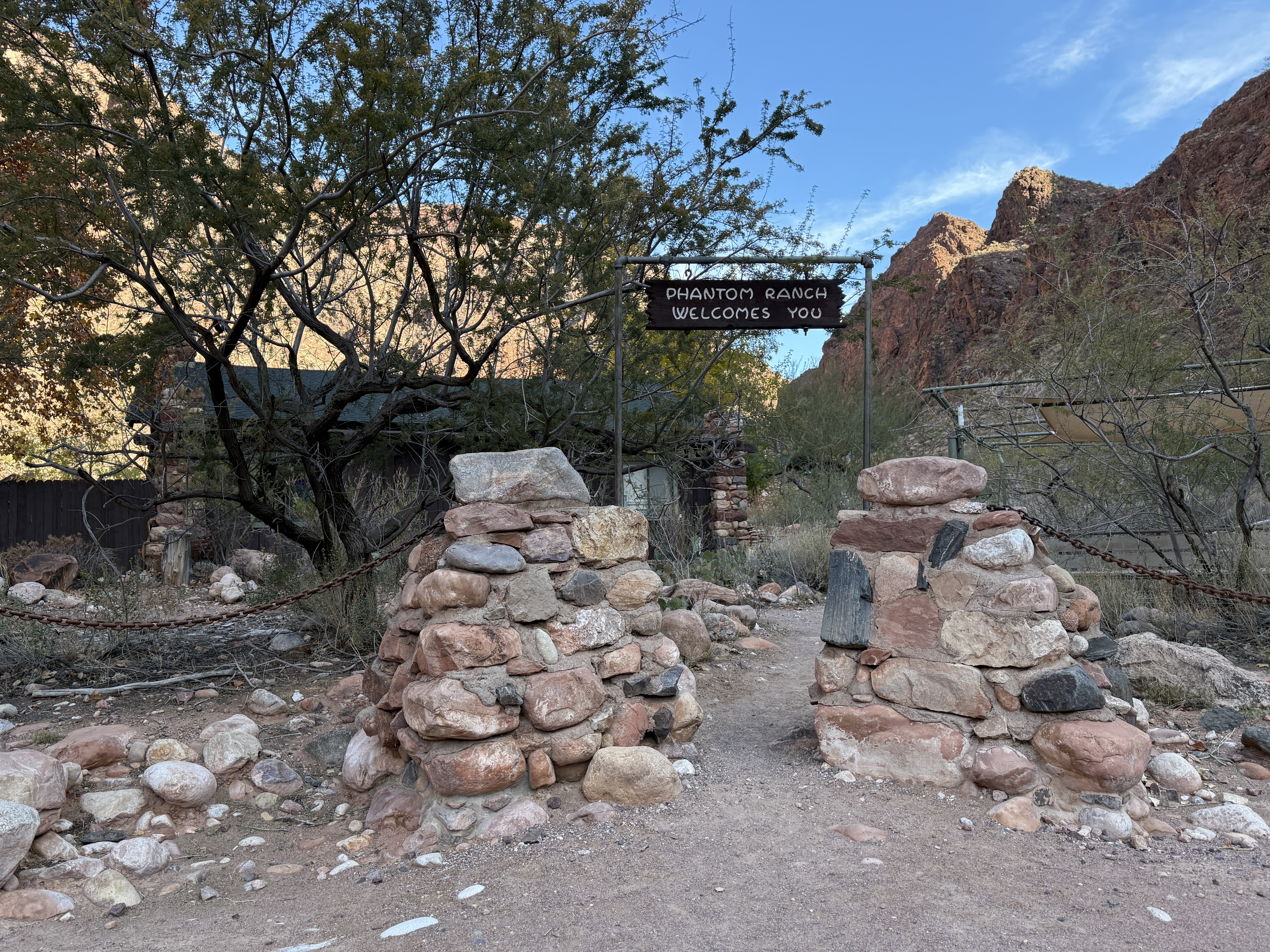
I passed under a wooden sign welcoming me to Phantom Ranch. A small heard of mule deer surprised me. They were the first wildlife I had seen since I started off from the trailhead the day before. They were completely unbothered by me as I snapped some pictures and videos. The Phantom Ranch spread is beautiful, with modest buildings made of wood and stone, stained and painted in hues of browns and greens, matching the environment in a way that shows true respect for the place.

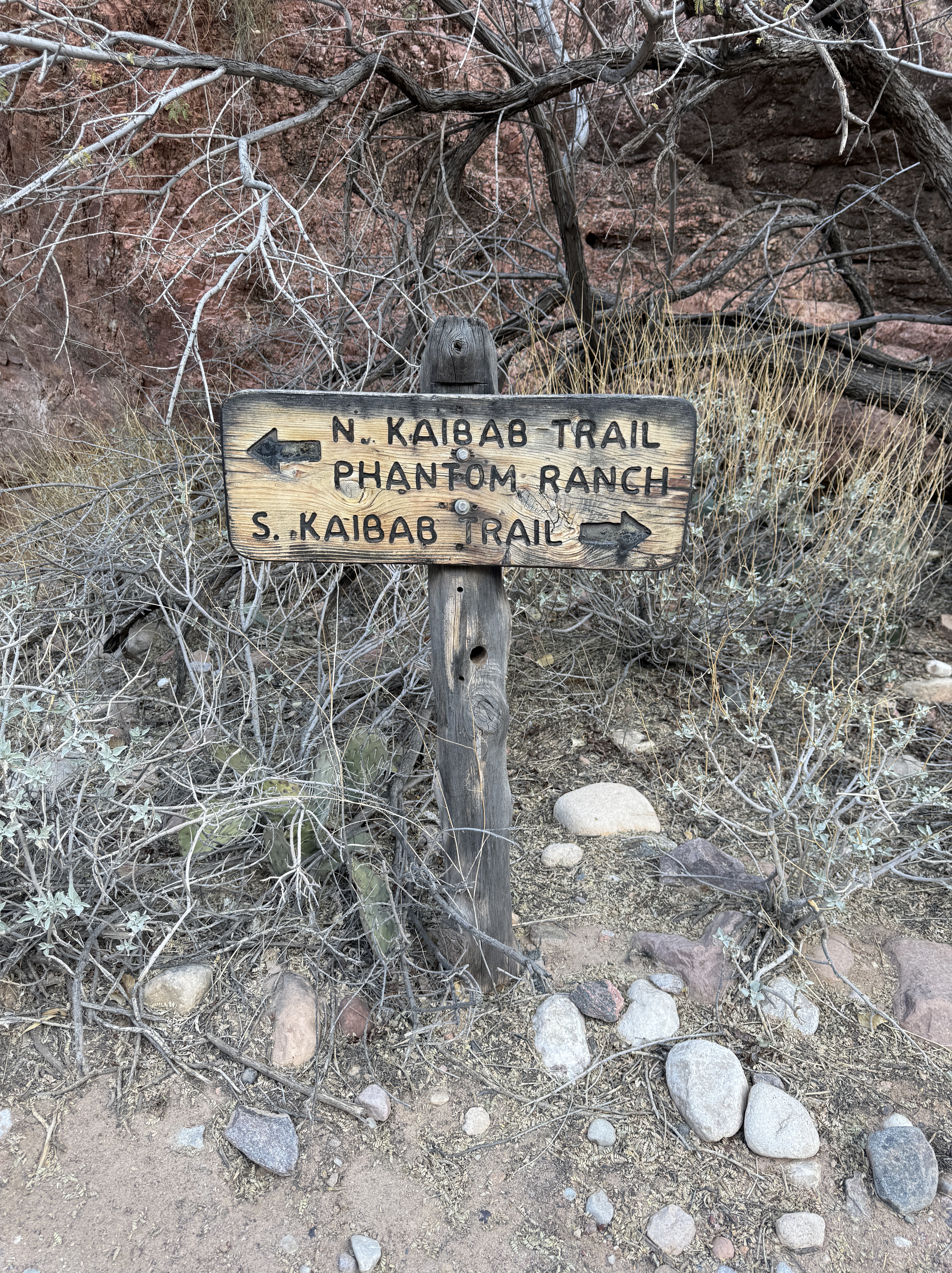
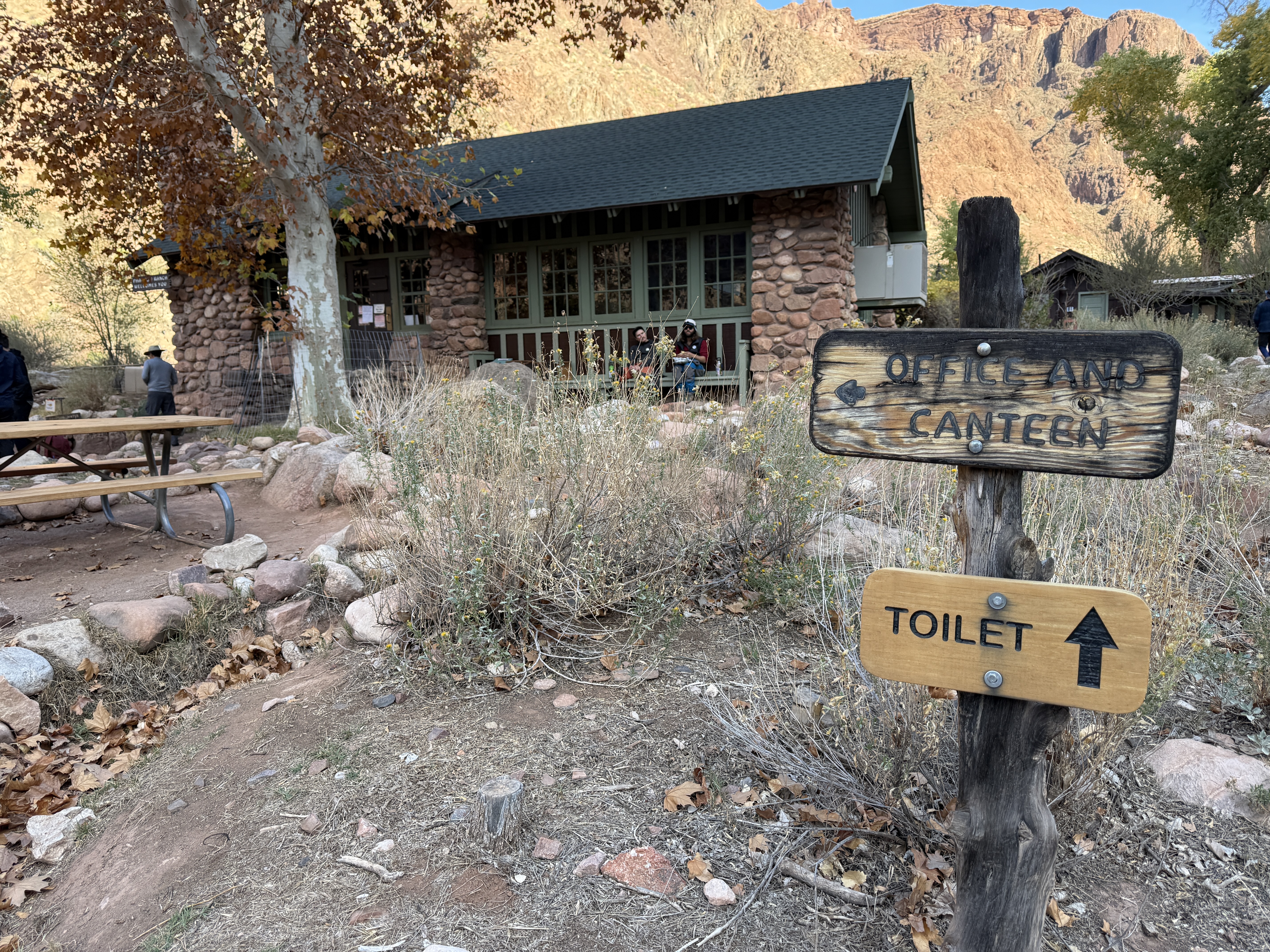
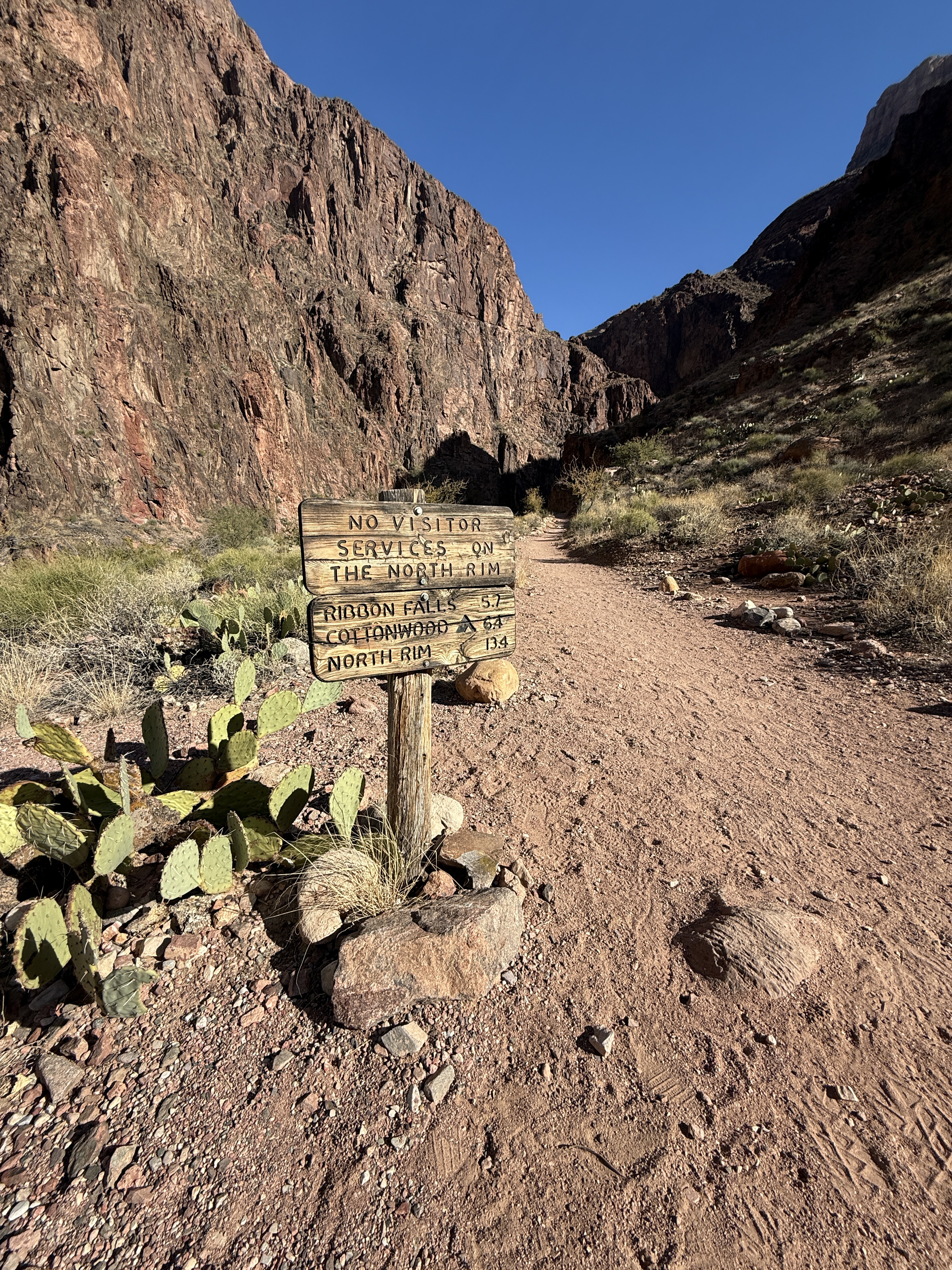
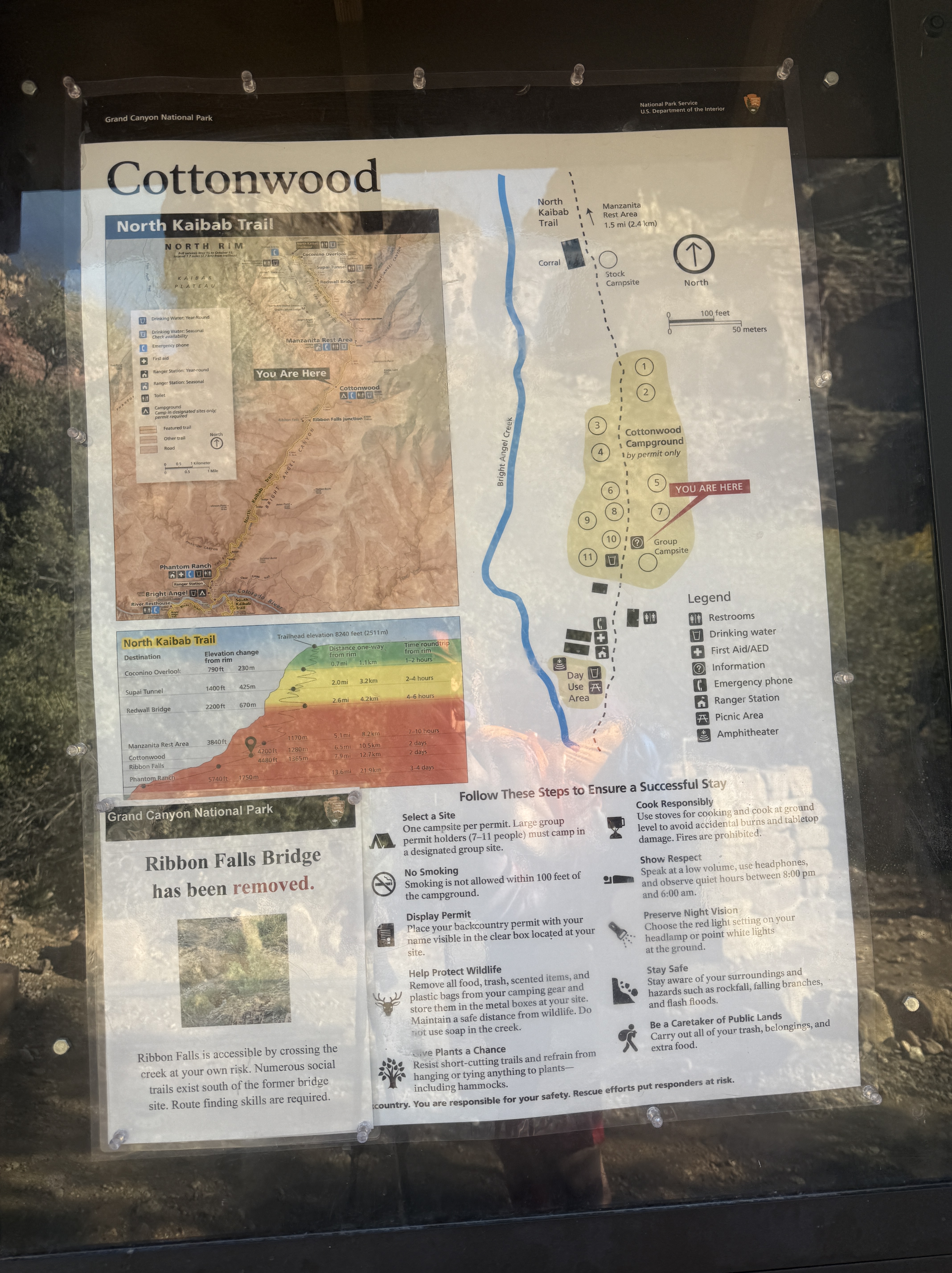
I found the canteen, but was sad to see it would be closed for the duration of my trip in the Canyon due to the waterline repair work and new breaks in the line. I was able to fill up my water bottle with fresh drinking water at a spigot outside the canteen and finished up my oatmeal that I had been too excited to eat before leaving camp that morning. A quick bathroom break at the facilities and a check of the weather forecast posted on a bulletin board, and I moved on. About a mile down the trail, a wooden sign warned me that there were no services on the north rim this time of the year and informed me that I had 6.4 miles to go to reach my home for the next three nights at Cottonwood Campground. I was now on the North Kaibab Trail.

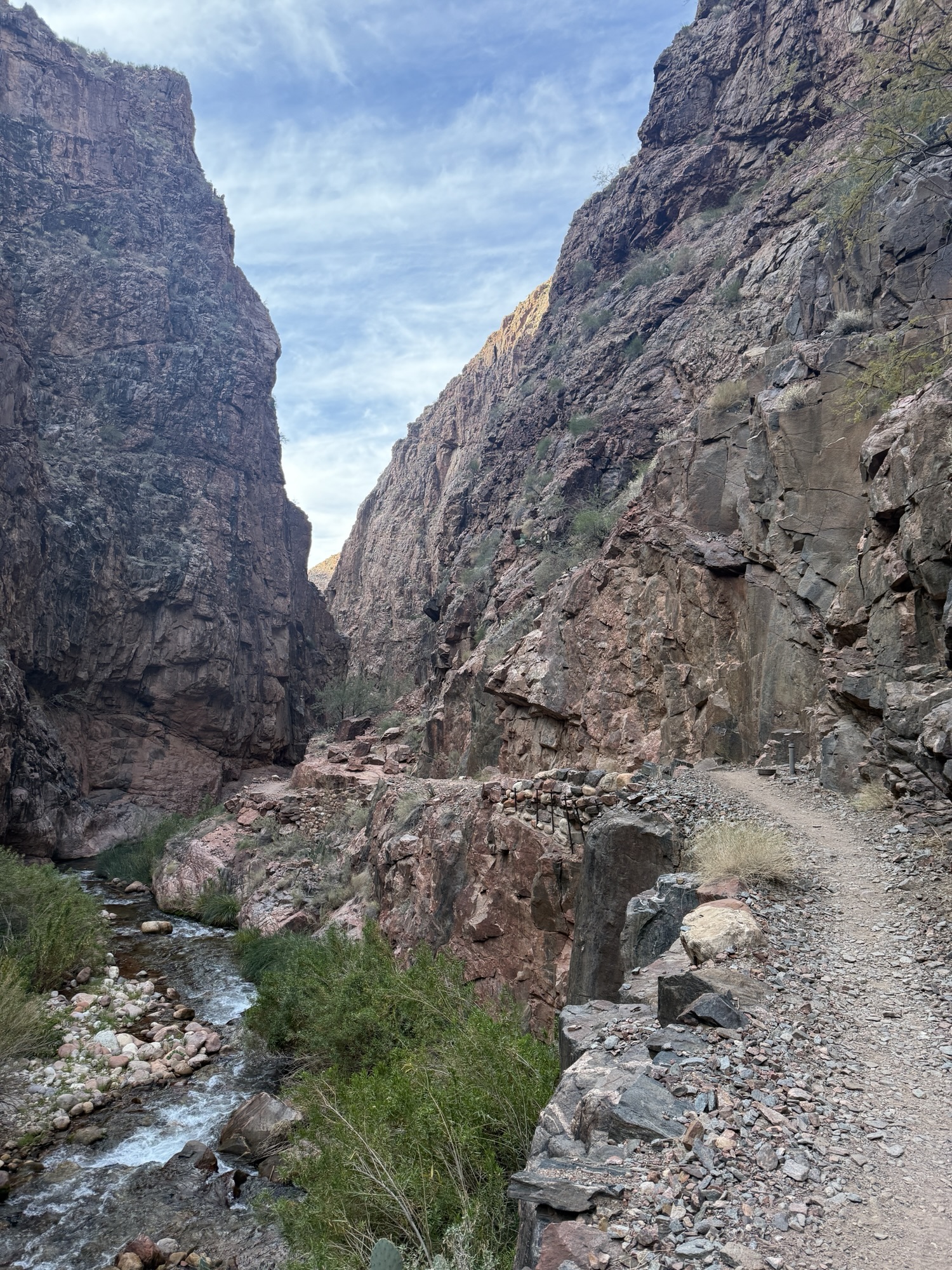
The further I walked, the narrower the canyon walls became, rising up hundreds and even thousands of feet in vertical faces. It was in this section, often referred to as “The Box,” that I found my gps trackers and InReach were struggling to find satellite connection and were pinging high up on the walls, the connection unable to accurately locate me only a dozen or so feet horizontally, but hundreds of feet below the location it reported. I knew my data was fucked, so I turned off all my trackers except my InReach, to save battery, and used educated guesses to figure out how far I’d come and how far I had to go.

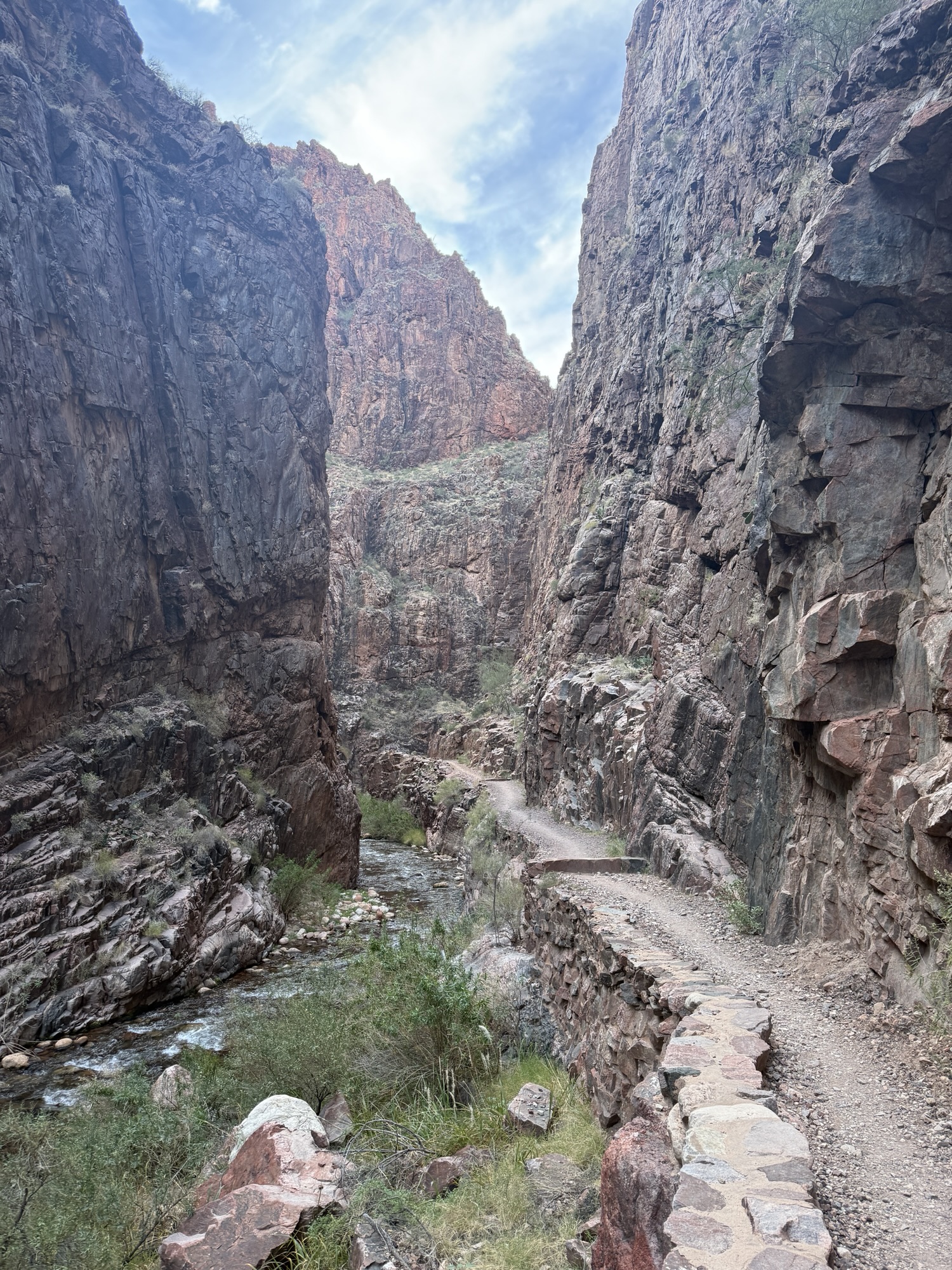
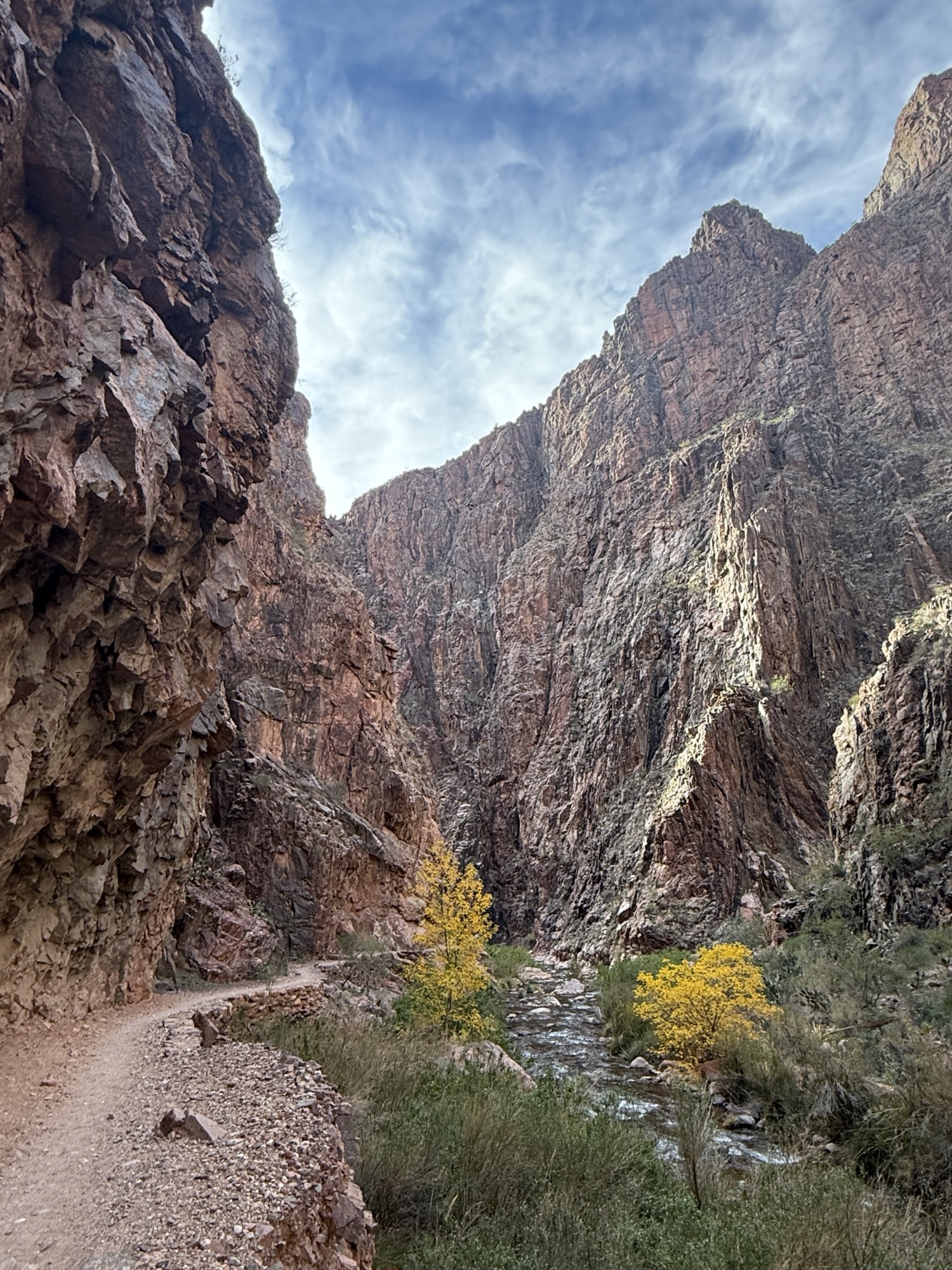
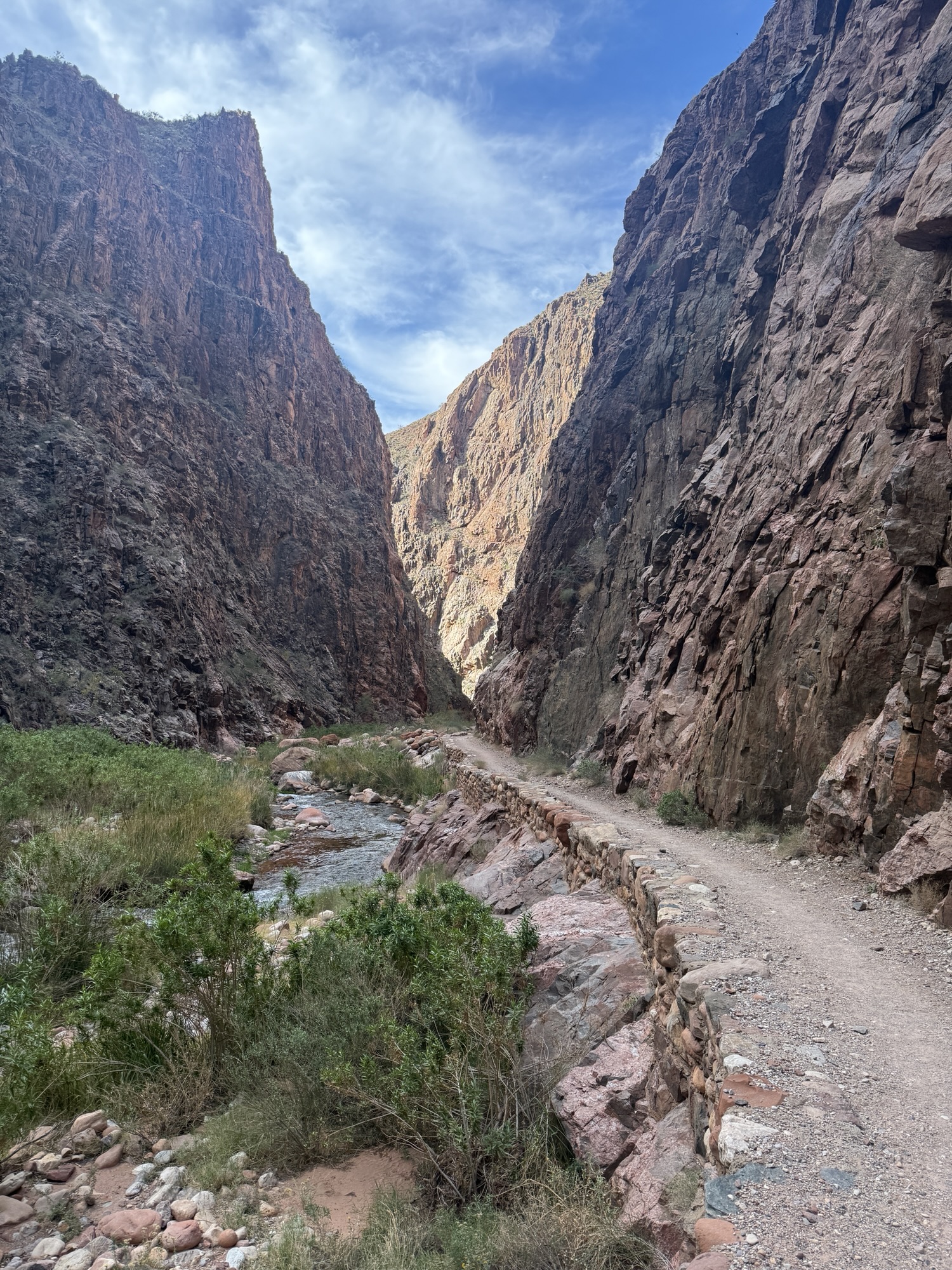
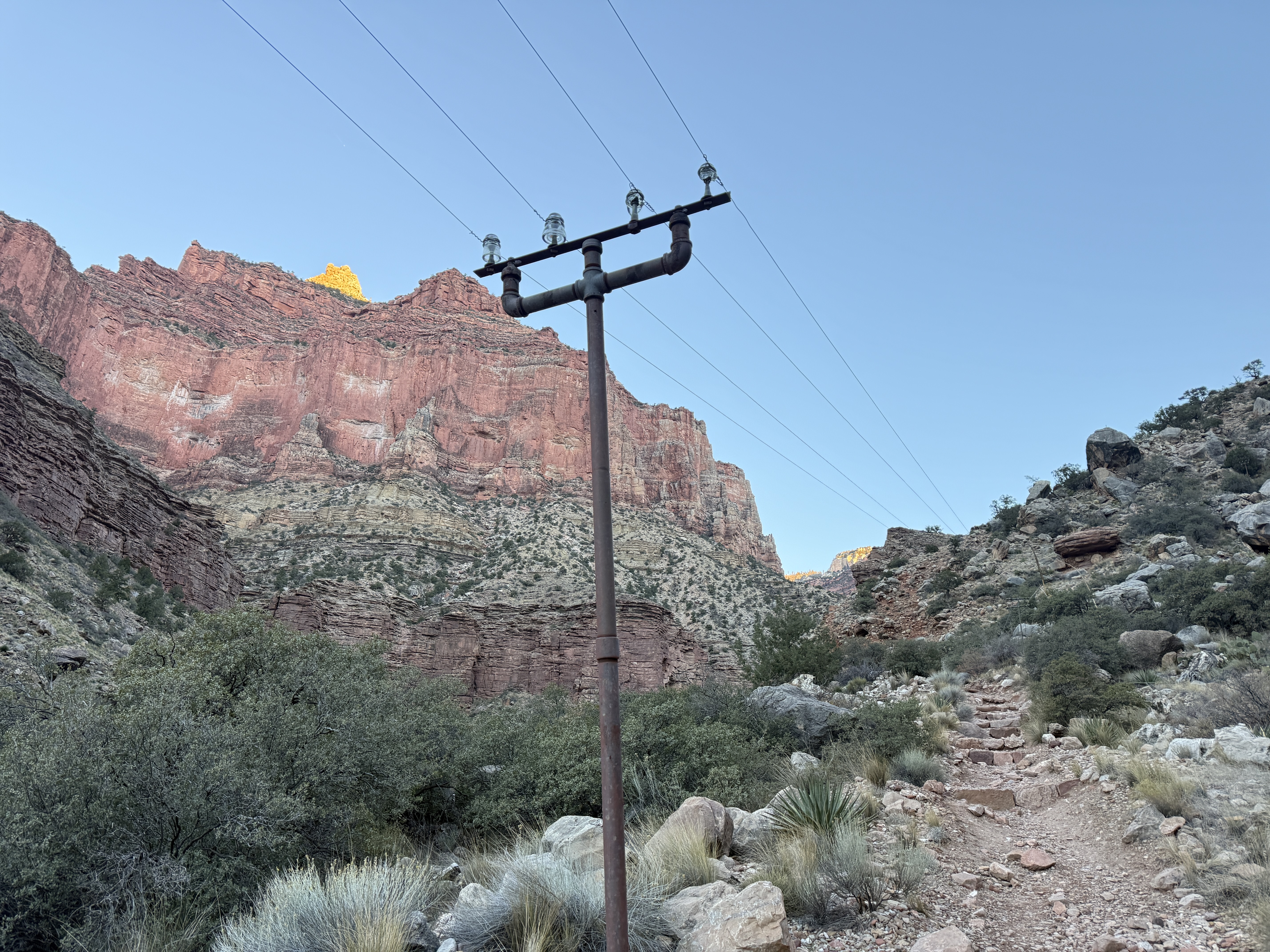
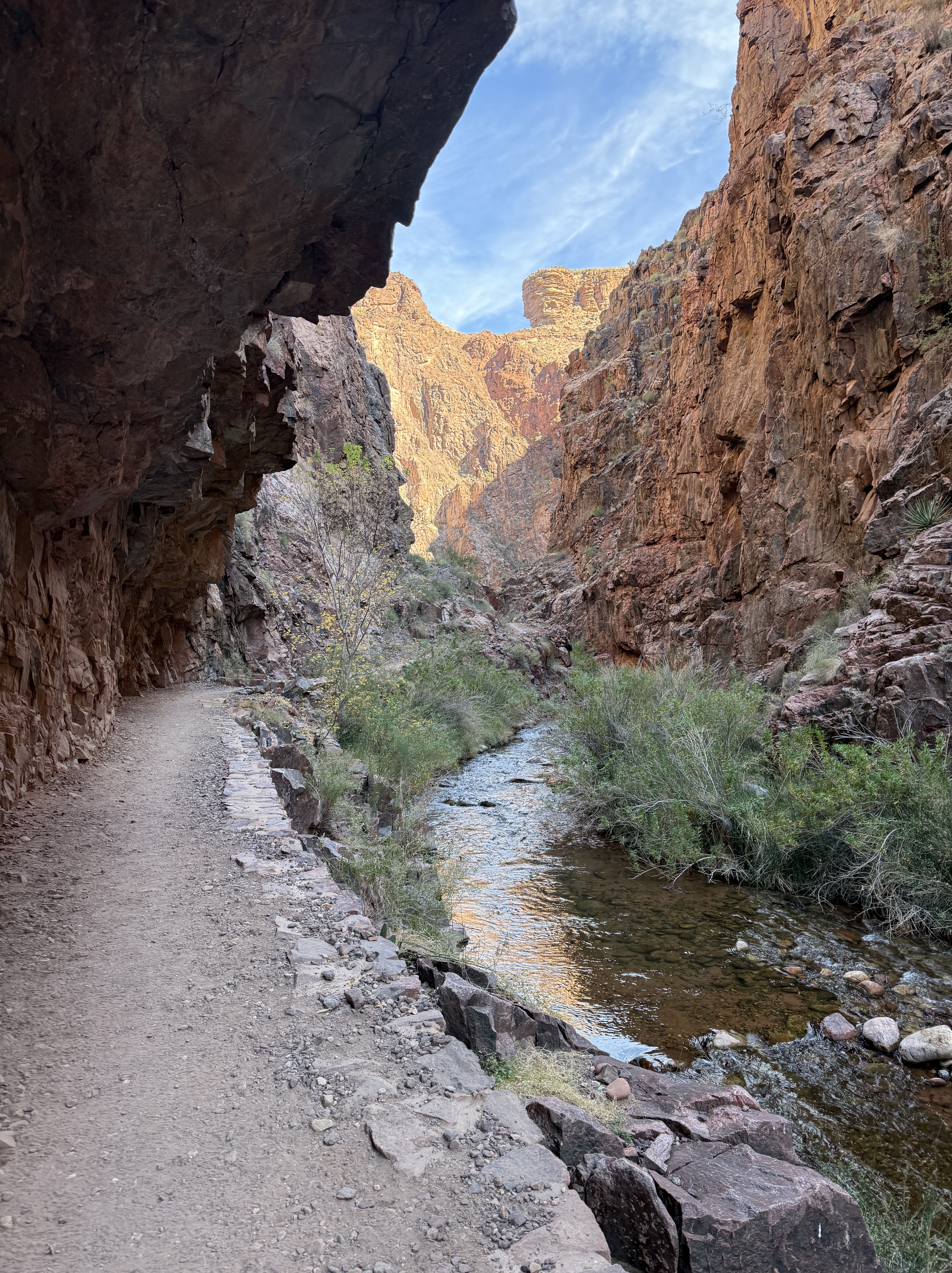
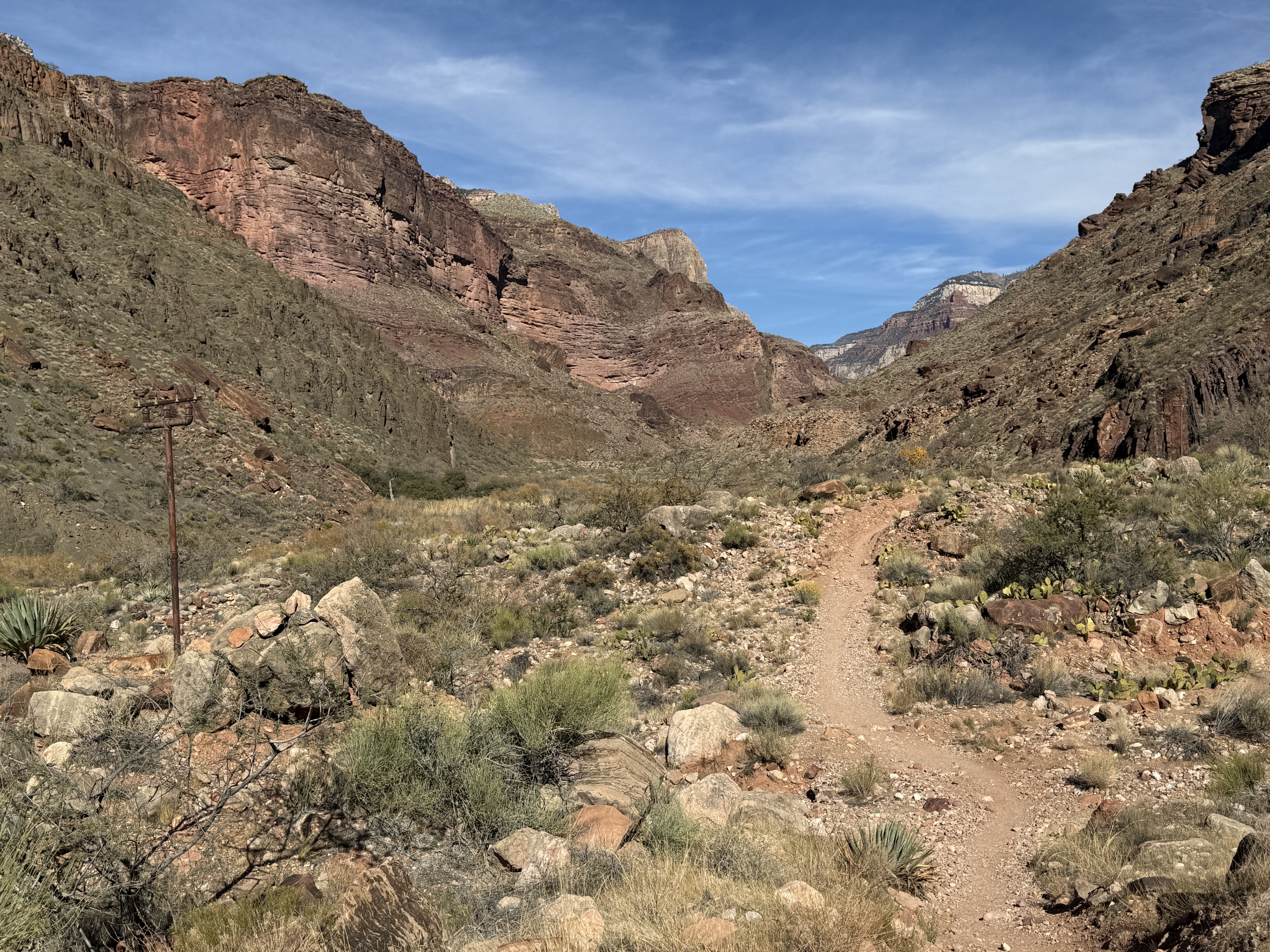
Navigation was not a problem here. The trail was built with great care, wide and well packed, with intermittent bridges and many rock retaining walls to offer a path over and around Bright Angel Creek. Telegraph poles, some still wearing their blue glass insulators, told much of the story of the Trans-Canyon Telegraph line. This communication system was built in 1924 then improved in 1935 by CCC workers, as were much of the north rim trail and facilities, and it allowed communication from the South Rim to the North Rim and everything in between.

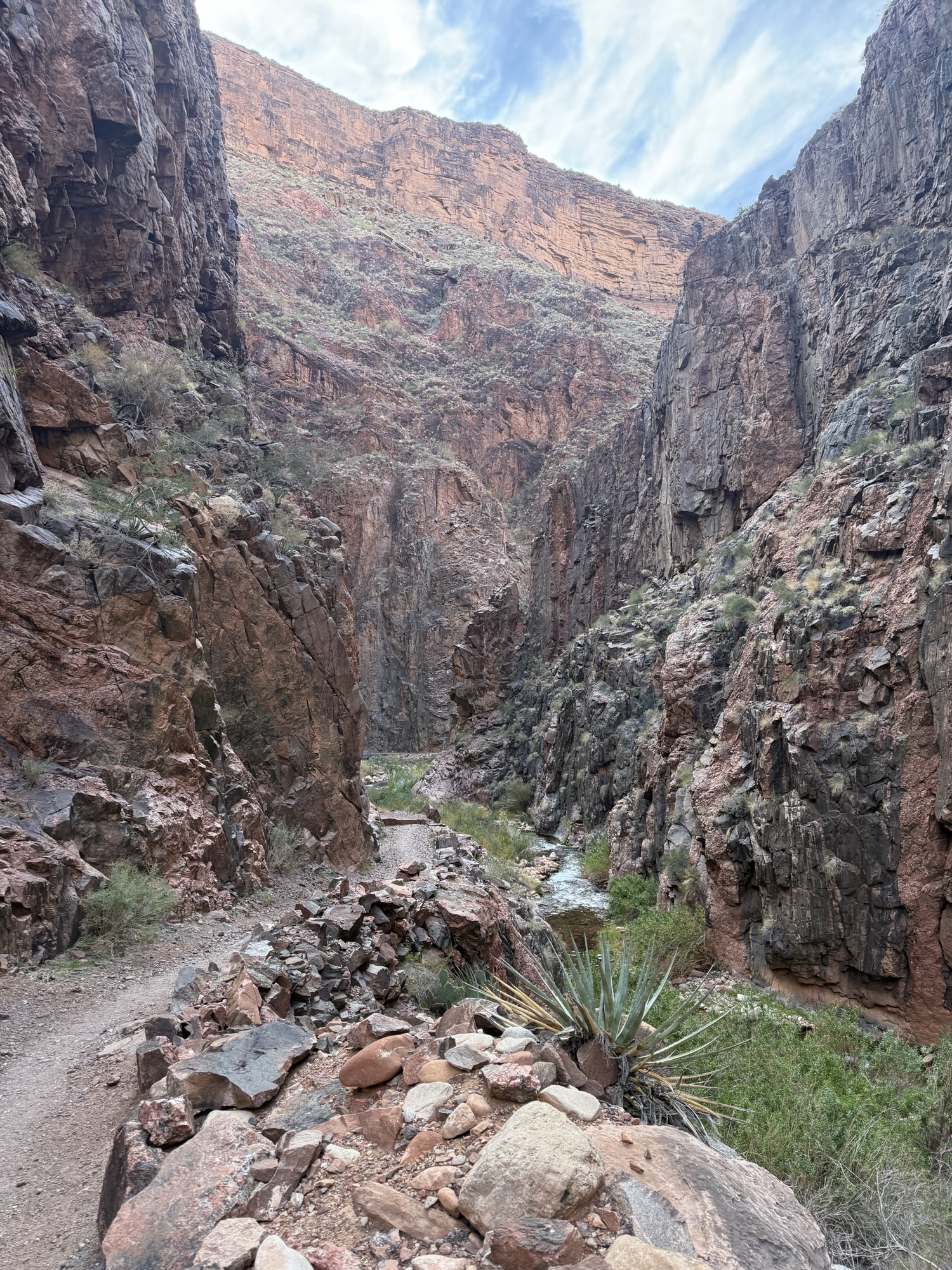
Walking along the Vishnu Basement Rocks in The Box for about 4 miles, I was entranced by the geology I was observing. Millions and even billions of years of layers built up here before being sliced open by streams and rivers. I resolved to carry a geology guide for the area on my next trip, but for now I would just take it all in… and take a ton of pictures. I passed a few workers who had excavated around the Trans Canyon Waterline that runs under the trail, fixing one of the many breaches in the 50-year-old infrastructure. A $208 million dollar project is currently underway to upgrade the ancient system.

Eventually, the box canyon opened up into a wide Valley and I was in the sun again. The temperatures had been long sleeve sun shirt warm in the canyon, but now I was sure it was in the mid 60s. I stripped off a layer and changed into shorts. I looked back at where I had come from and realized that I was gaining quite a bit of elevation, now 30 or 40 feet above Bright Angel Creek at some points and maybe 1,000’ above the Colorado River. I passed a group of biologists who were doing fish studies and removing invasive species. I moved by silently, snapping a photo, but we would meet in a couple of days, further up the trail.

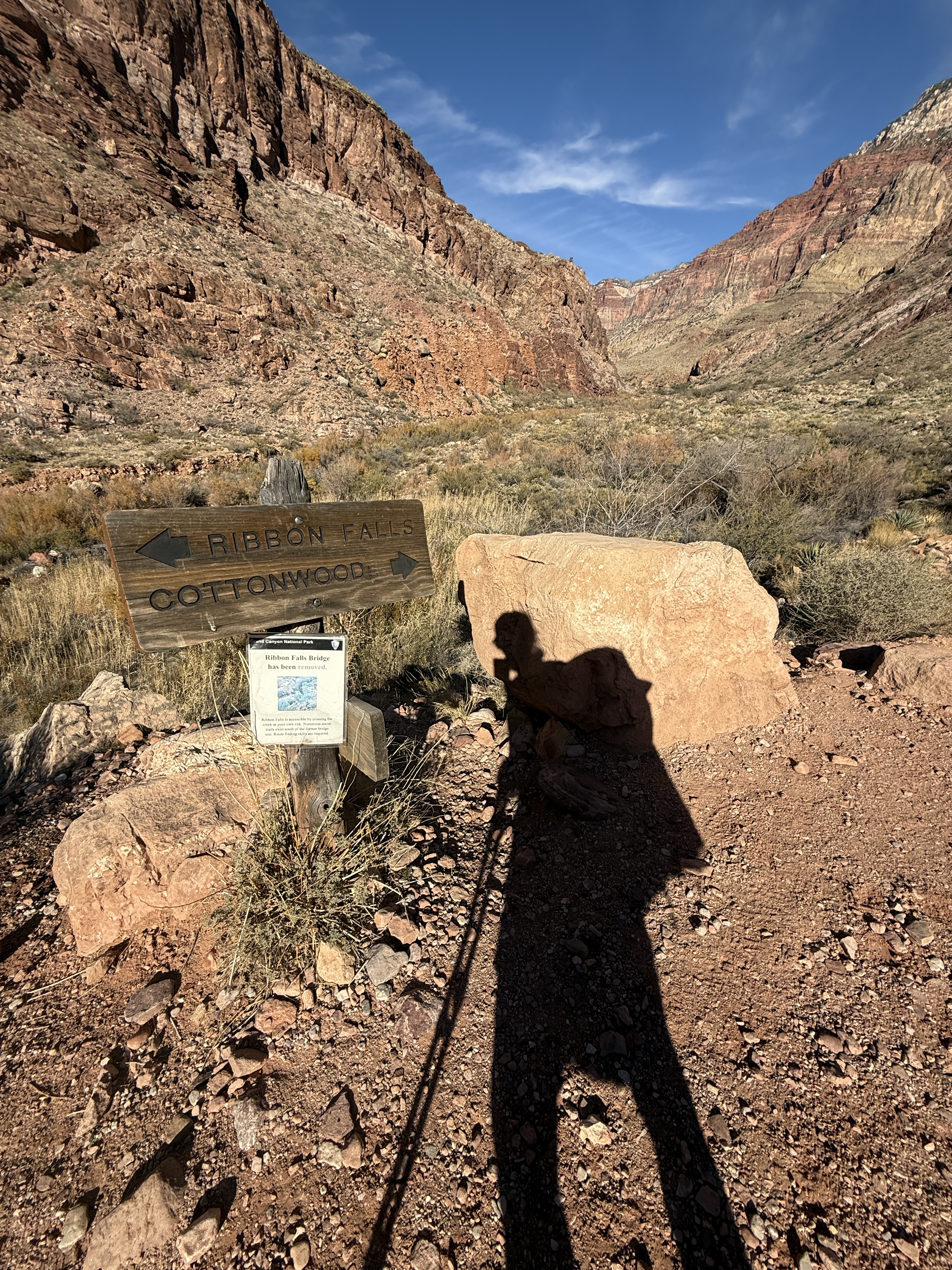
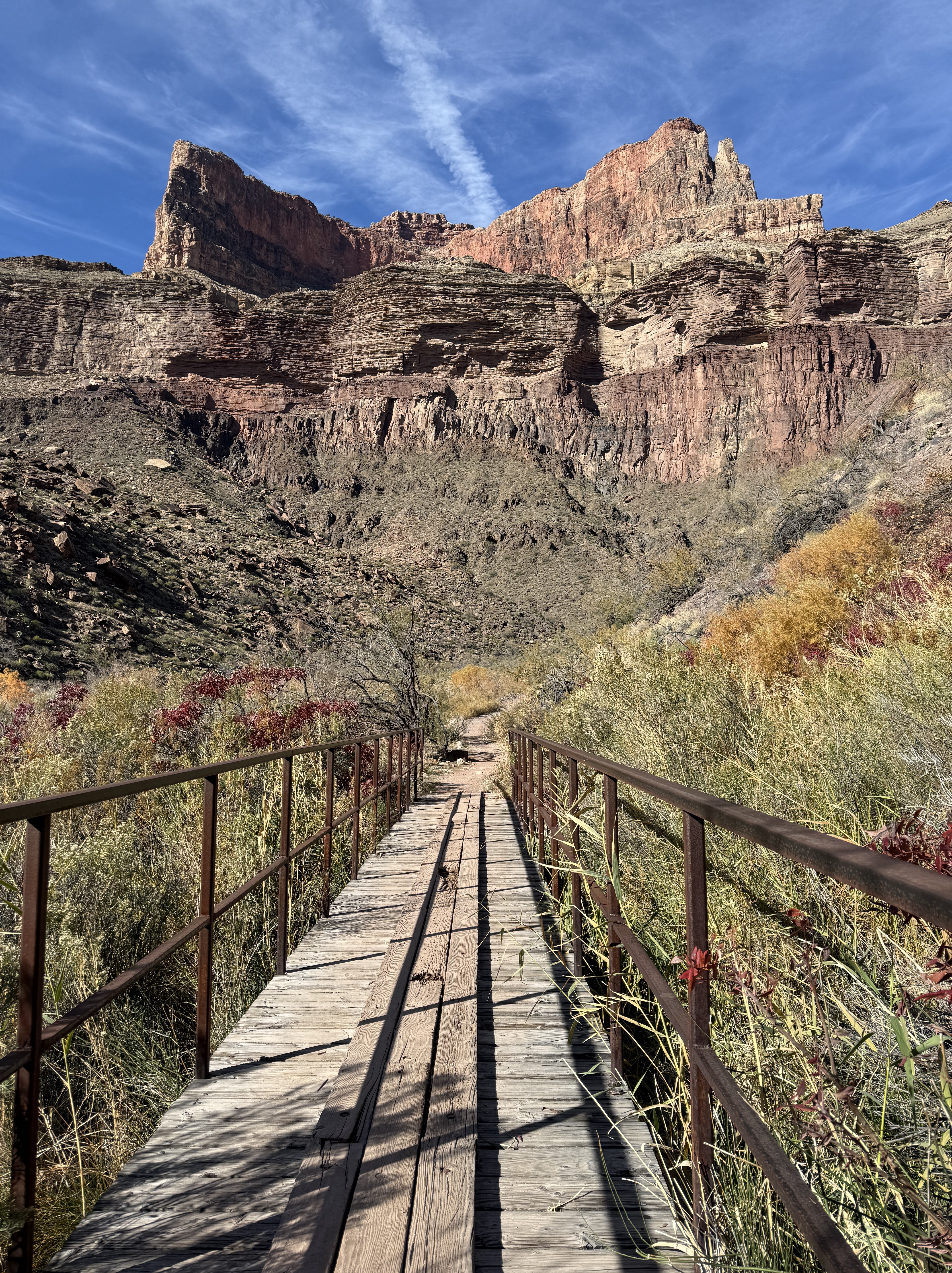
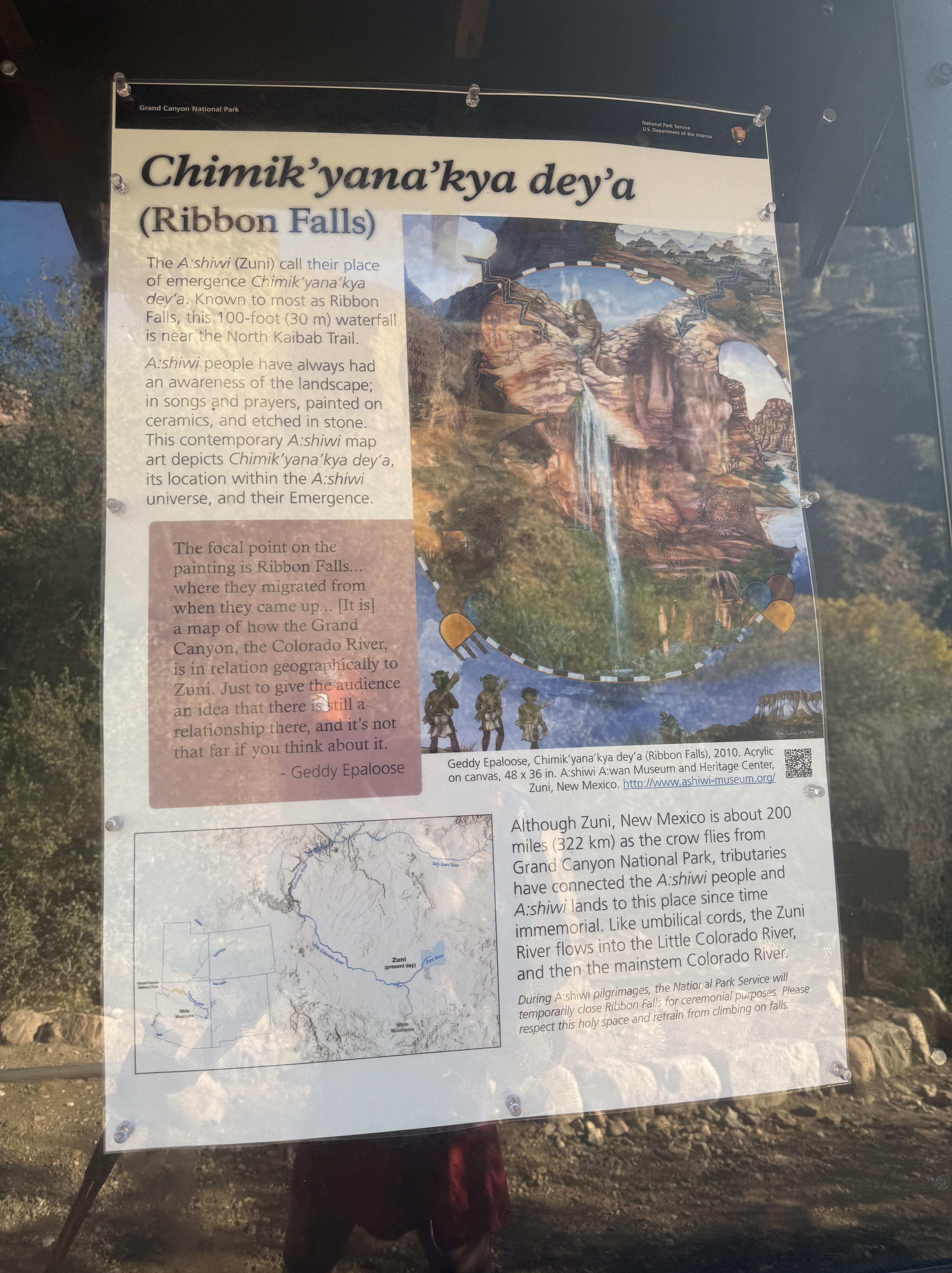
I decided to skip Chimik’yana’kya Dey’a (Ribbon Falls) for today, since I would be at Cottonwood for 3 nights, with one chill out day. I could make the mile or so walk back down to visit these sacred falls another time. The bridge to access this area had been removed, so it would be important for me to pick a good spot to cross the creek. I was getting tired after more than 11 miles for the day and didn’t have the bandwidth to experience such a special place. The Zuni consider Chimik’yana’kya Dey’a (Ribbon Falls) to be where they were created. I wanted to give it full attention and respect.

Just when I thought I couldn’t walk another step, there it was in the distance; a stand of Cottonwood trees and the faint sign of a structure I later discovered to be the Ranger Station. I mustered up the last of my energy and made it to the campground, spending a few minutes to find the perfect campsite. I unloaded my pack, noticing that I still have a terrible habit of packing way too much food. No wonder I was tired. I vowed to not let my years of living on little sustenance off the road system, and my tendency to boredom eat, influence me to overpack on my next trip.

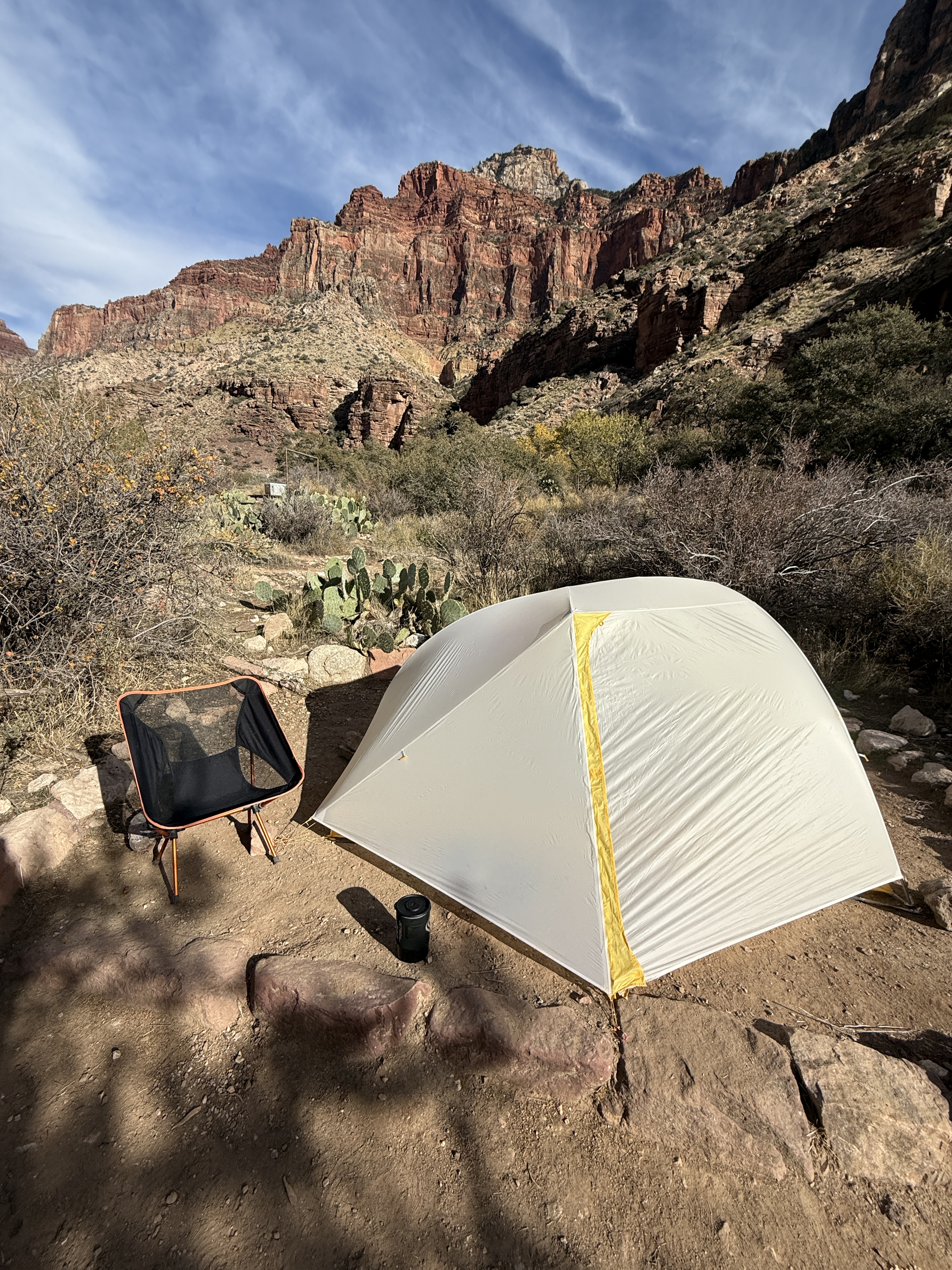
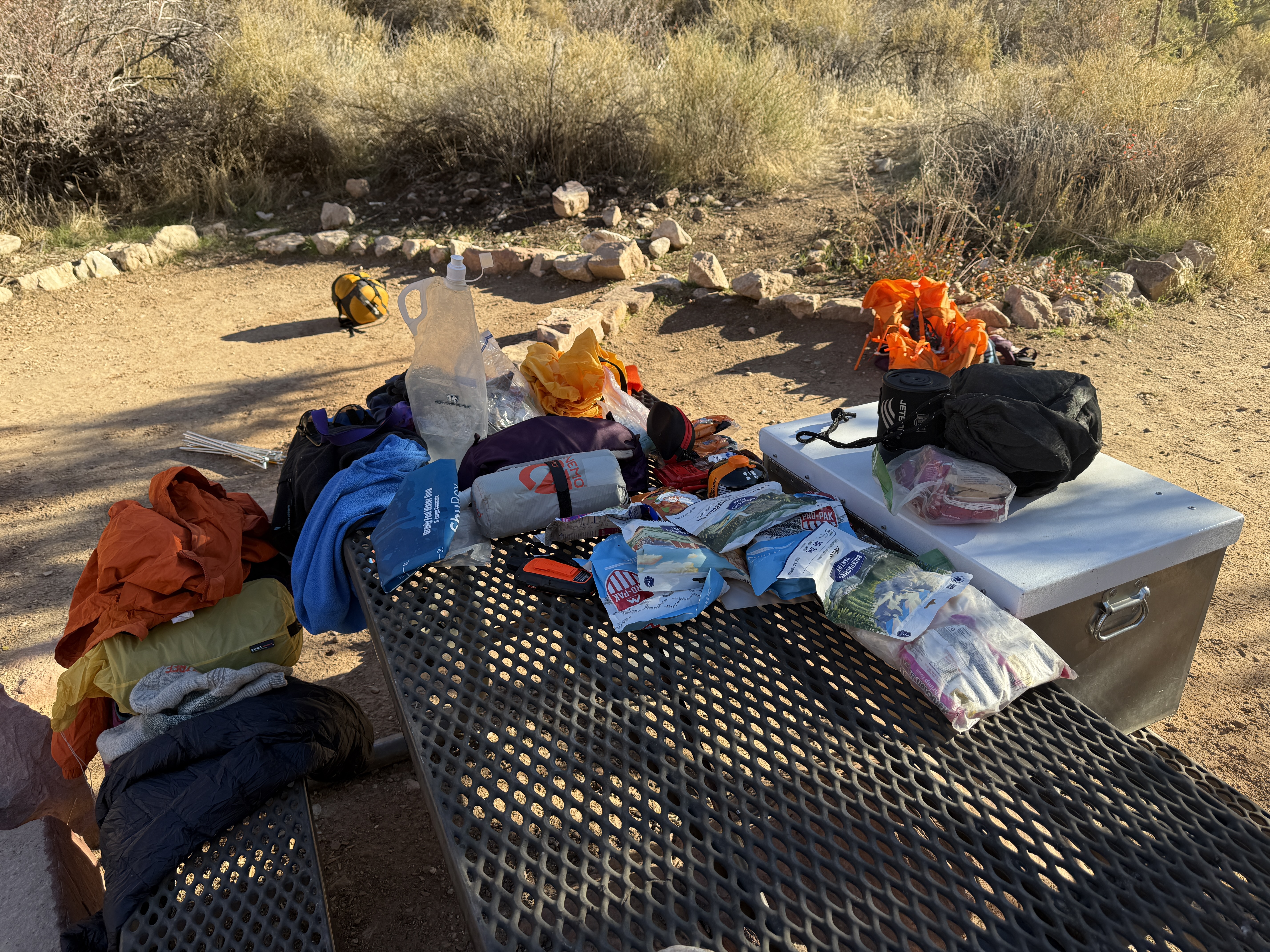
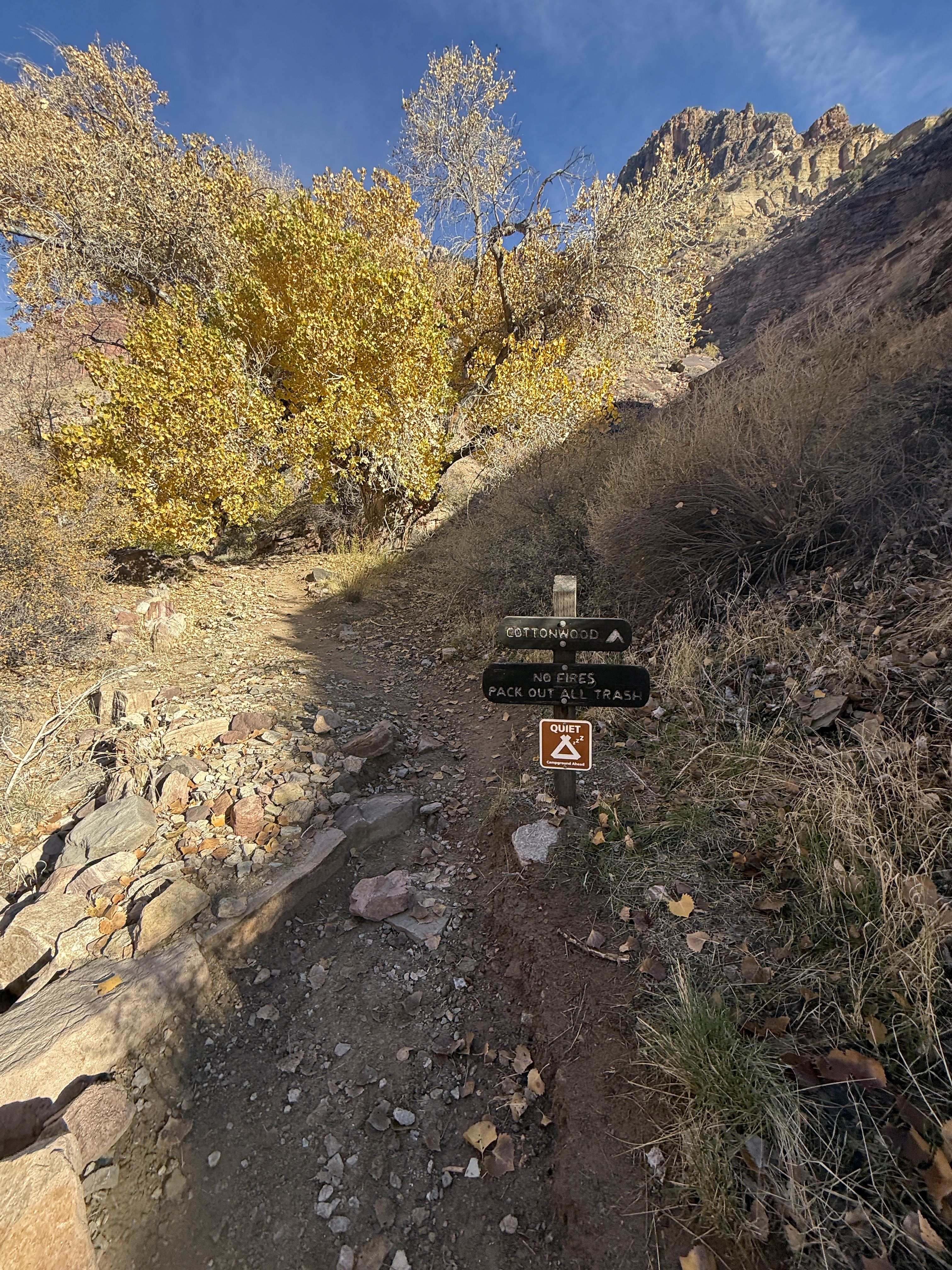
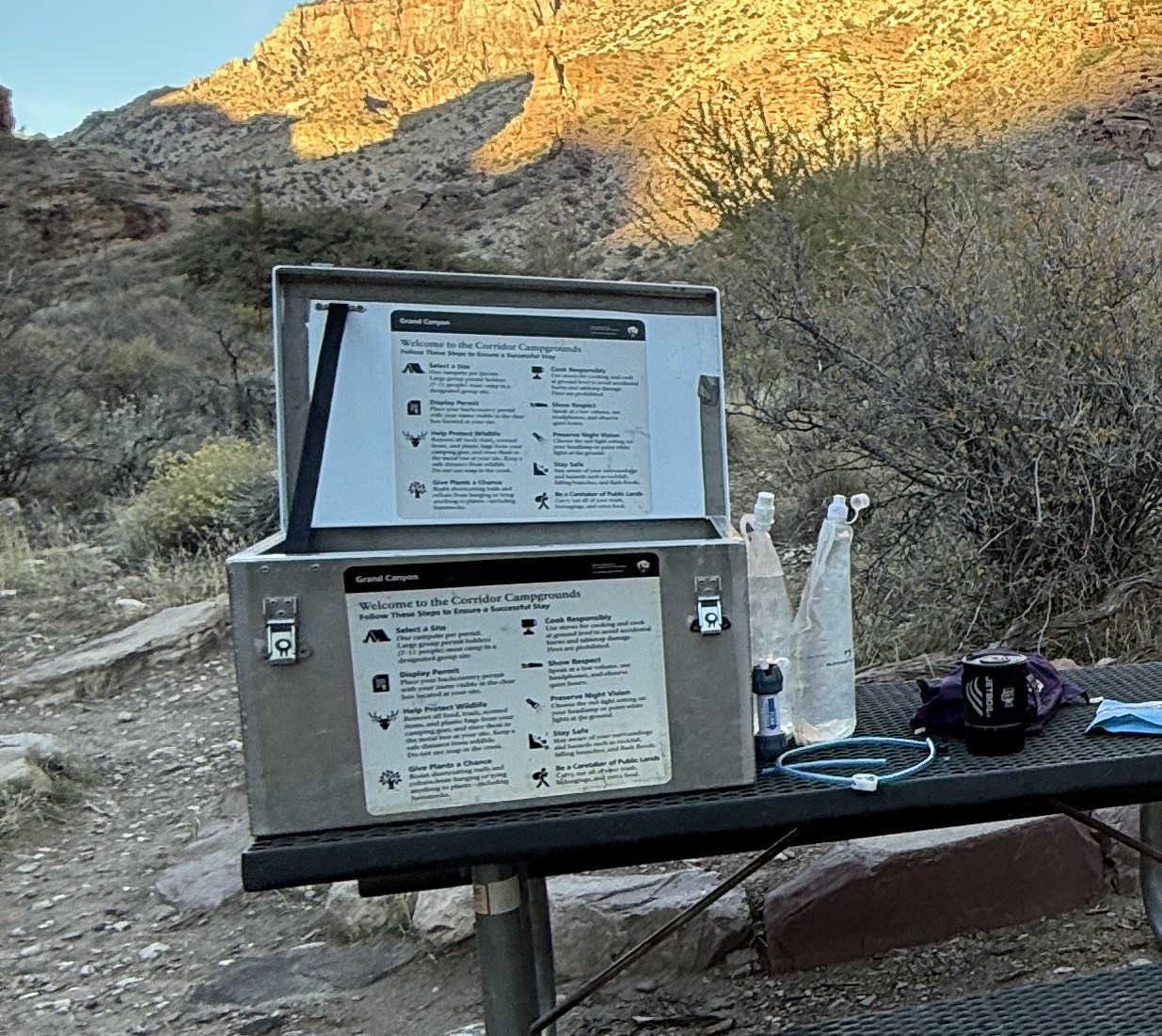
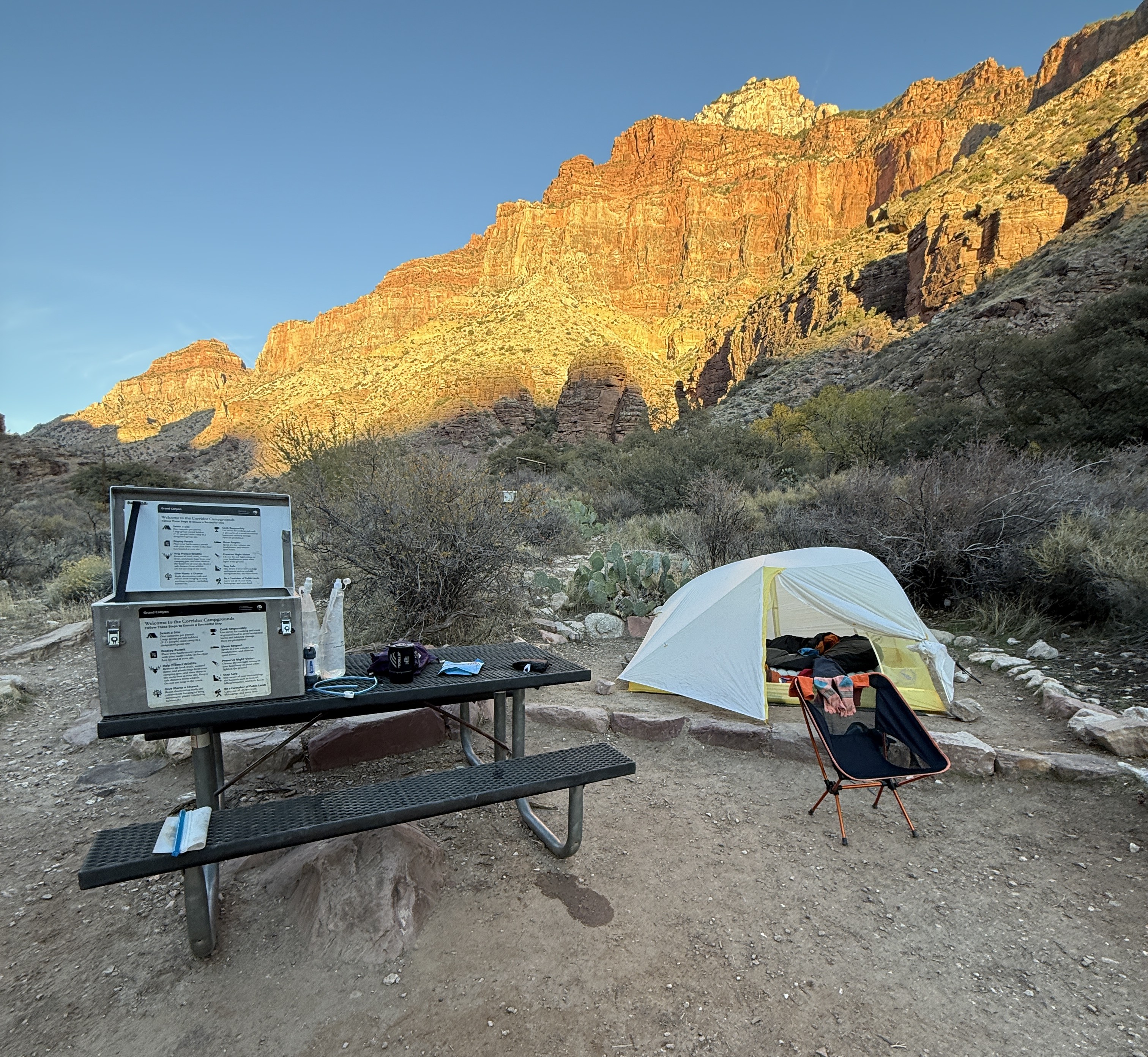
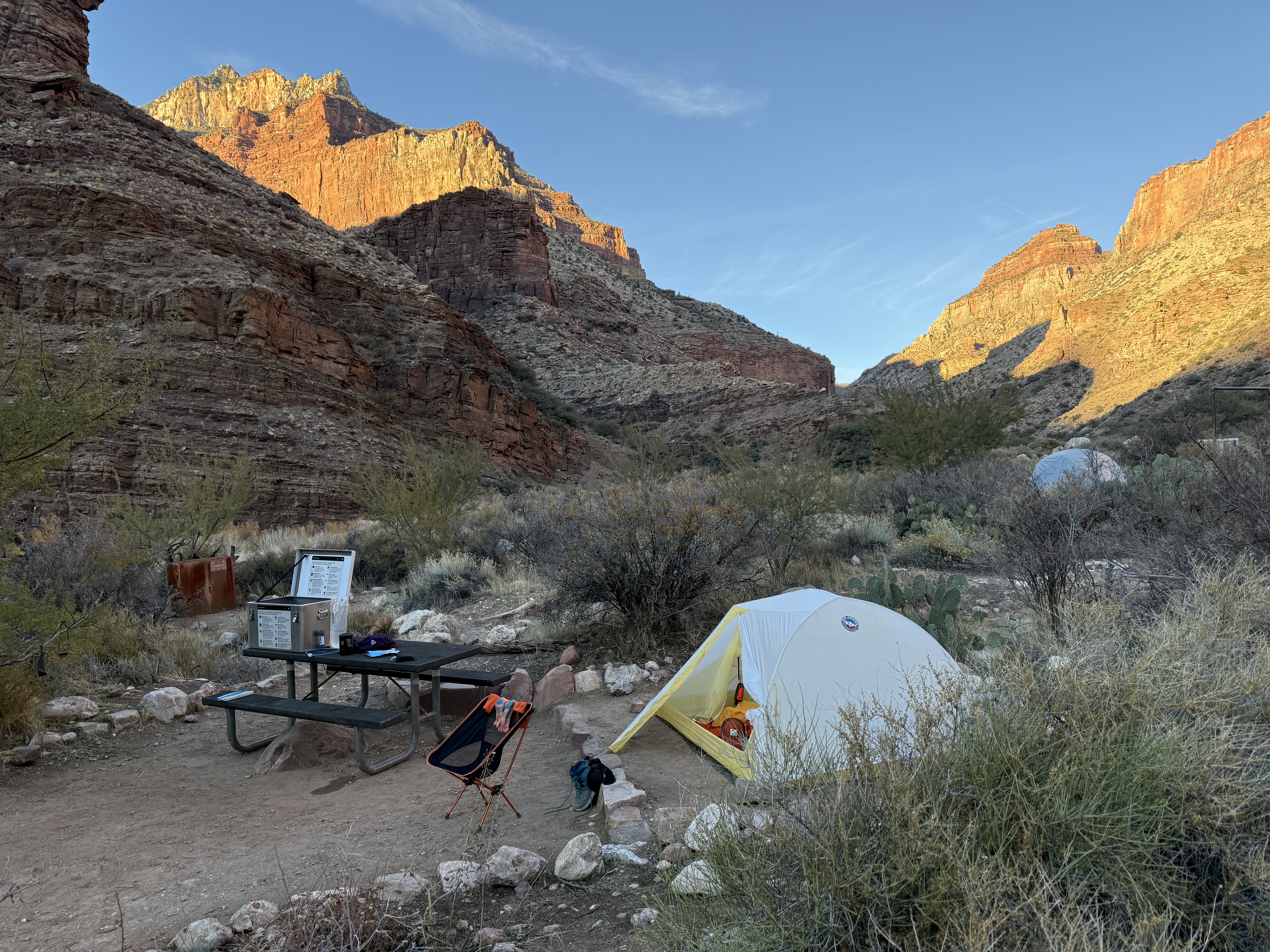
Cottonwood Campground is probably one of my favorite campgrounds I have ever been in. Many of the sites have quite a bit of privacy, each one adorned with a picnic table and a critter box, a metal box with a locking lid, much like our bear bins in Alaska. I brought an Ursack, but it was nice to organize all of my food and odiferous items in the bin. There is a composting toilet nearby and even a spigot with potable water, although it was shut off for the winter.

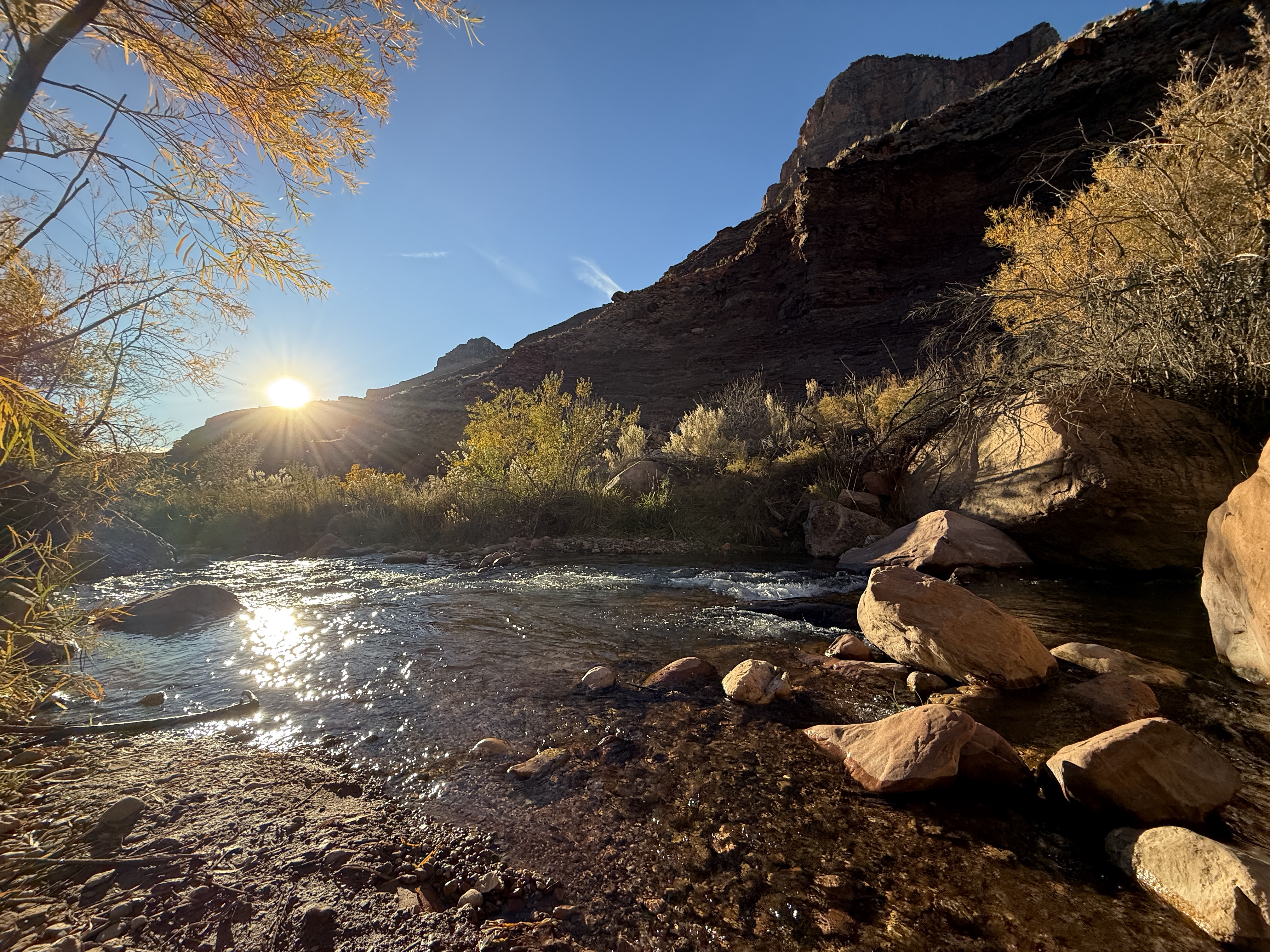
My legs were becoming stiff, so I shuffled as quickly as I could to the creek to collect drinking water for the night. I use a large Sawyer filter in line with a water sack that I soon discovered had lost an o-ring where the hose clips into the bag. Although it was leaking everywhere and took longer than normal, I was able to fill up 4 liters of water and get back to camp before my legs completely locked up.

Slow moving, but happy to be there, I set up my tent and put everything away before cooking up some Chili Mac and coffee. The sun began to set behind the canyon walls, well before the actual sunset time, and I donned a hat, down pants and my puffy jacket. As I was pouring water into my Jetboil, I realized my well-loved collapsible water bottle had a break in the seal near the mouthpiece. Next time I would bring brand new ones instead of relying on my used and abused bottles.

Sitting in my camp chair, I truly appreciated the comfort, instead of suffering uncomfortably on the bench of the picnic table. It was worth the extra weight.

Fed and organized, I crawled, literally, into my tent to do some reading. The dark came quickly, and when I say dark, I mean dark! The Grand Canyon was designated a Dark Sky Park in 2016 after a massive project to replace more than 5,000 light fixtures in the park with dark skies compliant units. I opened my tent and leaned out, absolutely enraptured by the milky way and the uncountable number of stars. I had never seen a sky so dark! I could pick out satellites (ironic after my lack of sat service earlier in the day), Starlink arrays and even the ISS!

I could have laid out all night just looking up. Until something ran over the top of my tent!! I leapt back in, zipping the enclosure, headlamp now on, searching for what may be in my tent. I did a thorough search, including in my sleeping bag, and determined whatever it was, was still on the outside. I decided to continue with my book and leave the stargazing for another night, but not long after nature called. I crawled out of my tent (again, literally) and after heeding the call, looked up. I couldn’t resist trying to take some photos of the brilliant sky. I was standing very still in effort to use the long exposure setting on my iPhone when something ran up my leg! That’s it. I was done for the night.

When the lights went out and I had settled in, almost asleep, there came more scampering over my tent! More than one something was out there trying to terrorize me. I pulled out my phone just in time to get a video of one of the little harassers running over my tent in between the rain fly and the main screened in portion. I think they were Deer Mice, known in the Grand Canyon to have overrun campsites due to careless food storage practices by backpackers. After a while, the psh psh psh of mouse feet either stopped or I fell asleep. Either way, I was unbothered and slept hard.

Rim To Rim To Rim AllTrails Link:

Just The Tips:

  1. Instead of flying into Phoenix, opt to fly into Flagstaff. I’ll be doing that next time instead of making the 3 hour drive each way.
  2. If you are flying in, pre order your stove fuel and other supplies online from Sportsman’s Warehouse in Phoenix or Flagstaff. I found this to be quick and easy.
  3. Be aware that your tracking devices and phone may not be able to get a satellite connection in some of the narrow canyons. Tracking may get wonky, as the vertical walls can cause a location ping, hundreds of feet above or below you.
  4. Permitting for the Grand Canyon can be confusing. It is best to apply for the lottery, which opens based on the month of travel and is available for application on the 16th of the month, in the 5th month prior to your trip. For example, a September Trip lottery application period would open April 16. See this article for more information about getting your Grand Canyon permit.
  5. Give yourself more than one night at Cottonwood Campground to allow for a side trip to Chimik’yana’kya Deya’ (Ribbon Falls) or a day hike to the North Rim, plus a rest day. I found 3 nights at Cottonwood to be perfect.
  6. If hiking rim to rim to rim in the winter, know that there are no services at and no access to the North Rim. You will be one of the few people in the area, far from help. Bring hiking poles and microspikes in case of snow. Evaluate your abilities and comfort with heights honestly before traveling this stretch of trail.
  7. Carry plenty of water and a water filtration system. Don’t drink unfiltered water. It can contain bacteria even if it looks clean. Be sure to dry out your filter when you get home.
  8. Get to the park early. The entrance gets extremely backed up with traffic beginning mid-morning.
Alone in the Grand Canyon: Descending into History and Time

Day 1 – South Kaibab Trailhead to Cremation Canyon

6.5 Miles, -3600′

November 29, 2024

The day had finally come! I had arrived in Phoenix the afternoon prior, picked up my rental car and drove north. I left the 80-degree heat and arrived in Flagstaff 3 and 1/2 hours later. I was now at an elevation just under 8,000′ and it was a chilly 35 degrees. I stayed in one of the cleanest and most comfortable hotels I’d ever experienced, and wished I had brought my swimsuit so I could have used their indoor pool. I highly recommend the Best Western Pony Inn and Suites for an overnight in Flagstaff.

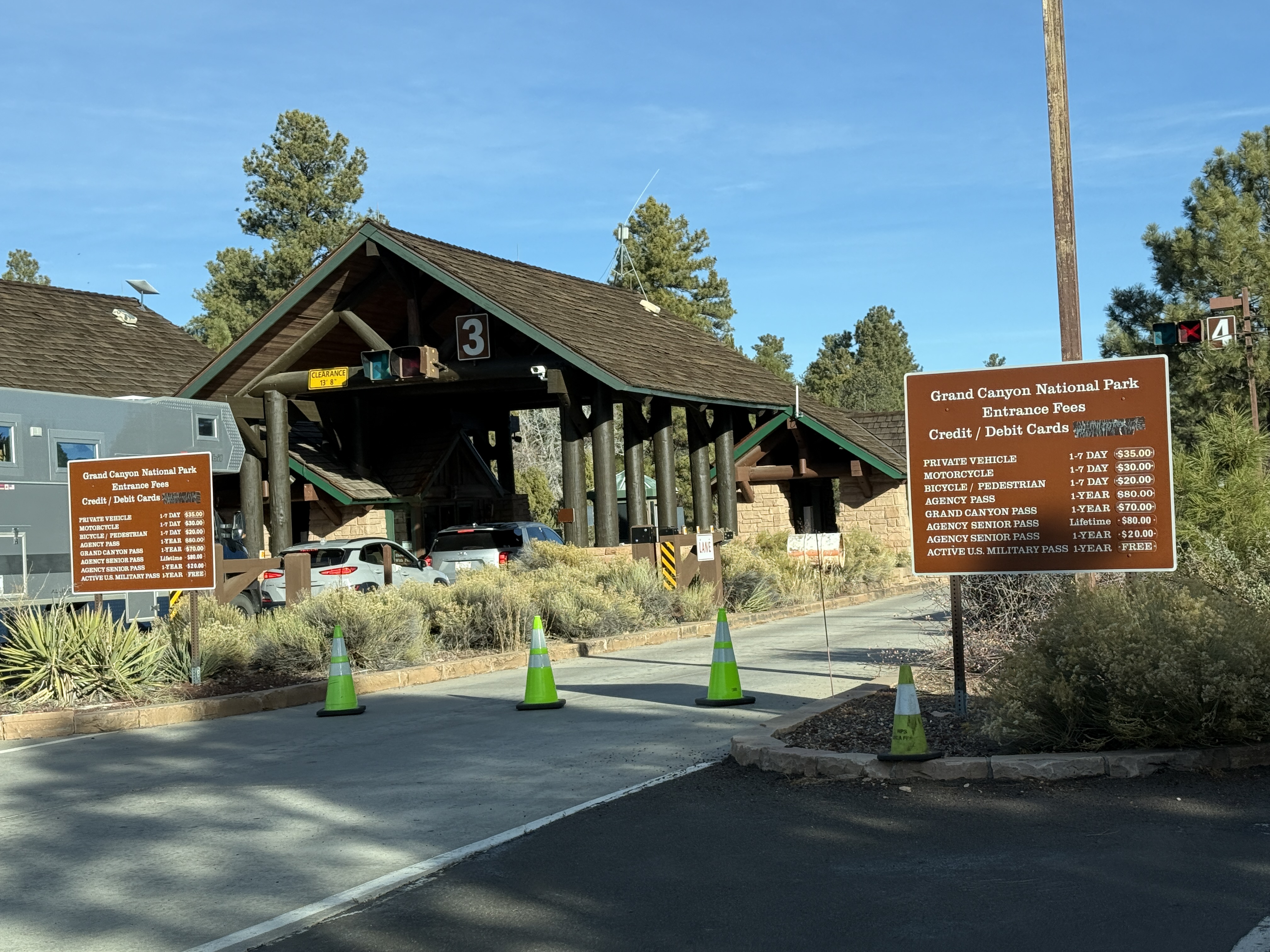
After a hearty breakfast at the hotel, I aired up my vehicle tires (the change in temperature and elevation created a low tire pressure warning) and headed an hour and a half north, a drive with incredible views and plenty of wildlife, including a few elk herds crossing the road. Arriving at the park gate mid-morning, the line was not too long, but it is wise to get there as early as possible to avoid the crowds, especially if you are visiting during the peak seasons.

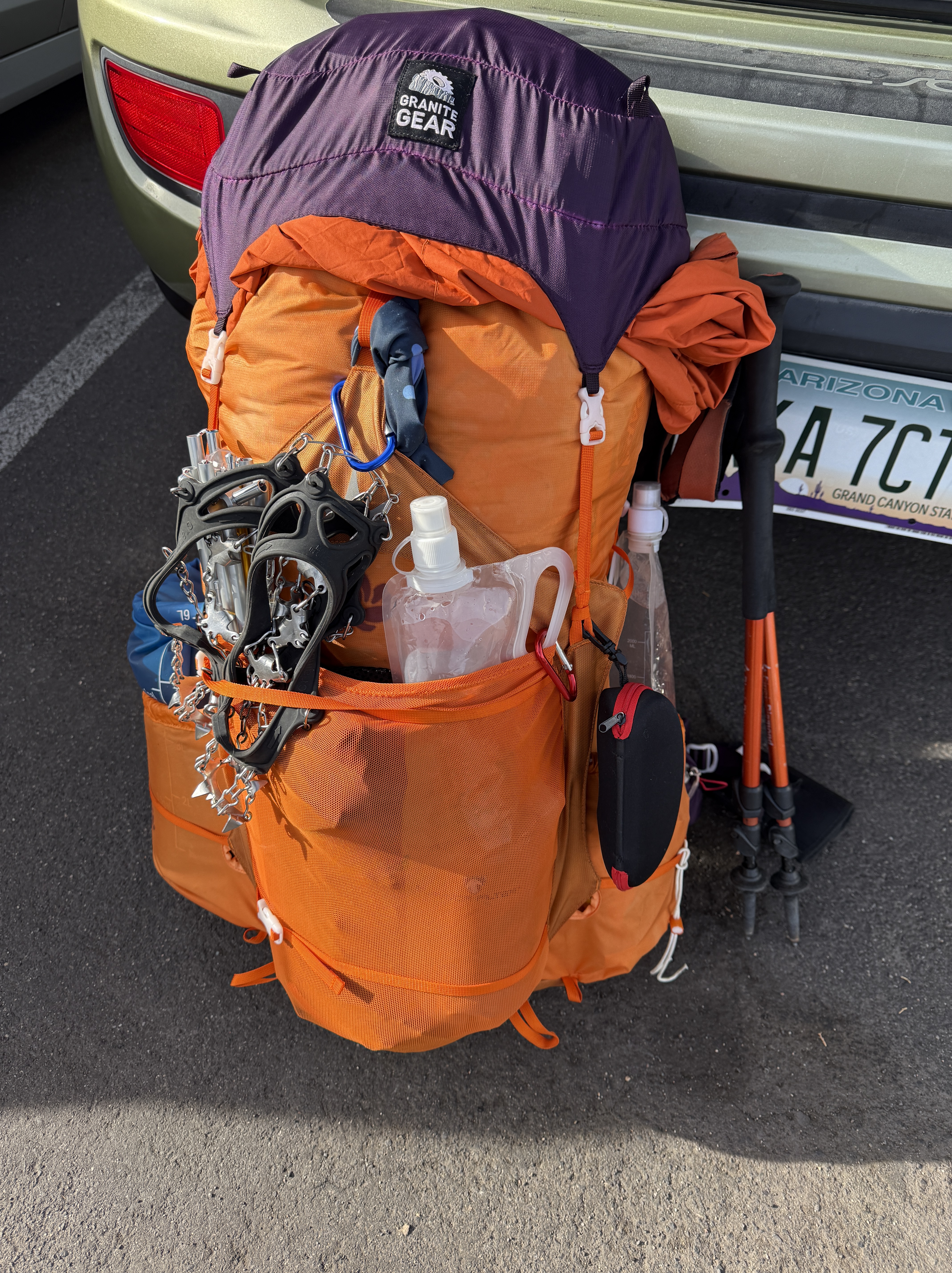
I found a parking spot close to shuttle terminal and triple checked my pack. I located a fountain to fill up my water bottles and filter bladder. There were no water stations or sources between here and Cremation Canyon and then Phatom Ranch, so I had to carry enough water for all day, overnight and the next morning. I probably overdid it with hauling nearly two gallons, but better safe than sorry! I have a terrible paranoia about running out of water and carrying an extra 12 or so lbs. downhill wouldn’t be so bad.

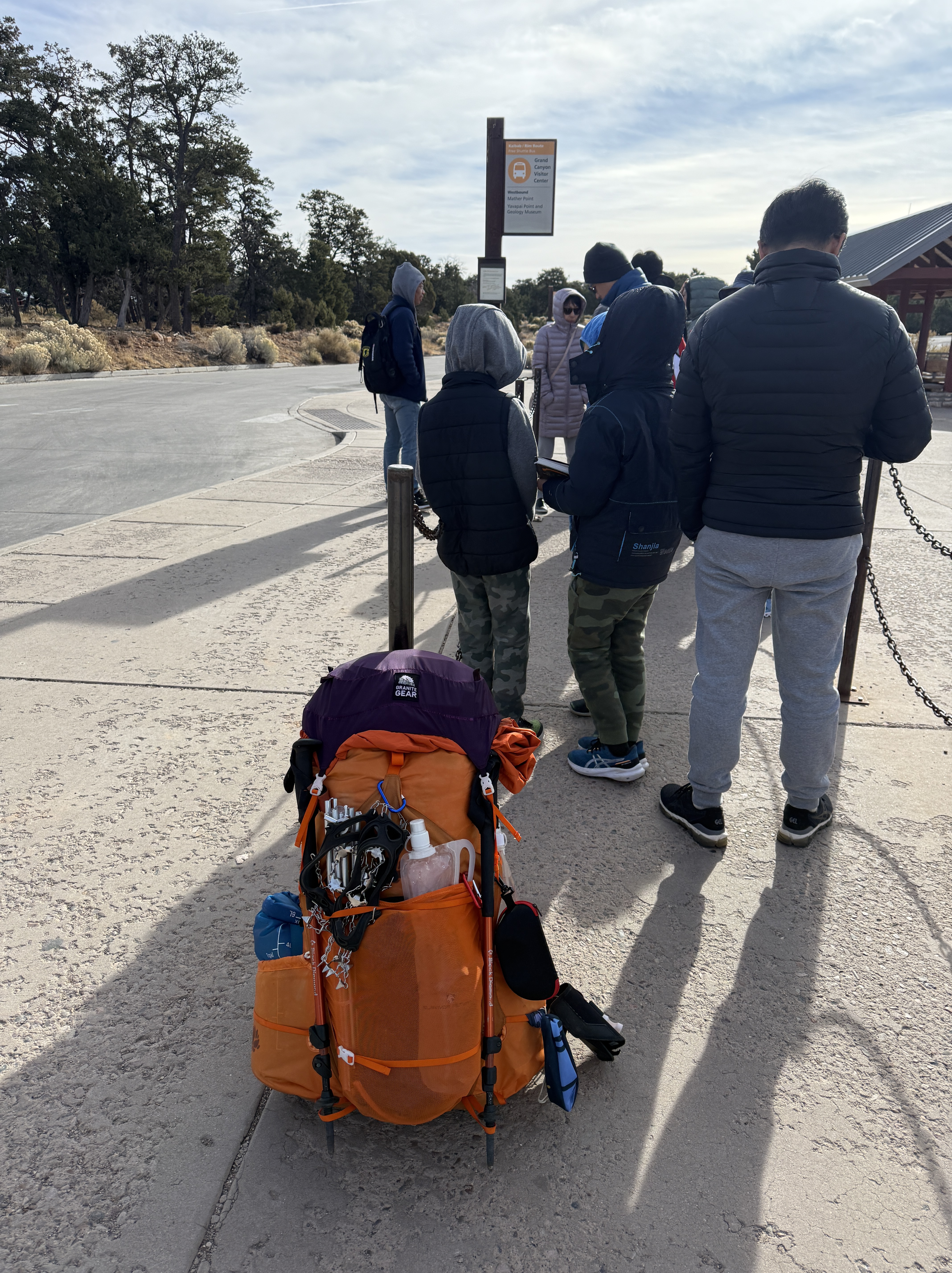
I had everything I needed and was ready to go. The shuttles run on a regular schedule throughout the year. Click HERE to see the current shuttle schedule. I boarded the Orange Eastbound bus and disembarked at the South Kaibab Trailhead about 20 minutes later. It was time to hike!

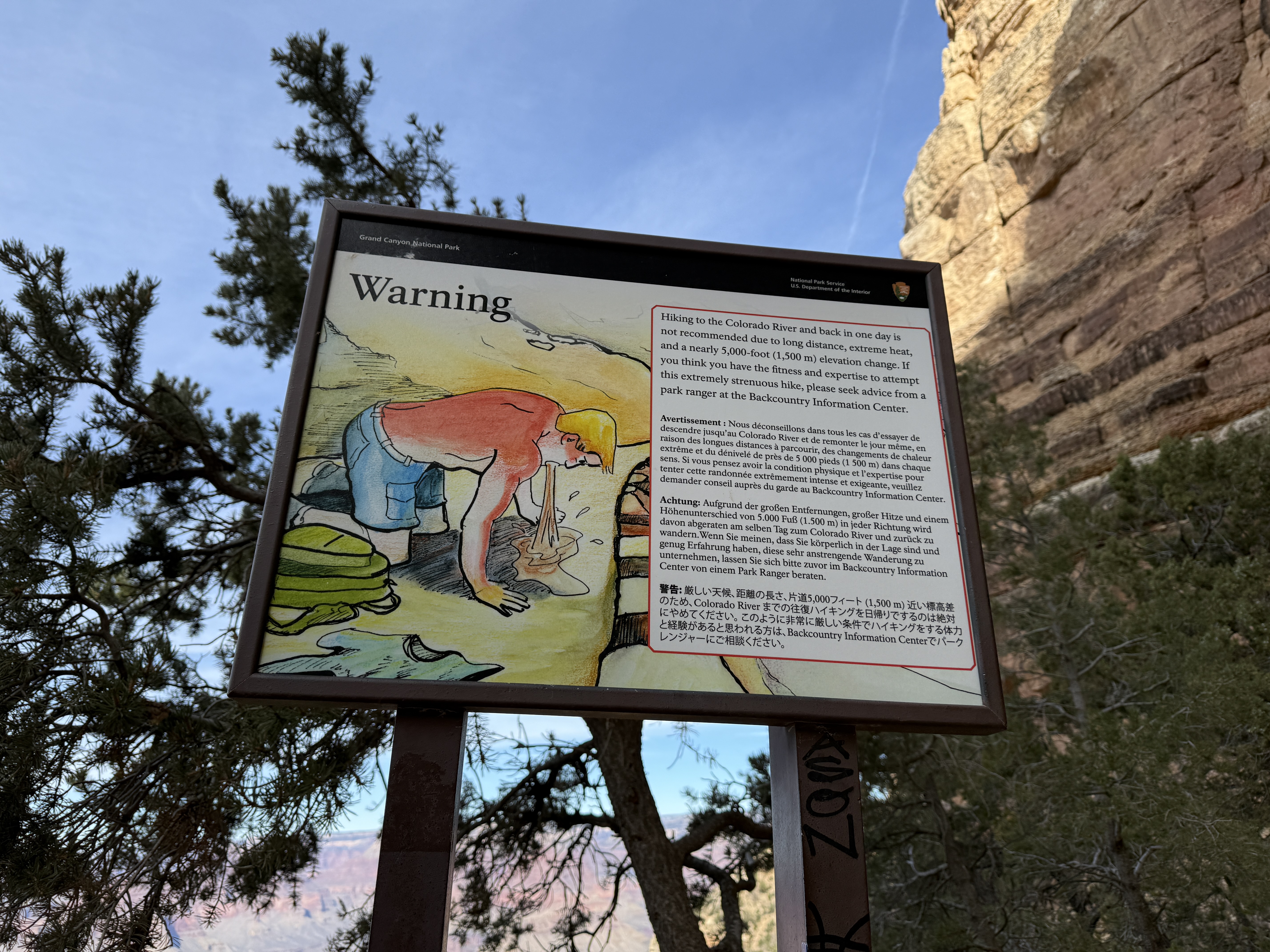
I was in absolute awe. I had never visited the Grand Canyon before and now I was about to be one of the less than 1% of the 5 million annual visitors to travel below the rim; not to mention one of the tiny fraction of the 1% of people who traverse the canyon rim to rim to rim. I couldn’t contain my excitement and, even though my backpack was more than 50lbs, I jogged my way down the wide path, past throngs of day hikers and numerous overlooks where the views continued to get better and better.

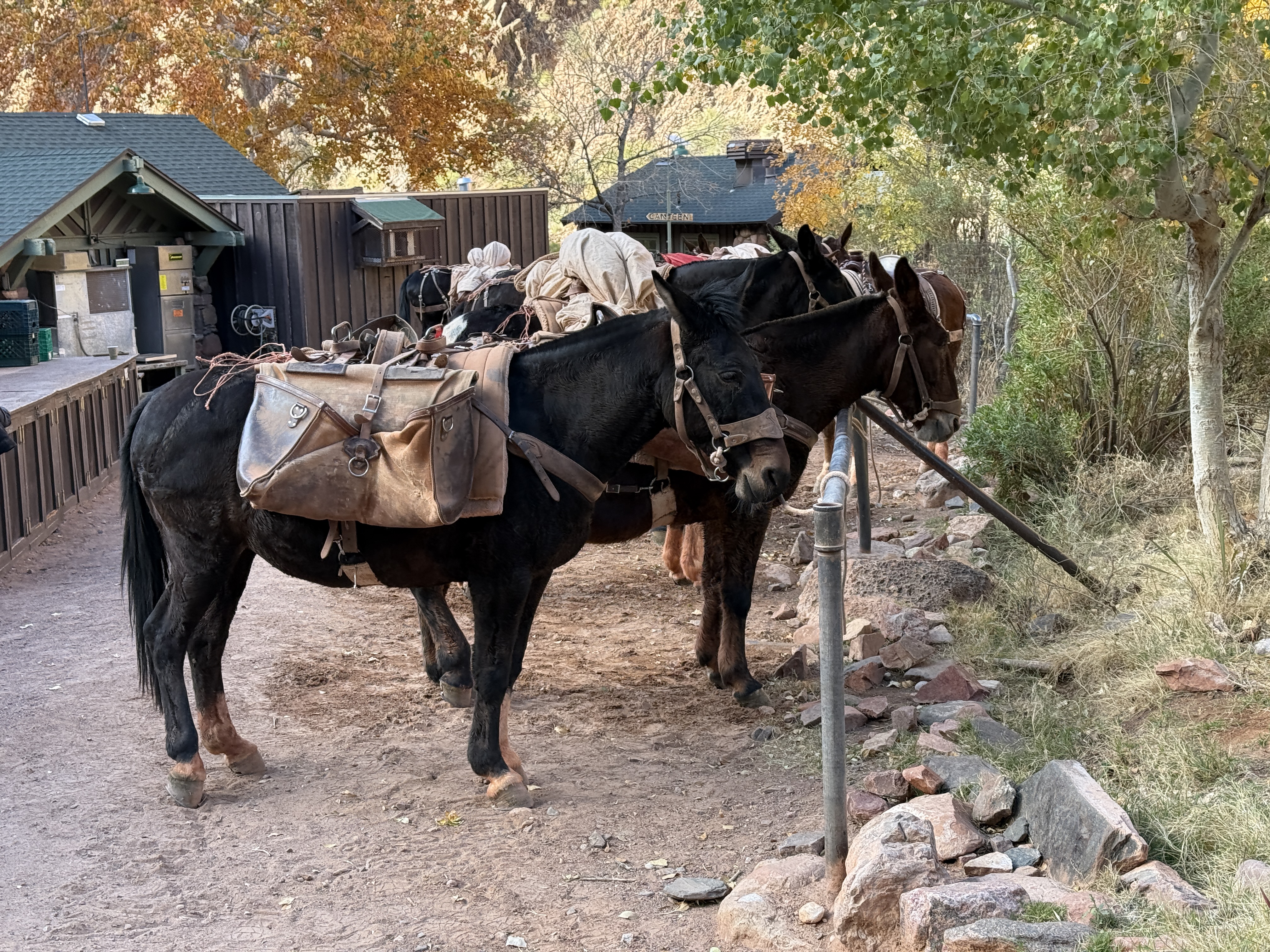
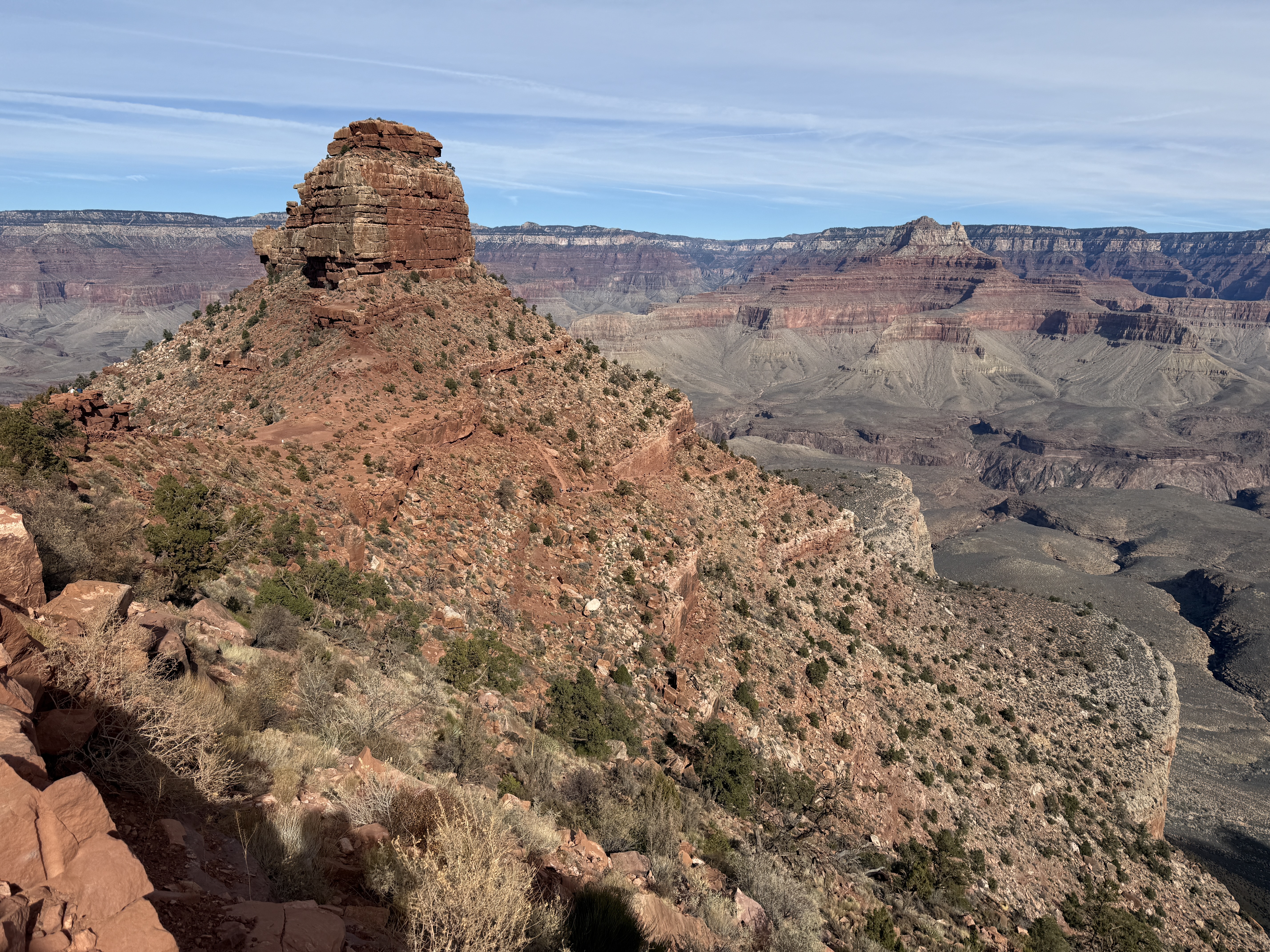
Descending past Ooh-ahh Point, Cedar Ridge, and Skeleton Point, I eventually passed all of the day hikers and was traveling alone. The mule pack train was moving uphill on their daily afternoon trek from Phantom Ranch to the South Rim stables. These pack trains haul all of the supplies and refuse to and from the ranch at the bottom of the Canyon.

Before I knew it, I had descended the ~3200′ to Tip Off and the Tonto Trail Intersection. Tip off has a covered shelter and composting toilet, sitting about 1600′ above the Colorado River. The Tonto Plateau is a wide bench at 4000,’ on the south side of the Colorado, running east/west, and its namesake trail travels a total of 95 miles. It is here I would be turning to the east and traveling 2 miles to the BJ9 Cremation Canyon zone.

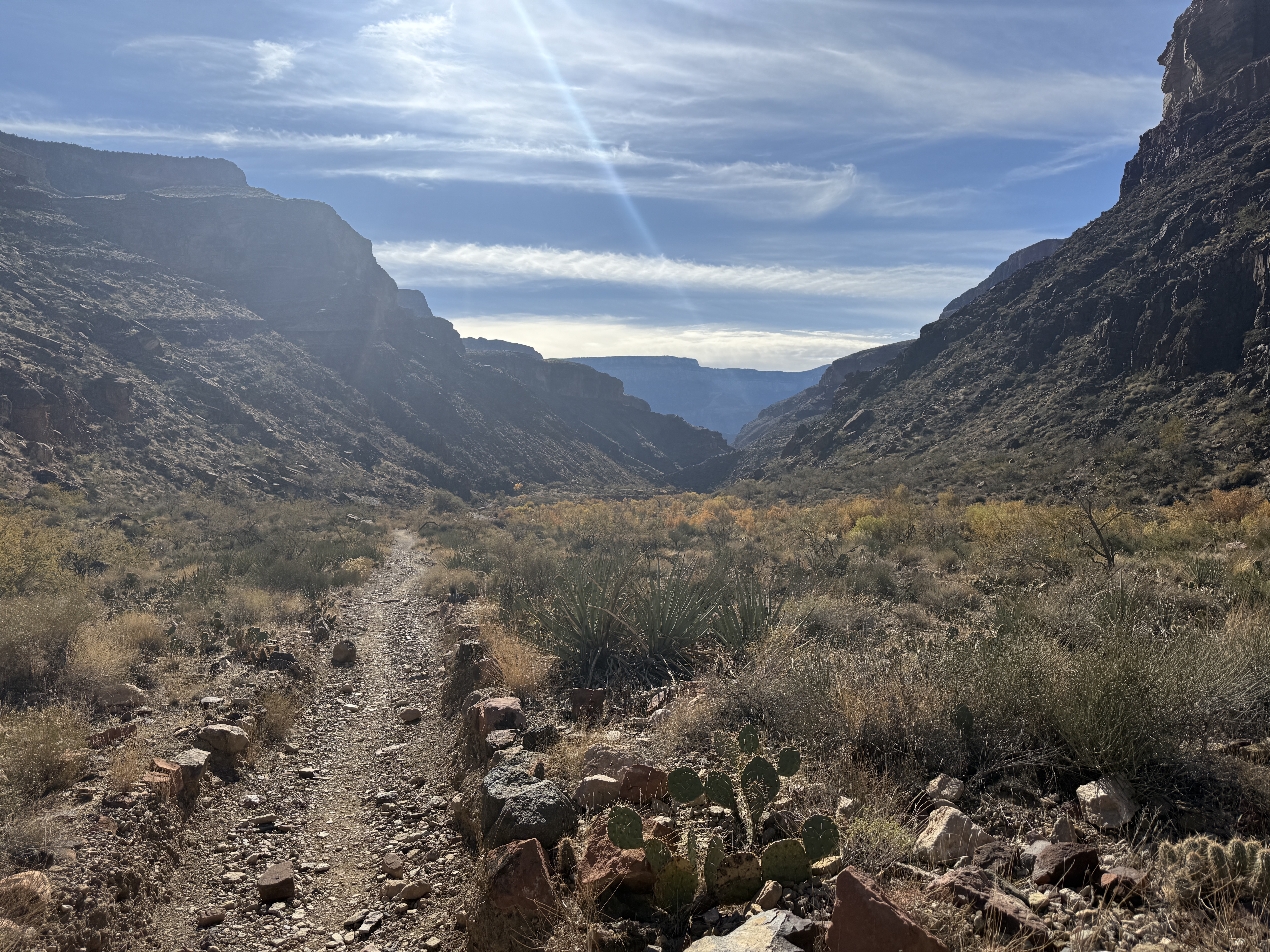
For the two miles I traveled, the Tonto trail winds through scrub brush and century plants, descending about 400′, with ample opportunity to find marine fossils and interesting rocks. After 4 and a half hours and 6.5 miles of trekking from the trailhead, with a backpack full of water (I hadn’t even made a dent in it), I was ready to find a spot to drop my pack and set up my camp chair. The adrenaline was wearing off and I was getting tired. I was ready for dinner and some coffee.

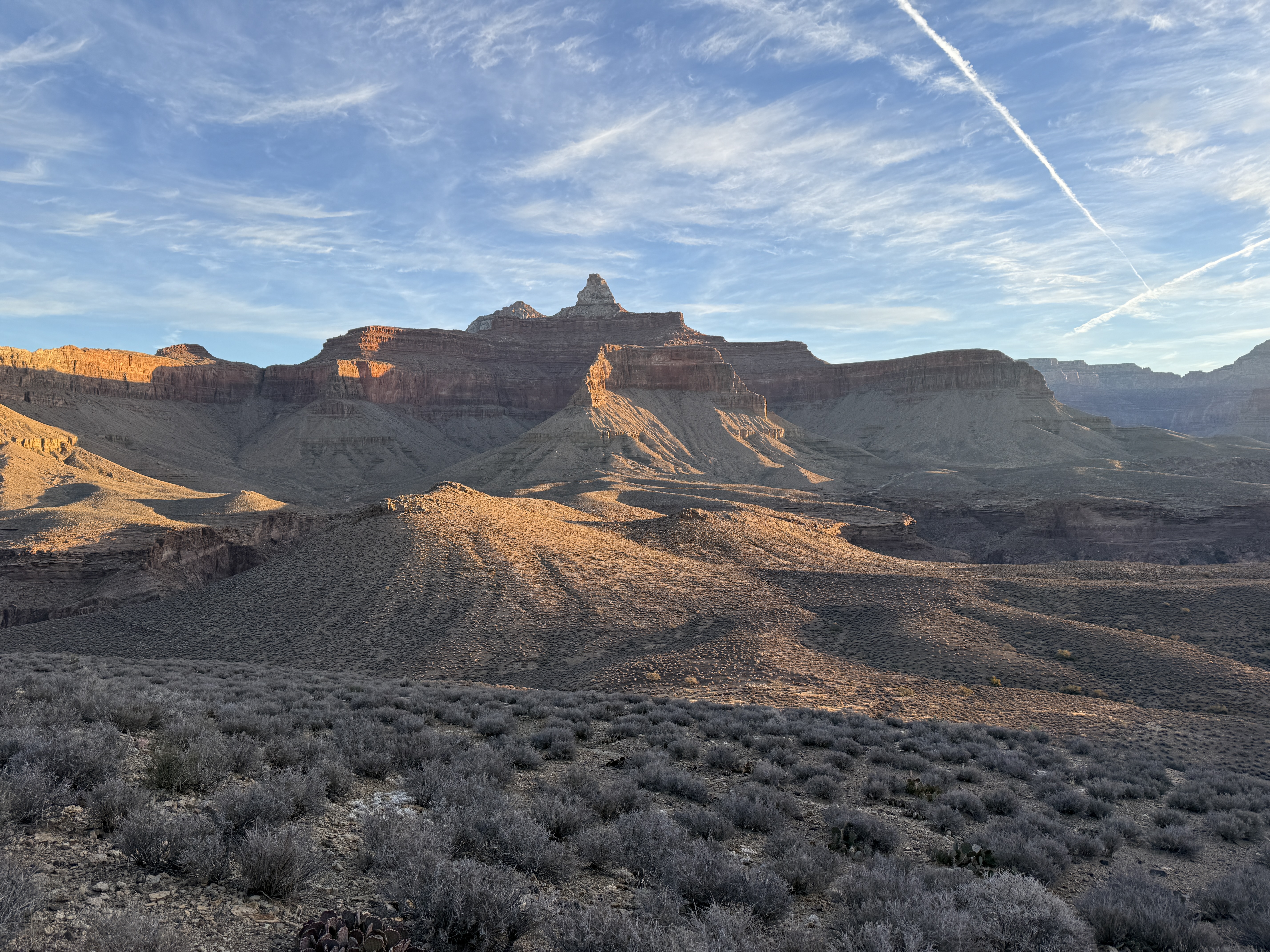
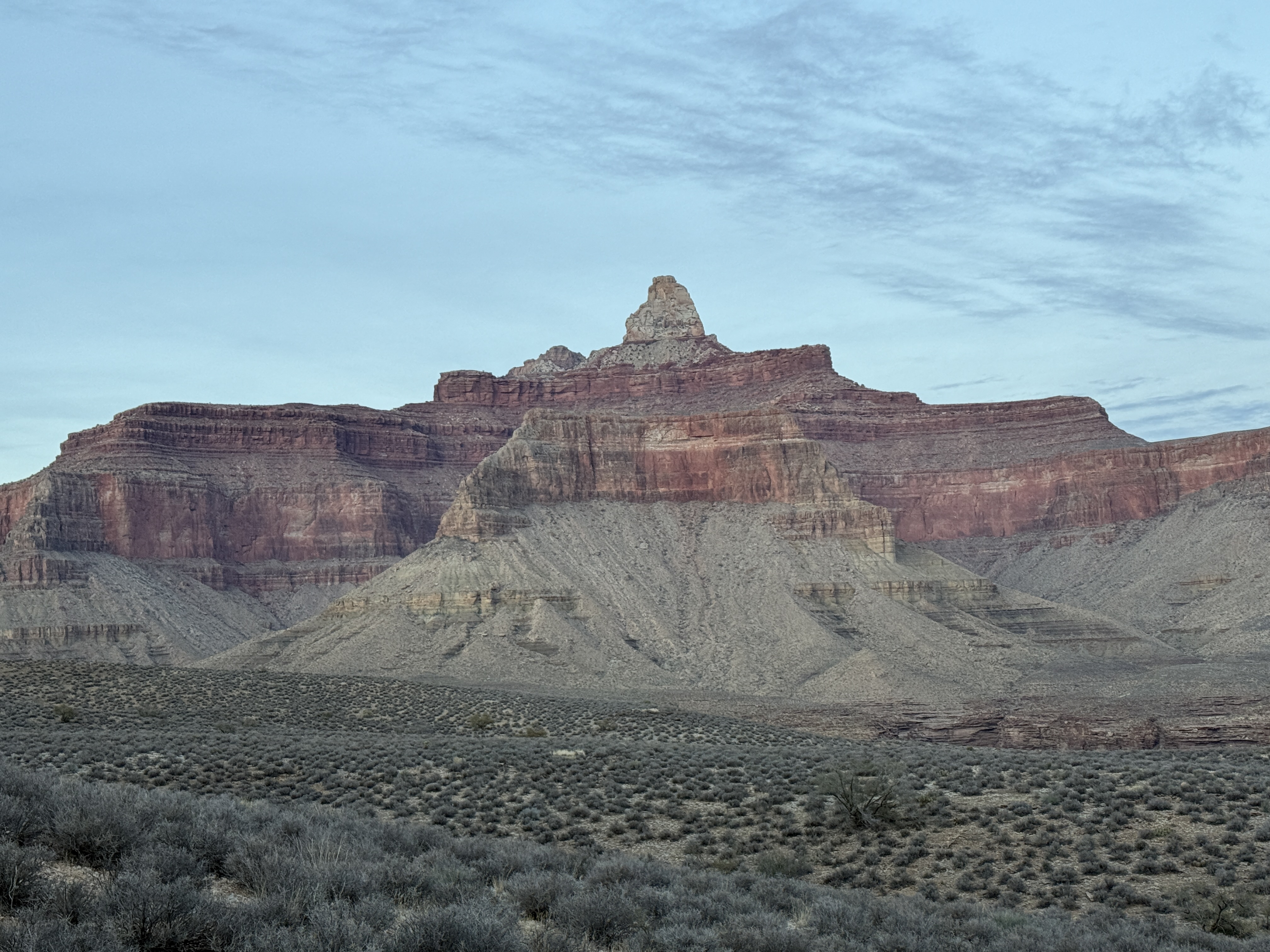
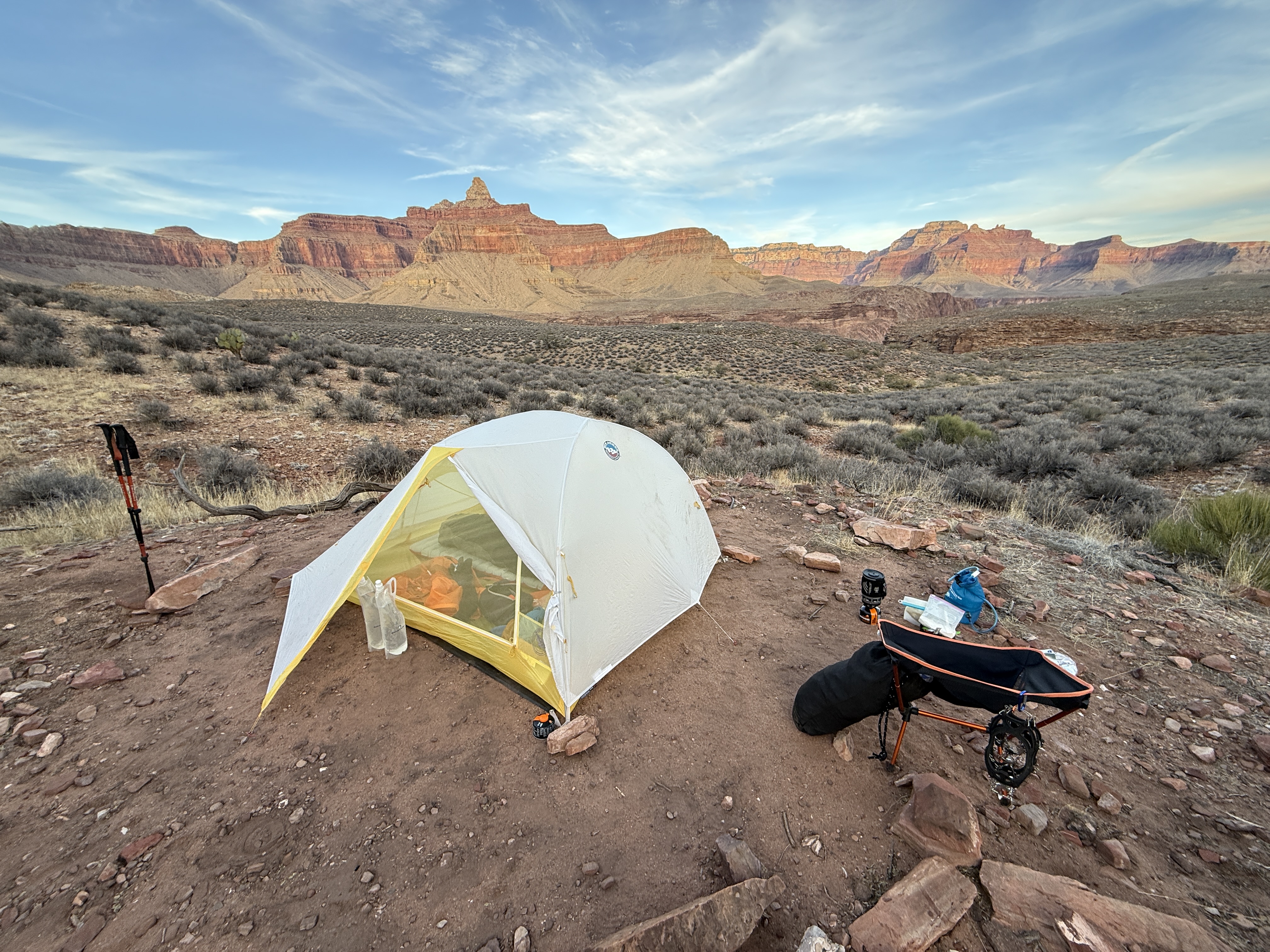
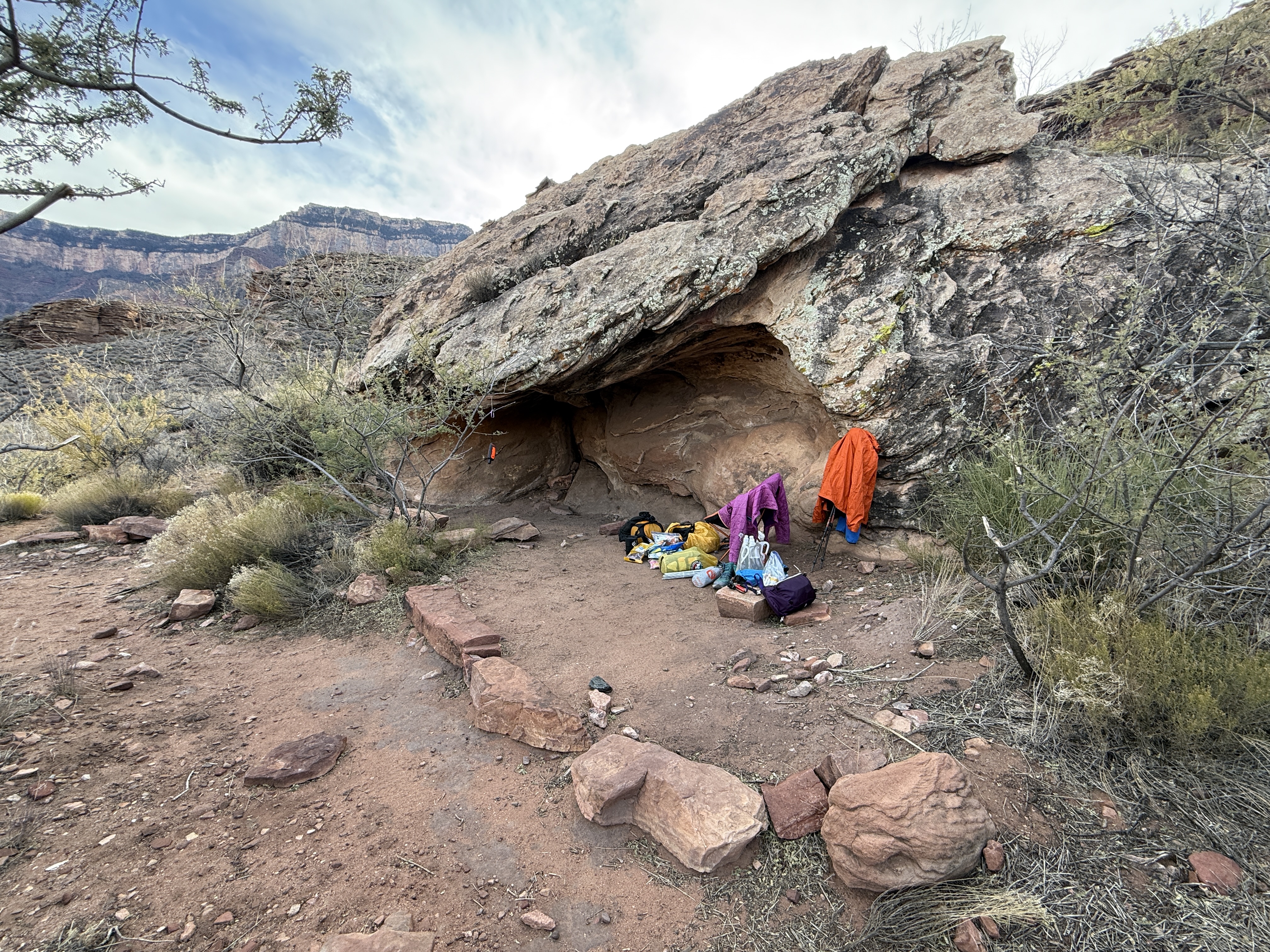
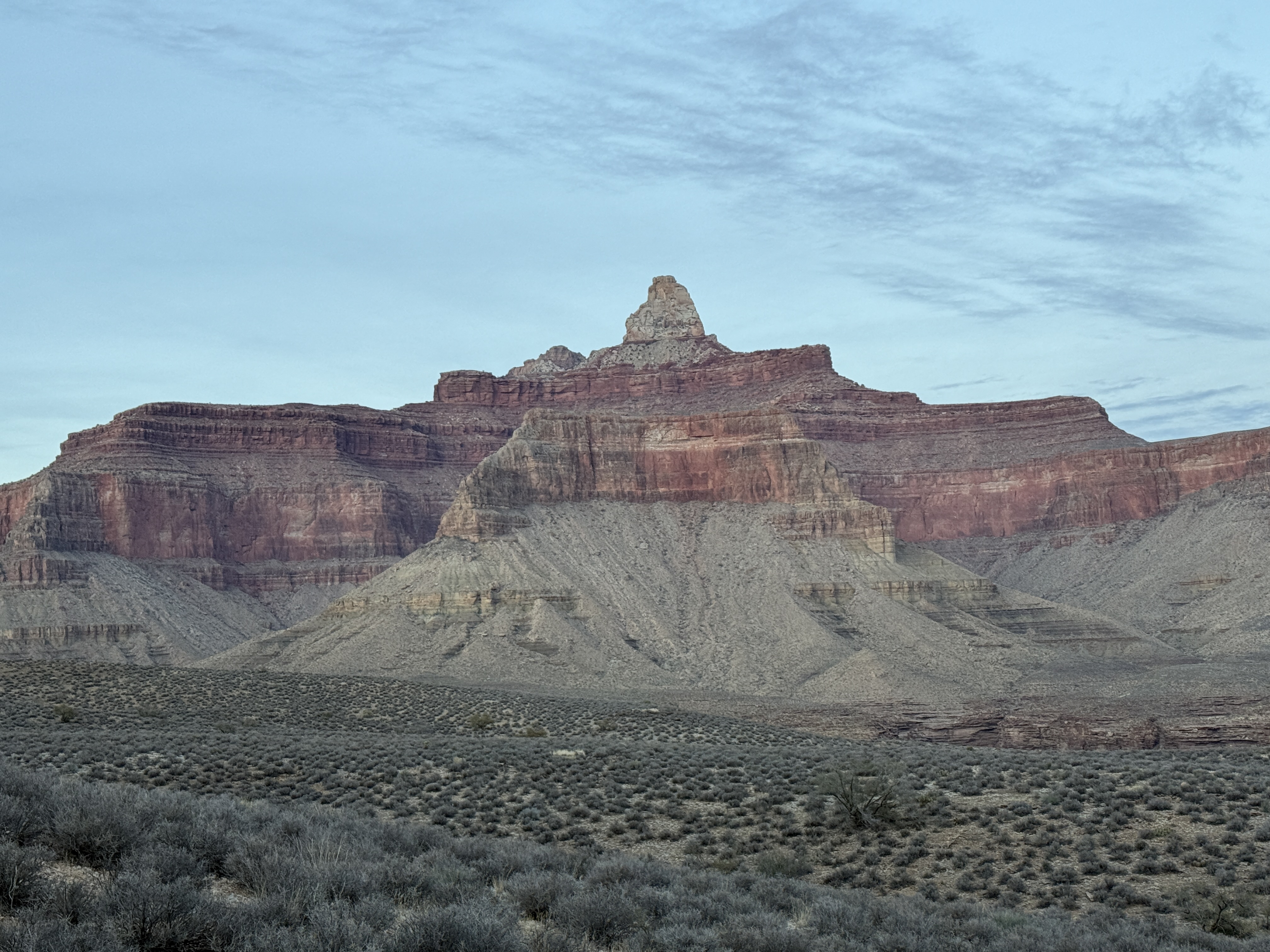
I knew I was looking for a sign that would delineate the Cremation Canyon area, but before I saw it, I came across an obvious campsite very close to the 2-mile mark on my gps. I figured I had just passed the sign on one of the little side trails that spur off of and back to the main trail through the brush. Maybe I was so tired that I had just walked right past it. This campsite had a really cool rock overhang and a view across the canyon toward Zoroaster Temple, a picturesque peak above Clear Creek. I decided I would stop here. (On the return trip I found that I had only been about .2 miles from the sign)

I set up my tent under the overhang, before having a vision of it collapsing on me during the night, and quickly moved out to the open area, away from the half cave. When my camp was organized and to my standards, I put on some warm clothes, sat in my camp chair and made myself a Ramen Bomb (ramen and powdered mashed potatoes) and some strong coffee. I silently took in the view and couldn’t have been any happier to be miles away from the nearest person. I watched the sun set and then settled into my tent, making it through only a handful of pages in my book before falling into a deep and restful sleep.

Rim To Rim To Rim AllTrails Link:

Just The Tips:

  1. Instead of flying into Phoenix, opt to fly into Flagstaff. I’ll be doing that next time instead of making the 3 hour drive each way.
  2. If you are flying in, pre order your stove fuel and other supplies online from Sportsman’s Warehouse in Phoenix or Flagstaff. I found this to be quick and easy.
  3. Be aware that your tracking devices and phone may not be able to get a satellite connection in some of the narrow canyons. Tracking may get wonky, as the vertical walls can cause a location ping, hundreds of feet above or below you.
  4. Permitting for the Grand Canyon can be confusing. It is best to apply for the lottery, which opens based on the month of travel and is available for application on the 16th of the month, in the 5th month prior to your trip. For example, a September Trip lottery application period would open April 16. See this article for more information about getting your Grand Canyon permit.
  5. Give yourself more than one night at Cottonwood Campground to allow for a side trip to Chimik’yana’kya Deya’ (Ribbon Falls) or a day hike to the North Rim, plus a rest day. I found 3 nights at Cottonwood to be perfect.
  6. If hiking rim to rim to rim in the winter, know that there are no services at and no access to the North Rim. You will be one of the few people in the area, far from help. Bring hiking poles and microspikes in case of snow. Evaluate your abilities and comfort with heights honestly before traveling this stretch of trail.
  7. Carry plenty of water and a water filtration system. Don’t drink unfiltered water. It can contain bacteria even if it looks clean. Be sure to dry out your filter when you get home.
  8. Get to the park early. The entrance gets extremely backed up with traffic beginning mid-morning.
Alone in the Grand Canyon: The Plan

Rim-Rim-Rim and Cremation Canyon

November 28-December 4, 2024

Planning and Preparation

I have gotten into the habit of traveling Outside of Alaska every winter for a backpacking trip, and this year the Grand Canyon was calling. It had been a long summer of work and, frankly, the rain was getting to me. The high desert sounded so appealing.

I had considered GCNP in the past, but didn’t have much experience with arid environments, although I was pleasantly surprised to learn that the rattlesnakes and scorpions hibernate for the winter. Game on.

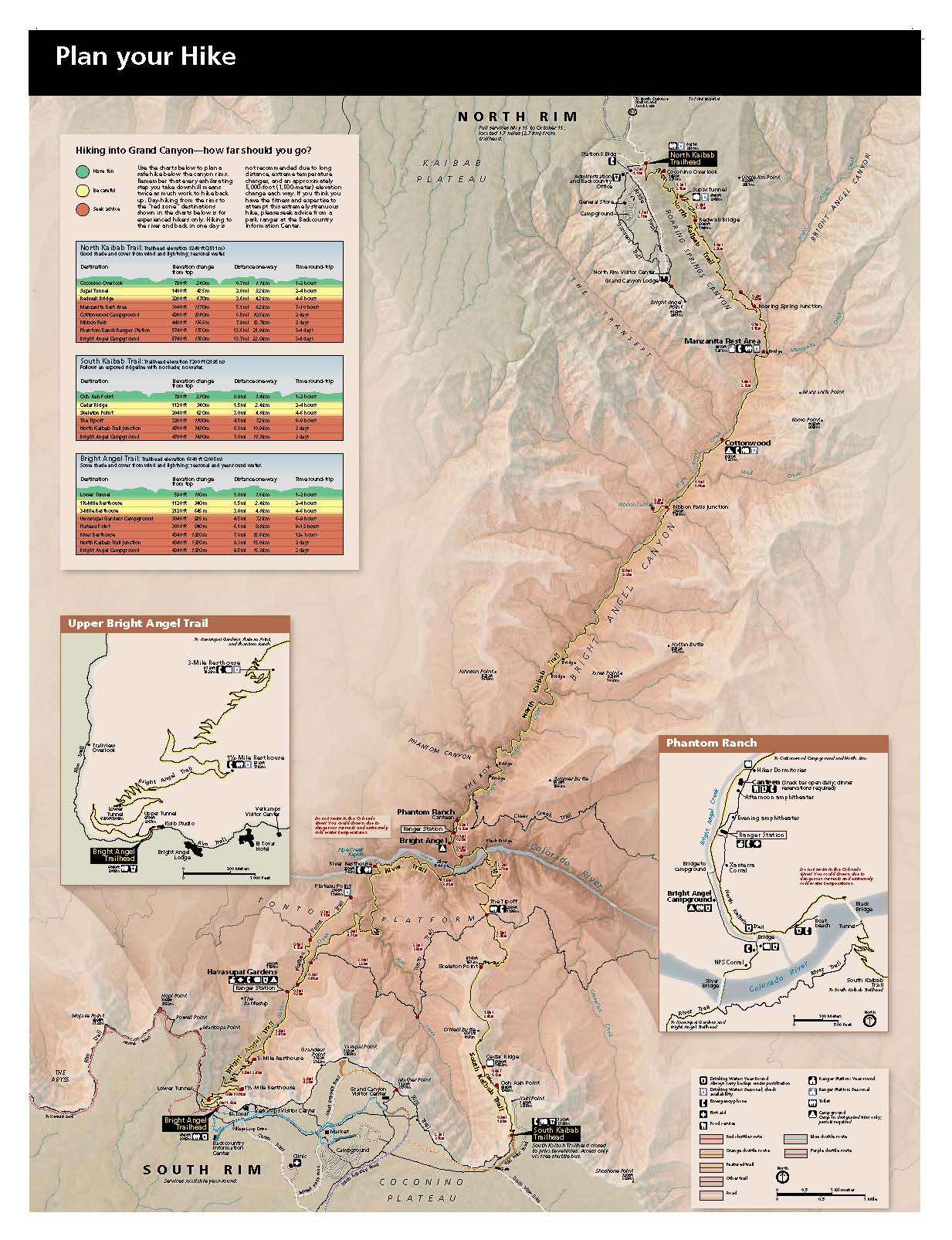
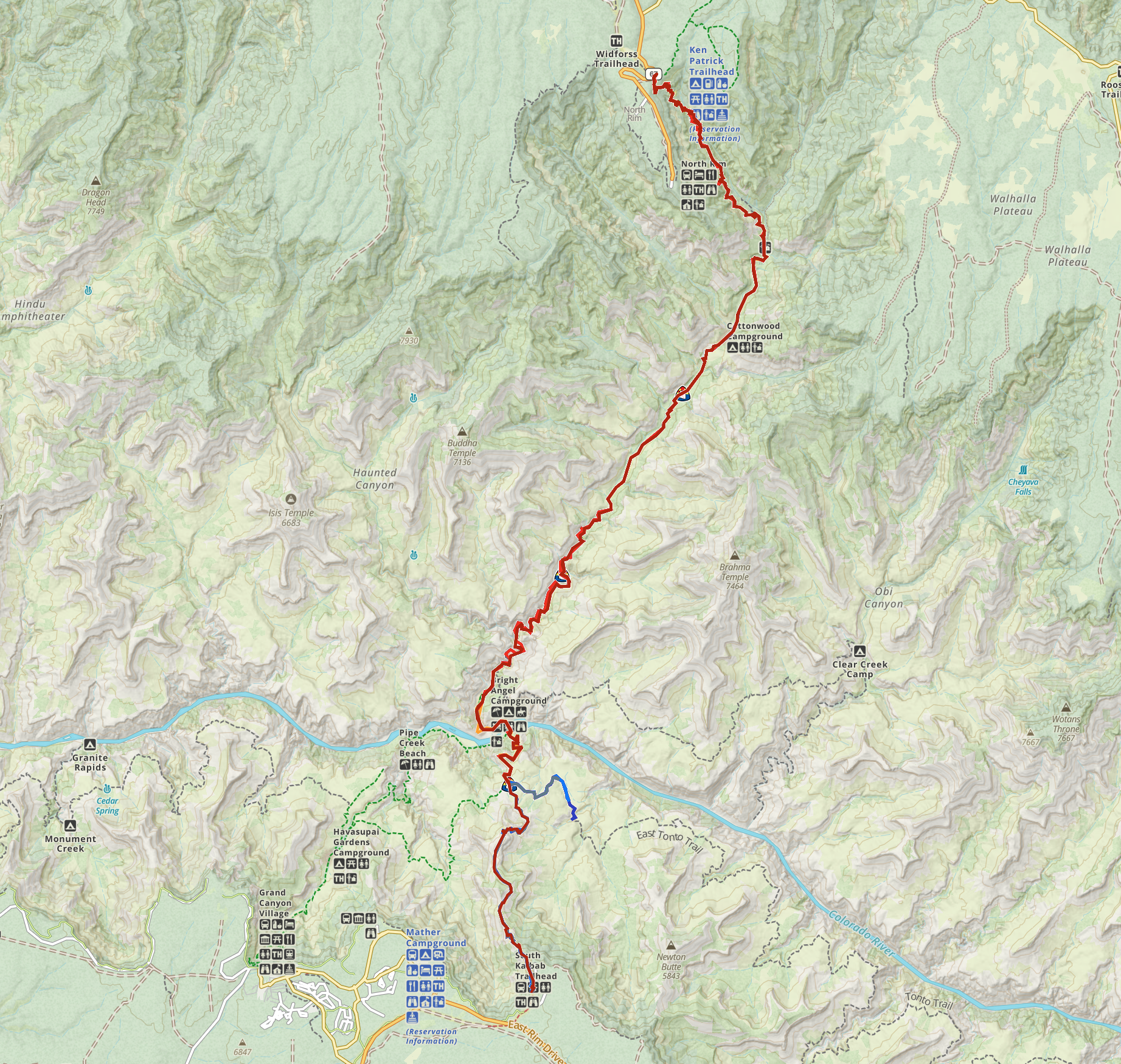
I knew I wanted to do a rim-rim-rim trip after seeing a friend post some photos about their backpacking adventure a few years ago. The main corridor trails between the north and south rims are shaped like a “Y,” with the North Kaibab Trail splitting into the Bright Angel Trail and the South Kaibab Trail, just before crossing the Colorado River, heading towards the South Rim. Most of the Bright Angel Trail would be closed through the winter, as would Bright Angel Campground at the bottom of the canyon, on the north side of the river.

These closures would mean I would either have to hike a little over 14 miles on the first day, with an elevation loss of 4800′ to get to Phantom Ranch and a gain of more than 1,600 to then make it to Cottonwood Campground, or figure out another plan. Fourteen miles with a pack full of gear and food for 6 days didn’t sound like fun, so I called the Ranger Station to see if they had any suggestions.

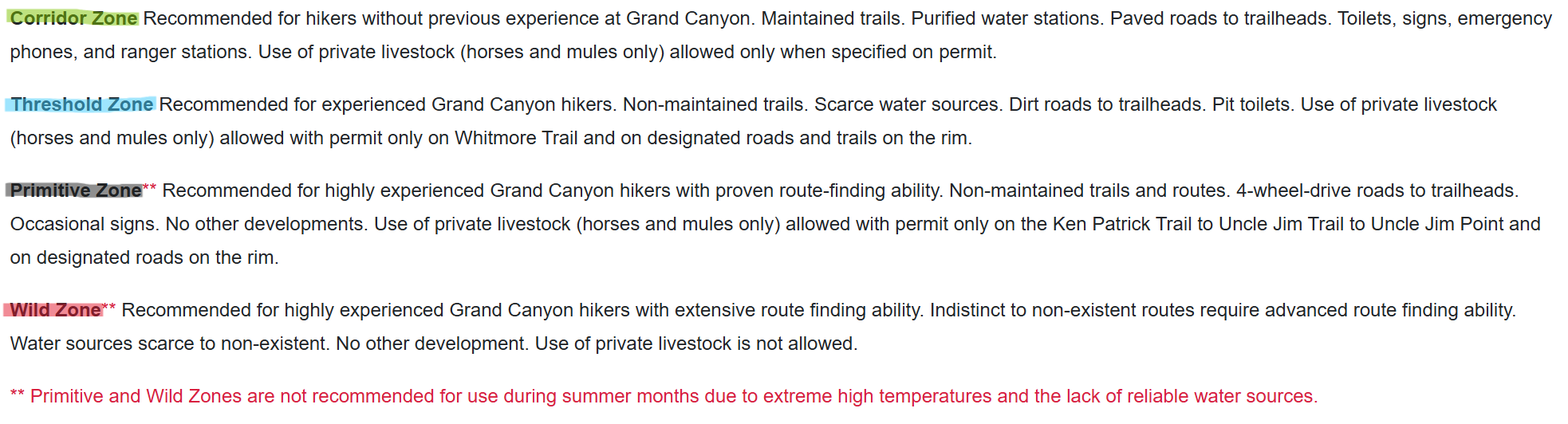
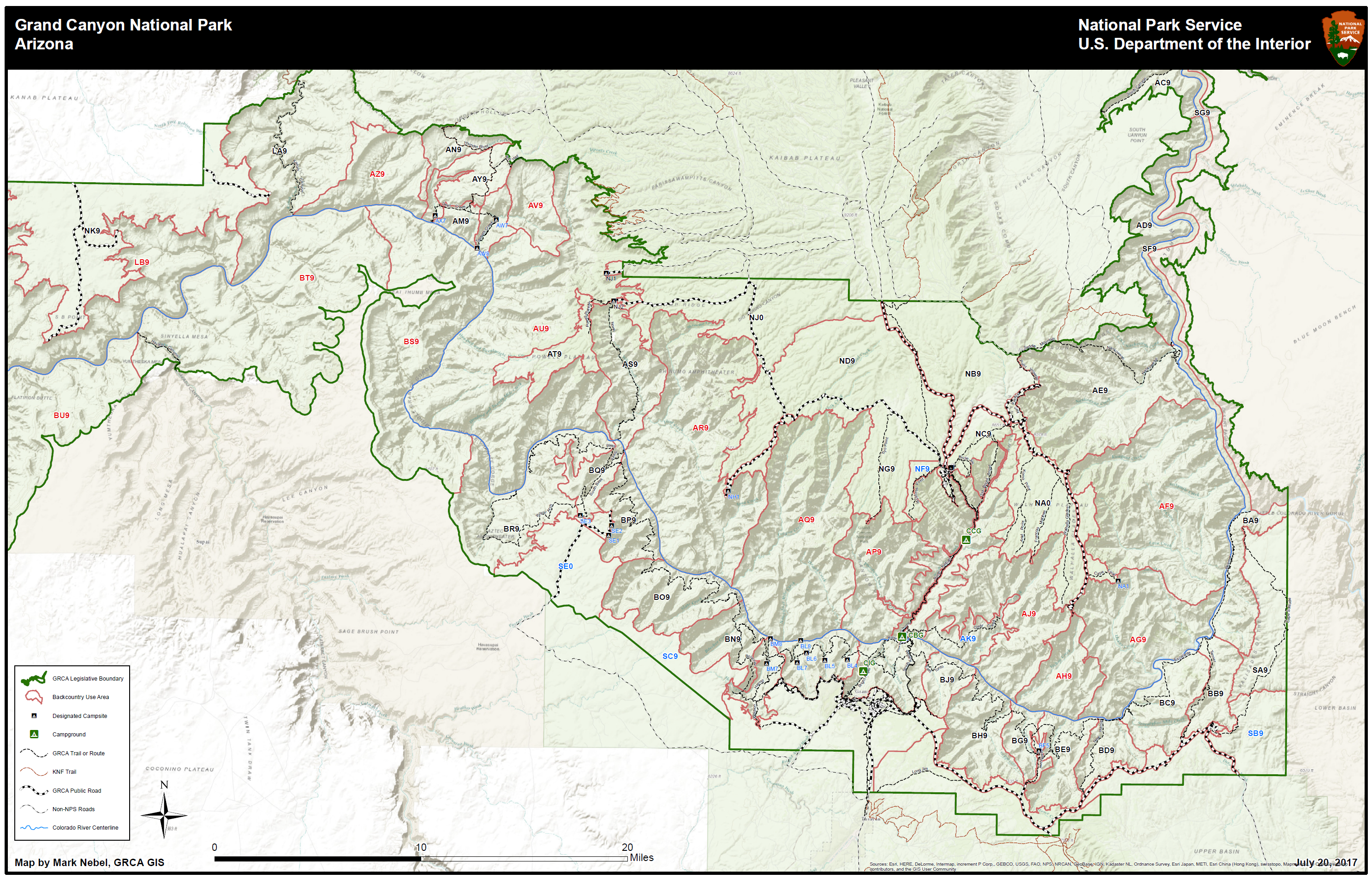
The Grand Canyon backcountry is divided into use areas. Each use area has an overnight capacity based upon the size of the area, the number of suitable and available campsites, its ecological sensitivity, its management zoning, and its use history. Use areas range in size from several hundred acres to several thousand acres. Each zone is color coded to indicated difficulty (taking into account the terrain, remoteness and facilities available).

The Ranger suggested I spend a night on each end of my trip in Cremation Canyon, an area designated as “Primitive,” with dispersed camping and limited available permits. I would have to walk two miles east on the Tonto Trail to camp, then return over those same two miles to the main trail. This would add 8 miles overall, since I would be staying one night on the way out and one night on the way back. Breaking up the hike between Cottonwood and the South Kaibab Trailhead would allow me to spend a couple of my 5 nights in a rarely traveled area.

I’m not sure if it was because all of the closures had scared people away or because it was less busy time, but had no problem getting permits for the end of November/beginning of December, well after the mid-June lottery application period. The popular times for the main corridor trails are spring and fall, as the summer temps can make the canyon fatally hot. The reverse temperature inversion in the canyon means that the bottom can be 20 degrees warmer than the rim.

The North Rim access roads and facilities typically shut down after November 30, eliminating the chance of seeing any folks coming down from that side. It is important to mention that if you straddle this time period, the permit process is a little more involved, requiring booking the November and December dates at Cottonwood separately. See “Just the Tips” at the end of this trip report for specifics on GCNP permitting.

I settled on a 5-night itinerary:

Then it was a countdown to November!

Rim To Rim To Rim AllTrails Link:

Just The Tips:

  1. Instead of flying into Phoenix, opt to fly into Flagstaff. I’ll be doing that next time instead of making the 3 hour drive each way.
  2. If you are flying in, pre order your stove fuel and other supplies online from Sportsman’s Warehouse in Phoenix or Flagstaff. I found this to be quick and easy.
  3. Be aware that your tracking devices and phone may not be able to get a satellite connection in some of the narrow canyons. Tracking may get wonky, as the vertical walls can cause a location ping, hundreds of feet above or below you.
  4. Permitting for the Grand Canyon can be confusing. It is best to apply for the lottery, which opens based on the month of travel and is available for application on the 16th of the month, in the 5th month prior to your trip. For example, a September Trip lottery application period would open April 16. See this article for more information about getting your Grand Canyon permit.
  5. Give yourself more than one night at Cottonwood Campground to allow for a side trip to Chimik’yana’kya Deya’ (Ribbon Falls) or a day hike to the North Rim, plus a rest day. I found 3 nights at Cottonwood to be perfect.
  6. If hiking rim to rim to rim in the winter, know that there are no services at and no access to the North Rim. You will be one of the few people in the area, far from help. Bring hiking poles and microspikes in case of snow. Evaluate your abilities and comfort with heights honestly before traveling this stretch of trail.
  7. Carry plenty of water and a water filtration system. Don’t drink unfiltered water. It can contain bacteria even if it looks clean. Be sure to dry out your filter when you get home.
  8. Get to the park early. The entrance gets extremely backed up with traffic beginning mid-morning.

Recent Trip Reports:

Misty Miles and Mountain Birds: A Storm King Scramble to Mitty Peak

April 20, 2025 Olympic NAtional Park, WA Mitty Peak 2674′ Mileage: 4.4 Miles RT Elevation Gain: 2400′ After 25 years, I finally had the opportunity to fly down to Seattle from Alaska to see one of my favorite bands of all time, Phish. I can’t travel without checking out a new hike, so I also…
Beyond Bird Point and Into Technicolor Solitude: Bird Ridge Overlook

September 7, 2024 Mileage: 13.5 Miles Elevation Gain: ~6700′ BRO (4625′) Chugach 120 #98 Bird PT (3505′) CHugach 120 #120 Permits: CSP Parking Fee The 2024 Alaska State Fair had come and gone, a sure sign that the dark winter was going to be closing in soon. Even though it was another rainy summer and…